Weight Loss Injections Prices Beyond the Sticker
Compare weight loss injections prices by list, net, and cash pay, then see insurance gaps, continuity risk, and a full year of care costs.

The popular advice is to find the lowest monthly quote and start there. That advice fails for weight loss injections prices because a monthly sticker rarely describes a full year of care. Dose, coverage, pharmacy route, monitoring, shipping, and supply continuity can each change the amount a patient ultimately pays.
What Weight Loss Injections Prices Leave Out
A monthly price can look precise while describing only one part of treatment. In a May 2024 analysis, KFF reported list prices of $936 to $1,349 per month for four GLP-1 medicines, or $11,232 to $16,188 for 12 months at those prices; KFF also noted that Medicare coverage rules allowed coverage for certain diabetes or cardiovascular-risk indications but not for drugs prescribed solely for weight loss at the time. These are list-price figures, not estimates of what an individual patient pays. KFF's May 2024 analysis of GLP-1 prices and coverage
A useful annual comparison therefore needs more than a monthly number. It should state the dose and treatment duration, identify which services are included, and make clear what coverage assumptions the quote relies on. The quoted pathway also needs to remain available for the period being priced.
Why Indication Changes the Benchmark
The reason a medicine is prescribed can affect whether insurance covers it and how much the patient pays. A drug used for diabetes or another covered indication may follow different coverage rules from the same drug prescribed solely for weight management. The price is tied to the treatment pathway, not just the medicine's name.
Clinical takeaway: Before comparing quotes, check the dose, duration, included services, and coverage assumptions.
A first-month price can be a poor guide to a full course if it covers only an introductory dose or omits services needed during treatment. Compare the expected cost across the intended year of care, including whether the quoted pathway is available for that full period.
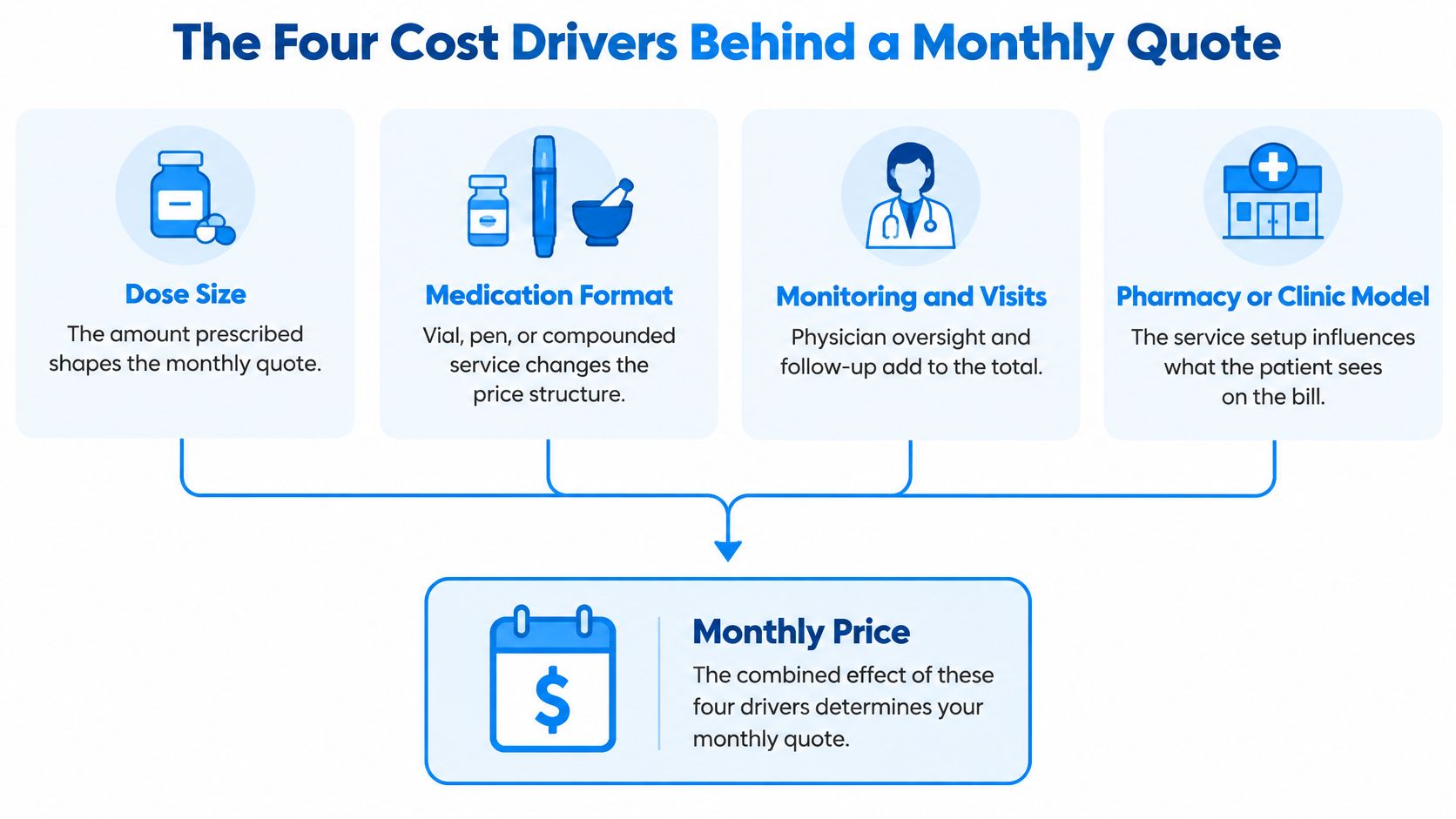
The Four Cost Drivers Behind a Monthly Quote
A monthly advertisement often blends unlike costs into one figure. Separating those components makes comparisons more reliable and exposes charges that may appear later.
Medication and Formulation
The first driver is the drug itself. Semaglutide and tirzepatide don't carry identical acquisition costs, and a branded product doesn't follow the same procurement pathway as a compounded preparation. Similar clinical intent doesn't make the economics interchangeable.
Formulation is the second driver. Injectable vials may require syringes and temperature-controlled packaging, while needle-free sublingual orally disintegrating tablets use a different dispensing model. Pens, vials, compounded preparations, and tablets can each alter pharmacy handling, required supplies, and the patient's final charge.
Clinical Care and Fulfillment
The third driver is clinical care. A physician evaluation, eligibility decision, prescription determination, and individualized titration schedule over about 12 weeks represent specialized services distinct from the medication. Follow-up may also involve dose adjustment, adverse effect review, laboratory monitoring, and assessment of whether treatment should continue.
Fulfillment is the fourth driver. Accredited pharmacy dispensing, packaging, tracked delivery, and replacement procedures can be included in one quote and excluded from another. Temperature-sensitive products may require insulated transit, and patients should understand those requirements through clear information about discreet cold-chain shipping procedures.
A practical worksheet keeps the comparison disciplined:
- Medication acquisition: Record the drug, formulation, strength, and dose.
- Clinical services: Separate consultation, monitoring, messaging, and laboratory costs.
- Supplies and shipping: Identify syringes, packaging, cold-chain materials, and delivery fees.
- Patient cost sharing: Place deductibles, copayments, and coinsurance in a separate column.
A low medication line item can conceal visit fees, laboratory charges, missed-dose replacement, or shipping. A higher all-in quote may already include monitoring and fulfillment. Neither figure is automatically better. The relevant question is whether both quotes cover the same clinical work over the same period.
Practical rule: Patients shouldn't compare a medication-only price with a supervised protocol price as if both products contain the same services.
Comparing List Net and Cash-Pay Pathways
A price can be accurate and still tell a patient little about the year of treatment. List price is the manufacturer's undiscounted figure; net cost reflects payer economics after discounts and rebates; cash-pay price is the patient-facing amount offered through a specific pharmacy or program. These figures describe different transactions and cannot be compared as if they were interchangeable.
A 2025 JAMA Health Forum analysis estimated annual payer net costs of $8,412 for semaglutide and $6,236 for tirzepatide, or about $701 and $520 per month. Those estimates were 41% and 79% below list price, respectively, and represent modeled payer costs, not patient offers (the analysis of net GLP-1 costs).
What Each Weight Loss Injection Price Actually Measures
| Pathway | What the figure measures | Planning caution |
|---|---|---|
| Branded list price | Undiscounted manufacturer benchmark | Does not predict what a patient will pay |
| Negotiated net cost | Payer cost after discounts and rebates | Available to payers, not as a standard pharmacy-counter price |
| Compounded cash pay | Patient-facing pharmacy price | Depends on the product and the legal pathway available |
| Manufacturer self-pay | Direct branded offer under program terms | Eligibility, price, and duration may be restricted |
A payer may use a modeled net cost to assess spending across a covered population. A patient without access to that coverage or a qualifying program must plan around an actual cash quote instead. Neither figure necessarily includes clinical visits, laboratory work, delivery, or other services, so a year-long comparison needs to identify what is excluded from each price.
Cash-pay pathways also differ in product format and continuity. For example, the differences between Zepbound vials and pens can affect how treatment is obtained and supplied. Similar clinical dosing does not make procurement, reimbursement, or ongoing access equivalent.
A first-month quote may not predict the annual total. Dose changes can alter medication costs, and an introductory offer may have terms that change or expire. Before comparing weight loss injections prices, identify whether each figure is list, payer net, or patient-facing, and whether it applies to the same treatment period and supply pathway.
Insurance Coverage and What Patients Still Pay
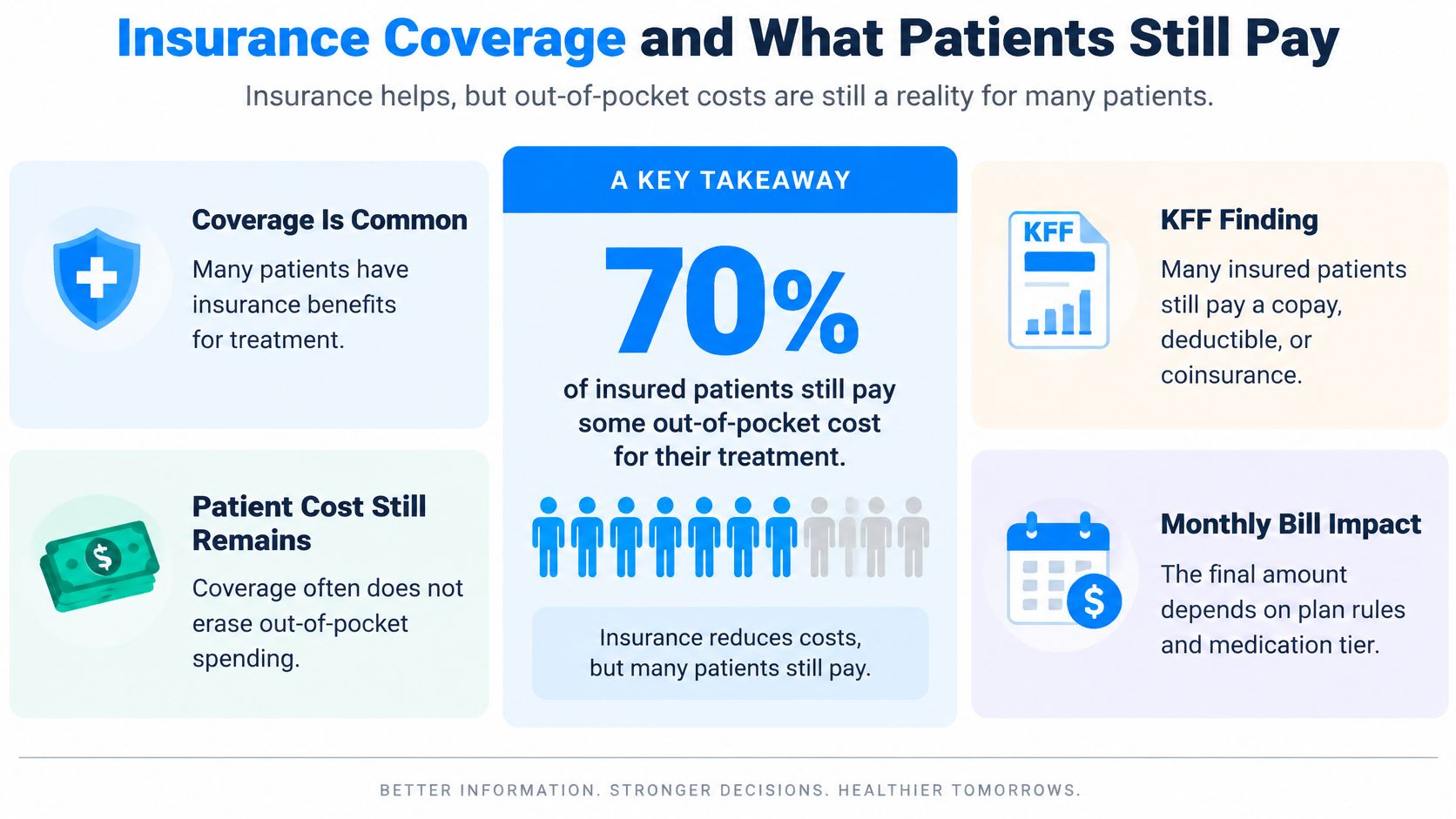
Coverage is common, but coverage doesn't reliably produce affordability. KFF reported that 70% of adults who had used GLP-1 drugs had insurance cover at least part of the cost, while 56% said the drugs were difficult to afford and 25% said they were very difficult to afford. A separate analysis of 9,848 prescription orders found an average out-of-pocket cost of $71.90 per prescription among insured patients, with differences by racial group. These findings are summarized in KFF's survey of prescription drug costs and GLP-1 use.
Three Budget Scenarios
A patient with partial coverage and a predictable copay may have manageable pharmacy costs. Consultation, monitoring, supplies, and shipping may still fall outside the prescription benefit, and prior authorization may need renewal during dose escalation.
A patient with a high deductible or coinsurance can face higher costs early in the year, before the deductible is met. Even if a manufacturer savings program reduces the pharmacy charge, the deductible can leave the patient responsible for a larger share of other covered care. Some plans also exclude obesity treatment while covering the same medication for another indication.
Cash payment avoids plan-specific coverage rules, but the annual total still depends on dose changes, clinical fees, shipping, and whether the pharmacy pathway remains available. Savings programs may lower medication costs for eligible patients; eligibility and terms vary.
Annual affordability depends on more than the copay. Prior authorization, indication, pharmacy tier, deductible timing, and dose escalation all affect what a patient pays. Add clinical visits, laboratory monitoring, shipping, and supplies to the pharmacy estimate before judging whether treatment is sustainable.
Matching a Price Pathway to Real Treatment Goals
The lowest monthly quote can produce the highest annual cost if the treatment pathway changes before the year is complete. Compare the full course of care against the patient's priorities: continuity, ability to use injections, and access to licensed clinical oversight.

When Continuity Is the Deciding Issue
The regulatory environment behind lower-priced compounded medications changed in 2025. The FDA removed semaglutide from the shortage list in February and tirzepatide in April, with deadlines for affected compounding pathways following in April and May. A review of these changes reports that compounded formulations had commonly cost about $250 to $400 per month, while manufacturer self-pay programs offered one branded option for roughly $349 to $699 monthly depending on dose and another for $499 monthly in 2025. These figures describe historical price points, not a guarantee that a particular price or access route remains available today. The review of regulatory changes and pricing provides context, but patients should confirm current terms directly with their clinician and dispensing pharmacy.
Ask two separate questions before choosing a pathway. First, is the medication and formulation permitted under current regulatory rules? Second, can the prescriber and pharmacy continue dispensing the prescribed product and dose through the planned treatment period? The first is a regulatory-status question; the second is a dispensing-continuity question. A favorable answer to one does not establish the other.
When Needle Aversion or Access Drives the Choice
Needle aversion can make an injectable regimen difficult to maintain, even at a favorable price. For appropriately selected patients, non-injectable formulations may be considered, but suitability, evidence, and availability should be reviewed with a clinician rather than inferred from an advertised price.
Other patients need coordinated telehealth oversight and home delivery. Vials + Vitals uses U.S.-licensed clinicians to review intake, prescribe when indicated, and arrange fulfillment through accredited partner pharmacies. Its model includes cold-chain shipping when required and a consultation-fee refund when treatment is not clinically appropriate. Compare the full service pathway, including pharmacy verification, dose management, delivery arrangements, and what happens if the prescribed formulation changes.
Titration Monitoring and Hair Retention Costs
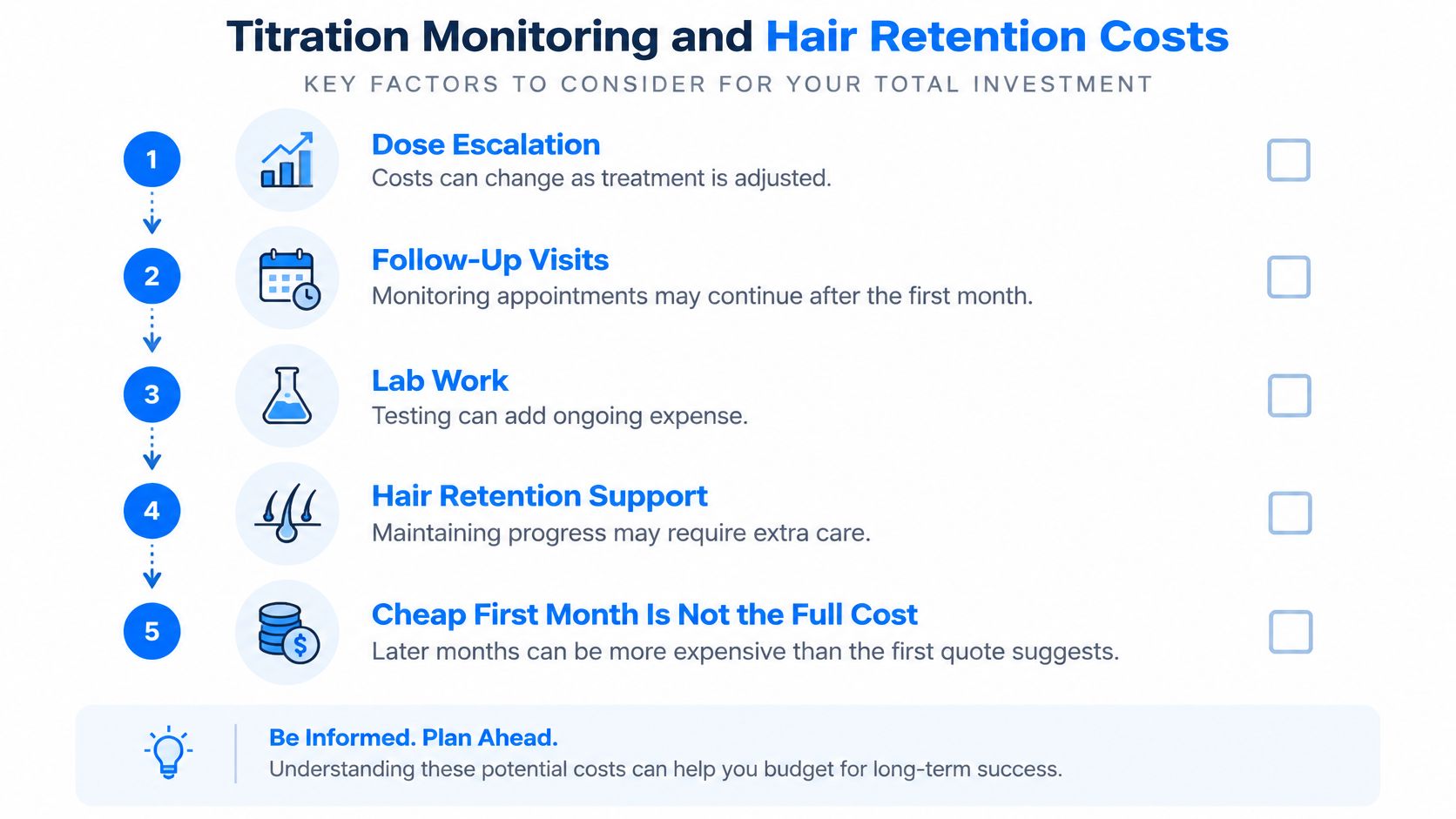
A low monthly quote can understate the cost of treatment if dose changes, symptom checks, nutrition support, and follow-up are billed separately. These services also affect whether a patient can stay on treatment long enough to assess its value.
Titration and Gastrointestinal Monitoring
Gradual dose escalation helps clinicians respond to nausea, changes in eating tolerance, hydration concerns, and treatment response. The schedule and pace vary by patient. Persistent vomiting, severe abdominal pain, inability to maintain fluids, or a marked reduction in oral intake calls for prompt clinical review.
Ask what the quoted price covers before starting. A clinic may bundle dose-adjustment visits and symptom follow-up, or charge for them separately. Extra visits can raise the annual total; without timely support, poor tolerability may lead a patient to stop after paying for medication that was not sustainable.
| Cost component | What to confirm |
|---|---|
| Consultation and dose review | Is the initial visit included, and are dose-change visits billed separately? |
| Nutrition review | Does the fee cover guidance on adequate protein, calories, and micronutrients, or is this a separate appointment? |
| Laboratory review | Are clinician review and any indicated testing included, or billed as separate services? |
| Follow-up | How many check-ins are included, and what does an additional visit cost? |
Rapid Loss and Telogen Effluvium
Hair shedding may follow substantial, rapid weight reduction. A review of weight-loss-associated telogen effluvium describes this temporary shift of follicles from the active growth phase into a resting phase and reports mean weight loss of 15.21% and a mean loss rate of 3.54 kg per month (analysis of telogen effluvium after weight loss).
The amount and pace of weight change can contribute to shedding, as can inadequate protein, iron, zinc, or overall calorie intake. A clinician may recommend nutrition review or laboratory assessment based on symptoms and medical history. Those services may be included in a care fee or add charges; testing is not automatically needed for every patient.
Shedding can become noticeable after a delay. Severe, prolonged, or patchy loss, or loss with scalp inflammation, warrants clinical assessment for other causes. Patients considering treatment for shedding should review hair-loss treatment side effects and considerations.
Budget for the pathway, not just the medication. A useful annual estimate includes planned follow-ups, nutrition support, and any likely review or testing fees, while recognizing that early discontinuation can leave months of medication and care costs without a sustained treatment course.
How to Choose a Supervised Price You Can Sustain
A sustainable choice depends on the barrier most likely to interrupt treatment. Regulatory predictability, injection tolerance, access to clinicians, and monthly cash flow don't carry equal weight for every patient.
A branded or manufacturer self-pay route is the more coherent choice when stable commercial supply and regulatory predictability matter more than obtaining the lowest quote. Patients should still verify dose-specific pricing, program eligibility, and whether clinical monitoring is included or purchased separately.
A compounded cash price is reasonable to consider only when the pharmacy pathway is transparent. The dispensing pharmacy, quality testing, dose availability, and ability to continue the same formulation through titration should be clear before payment. Without that continuity, a lower monthly figure may merely defer disruption.
A needle-free sublingual option is most relevant when aversion to injections threatens adherence. It shouldn't be selected just because a tablet appears less expensive. Clinical suitability, expected monitoring, and the patient's ability to follow the regimen determine whether the formulation solves the actual problem.
A telehealth protocol with licensed U.S. physician review is appropriate when access to in-person care is the main constraint. Patients should confirm state licensure requirements, cold-chain needs, excluded fees, and the process for dose changes or adverse effects. Nationwide availability remains subject to applicable licensure and regulatory limits.
The durable question isn't which injection is universally cheapest. It's which clinically appropriate pathway can remain available, tolerable, and affordable through maintenance.
The practical next step is a confidential online clinical assessment. A U.S.-licensed clinician can determine eligibility, formulation, and titration schedule, with fulfillment through an accredited pharmacy and a full consultation-fee refund if treatment isn't clinically appropriate. That assessment converts advertised weight loss injections prices into an individualized plan with clearer annual obligations.
Patients seeking a physician-directed assessment can review available semaglutide, tirzepatide, injectable, and needle-free options through Vials + Vitals, where U.S.-licensed clinicians determine eligibility before any prescription is issued. The service combines individualized titration, accredited pharmacy fulfillment, discreet delivery, and cold-chain shipping when required, allowing treatment decisions to rest on clinical suitability and sustainable total cost rather than a single monthly sticker.