Dutasteride vs Finasteride for Hair Loss: A Clinical Guide
Compare dutasteride vs finasteride for hair loss on trial evidence, dosing, onset, side effects, and pregnancy safety. Clinical decision factors explained.
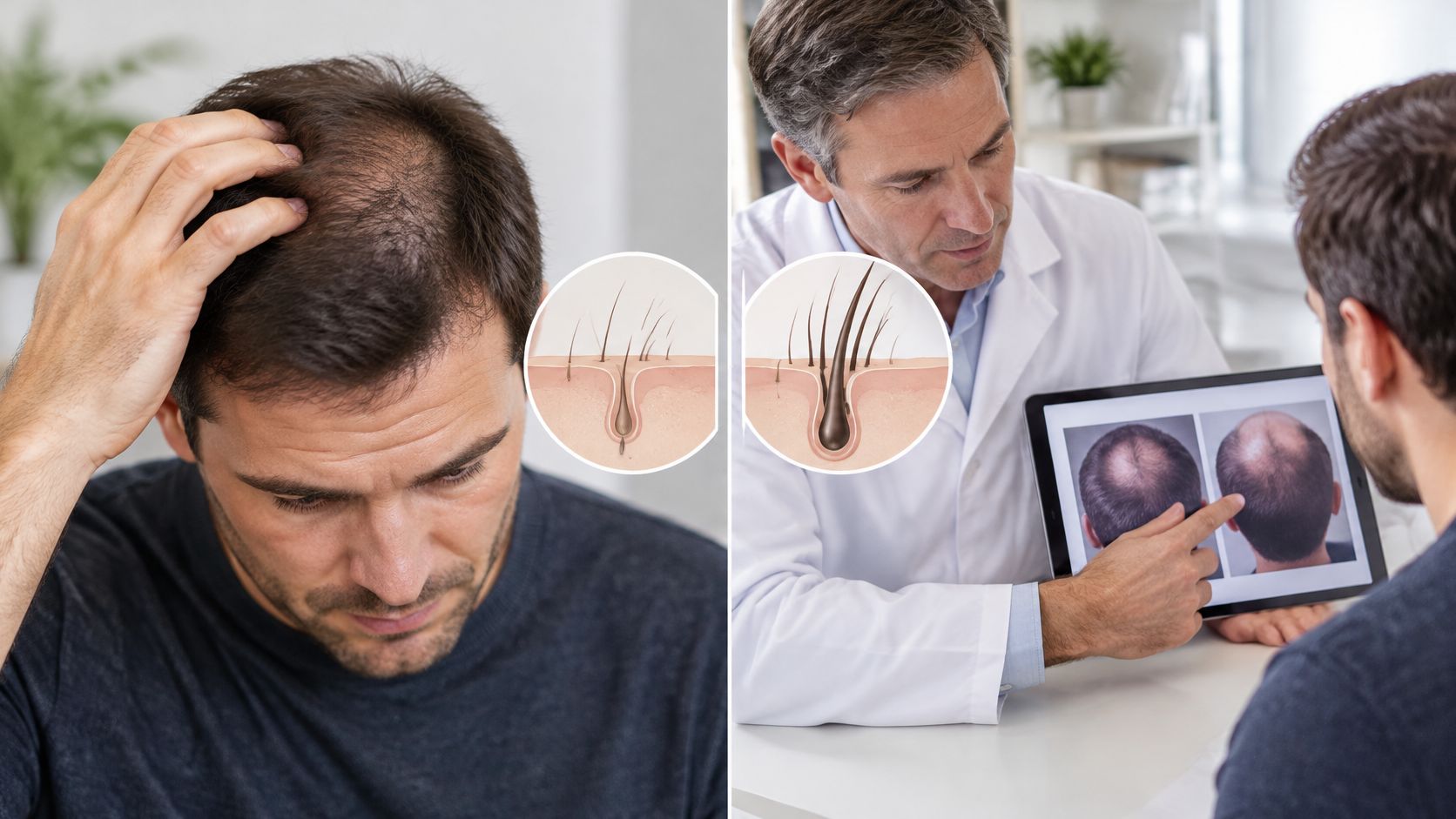
The usual shortcut in dutasteride vs. finasteride for hair loss is to choose the stronger DHT blocker and assume it must be the better treatment. Trial data do favor dutasteride on average hair-count outcomes, but that doesn't settle whether its additional benefit is worth its off-label status and prolonged persistence in the body.
For a clinical decision, the relevant question is narrower: how much does the evidence support an advantage, how applicable is it to a particular patient, and what does the longer drug exposure mean for tolerability and conception planning? The strongest comparative trial evidence concerns men with androgenetic alopecia, and it doesn't establish that every patient will respond better to dutasteride.
Why Dutasteride and Finasteride Are Compared for Hair Loss
Androgenetic alopecia is patterned hair loss associated with inherited follicle sensitivity to dihydrotestosterone, or DHT. In susceptible scalp follicles, DHT contributes to miniaturization, in which thicker hairs gradually become finer. Finasteride and dutasteride are compared because both inhibit 5-alpha-reductase, the enzyme involved in converting testosterone to DHT.
Their regulatory status differs. Finasteride is the established U.S. FDA-approved oral medication for male androgenetic alopecia; dutasteride is generally prescribed off-label for hair loss in the United States. Off-label use means a clinician may prescribe a drug for a purpose beyond its FDA-approved indication, but it doesn't make the two medications equivalent in approval, evidence base, or clinical decision-making.
What a comparison can establish
The randomized evidence provides a useful average comparison over a limited treatment period. It supports stronger hair-count outcomes with dutasteride in the trials reviewed, but it can't predict an individual patient's response or establish that the same result will hold over longer treatment. The included studies also differed in doses and protocols, which matters when interpreting a pooled estimate.
Finasteride's approval for male pattern hair loss is a separate consideration from whether dutasteride produced better average outcomes in specific head-to-head trials. A difference in measured efficacy doesn't automatically settle the practical choice. Diagnosis, response to prior treatment, tolerability, reproductive plans, and how long drug effects may persist after stopping all matter.
A useful comparison therefore separates pharmacology, trial outcomes, and patient-specific risk. Potency is one part of the decision, not a conclusion by itself.
How Each Drug Blocks DHT Differently
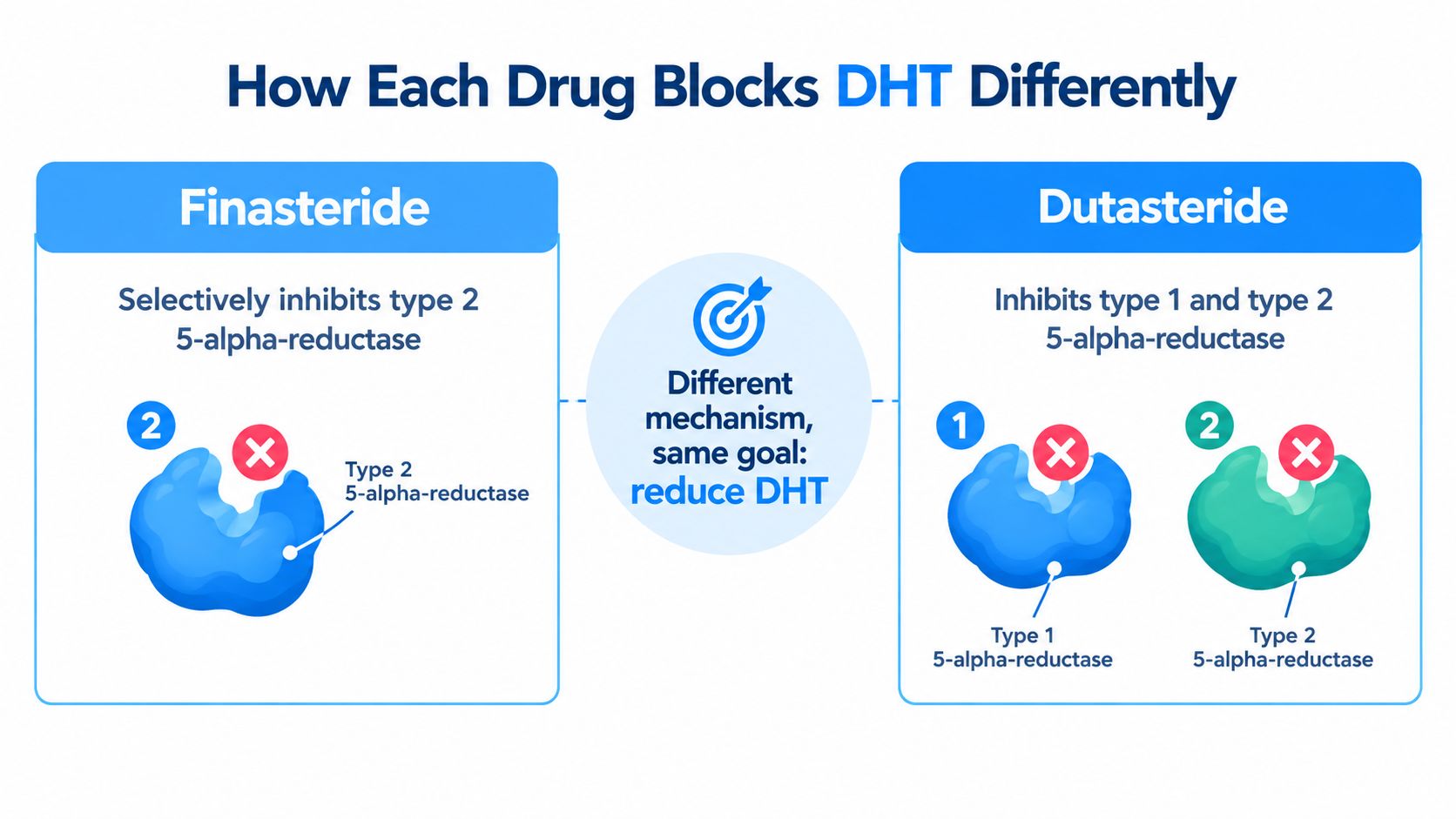
Finasteride and dutasteride both target 5-alpha-reductase, but they differ in enzyme coverage. Finasteride selectively inhibits type 2 5-alpha-reductase. Dutasteride inhibits all three 5-alpha-reductase isoenzymes, a broader action associated with more complete DHT suppression. That pharmacologic difference explains why dutasteride is often described as more potent, but it doesn't by itself prove that every patient will gain a clinically meaningful advantage.
Why half-life changes the decision
A second difference is how long each drug remains in the body. Dutasteride has a half-life of roughly four to five weeks, while finasteride's half-life is much shorter, and finasteride doesn't fully suppress DHT. These pharmacologic distinctions are described in the clinical reference on 5-alpha-reductase inhibitors and dutasteride's long half-life.
Half-life is relevant when considering a pause or discontinuation. Because dutasteride persists longer, its effects won't be expected to recede as quickly after stopping as those of a shorter-lived drug. That can matter to someone who experiences an unwanted effect or is planning for conception. A precise individual washout period can't be inferred from half-life alone and should be discussed with a clinician.
Practical rule: Broader enzyme inhibition describes what a drug does biologically. It doesn't answer whether the extra inhibition is worth the longer exposure for a particular person.
These medicines also aren't interchangeable milligram for milligram. They differ in enzyme selectivity and persistence, so any comparison should be based on studied regimens and clinical context, not a simple dose conversion.
What Head-to-Head Trials Show About Hair Count
The head-to-head evidence answers a narrower question than the one patients usually ask. It shows whether greater DHT suppression yields more hair on average. Whether that extra suppression is worth the exposure that delivers it is a separate question.
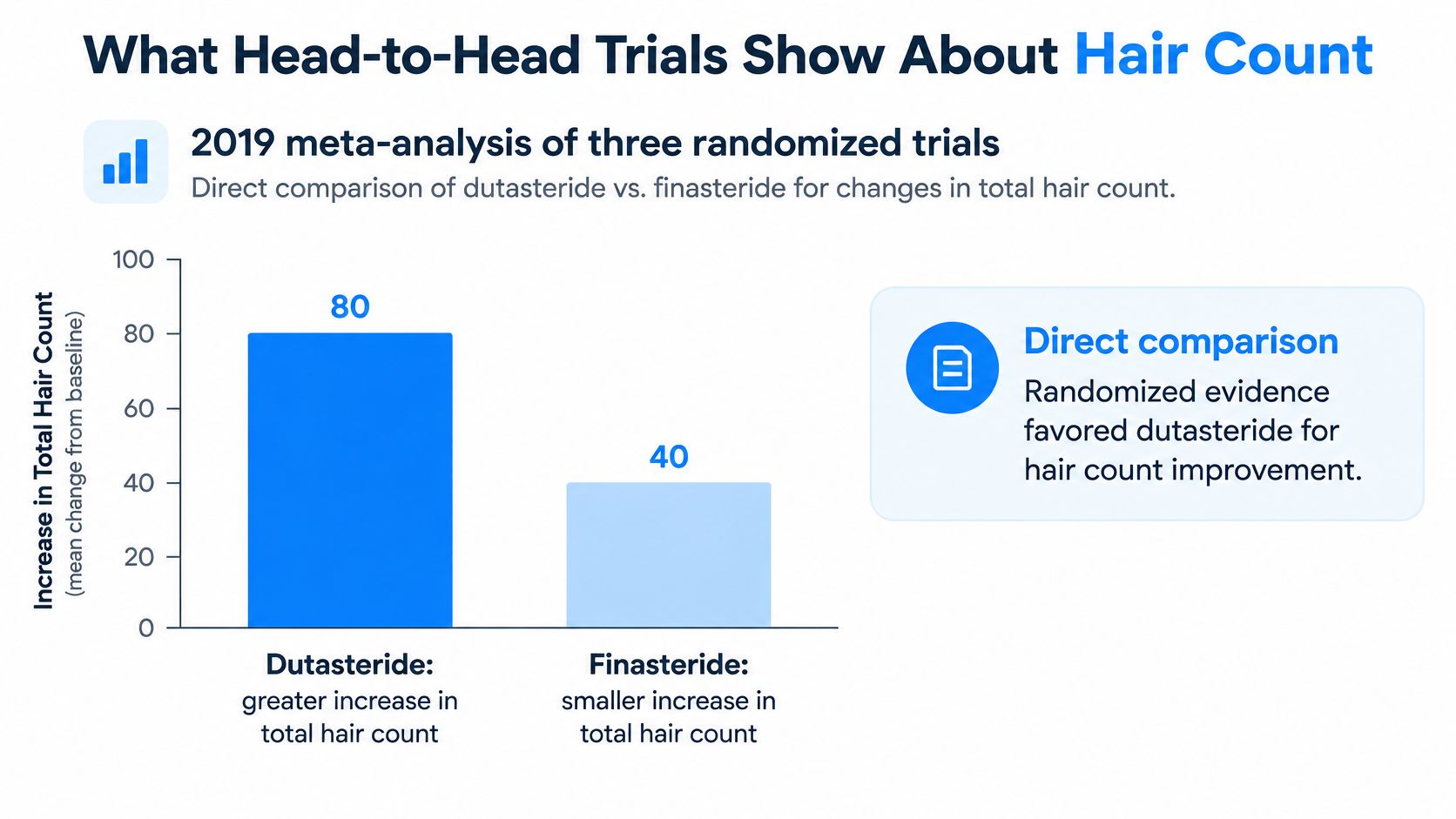
A 2019 meta-analysis of three randomized controlled trials, pooling 576 men treated for 24 weeks, reported a pooled mean difference of 28.57 hairs in the measured target area (95% CI, 18.75 to 38.39) in favor of dutasteride over finasteride (meta-analysis of dutasteride versus finasteride). The same analysis favored dutasteride on investigator-rated global photographs, panel photographic assessments, and participants' own assessments.
What the result does and doesn't mean
A pooled mean difference is an average separation between groups. It isn't a prediction for any individual scalp, and it says nothing about how visible the change will be. The trials ran for a fixed, relatively short window, enrolled selected populations, and used different doses and protocols, so the estimate generalizes cautiously.
The largest trial behind the pooled figure was a randomized, double-blind comparison of dutasteride at several doses against finasteride and placebo. Dutasteride's response was dose-dependent, and the 0.5 mg daily dose significantly increased hair count and hair width versus both comparators at the trial endpoint (randomized trial of dutasteride doses and finasteride).
Statistical significance means the group difference was unlikely to arise by chance under the study's model. It does not weigh the size of the benefit against the cost of obtaining it. Finasteride remains the FDA-approved oral medication for male androgenetic alopecia in the United States, while dutasteride for hair loss is generally used off-label and persists in the body far longer per dose. Whether a mean advantage of this size justifies that prolonged exposure is a question hair-count data alone cannot settle.
Dosing Schedules and When Results Appear
Both drugs enter the comparative evidence as once-daily oral regimens. The 24-week randomized trial cited earlier tested dutasteride at 0.02 mg, 0.1 mg, and 0.5 mg daily against finasteride 1 mg daily and placebo. Its dose-dependent response is why findings from the 0.5 mg arm should not be extended to lower doses, which remain less studied for hair loss.
The schedules look identical on paper, but the pharmacokinetics behind them are not. Finasteride's half-life is much shorter, so drug levels fall quickly after a missed or stopped dose. Dutasteride persists for weeks, which cushions occasional missed doses but also means a patient who stops still carries meaningful exposure long afterward. Anyone planning a washout, whether to switch medications or for personal timing reasons, should expect a slow tail rather than a clean stop.
That persistence is the underappreciated cost side of the potency question. The same pharmacology that may produce a modest hair-count advantage also lengthens the exposure window, so the key dosing decision is how much ongoing exposure an incremental benefit justifies for a given patient.
Study parameters at a glance
| Parameter | Dutasteride | Finasteride |
|---|---|---|
| Regimen used in key comparative arms | 0.5 mg daily | 1 mg daily |
| Half-life | Roughly four to five weeks | Much shorter than dutasteride |
| U.S. status for male hair loss | Generally used off-label | FDA-approved oral medication |
| Assessment interval in the key comparative trial | 24 weeks | 24 weeks |
Visible regrowth is measured in months. Shedding fluctuates day to day, so impressions formed at the shower drain are a weak signal. Standardized photographs taken under consistent conditions, or clinician-measured density counts, give a far more reliable read at checkpoints such as the 24-week mark used in the comparative trial. That endpoint works as a benchmark for structured comparison; it was never designed to predict when an individual patient will see change.
A clinician can set checkpoint timing, choose between photographs and density measurements, and plan what a washout would look like if treatment pauses. Patients looking to support progress between visits can review practical ways to help hair grow faster for men, though general growth guidance cannot substitute for assessment when loss is progressive or unexplained.
Side Effects, Fertility, and Pregnancy Safety
Safety isn't one category. Sexual symptoms, mood changes, fertility questions, and pregnancy exposure call for separate discussion, especially because dutasteride remains in the body longer after stopping.
Sexual and mood considerations
The supplied comparative evidence reports no statistically significant difference in overall adverse-event rates between the analyzed treatment groups. That finding doesn't mean the drugs have identical effects for every patient, or that a particular symptom should be dismissed. Anyone who notices a concerning change should contact the prescribing clinician to discuss whether to continue, pause, or reassess treatment.
Regulatory safety communications have highlighted reports of sexual dysfunction and mood alterations, including suicidal ideation. For dutasteride-related suicidal ideation, causality has not been established sufficiently. New or worsening mood symptoms deserve prompt medical attention, regardless of which medication a patient is taking.
Fertility and pregnancy require specific counseling
Published fertility reviews describe low-dose finasteride-related fertility effects as generally reversible. For dutasteride, the evidence is insufficient to prove that paternal use is completely safe. The amount transferred in semen is expected to be very small, but condom use has been advised when a partner is or may be pregnant; patients can review the fertility and reproductive safety discussion with their clinician.
A partner's pregnancy status and the patient's conception plans should be discussed before starting treatment. A person who could become pregnant and a person who could father a pregnancy may face different counseling questions, and women considering treatment for hair loss need an individualized medical review. Dutasteride's long half-life also makes stopping it less immediate in practical terms, but the available evidence here doesn't establish a specific conception washout schedule.
For a broader discussion of medication risks, see hair-loss treatment side effects.
Choosing the Right Option for Your Situation
The treatment choice depends on what the patient is trying to solve and what trade-offs are acceptable. For someone with early hair loss who hasn't tried a 5-alpha-reductase inhibitor, finasteride may be a reasonable option to discuss because it's FDA-approved for male androgenetic alopecia. For progressive loss despite treatment, a clinician may consider whether dutasteride's stronger average trial outcomes justify off-label use and the longer persistence after discontinuation.
That isn't a rule that dutasteride belongs only after finasteride fails. It's a way to frame the decision: the more uncertain the added benefit for an individual, the more important it is to weigh prolonged exposure carefully. Prior sexual or mood symptoms, plans to conceive, or a partner who is or may become pregnant can change that balance. Women with hair loss need a separate diagnostic and safety assessment rather than an assumption that male trial findings apply to them.

Questions that sharpen the clinical decision
A patient and clinician can make the comparison more specific by reviewing:
- Diagnosis: Does the pattern fit androgenetic alopecia, or should another cause be investigated?
- Treatment history: Has a prior medication been used consistently, and was response measured objectively?
- Exposure tolerance: Would prolonged drug persistence make a potential adverse effect harder to manage?
- Reproductive plans: Is conception being considered, or could a partner be pregnant?
- Monitoring: Can standardized photographs or clinician-directed density measurements document change?
Vials + Vitals is a physician-directed telehealth service with a confidential online clinical assessment and U.S.-licensed physician review of each intake. Its Follicular Retention Index supports structured tracking of hair retention; the clinician determines eligibility and whether a medication is appropriate. Readers comparing available approaches can also consult this overview of hair-loss products for men.
Next Steps for a Physician-Guided Decision
Before starting either medication, a licensed physician should confirm the likely diagnosis and consider other possible causes of hair loss. The review should include current medications, relevant hormone and medical history, pregnancy status where applicable, and plans to conceive. A history of sexual or mood-related symptoms should be discussed candidly, along with liver-function considerations when relevant to the patient's medical history.
A practical monitoring plan starts with consistent baseline photographs and a defined follow-up point. Reassessment at around six months aligns with the time window used in the comparative evidence, but a clinician should determine whether that timing fits the individual case. At follow-up, the patient and physician can document whether to continue, change, or stop treatment based on measured response, tolerability, and current plans.

For readers seeking that assessment remotely, Vials + Vitals offers a confidential online clinical intake reviewed by a U.S.-licensed physician, who determines eligibility and whether either option is clinically appropriate. The service states that it provides a full consultation-fee refund when treatment isn't appropriate. The decision should rest on diagnosis, evidence, safety, and the patient's priorities, not potency alone.
Start a confidential online assessment with Vials + Vitals to have a U.S.-licensed physician review the hair-loss history, treatment goals, and safety considerations relevant to finasteride or dutasteride. The physician determines eligibility and whether either treatment is appropriate, with a full consultation-fee refund if treatment isn't clinically suitable.