Metabolic Calorie Calculator: Inputs, Outputs, and Limits
A metabolic calorie calculator estimates energy needs from age, sex, height, weight, and activity. Learn its inputs, outputs, and limits.

The most popular advice about calorie calculators is also the easiest to misunderstand: calculate a number, subtract calories, and treat the result as a plan. A metabolic calorie calculator can estimate energy needs, but its output isn't a measurement or a prescription. The useful question isn't only what number it returns. It's what that number represents, which assumptions shaped it, and how a person should respond when real-world weight trends don't match the estimate.
What a Metabolic Calorie Calculator Measures
A metabolic calorie calculator estimates how much energy a person uses at rest and across a typical day. It may then use that estimate to calculate a maintenance figure, meaning the energy intake predicted to keep body weight broadly stable. These are related outputs, but they aren't interchangeable.
Resting metabolic rate (RMR) is the energy the body uses to sustain essential functions while at rest. Total daily energy expenditure (TDEE) includes resting needs as well as energy associated with physical activity and the thermic effect of food. Maintenance energy describes the estimated intake that would balance energy expenditure over time. A well-designed tool keeps these concepts distinct instead of presenting them as if they were one directly measured quantity.
Practical rule: An estimated resting value is an input to a broader daily-energy estimate, not a personal calorie prescription.
A calculator generally predicts RMR from information such as age, sex, height, and body weight. It doesn't directly measure the body's use of oxygen and production of carbon dioxide. Indirect calorimetry does measure those gases and serves as a measurement reference for resting energy needs. Even then, a measured resting value doesn't automatically establish a person's total daily expenditure or the right treatment target.
The difference matters because people often read a maintenance result as a precise number that must be correct for their bodies. In practice, activity, illness, medication, body composition, and changes in body weight can all affect energy needs. A calculator's estimate may be useful as a starting point, but it can't explain every reason a person's weight is changing or establish whether a particular diet is medically appropriate.
A production-grade calculator should therefore label results as estimates, display units clearly, and separate resting needs from total daily needs. It should also make assumptions visible, including the activity category used to calculate maintenance. Before anyone adjusts food intake, the first step is understanding which value the tool has estimated and what the value does not establish.
Core Inputs and the Equations Behind the Estimate
A calculator's equation can be correct and still produce a poor estimate if its inputs are wrong. For adults with overweight or obesity, the Academy of Nutrition and Dietetics recommends the Mifflin–St Jeor equation when indirect calorimetry is unavailable. It predicts resting metabolic rate (RMR) from sex, age, height, and actual body weight, using a different constant for men and women (Academy of Nutrition and Dietetics guidance on Mifflin–St Jeor).
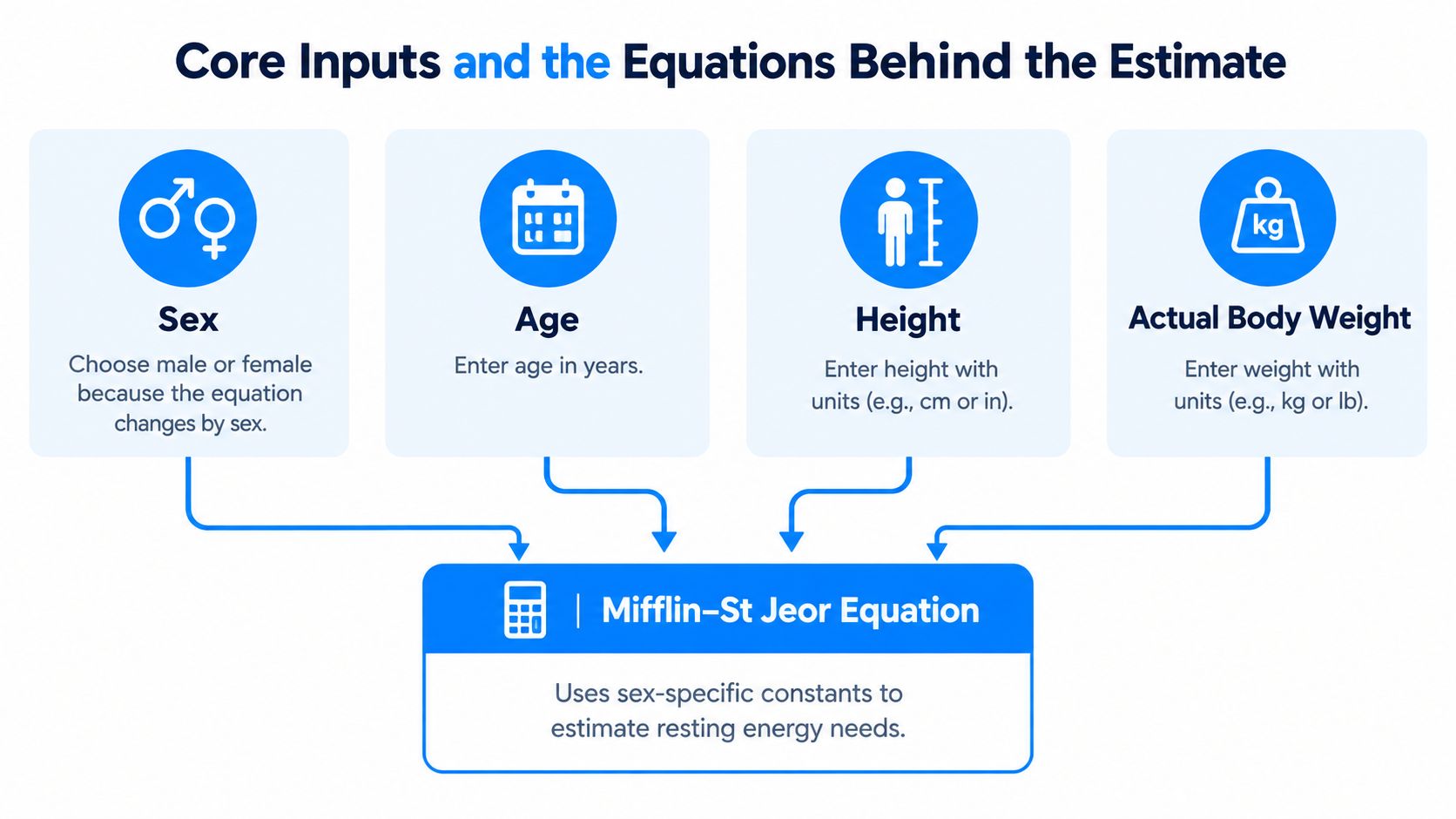
The equations are:
- Men: RMR = 10 × weight (kg) + 6.25 × height (cm) − 5 × age (years) + 5
- Women: RMR = 10 × weight (kg) + 6.25 × height (cm) − 5 × age (years) − 161
The result is a prediction based on population-level patterns, not a direct reading of someone's muscle mass or metabolism. For example, for a 40-year-old woman weighing 80 kg and measuring 165 cm, the equation estimates about 1,480 kcal at rest. Holding height and weight constant, each additional year of age lowers the equation's result by 5 kcal.
Check each input before interpreting the result:
- Sex: The selected option determines which constant the equation uses.
- Age: Enter age in years. An incorrect value changes the estimate.
- Height: Confirm the value and its unit, such as centimeters.
- Actual body weight: Enter current body weight and check its unit.
The calculation expects weight in kilograms and height in centimeters. A tool that accepts other units must convert them correctly and make the units clear. A plausible-looking answer can still be wrong if a value was entered in the wrong unit.
In ambulatory adults, validation research found that approximately 82% of estimates were within ±10% of indirect-calorimetry measurements. Accuracy was lower in people with obesity. This supports using the equation as a starting estimate, then reviewing it against a person's weight trend and with a clinician before setting an aggressive calorie target. The equation estimates resting needs; it does not establish a safe minimum intake, including during GLP-1 treatment.
Activity Categories and Maintenance Calorie Estimates
An RMR estimate answers a limited question: how much energy the equation predicts the body uses at rest. A maintenance estimate adds another layer by accounting for physical activity. That layer depends on how activity is classified, so the category shouldn't disappear from the result.
The National Academies defines Estimated Energy Requirement (EER) as the average dietary energy intake predicted to maintain energy balance for an adult based on age, sex, weight, height, and physical-activity level. Its adult equations incorporate those variables and distinguish activity categories, offering a more reproducible basis for maintenance estimates than an unexplained multiplier (National Academies overview of Estimated Energy Requirement).
Choose activity by behavior, not aspiration
A useful activity category describes a person's usual behavior. It should reflect everyday movement and exercise patterns, not the activity level someone hopes to reach or a plan followed only occasionally. A desk-based routine with limited purposeful movement, for example, shouldn't be classified as highly active solely because exercise is planned.
The tool should collect activity using behaviorally defined categories and preserve the selected category in the output. That makes it possible to review what went into the maintenance estimate and reconsider the assumption if daily movement changes. If the tool shows only a final calorie figure, it can conceal how much the result depends on the activity selection.
Keep maintenance separate from a treatment deficit
Maintenance energy is the estimated intake associated with energy balance. A therapeutic calorie deficit is a separate decision that may be considered for a specific health goal. A calculator shouldn't turn one into the other or present a deficit as a universal next step.
Predictive equations can overestimate or underestimate a person's needs. The result should therefore serve as a starting estimate that can be reassessed using weight trends, adherence, symptoms, and clinician oversight. In medically supervised GLP-1 care, appetite and body mass can change over time, which may make an unchanged estimate less appropriate. Recording the activity category and distinguishing maintenance from a treatment target help make those later adjustments more interpretable.
Reading the Output and Its Margin of Error
A single maintenance number can look more certain than the calculation deserves. Prediction equations infer resting energy from body-size and demographic inputs; indirect calorimetry measures gas exchange and provides a reference for resting metabolic rate. These methods don't answer the same question, and a predicted value shouldn't be mistaken for a measured one.

The limits can matter in everyday decisions. In a study of young underweight women, commonly used equations placed only 23.1%–54.8% of predictions within 10% of measured RMR, and reported errors reached 162–278 kcal per day. An error of that size can rival a typical dieting deficit, especially when a person treats a calculated target as exact (study of resting-energy prediction equations in underweight women).
That result applies to the study population, not to every person using a calculator. It does, however, show why a neat-looking output doesn't guarantee a close estimate. The uncertainty may be especially relevant for people with obesity, low muscle mass, very low body weight, menopause-related body-composition changes, or major recent weight loss. These characteristics can make a general prediction less representative of an individual's energy needs.
Read the result as a range, then reassess
A useful calculator should avoid implying diagnostic precision. When possible, it should show an uncertainty range, identify the activity category used, and state that the result is an estimate. A person can then compare the estimate with several weeks of weight trend, food intake, and activity rather than assuming the first output is definitive.
Clinical verification deserves consideration when an estimate will inform an aggressive calorie target or when a person's circumstances make a general equation less reliable. A clinician can decide whether indirect calorimetry or another assessment is appropriate. The practical question isn't whether a calculator produced a number. It's whether that number remains consistent with the person's observed trend and clinical context.
Metabolic Adaptation and Why Plateaus Shift Targets
Calorie needs aren't fixed. As body weight changes, energy expenditure may change too. Metabolic adaptation describes a reduction in measured resting energy expenditure beyond the reduction predicted from weight loss alone. It's one reason an early calculator estimate may become less representative later.
In a study of women with overweight who followed an 800-kcal-per-day diet until reaching a BMI of 25 or less, post-weight-loss metabolic adaptation averaged 46 kcal per day below predicted RMR and was associated with a longer time to reach the weight-loss goal (study of metabolic adaptation after weight loss). This finding describes that study, not a predictable response for every person.
A review summarized average adaptation of 72 kcal per day after three weeks of 50% calorie restriction, representing approximately 33% of the observed reduction in resting metabolic rate. After one year, adaptation was approximately 40 kcal per day, accounting for about 40% of the RMR reduction. The review also notes that individual responses vary and that the magnitude of adaptation remains an active area of scientific debate (review of metabolic adaptation during weight loss).
These findings don't establish a rule that calorie intake should be reduced whenever weight loss slows. A plateau may call for checking the underlying information: recent weight trend, adherence, activity, and whether body weight has changed since the estimate was calculated. Changing the target automatically can make the plan less suitable without showing that energy needs were reassessed carefully.
A plateau is a reason to review the evidence, not proof that the target must be lower.
A clinical study also found different average adaptation between participants assigned to intermittent and continuous short-term energy restriction. The pattern shows that energy expenditure can respond differently to different restriction approaches, but it shouldn't be generalized to every patient or diet (clinical study of metabolic adaptation during energy restriction).
A better response combines serial weight trends with adherence and activity records, then considers clinician input when needed. Readers looking for a structured discussion of stalled progress can review clinical considerations for a weight-loss plateau.
Calorie Targets During GLP-1 Treatment
During GLP-1 treatment, a calculated calorie deficit may be difficult to reach because appetite and satiety can change. That makes the lowest possible calorie number a poor stand-alone goal. A clinically useful target should include a minimum-quality threshold that considers nutrition and the person's ability to maintain adequate intake.
A recent nutrition review warns that intakes below roughly 1,200 kcal per day for females and 1,800 kcal per day for males may increase the risk of nutrient deficiencies and lean-mass loss during GLP-1 use. It emphasizes protein, fiber, micronutrients, and hydration rather than treating lower calorie intake as automatically better (nutrition review on GLP-1 medication and nutrition). These figures are warnings from a review, not universal personal prescriptions or a substitute for clinical assessment.
Prioritize nutrition quality alongside the estimate
If appetite falls sharply, the clinical priority may shift from maximizing a deficit to protecting protein intake, hydration, micronutrient adequacy, and muscle. The appropriate monitoring plan depends on factors such as age, resistance training, baseline body composition, comorbidities, medication effects, and the pace of weight change. A calculator can help frame energy needs, but it can't determine an individual's safe intake floor.
An unexpected inability to eat enough, rapid weight loss, or new symptoms warrants discussion with the treating clinician. That conversation can consider whether nutrition needs attention, whether the treatment plan should be reviewed, and whether the current estimate still fits the person's circumstances. A lower number isn't a better number if it makes adequate nutrition harder to achieve.
Semaglutide and tirzepatide are prescription therapies. Eligibility, formulation, dose escalation, monitoring, and continuation should be determined by licensed U.S. healthcare providers after an individualized clinical evaluation. A metabolic calorie calculator doesn't select a medication or set its dose.
For questions about progress during semaglutide treatment, readers can review clinical factors that may affect weight change during semaglutide care. The key clinical distinction remains the same: an energy estimate can support monitoring, but it can't replace individualized nutrition planning or medication oversight.
Clinical Examples Using the Metabolic Calorie Tool
Consider an adult beginning a supervised weight-management plan. The person enters sex, age, height, and actual body weight, checks the units, and selects an activity category that reflects routine behavior. The clinician reviews the estimated resting value and maintenance output as a starting range, not as a measured rate or an automatic deficit. If the person's health history or body composition makes a general equation less reliable, the clinician can decide whether additional assessment is needed.
A different adult follows an initial estimate for several weeks, but the observed weight trend doesn't match what the plan anticipated. The response isn't to assume that the person needs a more aggressive restriction. Instead, the activity category, food-intake record, adherence, symptoms, and weight trend can be reviewed together; the estimate may then be recalibrated with clinician input.

When appetite changes the plan
A third adult begins treatment and notices a sharp drop in appetite. The calculator's prior maintenance estimate doesn't establish whether the person is meeting nutritional needs now. The clinician reviews intake, hydration, symptoms, weight trend, and the treatment context, with attention to adequate nutrition rather than celebrating a lower intake.
These profiles illustrate a consistent process: document the inputs and activity category, interpret the output with uncertainty in mind, and compare it with what happens over time. A clinician should be involved when weight changes are unexplained, symptoms develop, adequate intake becomes difficult, or prescription treatment affects eating patterns.
For readers considering how treatment, monitoring, and weight change fit together, an overview of weight-loss injections and their clinical context can provide additional context. These examples are illustrative only; they don't establish an expected outcome for any individual.
Comparing Calculator Options and Choosing a Tool
A calculator is easier to evaluate when its features are compared against practical questions, not against a promised result. The most important distinction is whether it shows how an estimate was produced and what the number represents.
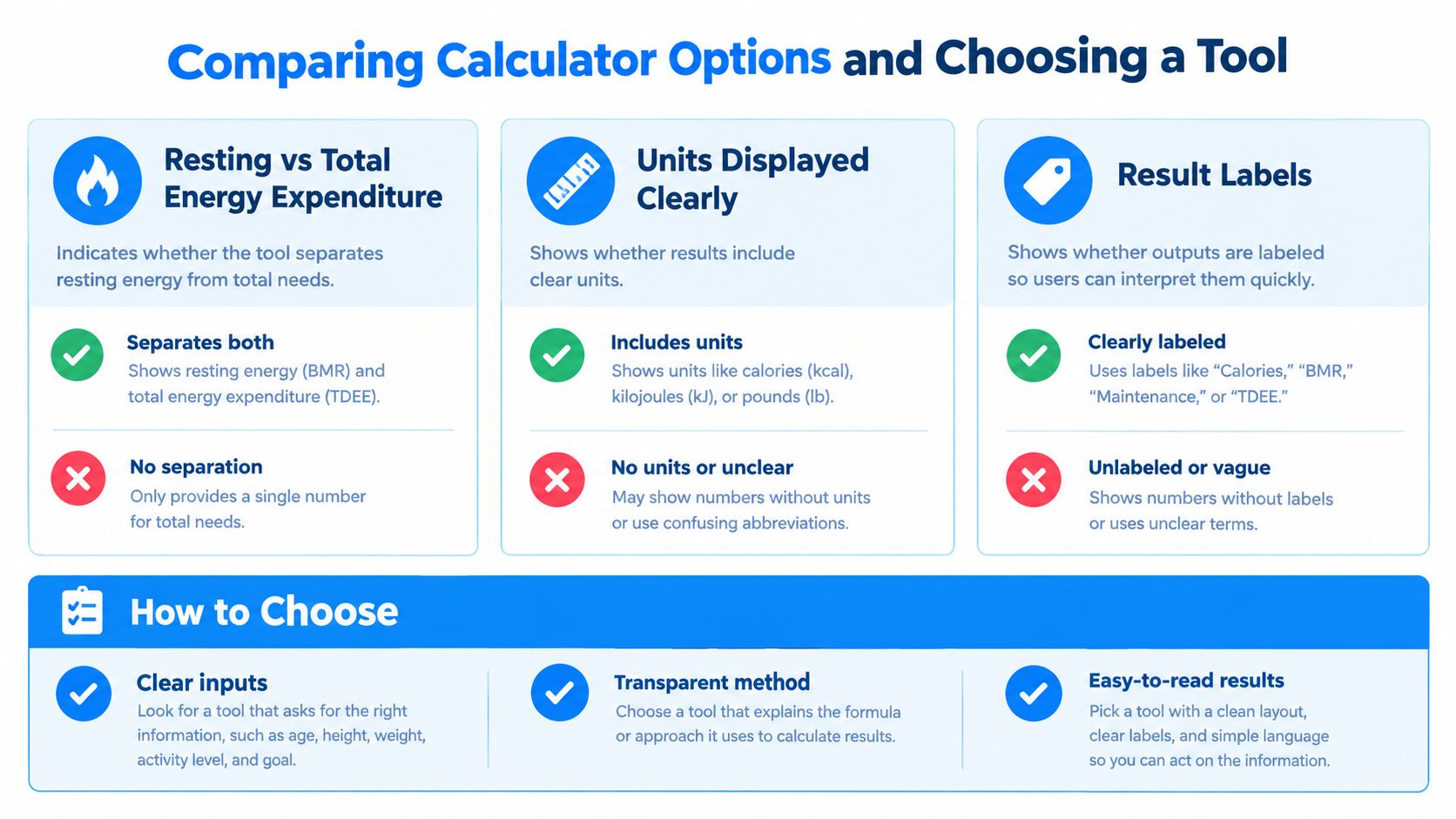
| Evaluation point | A clear tool should | Why it matters |
|---|---|---|
| Resting versus total energy | Show resting needs separately from total daily needs | Users can see which value is an estimate of rest and which includes activity |
| Units and inputs | Display units beside height, weight, and energy results | Incorrect or unclear units can undermine the calculation |
| Activity category | Identify the selected category in the output | The maintenance estimate depends on the activity assumption |
| Estimate and uncertainty | Label the result as an estimate and avoid implying precision | Prediction equations don't measure an individual's metabolism |
| Clinical review | Flag circumstances that may call for clinician input | Pregnancy, eating-disorder history, diabetes treatment, significant gastrointestinal disease, unexplained weight change, and prescription anti-obesity medication can affect the plan |
A basic calculator may return one number with little explanation. A more useful clinical tool separates resting from total expenditure, preserves the activity category, and makes its assumptions visible. Neither type should diagnose a condition, determine a medication, or establish a rigid calorie prescription without considering the person.
Vials + Vitals is a physician-directed telehealth service that offers a Metabolic Calorie Tool alongside a GLP-1 Titration Calculator and a Follicular Retention Index. Its model includes U.S.-licensed physicians who review patient intakes and determine eligibility and titration. Prescription treatments and compounded formulations are prescribed strictly at the clinical discretion of licensed U.S. healthcare providers following an individualized telehealth intake and consultation.
The service context doesn't change the basic standard for evaluating a calculator: transparent inputs, clearly labeled estimates, and appropriate clinician oversight. Readers can apply the same criteria to any tool, including one that isn't connected to medical care.
Quick Reference and Next Steps
The table summarizes what a metabolic calorie calculator uses and how each output should be understood.
Quick Reference for Calculator Inputs and Outputs
| Element | What It Represents | How to Interpret It |
|---|---|---|
| Sex | The sex-specific input used in the Mifflin–St Jeor equation | Confirm the selected option because it changes the equation's constant |
| Age | Age in years | Check that the entry is current and uses the expected unit |
| Height | A measure of body size | Confirm the value and displayed unit |
| Actual body weight | The weight input used in the resting-energy estimate | Check the entry and unit; recognize that the equation doesn't directly assess body composition |
| Activity category | The selected description of usual activity | Choose the category that reflects routine behavior and record it with the result |
| Resting metabolic rate | An estimated energy need at rest | Treat it as a prediction, not a measured metabolic rate |
| Total daily energy expenditure | An estimate that includes activity and other daily energy costs | Read it in light of the activity assumption and individual uncertainty |
| Maintenance energy | The estimated intake associated with energy balance | Use it as a starting reference, not a fixed prescription |
| Calorie deficit | A possible therapeutic adjustment from maintenance | It requires individualized consideration and isn't automatically appropriate |
Before using a result, the person should check the entries and units, note the activity category, and confirm whether the tool displays RMR, total daily expenditure, or maintenance energy. Afterward, the estimate can be reviewed alongside weight trend, food intake, activity, symptoms, and changes in treatment. Reassessment is particularly important when body weight or daily activity changes, or when the observed trend disagrees with the estimate.
Readers considering prescription treatment should review the Metabolic Calorie Tool with a licensed provider through an individualized telehealth consultation. Prescription treatments and compounded formulations are prescribed strictly at the clinical discretion of licensed U.S. healthcare providers following an individualized telehealth intake and consultation.
Informational purposes only. Compounded medications are evaluated by a licensed provider for individual suitability and are fulfilled by state-licensed partner compounding pharmacies.
Vials + Vitals offers a Metabolic Calorie Tool within a physician-directed telehealth model, with licensed providers reviewing individual intakes and clinical suitability. Readers can explore Vials + Vitals to learn about its clinical tools and arrange an individualized consultation.