How Long Does Semaglutide Take to Work
How long does semaglutide take to work? Early appetite shifts may appear by week 4, while average weight loss builds over months of titration.

Measurable weight change with semaglutide can appear by about week 4, while the usual 2.4 mg maintenance dose is reached around week 17 on the standard schedule. The STEP 1 average of 14.9% weight loss was measured at week 68, not after the first injections.
That distinction helps explain why an unchanged scale early in treatment isn't automatically evidence of failure. Appetite, glucose readings, and body weight represent different outcomes, so a useful clinical assessment considers more than whether weight dropped immediately.
How Long Semaglutide Takes to Work
The first measurable response and the full treatment response aren't the same event. In STEP 1, researchers observed weight loss at the first assessment after randomization, but the principal results reflected sustained treatment rather than introductory doses.
In that trial, once-weekly semaglutide 2.4 mg plus lifestyle intervention produced average weight loss of 14.9%, compared with 2.4% with placebo, and 86.4% of treated participants achieved at least 5% weight loss by week 68, as summarized in the STEP 1 clinical trial review. Those findings describe a group average under a particular treatment protocol, not an individual deadline.
Different meanings of working
The question “how long does semaglutide take to work” becomes easier to answer when the intended outcome is clear. Someone seeking appetite control may notice a different signal than someone monitoring diabetes or assessing weight change.
Three timelines matter: drug exposure develops within days, appetite or glucose trends are commonly assessed during the first several weeks, and substantial body-weight change is evaluated over months.
For example, a patient might leave food on a plate more often without seeing an obvious change in clothing fit. Another might record improving glucose readings before noticing a consistent downward weight trend. Neither observation, by itself, establishes the eventual treatment outcome.
What an early assessment should establish
An early appointment should clarify whether treatment is tolerable, whether doses are being taken as prescribed, and which outcomes are being monitored. The clinician also needs to understand whether appetite changes support adequate nutrition rather than making eating uncomfortable.
- Appetite response: Changes in hunger, fullness, and usual portion sizes may provide useful context.
- Glucose response: When relevant, the prescriber reviews readings alongside the patient's existing treatment.
- Weight response: A trend is more informative than an isolated measurement.
Prescription treatments, including compounded formulations, are prescribed strictly at the clinical discretion of licensed U.S. healthcare providers following an individualized telehealth intake and consultation. A clinical timeline helps guide that evaluation; it doesn't replace it.
How Semaglutide Starts Changing Appetite and Glucose
Semaglutide can reach peak levels in the bloodstream within days, while appetite or glucose trends may take several weeks to assess. Body-weight change is judged over months. These are three different clocks, so a slow-moving scale during dose initiation does not, by itself, mean treatment has failed or that the dose should be increased sooner.
Semaglutide activates GLP-1 receptors, which help regulate appetite and glucose. For weight management, this signaling can reduce appetite and food intake. A patient may feel satisfied with a smaller portion, much like a meal that used to feel unfinished now feels complete.
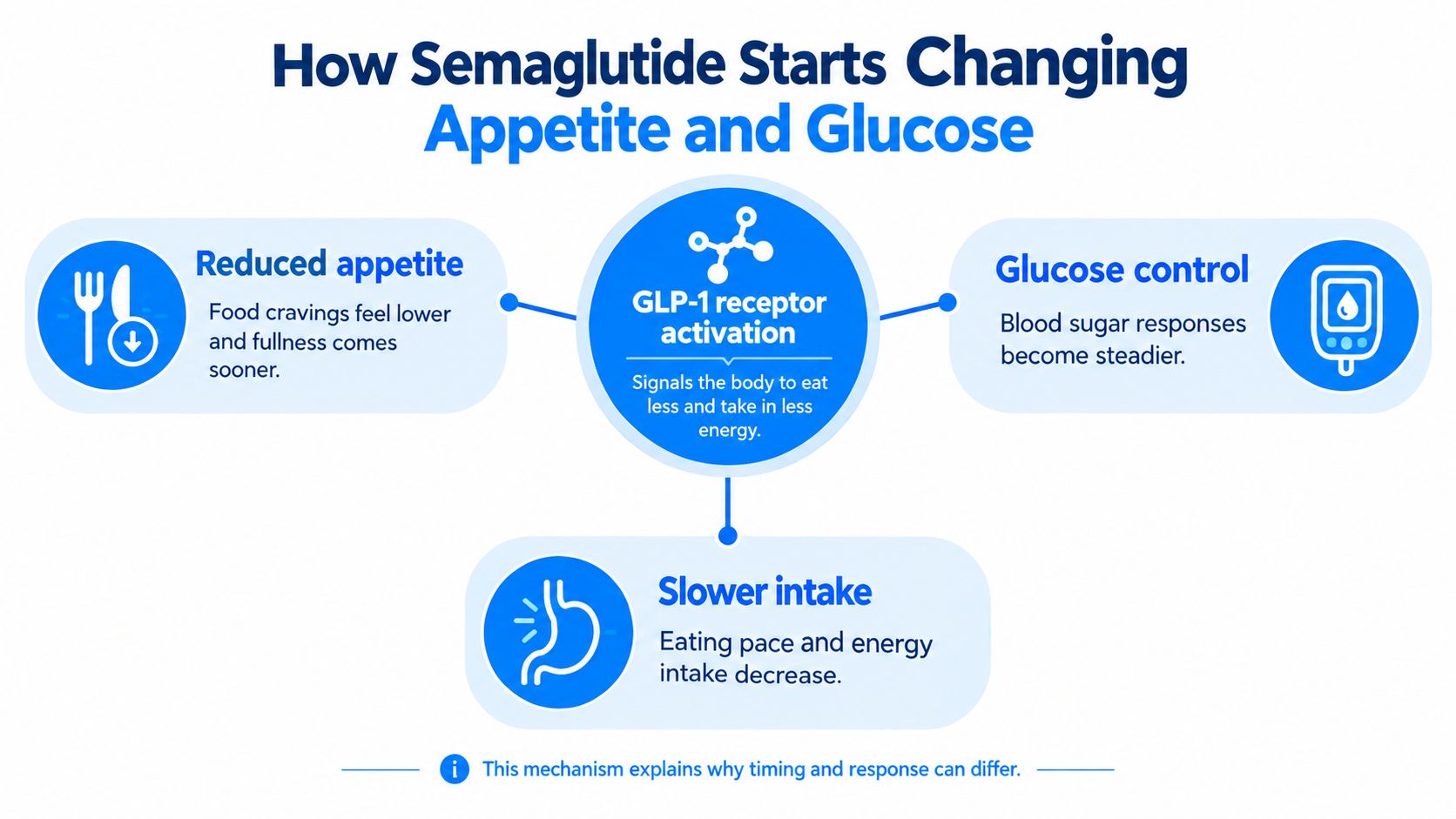
With weekly injections, medication exposure builds gradually rather than switching fully on and off. Some semaglutide remains in the body when the next dose is due. For injectable Wegovy, peak plasma concentrations occur approximately 1–3 days after a dose, the elimination half-life is about 1 week, and repeated doses build toward steadier exposure over roughly 4–5 weeks, according to the FDA prescribing information on semaglutide pharmacokinetics.
The labeled initiation dose is 0.25 mg once weekly. During this phase, appetite or glucose patterns may begin to shift, while noticeable weight change can take longer. Later dose increases raise medication exposure. They continue the same treatment process, though appetite effects and tolerability may change after an increase.
At meals, note whether a familiar portion feels more filling or hunger changes before eating. For glucose monitoring, follow the clinician's plan and look at patterns rather than relying on one favorable reading. Keep symptoms separate from appetite changes, since gastrointestinal discomfort is not evidence of a stronger benefit.
People tracking diabetes may also want to ask how treatment relates to their individual glucose goals. This guide to reducing HbA1c levels can help frame those questions. HbA1c goals and weight change are different outcomes, and progress in one does not guarantee the same timing in the other.
Greater discomfort isn't proof of greater benefit. Gastrointestinal effects can make treatment harder to tolerate. Follow the prescriber's dose schedule rather than increasing the dose to seek a stronger immediate effect.
Why the Dose Schedule Shapes the Timeline
A treatment calendar only makes sense alongside the prescribed dose. A patient who has just started isn't receiving the same exposure as someone who has completed escalation and remained on maintenance treatment.
Titration means increasing the dose in planned steps. For injectable Wegovy, the gradual schedule is intended to reduce gastrointestinal adverse reactions rather than deliver the eventual maintenance dose immediately.
Standard Once-Weekly Semaglutide Titration
The following schedule comes from the U.S. Wegovy prescribing information, which lists 0.25 mg during weeks 1–4, 0.5 mg during weeks 5–8, 1 mg during weeks 9–12, 1.7 mg during weeks 13–16, and maintenance treatment from week 17 onward.
| Phase | Weeks | Once-weekly dose |
|---|---|---|
| Initiation | 1–4 | 0.25 mg |
| Early escalation | 5–8 | 0.5 mg |
| Continued escalation | 9–12 | 1 mg |
| Later escalation | 13–16 | 1.7 mg |
| Maintenance | 17 onward | 1.7 mg or 2.4 mg, as prescribed |
The table describes a labeled injectable protocol, not a dosing recommendation for every semaglutide product. A compounded preparation or another route of administration shouldn't be assumed to follow an identical schedule.
Why a longer calendar may be appropriate
If a patient doesn't tolerate an increase, escalation may be delayed for 4 weeks, as described in the FDA labeling on tolerability-based dose escalation. A delay can therefore reflect an intentional clinical adjustment rather than abandonment of treatment.
Consider a patient who develops persistent gastrointestinal symptoms after a planned increase. The useful question isn't whether the next dose can be reached sooner. It's whether the current plan remains tolerable enough to continue safely and consistently.
A dose-escalation schedule is a clinical safety framework, not a deadline that every patient must meet.
Early follow-up should therefore distinguish between time since starting and time at a tolerated therapeutic dose. Those aren't interchangeable measures of treatment exposure.
A practical review also checks whether the patient understands the prescription, has followed administration instructions, and knows whom to contact before making changes. The strongest early assessment combines these details with symptoms and outcome trends instead of treating the calendar alone as evidence of success or failure.
Weight Loss Milestones from Month One to Week 68
In the STEP 1 trial, weight loss was measurable by week 4, average weight reached its lowest point around week 60, and the estimated difference in weight change between treatment groups was 12.4 percentage points at week 68. These were group results among adults with overweight or obesity who received semaglutide alongside lifestyle intervention, as reported in the published STEP 1 randomized trial.
Those milestones represent three different clocks. Semaglutide exposure begins within days, appetite or glucose trends may emerge over the first 4–8 weeks, and body-weight change is best judged over months. Early appetite changes and scale movement do not necessarily happen together. A slow scale during dose initiation does not, by itself, mean treatment has failed or that the dose should be raised sooner.
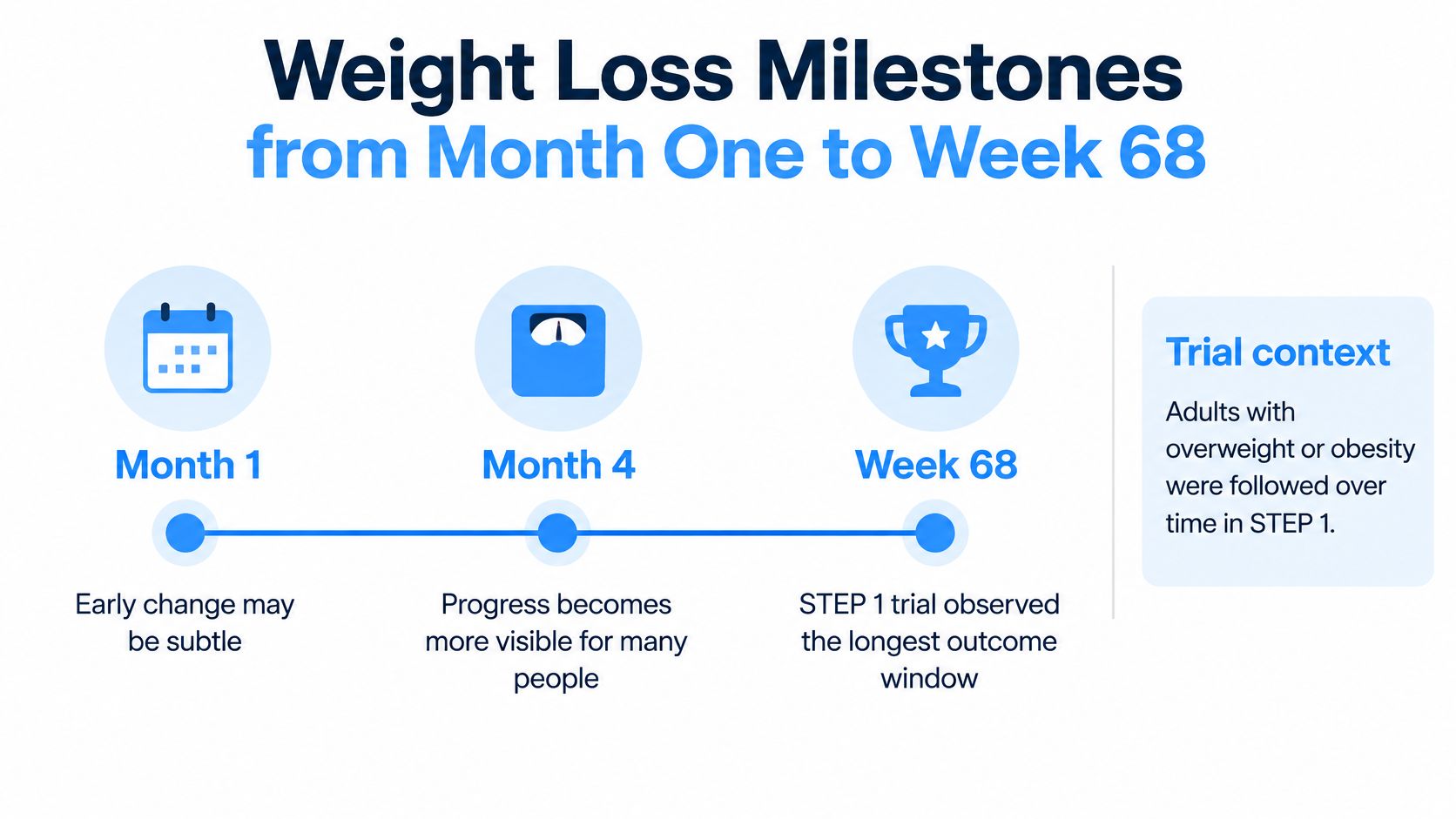
The timeline shows observations across a study, not deadlines for individual patients. The week 4 finding means researchers could measure change in the group by then; it does not mean every participant noticed a visible difference at that point. Later results reflect cumulative treatment over an extended period, including dose escalation and lifestyle support, rather than the effect of one injection.
For example, an adult may start feeling satisfied with smaller portions before their weight shows a clear downward trend. At follow-up, that appetite change is useful to record, even if the scale has not yet matched expectations shaped by trial headlines. The example illustrates a possible sequence, not a predicted outcome.
Keep three distinctions in mind: an early change in eating behavior is not a final weight result; a trial average is not a personal target date; and findings from an injectable product should not automatically be applied to compounded preparations or other routes.
When reviewing weight-loss injection before-and-after expectations, look beyond appearance. Treatment duration, prescribed product, lifestyle support, and how outcomes were measured all provide context. Weight loss develops cumulatively, and progress is most meaningfully interpreted over time rather than by expecting every measure to change at once.
Why Early Progress Differs Between Patients
Semaglutide exposure begins after a dose, but that does not mean every visible effect follows on the same clock. Drug exposure develops within days; appetite or glucose trends may become noticeable during the first 4–8 weeks; body-weight change is better judged over months. These are different signals, and a slow-moving scale during dose initiation does not by itself show that treatment has failed.
The prescribed dose schedule helps explain why two people starting at the same time may not have the same treatment experience. One may advance through planned doses as intended. Another may need more time at a dose because of tolerability concerns. Their calendar weeks match, but their dose exposure does not.

Diagnosis also affects which outcomes are most relevant. FDA materials report average weight reductions of roughly 15%–16% in adults without type 2 diabetes, compared with about 9.6% in adults with type 2 diabetes in the relevant trials, as described in the FDA semaglutide clinical materials. These are trial averages, not personal targets or deadlines. A clinician interprets them in light of a patient's diagnosis and treatment goals.
For someone treating type 2 diabetes, glucose trends may provide useful evidence of response even when weight change is modest. For someone focused on weight management, reduced hunger can be an early signal, but it does not establish the eventual amount of weight loss. Each outcome has its own timeline.
When progress seems limited, the prescriber can review the full context: the doses taken and any interruptions, tolerability, eating patterns, other medicines, diagnosis, and treatment goals. A guide to why weight loss may be limited on semaglutide may help a patient prepare questions, but it is not a basis for changing a dose independently.
A slow early scale reading is not a reason to rush dose increases. Persistent adverse effects, absent appetite changes, or measurements that do not improve after supervised titration warrant a clinical review. Depending on the individual response, the prescriber may continue observation, adjust for tolerability, or consider another treatment strategy. The right interpretation depends on the person's course, not someone else's timeline.
How to Monitor Progress and Choose a Protocol
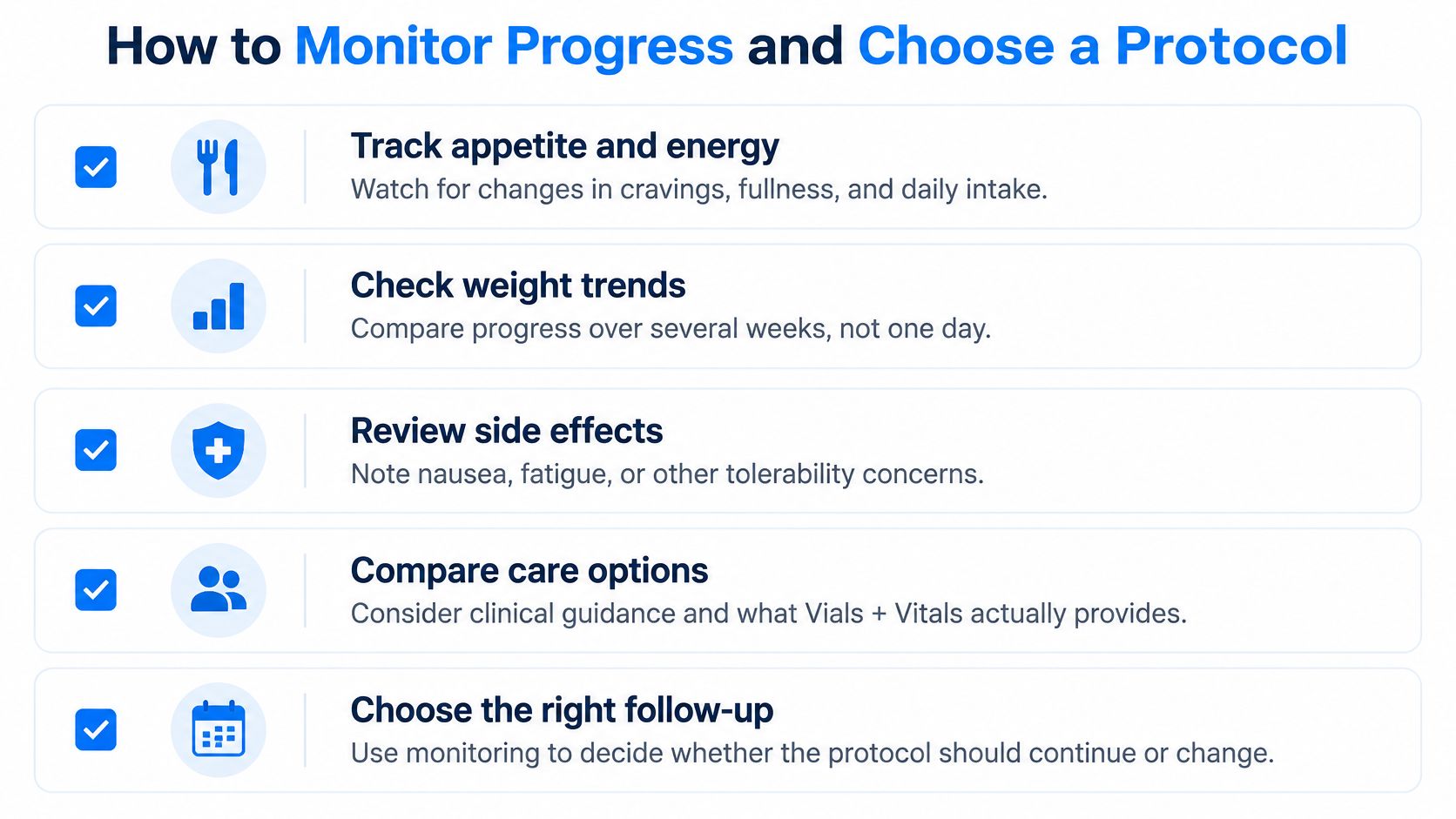
A useful monitoring plan should make follow-up easier, not turn every meal or weigh-in into a test. A brief, consistent record helps the clinician distinguish an isolated observation from a persistent pattern.
The record should also separate desired effects from problems. Feeling satisfied with an appropriate meal and being unable to eat comfortably aren't equivalent outcomes.
What belongs in a progress log
- Appetite and portions: Note changes in hunger, fullness, cravings, and typical meal size.
- Weight trend: Record measurements consistently enough to identify the broader direction rather than interpreting each result separately.
- Glucose when relevant: Follow the clinician's testing instructions and document concerns.
- Adverse effects: Describe symptoms, their timing, and whether they interfere with eating or taking medication as prescribed.
- Administration questions: Record missed doses or uncertainty so the prescriber can give product-specific instructions.
Comparing responses to a plateau
Unsupervised escalation changes medication exposure without resolving why progress appears limited. It also bypasses the tolerability assessment built into prescribed treatment.
Observation with clinician review is different from doing nothing. The clinician can examine the log, confirm the dose history, and decide whether continued monitoring or a change is appropriate.
Structured telehealth care adds an organized intake, prescribing review, and follow-up pathway. The publisher's physician-directed service includes an online assessment, individualized titration oversight, injectable semaglutide and dual-incretin options, and needle-free sublingual tablets for patients who prefer to avoid syringes.
These formulation options shouldn't be treated as interchangeable evidence. The injectable trial results described earlier don't establish the same absorption, timing, or outcomes for a sublingual compounded preparation. Clinical suitability must be evaluated separately.
Maintenance matters: A plateau, a dose change, and a decision to stop treatment are different clinical questions.
Stopping should be discussed as a maintenance decision, not treated as a neutral endpoint after early progress. The care plan should specify what will be monitored and how the clinician will respond if appetite control or other improvements recede.
Compounded medicines aren't selected by a patient to force faster results. A licensed U.S. provider determines whether a prescription is appropriate after individualized intake and consultation, with fulfillment through licensed partner pharmacies.
What to Do After You Know the Timeline
A realistic timeline should lead to a clearer follow-up plan, not passive waiting. Patients should know which observations to record, which concerns to report, and when the prescriber expects to review progress.
The next monitoring period should focus on appetite, portion size, tolerability, and the relevant weight or glucose trend. A single scale reading shouldn't determine whether treatment continues, stops, or increases.
Prepare for a useful reassessment
A concise appointment summary can be more useful than a general statement that treatment “isn't working.” It should describe what changed, what didn't, and whether symptoms have made the prescription difficult to follow.
- Bring the actual dose history: Include interruptions, delayed increases, and administration questions.
- Describe persistent symptoms: Report gastrointestinal effects instead of skipping medication or taking extra doses later.
- Clarify the desired outcome: Identify whether the concern involves hunger, glucose, weight, or the ability to tolerate treatment.
- Ask about alternatives when appropriate: Continued lack of benefit deserves a clinical decision rather than indefinite waiting.
Patients should keep the prescriber's schedule unless the clinician advises otherwise. Missed-dose instructions depend on the prescribed product and circumstances; improvising by stacking doses isn't an appropriate response.
Plan beyond the first visible change
Maintenance deserves discussion before treatment ends. The clinician and patient should agree on what continued benefit means, what follow-up is needed, and how a future treatment change would be managed.
Adults considering supervised care can complete a confidential online assessment so a U.S.-licensed provider can determine eligibility, formulation, and an appropriate titration schedule. Home delivery follows only when treatment is clinically appropriate, and the consultation fee is refunded when treatment isn't appropriate.
The practical objective is an interpretable, tolerable treatment course, not the fastest possible escalation. Careful monitoring helps the clinician decide whether to continue, adjust, or reconsider the strategy without assigning a personal deadline based on a trial average.
Informational purposes only. Compounded medications are evaluated by a licensed provider for individual suitability and are fulfilled by state-licensed partner compounding pharmacies.
Vials + Vitals offers physician-directed telehealth assessment, individualized prescribing, and titration oversight for adults considering GLP-1 weight-management care. Adults seeking help interpreting their treatment timeline can visit the service to complete a confidential assessment and discuss appropriate options with a U.S.-licensed provider.