Weight Loss Injections Before and After: 6 Clinical Examples
Explore weight loss injections before and after results, with clinical context on dosing, timelines, safety, maintenance, and realistic outcomes.

The most popular advice about weight loss injections before and after results is also the least credible. A single photograph, a celebrity transformation, or a promised number of pounds doesn't establish what treatment did, how long it took, or whether the result lasted. Clinicians evaluate a different record. That record includes baseline weight and BMI, the target population, medication and dose, titration schedule, treatment duration, adherence, comorbidities, adverse effects, and maintenance status.
Validated outcomes carry more weight than appearance alone. Percentage weight change, waist circumference, cardiometabolic markers, and, where trials measured them, clinical events show whether a visual change reflects a meaningful health change. Readers can use a real-world calorie guide for weight management for nutrition context, but calorie targets don't replace medication-specific evidence.
The six examples that follow treat each result as a longitudinal clinical story. They distinguish randomized evidence from maintenance data, formulation-specific findings, and illustrative patterns. Any composite vignette is identified as illustrative and isn't presented as an actual Vials + Vitals patient.
1. Semaglutide 2.4 mg Once Weekly Weight Change in the STEP 1 Trial
STEP 1 remains the reference point for injectable semaglutide 2.4 mg because it tested a defined population under a controlled protocol. Adults had overweight or obesity without diabetes, received once-weekly subcutaneous treatment plus lifestyle intervention, and followed gradual dose escalation before reaching the maintenance dose. That structure matters. The maintenance dose wasn't the starting dose, and tolerability during titration shaped whether participants stayed on therapy.
The quantitative result gives readers a usable before-and-after frame. In the STEP 1 trial record summarized on PubMed, mean body-weight reduction was 14.9% with semaglutide versus 2.4% with placebo at week 68, and 86.4% versus 31.5% lost at least 5%, 69.1% versus 12.0% lost at least 10%, and 50.5% versus 4.9% lost at least 15%. Those thresholds are more informative than a best-case image because they show both the average and the spread of response.
How Clinicians Translate the Average
A group mean isn't a personal target. For practical planning, the STEP 1 report in The New England Journal of Medicine recorded absolute changes of approximately 15.3 kg versus 2.6 kg, which helps clinicians discuss percentage change and kilograms together at defined checkpoints. A patient who responds more slowly during escalation hasn't necessarily failed treatment, and a rapid early loss doesn't guarantee the same trajectory later.
- Set expectations by percentage: Ranges and milestones describe response more accurately than isolated photographs.
- Reassess after maintenance: Plateaus are common, and persistent absence of progress warrants review of dose, adherence, nutrition, and tolerability, including guidance on a GLP-1 weight loss plateau.
- Protect lean mass: Adequate dietary protein and resistance training support function during weight reduction.
- Use tools as aids: The GLP-1 Titration Calculator can support planning, but escalation timing still depends on individual tolerability.
Regulatory context also defines who the result applies to. The FDA approved Wegovy on June 4, 2021, for chronic weight management in adults with obesity, or overweight with at least one weight-related condition, as described in the FDA approval letter for Wegovy. Readers seeking broader background can browse obesity health articles, while remembering that eligibility requires individualized medical review.

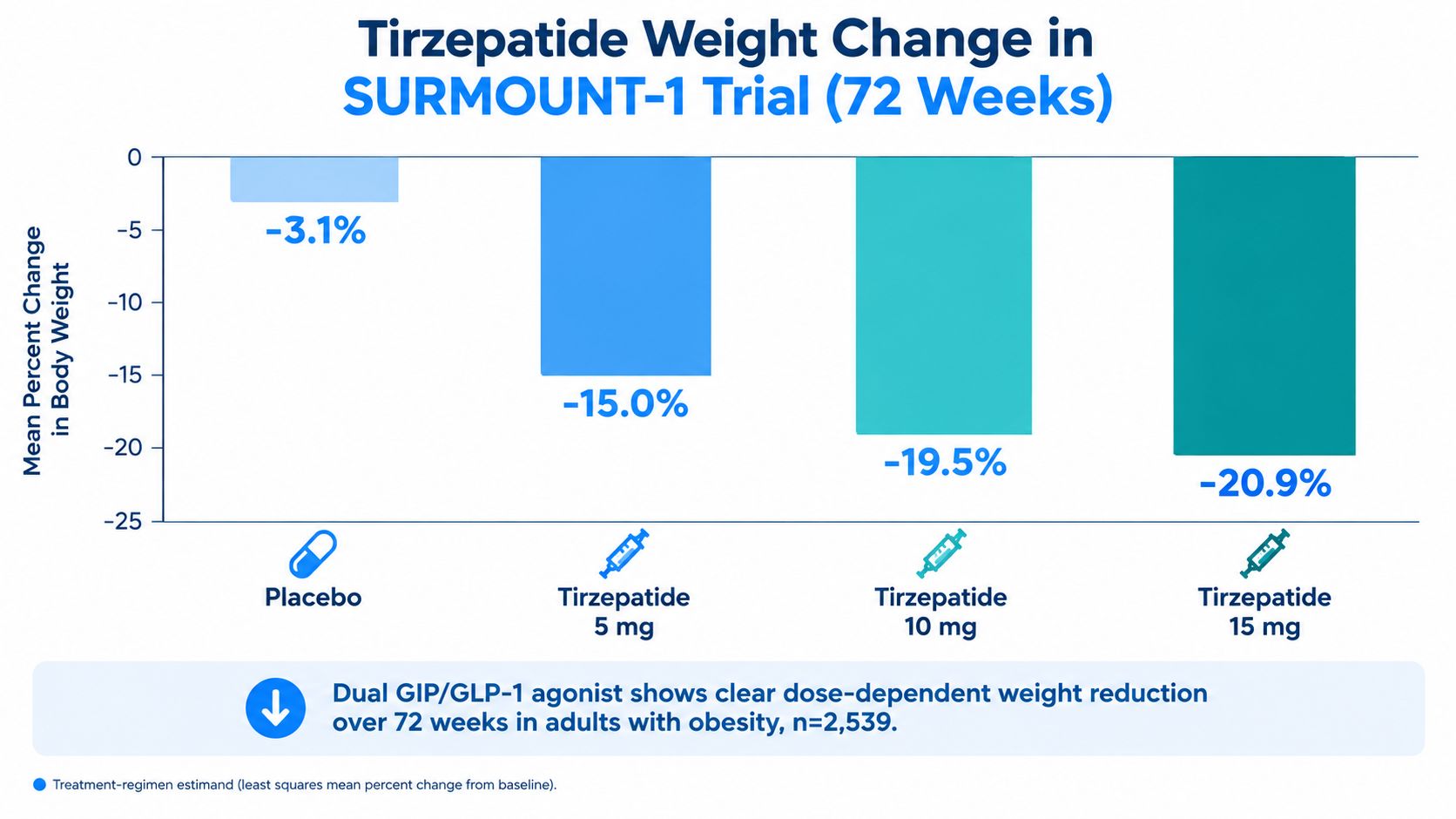
2. Tirzepatide Dose-Response Outcomes The SURMOUNT-1 Trial
Tirzepatide adds a second question to the before-and-after discussion. It's not only whether weight changed, but how response varied by dose over time. SURMOUNT-1 studied adults with obesity or overweight without diabetes who received once-weekly tirzepatide, a dual GIP and GLP-1 receptor agonist, with stepwise escalation.
Dose response was clear at week 72. In the SURMOUNT-1 results reported by Lilly, mean weight reduction was 15.0% with 5 mg, 19.5% with 10 mg, and 20.9% with 15 mg, compared with 3.1% with placebo, while at least 10% loss occurred in 73%, 86%, and 90% across doses. Higher thresholds followed the same pattern, which supports presenting outcomes as dose- and time-dependent averages rather than guaranteed individual results.
Practical rule: A higher dose isn't automatically the better dose. The lowest dose that maintains a patient's trajectory with acceptable tolerability is often the more sustainable clinical choice.
What Titration Changes in Practice
Delayed escalation is preferable to discontinuation when gastrointestinal symptoms emerge. Clinicians can hold a dose, review hydration and meal size, and reassess before advancing. That approach protects adherence, which is the variable photographs never show.
An illustrative pattern clarifies the point. One patient reaches a moderate dose, tolerates it well, and continues losing steadily, while another escalates quickly, develops persistent nausea, and stops treatment. The second patient's short-term image could look more dramatic, yet the first patient's longitudinal record is clinically stronger.
Structured monitoring makes that distinction visible. Weight, waist circumference, and glycemic markers at baseline and at regular intervals show whether dose changes are working. Format also affects adherence for some patients, which is why practical comparisons such as Zepbound vials versus pens belong in treatment planning rather than after problems develop. Small, frequent meals and consistent hydration during escalation can reduce symptom burden, but persistent vomiting, dehydration, or inability to eat requires prompt clinical review.
3. Weight Regain After Discontinuation STEP 4 and SURMOUNT-4 Maintenance Outcomes
Most galleries stop at the lowest weight. Maintenance trials ask what happens next. STEP 4 and SURMOUNT-4 used withdrawal designs in which participants who had lost weight during initial treatment either continued therapy or switched to placebo, allowing clinicians to separate active treatment effect from durable maintenance.
The broader evidence points in the same direction. In a 2025 systematic review summarized on PubMed, pooled regain after stopping semaglutide or tirzepatide was approximately 9.69 kg, compared with 2.20 kg after liraglutide, and a related commentary reported real-world discontinuation rates that may reach 50% to 75% at 12 months. Regain was proportional to the amount initially lost, yet it wasn't universal, since 42% of people in the cited real-world analysis didn't regain weight after discontinuation.
That nuance changes counseling. Treatment shouldn't be framed as a short course with a permanent finish line, and discontinuation shouldn't be framed as personal failure. Cost, supply, tolerability, pregnancy planning, surgery, or a change in medical status can all interrupt therapy, and each reason requires a different follow-up plan.
Planning for the Period After the After Photo
- Frame duration early: Patients benefit from hearing at the first visit that obesity treatment is typically chronic disease management.
- Plan discontinuation deliberately: If stopping becomes necessary, follow-up should track weight trajectory, glycemic markers, blood pressure, and lifestyle support rather than ending contact.
- Measure trajectory, not a snapshot: A single time point can't show stability, gradual regain, or recovery after a plateau.
- Support nutrition during maintenance: Tools such as the Metabolic Calorie Tool and practical resources on meal bar nutrition for recovery can support planning, but they don't replace clinician oversight.
An illustrative contrast is useful. A patient who remains on therapy after reaching a target may show a stable record over subsequent visits, while a patient whose course is interrupted may show progressive regain over the following months. Both records start with the same successful image, yet they describe different clinical outcomes.
4. Oral Semaglutide for Weight Management The OASIS 4 Trial and Needle-Free Considerations
Needle aversion is a legitimate adherence issue, not a cosmetic preference. Oral semaglutide therefore attracts attention from patients who won't start or won't continue injections. The clinical task is to separate evidence for a specific swallowed tablet studied in a trial from assumptions about every needle-free product.
OASIS 4 studied a once-daily oral tablet taken under strict conditions. Administration timing, fasting status, and limited water intake weren't minor details; they were part of how the studied product was delivered. A before-and-after claim for an oral product is credible only when the formulation, route, and instructions match the evidence being cited.
Formulation-specific evidence matters. Results from a swallowed tablet don't automatically establish outcomes for a sublingual or orally disintegrating product.
Guardrails for Formulation Changes
Clinicians shouldn't extrapolate efficacy or pharmacokinetic expectations from one oral formulation to another without product-specific evidence. That caution applies especially to sublingual ODT options, which require physician review and the formulation-specific guardrails established by the medical advisory board. Convenience doesn't remove the need for monitoring.
An illustrative scenario shows why. A patient with significant needle aversion completes an initial evaluation, discusses oral administration requirements, and agrees to a documented reassessment of weight trajectory and tolerability. If weight loss stalls, the clinician first checks adherence, dosing timing, interacting oral medications, and dose appropriateness before changing formulation again.
Patient safety parameters remain consistent across routes. Gastrointestinal tolerability, hydration, nutrition, and adherence require monitoring, and patients need clear instructions on when to seek review. A discreet oral format may improve willingness to start therapy, but the clinical record still needs baseline measures, scheduled follow-up, and a maintenance plan. Without those elements, needle-free treatment becomes another image-driven claim rather than an evidence-led protocol.
5. Hair Retention Biology During Rapid Weight Loss Telogen Effluvium and Nutritional Determinants
Hair shedding during rapid weight loss often gets blamed directly on the injection. The biology is usually more indirect. Telogen effluvium is a diffuse, non-scarring shedding pattern that can follow physiologic stress, acute caloric restriction, or inadequate protein and micronutrient intake, and it typically appears after a delay rather than immediately after the triggering change.
That delay creates confusion in before-and-after accounts. A patient may connect shedding to the most recent dose increase, while the relevant stressor was the earlier period of rapid loss and low intake. Clinicians therefore review the timeline, dietary adequacy, iron status, thyroid function, and any independent pattern suggestive of androgenetic alopecia before attributing causality.
Body composition belongs in the same conversation. In a peer-reviewed review of incretin body-composition evidence, a SURMOUNT-1 subanalysis found approximately 75% of tirzepatide-associated weight loss came from fat mass, with a comparatively smaller decline in lean body mass. Even a smaller lean-mass loss can matter for older adults or patients at risk of frailty, so strength, activity tolerance, and protein intake deserve attention alongside appearance.
A Structured Hair Assessment
- Review protein adequacy: Intake should support lean mass and hair follicle function and be individualized to kidney function and overall health.
- Check common contributors: Ferritin, thyroid-stimulating hormone, vitamin D, and a complete blood count can help distinguish nutritional or endocrine causes from medication timing alone.
- Document objectively: Standardized photographs at consistent intervals and structured tools such as the Follicular Retention Index are more informative than unstandardized marketing images.
- Separate overlapping diagnoses: Established androgenetic alopecia may progress during weight loss and require dermatologic management, a distinction also relevant to hair loss treatment side effects.
An illustrative pattern is a patient whose diffuse shedding follows a rapid-loss phase with low protein intake and then improves after nutrition is corrected and weight stabilizes. That pattern supports a modifiable nutritional pathway, but it doesn't prove every case has the same cause. Specialized evaluation is warranted when shedding is patchy, scarring, persistent, or accompanied by scalp symptoms.

6. Cardiovascular Outcomes Beyond Weight The SELECT Trial
SELECT changed the meaning of an after result for a specific high-risk population. The trial assessed once-weekly semaglutide in adults with established cardiovascular disease and overweight or obesity without diabetes. For those patients, event-free survival and cardiometabolic risk markers matter at least as much as scale weight.
This distinction prevents a common misreading. A modest visual change in a patient with prior cardiovascular disease may accompany a clinically important risk-management plan, while a dramatic visual change in a lower-risk patient doesn't by itself prove cardiovascular benefit. Population, baseline risk, and concurrent therapy define what the outcome means.
Clinical takeaway: Incretin therapy supplements guideline-directed secondary prevention. It doesn't replace antiplatelet therapy, lipid management, blood pressure control, or cardiology follow-up where those treatments are indicated.
What to Document Beyond the Scale
Baseline assessment should record established cardiovascular disease, blood pressure, lipids, glycemic status, kidney function, and current preventive medications. Follow-up then tracks whether those markers move in a favorable direction and whether the patient remains event free. Coordination with a cardiologist or primary care clinician supports shared decision-making, especially when other medications need adjustment as weight and blood pressure change.
An illustrative scenario involves a patient with a prior myocardial infarction and obesity who's evaluated for incretin therapy as one component of secondary prevention. The after assessment includes weight trajectory, blood pressure, lipid profile, activity tolerance, tolerability, and continued adherence to established preventive treatment. That's a more complete record than paired photographs.
Mechanisms beyond weight reduction remain under active study, and clinicians shouldn't claim that every cardiovascular effect is explained by pounds lost. The optimized approach is conservative. Treat the cardiovascular evidence as population-specific, maintain proven preventive therapy, and judge progress across multiple markers over time.

6-Point Comparison of Weight Loss Injections: Before and After
| Example | Approach and Requirements | Evidence or Expected Outcome | Key Advantage | Ideal Use Case |
|---|---|---|---|---|
| Semaglutide 2.4 mg (STEP 1) | Weekly injection with gradual dose escalation and lifestyle support | Mean weight change −14.9% at 68 weeks versus −2.4% with placebo | Large trial with well-established weight-loss benchmark | Adults with obesity or overweight with a weight-related condition, without diabetes |
| Tirzepatide (SURMOUNT-1) | Weekly injection; stepwise titration to 5, 10, or 15 mg with lifestyle support | Mean weight change at 72 weeks: −15.0%, −19.5%, and −20.9% by dose, versus −3.1% with placebo | Strong weight reduction with a clear dose-response relationship | Adults with obesity or overweight with a weight-related condition, without diabetes |
| Continued treatment versus withdrawal (STEP 4 and SURMOUNT-4) | Ongoing medication and follow-up; studies compared continuation with switching to placebo | Continued treatment maintained or extended weight loss; withdrawal was followed by partial regain | Clarifies the role of ongoing therapy in weight maintenance | Long-term treatment planning and counseling about stopping therapy |
| Oral semaglutide 25 mg (OASIS 4) | Daily tablet taken fasting with limited water; wait before food, drinks, or other medications | Mean weight change about −13.6% at 64 weeks versus −2.2% with placebo | Needle-free delivery with randomized trial evidence | Patients who prefer tablets and can follow strict dosing instructions |
| Hair shedding during rapid weight loss | Assess nutrition and other causes; may require history, examination, and targeted lab tests | Telogen effluvium may begin 2–3 months after a trigger and often resolves after it is addressed | Helps distinguish potentially reversible shedding from other hair-loss conditions | Patients experiencing diffuse shedding during substantial weight loss |
| Cardiovascular outcomes (SELECT) | Weekly semaglutide plus standard cardiovascular care and ongoing monitoring | 20% relative reduction in major cardiovascular events versus placebo over median 3.3-year follow-up | Measures cardiovascular benefit beyond weight change | Adults with overweight or obesity, established cardiovascular disease, and no diabetes |
How to Interpret Your Next Before-and-After Result
A credible result can be checked. Readers should confirm that it identifies baseline characteristics, medication, route, dose-escalation schedule, and treatment duration. It should also state percentage weight change, waist and cardiometabolic markers where relevant, tolerability, adherence, and whether maintenance therapy continued after the initial loss.
Missing details change interpretation. A result without duration may compare a short titration phase with a long randomized trial. A result without dose can't be matched to dose-response evidence, and a result without maintenance status can't show whether the outcome endured. A result without safety context can't show whether the patient ate adequately, preserved function, or needed dose delays.
- Baseline and population: Weight, BMI, comorbidities, diabetes status, and cardiovascular history define applicability.
- Protocol: Medication, formulation, route, starting dose, escalation interval, maintenance dose, and lifestyle support define what was tested.
- Outcomes: Percentage change, absolute weight, waist circumference, strength or function, and cardiometabolic markers define quality of response.
- Safety and adherence: Gastrointestinal effects, nutrition, hydration, hair shedding, missed doses, and discontinuation reasons define tolerability.
- Maintenance: Continued therapy, structured follow-up, or a planned discontinuation strategy defines durability.
The most useful transformation is often a sustainable clinical trajectory rather than a dramatic photograph. That's particularly true for patients pursuing large losses, older adults concerned about lean mass, patients with needle aversion considering oral options, and patients whose cardiovascular risk makes non-scale outcomes central. Each group needs formulation-specific evidence and realistic expectations rather than a universal promise.
Individualized medical evaluation remains the safeguard. Vials + Vitals provides physician-directed assessment, individualized titration oversight, and access to selected GLP-1, dual-incretin, and needle-free ODT options when clinically appropriate. Eligibility, formulation, and escalation are determined by licensed providers, with ongoing monitoring rather than a one-time prescription decision.
The central standard is simple. Credible weight loss injections before and after stories must show the full protocol, the time horizon, the safety context, and the maintenance plan. A final image without those elements is marketing material, not clinical evidence.
Vials + Vitals offers physician-directed telehealth assessment for GLP-1 and dual-incretin weight management, including injectable protocols and selected needle-free ODT options when a licensed provider determines they're clinically appropriate. Patients receive individualized titration oversight, discreet fulfillment through accredited U.S. pharmacies, and structured follow-up focused on tolerability, nutrition, and maintenance. Visit Vials + Vitals to complete a confidential clinical assessment and discuss a protocol matched to individual biology and goals.