Cold Chain Shipping: A Guide for GLP-1 Patients
Learn how cold chain shipping protects temperature-sensitive medications like semaglutide and tirzepatide, from packaging to your doorstep.
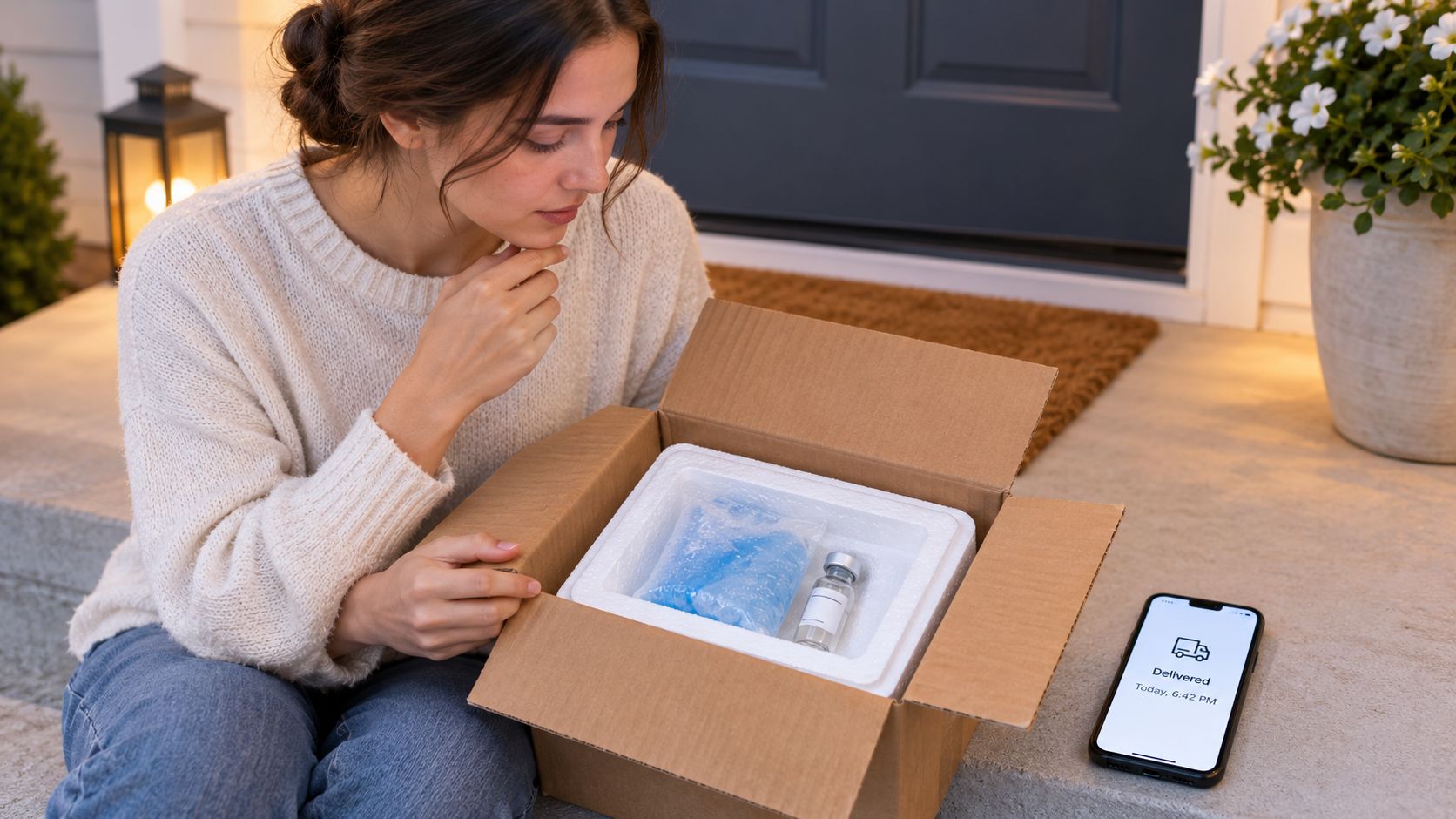
A package arrives at the front door with an injectable medication inside. The outer carton looks intact, but the patient still pauses. Is the gel pack cold enough? Did the box sit in the sun? Is the vial safe to use, or should the pharmacy replace it?
Those questions are reasonable. Cold chain shipping doesn't end when a parcel leaves the dispensing pharmacy. It continues through carrier handling, the last-mile handoff, the patient's refrigerator, and the response to any uncertain temperature exposure. For people receiving semaglutide, tirzepatide, or another temperature-sensitive peptide therapy through telehealth, understanding that continuum can prevent both unsafe use and unnecessary disposal.
When the Box Lands on Your Porch
A patient receiving a temperature-sensitive injectable through a telehealth pharmacy may have no visibility into the shipment's route. The parcel could have moved through several facilities, encountered a carrier delay, and spent time outside before the delivery scan appeared. At home, the first instinct is often to inspect the coolant pack. If it's still cold, the shipment feels reassuring. If it's soft or partially thawed, anxiety rises.
The problem is that a cold gel pack doesn't prove that the vial stayed within its labeled range. A package can contain cold material after an exposure that affected the medication, just as a brief warm reading doesn't automatically mean the product is unusable. Product quality depends on the temperature history and the duration of exposure, not appearance alone.
The home is part of the supply chain
Hospitals and pharmacies use controlled procedures for receiving refrigerated medicines. Patients often receive a box without the same context, even though the final handoff can introduce its own risks. Porch exposure, delayed unpacking, a household refrigerator door, a power interruption, or an unplanned trip can all affect what happens after delivery.
A safe process therefore has three connected checkpoints:
- Transit: The pharmacy qualifies packaging, selects the intended shipping lane, and monitors conditions when appropriate.
- Arrival: The patient records delivery details, inspects the parcel, and moves the medication into appropriate storage.
- Home storage: The patient follows the product label and contacts the dispensing pharmacy when exposure is uncertain.
Practical rule: A patient shouldn't inject a vial that appears frozen, overheated, damaged, or outside its labeled storage conditions until the dispensing pharmacy reviews the situation.
The purpose of cold chain shipping is not to make a box feel cold. It is to provide a documented, science-based path from dispensing to administration. That distinction matters for any direct-to-patient peptide therapy, especially when a patient can't independently reconstruct what happened during transit.
What Cold Chain Shipping Means
Cold chain shipping is a validated time-and-temperature system that protects a medicine from dispensing through delivery and home storage. The insulated box is one component. Packaging qualification, coolant preparation, monitoring, carrier procedures, receiving instructions, and excursion review must work together.
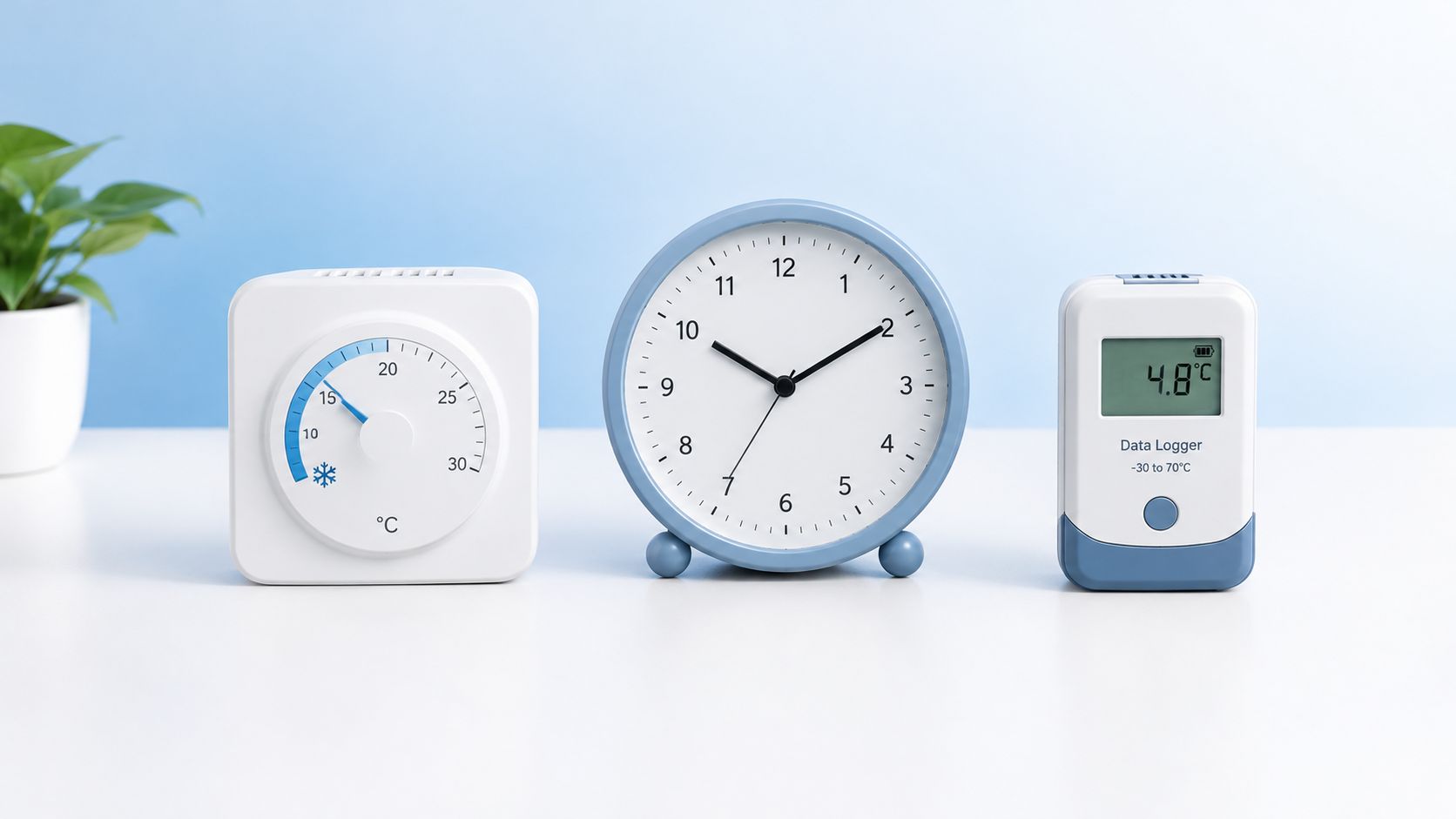
A useful analogy is a thermostat plus a clock. The thermostat represents the acceptable temperature range. The clock represents the duration of exposure. A vial briefly outside its labeled range may require a different assessment from one exposed for much longer, even when both reached a similar peak temperature.
Many biologic medicines are transported and stored within a 2°C–8°C range, unless the product labeling states otherwise. Pharmaceutical literature explains that biologic package inserts commonly prohibit excursions beyond the labeled range unless stability evidence supports the exposure. Heat, freezing, and repeated temperature cycling can affect protein-based products. The scholarly review of cold-chain requirements and biologic stability provides clinical context for treating temperature control as a safeguard for product potency.
What validation adds
A pharmacy qualifies a shipper against more than mild-weather conditions. The process should account for expected seasonal routes, maximum transit duration, carrier delays, and repeated opening or last-mile exposure. Coolants need appropriate conditioning, and the package should be designed around the labeled range rather than the coldest possible interior.
A calibrated data logger creates a continuous temperature record. WHO guidance recommends electronic monitoring and event logging for refrigerated transport. Storage sensors should achieve accuracy of ±0.5°C or better and be positioned at mapped hot and cold points, away from doors and temporary heat sources. The WHO guidance on temperature monitoring and distribution explains why documented measurement provides more useful evidence than visual inspection.
For the patient, the practical question is whether the validated system held the product within its acceptable range for the intended transit period and whether evidence supports that conclusion. That is the foundation of patient-safe cold chain shipping.
Why GLP-1 and Peptide Therapies Need It
A GLP-1 or other peptide medication can arrive looking perfectly normal after a difficult journey. Its appearance alone cannot show whether heat, freezing, or repeated temperature cycling affected the molecule. These therapies depend on a specific three-dimensional structure. Thermal stress may alter that structure, promote aggregation, or change the product's physical and chemical behavior.
A brief temperature variation does not automatically mean a medication is unusable. It does mean the vial may require professional assessment. A clear solution and intact label cannot reveal the complete temperature history or confirm that labeled potency remains supported.
Stability supports dose reliability
For semaglutide, tirzepatide, and related peptide therapies, following the labeled storage range helps maintain dose reliability within a clinician-directed protocol. If thermal exposure changes the active molecule, the patient may not receive the expected amount of active drug. That can complicate appetite control, glycemic management, or interpretation of treatment response during titration.
Labeled storage instructions are product-specific, so the dispensing pharmacy and prescriber should guide decisions after a suspected temperature excursion. The treatment plan depends on the medication behaving consistently from one dose to the next.
Three points deserve attention
Temperature exposure can occur before the vial reaches the patient, and the handoff at delivery is another point where control can fail.
- In transit: Carrier delays, weather, and handling may extend the time outside the intended shipping conditions.
- At the doorstep: Sun exposure, porch delays, and slow unpacking can add avoidable exposure.
- During home storage: A refrigerator door, freezer plate, or unstable household refrigerator can create localized temperature problems.
For telehealth fulfillment, the safety chain must connect the dispensing pharmacy's preparation and dispatch steps with the patient's actions at home. Delivery instructions should make clear when to retrieve the package, where to place the medication, and whom to contact if the shipment arrives warm, frozen, damaged, or late.
Compounded formulations require separate quality controls. When a qualified compounding pharmacy fills a prescription, the formulation should be prepared under applicable USP processes with analytical potency and sterility testing. Those checks address formulation quality. Cold chain shipping addresses exposure during delivery. They work together, but they answer different questions.
Temperature control is part of dose reliability and treatment safety, not a parcel-handling formality. A medication that must remain stable within its labeled range may be affected by freezing, overheating, or repeated cycling after it leaves professional custody.
Inside the Package, Layer by Layer
A validated cold-chain kit works as a layered control system. Each component handles a different failure mode, and no single layer can compensate for every other layer.
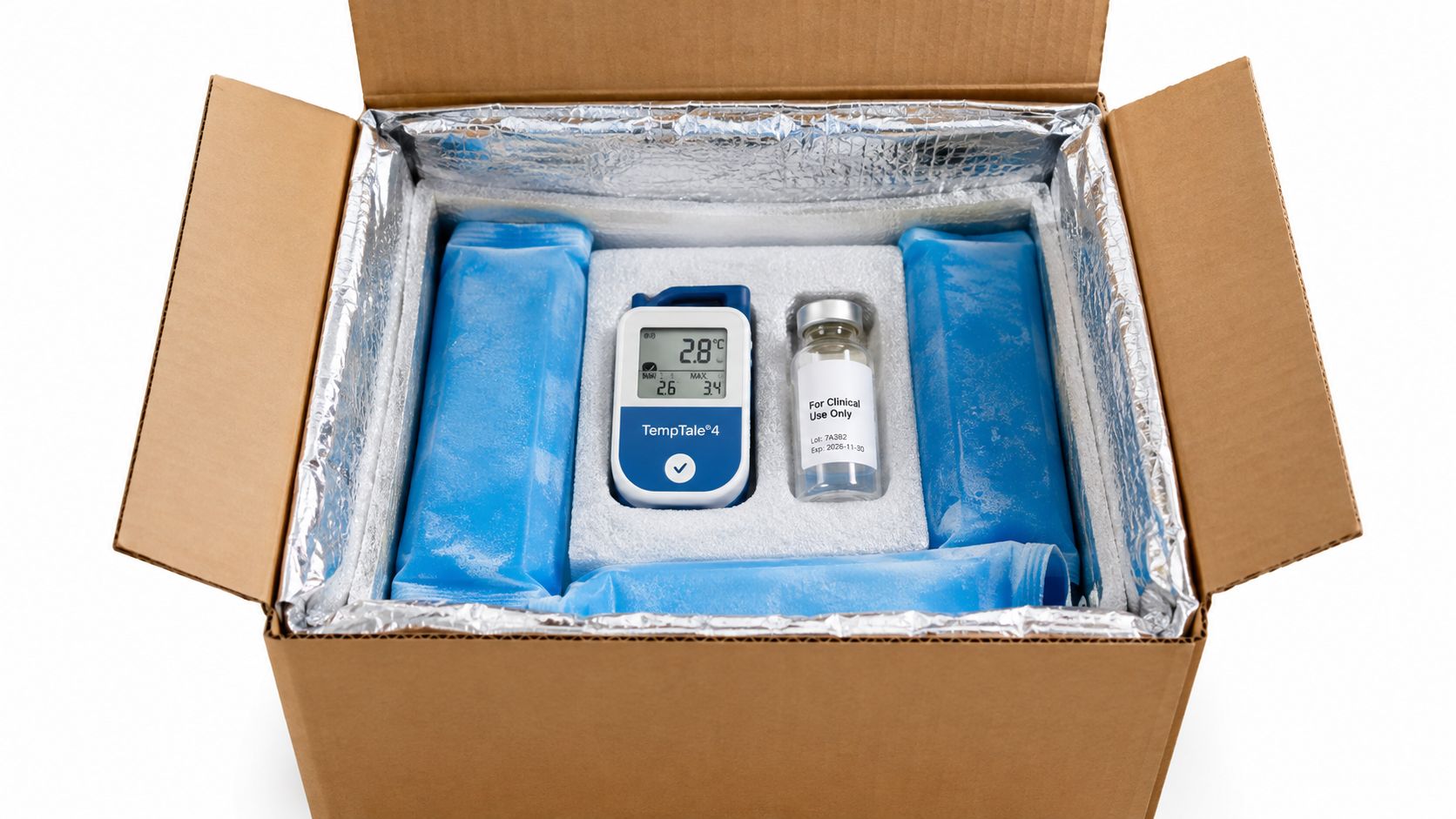
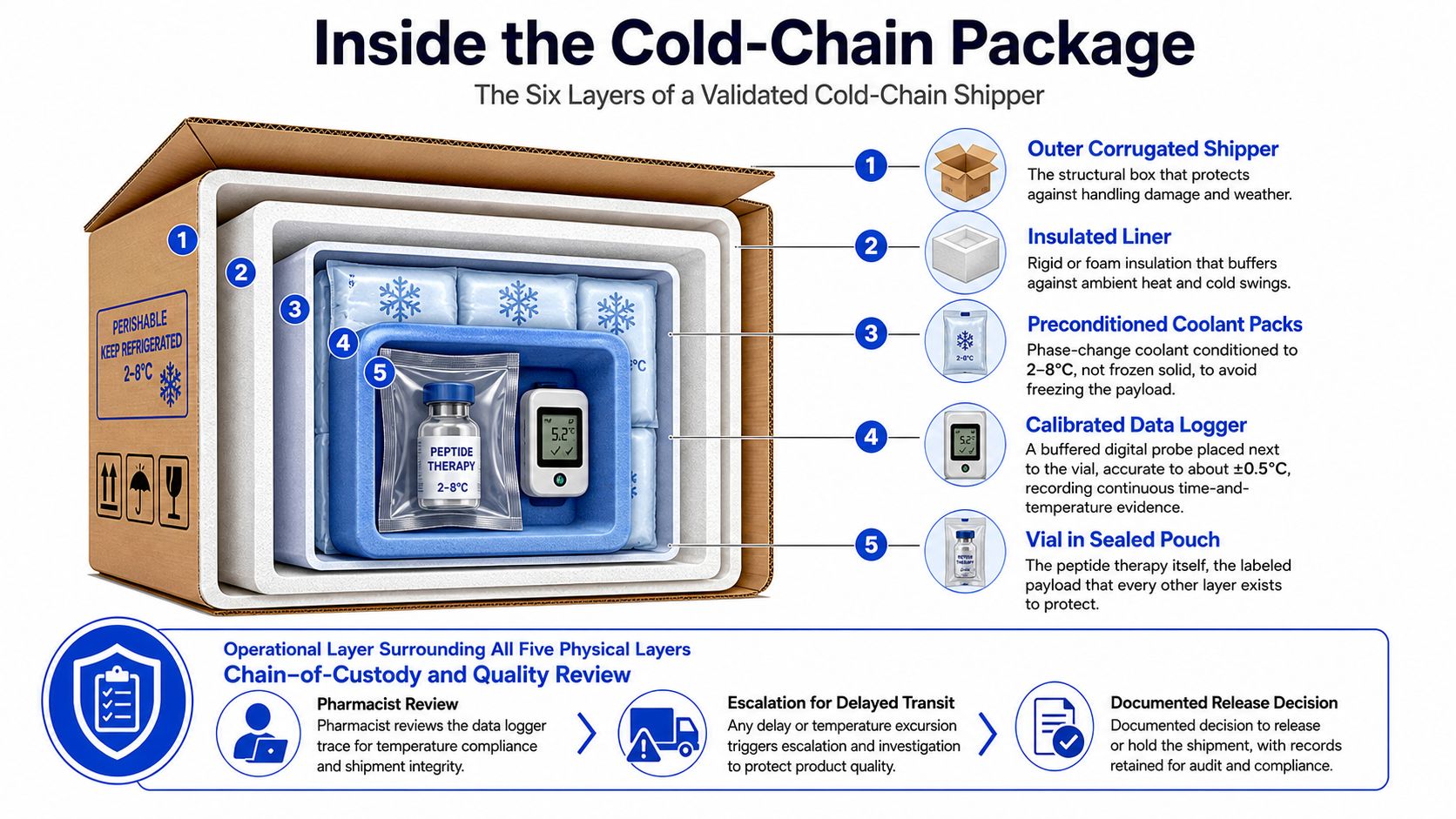
The outer box protects against handling damage and weather. Inside it, an insulated liner slows changes in ambient temperature. Conditioned coolant maintains the intended thermal environment. The vial sits in a protected payload area, while a calibrated logger records what the product experienced.
Five physical layers
- Outer shipper: The corrugated carton provides structure and helps protect the contents from crushing, puncture, and ordinary handling exposure.
- Insulated liner: Foam or another insulating material slows the transfer of heat and cold from the surrounding environment.
- Conditioned coolant: Coolant packs are preconditioned for the product's target range. They aren't necessarily frozen solid, because excessive cold can create a freezing risk for a refrigerated payload.
- Payload protection: The vial remains sealed and positioned so that coolant and insulation work as designed around it.
- Temperature logger: A calibrated, buffered probe placed near the vial records the time-and-temperature profile rather than relying on a pack's appearance.
Packaging qualification should challenge the system with worst-case ambient profiles, maximum planned transit duration, carrier delays, and repeated opening or last-mile exposure. That testing gives the pharmacy evidence about the intended lane. It doesn't create unlimited protection if a package remains delayed beyond the qualified period.
Validated transit is not unlimited transit
A shipment designed for a specific delivery window shouldn't automatically be treated as safe after an unexpected extension. Delayed delivery should trigger escalation, chain-of-custody review, and, when available, examination of the logger trace.
The operational layer matters because packaging alone cannot prevent every problem. A pharmacy's shipment procedures should define logger activation, alarm thresholds, handoff documentation, delayed-delivery escalation, and quarantine when an excursion is suspected.
The mental model is simple: outer box, insulation, coolant, payload, logger, and quality review. The box manages physical protection. The insulation moderates environmental change. The coolant supplies thermal control. The logger creates evidence. The pharmacy's review process turns that evidence into a release, quarantine, or replacement decision.
When the Reading Goes Out of Range
A temperature excursion isn't a simple pass-or-fail event. The clinically relevant question combines magnitude and duration. A short reading outside the labeled range may not have the same implications as a prolonged exposure, and the product's formulation and stability data determine how the event should be handled.
Mean kinetic temperature, or MKT, offers a pharmacist a way to summarize variable time-and-temperature exposure as an effective temperature that reflects cumulative effects on degradation kinetics. The USP material discussing mean kinetic temperature and excursion assessment also cautions that MKT alone may not resolve every stability question, particularly when a product has specific limits that require additional evidence.
What the quality review considers
A receiving pharmacy or quality unit should preserve the affected medication at its recommended temperature while the event is assessed. The product shouldn't be automatically used or discarded based only on the patient's impression of the box.
Review commonly considers:
- Temperature range: The highest and lowest recorded temperatures.
- Exposure duration: The total time outside the labeled range and the cumulative profile.
- Product identity: The formulation, lot, and remaining shelf life.
- Stability evidence: Available product-specific data and any validated excursion limits.
- Event context: Porch delay, carrier interruption, damaged packaging, or a suspected logger problem.
FDA stability guidance recommends studying short-term high-temperature exposure to address shipping and handling excursions, including appropriate testing conditions for products intended for freezer storage. That evidence helps quality personnel distinguish a recoverable event from one that requires replacement.
Cold isn't proof of quality, and warmth isn't automatic proof of damage. The logger trace, product-specific stability evidence, and pharmacist or quality-unit disposition carry more weight than the condition of a gel pack.
A patient who suspects an excursion should record the delivery time, visible package condition, and any available temperature information. The vial should remain at the labeled temperature while the dispensing pharmacy reviews the event. A brief excursion may support release after documented assessment, while a prolonged event or exposure beyond validated tolerance may require replacement.
Your First 24 Hours at Home
The first day after delivery is part of the medication's safety process. A patient doesn't need to perform laboratory analysis, but a consistent handoff routine reduces avoidable uncertainty.
Inspect the parcel before opening it. Look for crushing, puncture, water damage, unusual warmth, or evidence that the package remained outdoors. Note the delivery time and photograph visible damage if appropriate.
Open the shipment promptly. Confirm that the vial, label, instructions, and any monitoring device are present. A soft coolant pack isn't by itself a quality decision, and a hard-frozen pack isn't proof that the medication stayed within range.
Move the vial into the refrigerator according to the label. Avoid the refrigerator door, where temperatures can fluctuate with repeated opening. Keep the vial away from freezer plates and areas that may freeze the product.
Pause before injecting if anything seems wrong. A vial that appears frozen, overheated, cloudy, damaged, or exposed beyond the labeled conditions should remain stored appropriately while the dispensing pharmacy is contacted.
CDC transport guidance calls for continuous digital data loggers with accuracy of approximately ±0.5°C, placing the buffered probe directly with the product, immediate storage on arrival, and documented temperature checks. The CDC temperature-monitoring guidance supports using documented checks rather than guessing from the coolant.
Common home questions
A patient may wonder whether the vial can remain on the counter while groceries are unpacked. The safest answer depends on the labeled storage requirements and the product's exposure history, so prompt refrigeration is preferable to treating countertop time as harmless.
A power outage or overnight refrigerator failure also needs escalation, not guesswork. The vial should be kept according to its labeled instructions as closely as possible, and the dispensing pharmacy should be told what happened, including the suspected duration and any temperature information.
Travel requires planning before departure. A flight, hotel stay, or extended car trip can create a second shipping-like event. The patient should ask the dispensing pharmacy or prescribing clinician about transport, storage, and administration before traveling rather than improvising with frozen packs.
Overpacking isn't automatically safer. A package that becomes excessively cold can create freezing damage for a product intended for refrigeration, and unnecessary frozen gel packs create waste. The safest shipment is the one that maintains the labeled range, records exposure, and gives the patient a clear response path.
How Telehealth Pharmacies Handle Fulfillment
Retail pickup and telehealth fulfillment solve different logistical problems. A retail patient may collect a refrigerated prescription directly from a pharmacy, while a telehealth patient may receive a parcel after a longer and more variable shipping lane. That difference makes lane qualification, tracking, and receiving procedures central to the clinical pathway.
A physician-directed telehealth process generally begins with a confidential online assessment. A U.S.-licensed provider reviews eligibility, determines whether treatment is clinically indicated, and selects a formulation and titration schedule. If the prescription is appropriate, an accredited U.S. pharmacy partner prepares and dispenses the medication for tracked delivery.
Clinical decisions and logistics decisions are connected
The treatment choice should not be confused with the shipping method. A clinician may determine that an injectable vial is appropriate, or may consider a needle-free sublingual orally disintegrating tablet for a select therapy when clinically suitable. That is a treatment decision. Cold chain shipping applies when the selected formulation requires temperature-controlled transit.
Operational safeguards can include:
- Pharmacy quality controls: Compounded formulations prepared to USP standards with analytical potency and sterility testing.
- Credentialing and oversight: Use of accredited pharmacy partners, with NABP accreditation and LegitScript approvals cited by the service.
- Patient privacy: HIPAA-compliant processes and discreet, unbranded shipping with tracking.
- Temperature review: Insulated transit for formulations requiring it, supported by a defined lane and documented review process.
Marketing language such as “cold-chain shipping” is incomplete by itself. The meaningful questions are whether the lane was qualified, whether the logger was activated and reviewed, what happens after a carrier delay, and who makes the release decision when the trace is uncertain.
Vials + Vitals is one physician-directed telehealth option that coordinates online assessment, licensed provider review, individualized titration, and dispensing through an accredited U.S. pharmacy network. Its fulfillment model includes tracked, discreet delivery and temperature-controlled transit when the formulation requires it. Patients should still follow the receiving instructions and contact the dispensing pharmacy when a shipment appears compromised.
Clinical Takeaways for Safe Home Use
Cold chain shipping is a patient-safety continuum with three checkpoints:
- Transit: A qualified shipper, conditioned coolant, and calibrated monitoring create evidence about the delivery lane.
- Arrival: The patient records delivery details, inspects the package, stores the vial promptly, and reports concerns.
- Home: The patient avoids unstable refrigerator locations, protects the vial from freezing, and plans ahead for outages or travel.
GLP-1 and dual incretin protocols use gradual, clinician-directed dose escalation because gastrointestinal effects are common and dose-relevant. In the SURPASS-2 trial, nausea, diarrhea, and vomiting occurred in both tirzepatide and semaglutide groups, with rates varying by treatment group and dose, as reported in the peer-reviewed trial publication. A destabilized product could undermine the consistency that titration requires.
If a delivery seems compromised, preserve the vial at its labeled temperature and contact the dispensing pharmacy. Appearance alone shouldn't determine use or disposal.
Vials + Vitals provides physician-directed telehealth assessment, individualized GLP-1 and peptide protocols, and tracked fulfillment with temperature-controlled shipping when required. Patients seeking a clinically supervised home-delivery pathway can visit Vials + Vitals to review the available care process and begin an online assessment.