Telehealth Weight Loss Doctor: How to Choose and Verify One
Learn how to find, verify and evaluate a telehealth weight loss doctor, including credentials, titration monitoring, safety checks and pharmacy standards.

What happens after a weight-loss prescription arrives if side effects arise, pharmacy access is interrupted, or treatment needs to shift toward maintenance? These situations show the quality of a telehealth weight loss doctor more clearly than how quickly approval arrives.
Vials + Vitals describes its care as physician-directed, with an independent medical advisory board defining protocols and titration guardrails. For any telehealth program, assess how clinicians handle follow-up, supply interruptions, and changes in treatment over time. Remote care can reduce travel and scheduling barriers, but ongoing monitoring and continuity of care matter just as much as the initial prescription.
Credentials to Verify Before You Book
| Credential | How to Verify | Red Flag |
|---|---|---|
| State medical license | Look up the clinician on the state medical board site for the patient's home state, and confirm authorization wherever the patient will physically attend the visit | Name not found, restricted license, or authorization limited to another state |
| Board certification in obesity medicine | Search the American Board of Obesity Medicine directory | A title such as certified weight specialist with no identifiable certifying board |
| Named medical group or employer | Request the legal entity responsible for the clinician and chart, plus its address | A provider name without an accountable group or clinic |
| Dispensing pharmacy license | Confirm the pharmacy through the state board of pharmacy license lookup | Pharmacy absent from state records or unwilling to be named |
| Pharmacy accreditation | Check the NABP Verified Internet Pharmacy Practice Sites (VIPPS) listing or current accreditation records | No accreditation and no explanation of third-party testing |
Licensure follows the patient's physical location during the encounter, not the company's mailing address. A clinician licensed only elsewhere generally can't treat that patient without the required authorization in the patient's location. Travel therefore matters: attending a virtual appointment from another state can change whether the clinician may provide care.
A license establishes legal authority, not expertise or careful follow-up. Obesity-medicine certification adds a useful training signal, but patients should also assess how the clinician handles contraindications, medication interactions, and treatment that isn't working.
Verify the accountable clinical organization
Vials + Vitals provides telehealth services to patients located in all 50 U.S. states and the District of Columbia. It partners with DrTelx, an independent telehealth medical group whose providers are licensed in the states where Vials + Vitals offers care. Its consultations are conducted by licensed U.S. healthcare providers.
That organizational information should still lead to an identifiable individual clinician. Patients should obtain the prescriber's full name, credential, and instructions for accessing medical records rather than treating a company logo as proof of clinical accountability.
Pharmacy accreditation is separate from state licensure. Third-party testing doesn't replace a pharmacy license, and neither accreditation nor a polished website establishes that a particular compounded formulation is FDA-approved.
Verification rule: A prescriber who can't be located through the relevant official licensing-board lookup should not be consulted.
Before prescribing, the written order should also identify the exact medication, dosage form, concentration, and compounded status. A generic description such as weight-loss injection isn't sufficient for medication reconciliation or a safe transfer of care.
Questions to Ask Before Starting Treatment
Who reviews the chart, and will follow-up involve the same clinician?
A credible answer identifies a licensed provider, a follow-up schedule, and the covering clinician when the original prescriber isn't available. Continuity can involve a team, provided that team shares the chart and takes responsibility for decisions.Can the clinician decline, modify, or defer a request pending laboratory results?
The answer should be yes. At Vials + Vitals, the reviewing physician may approve, modify, defer pending labs, or decline a request.What is the starting dose, and what permits an increase?
Look for low-dose initiation and written escalation rules tied to tolerability, not an automatic shipment schedule. The plan should explain who authorizes changes.What monitoring occurs during early treatment?
A credible program names the review intervals, information collected, and response pathway for problems. An invitation to send messages isn't equivalent to scheduled clinical assessment.Is the medication FDA-approved or compounded, and what concentration will arrive?
The answer should match the pharmacy label exactly. The guide to weight-loss injections can support a treatment discussion, but product selection still requires individualized evaluation.Does the patient's location require a live consultation?
The service should distinguish an asynchronous questionnaire from a synchronous encounter and establish the appropriate pathway before treatment.What happens after missed doses or discontinuation?
Expect written instructions that distinguish a brief delay from an extended interruption, plus a maintenance discussion. Patients shouldn't have to improvise from the last prescription label.
Clarify the financial commitment
Ask whether the service accepts insurance or operates on a cash-pay basis, whether the selected medication is covered, and whether prior authorization assistance is included. Obtain a written price for each month of titration, including medication, follow-up, supplies, shipping, and any laboratory charges.
Vials + Vitals states that displayed prices include the initial doctor review and standard shipping, without separate charges for either; additional services may have separate terms. That doesn't establish an individual insurance benefit or the cost of outside testing.
A service that can't provide the product, prescribed dose, and monitoring plan in writing before prescribing isn't ready to start treatment.
How Intake and Titration Work Step by Step
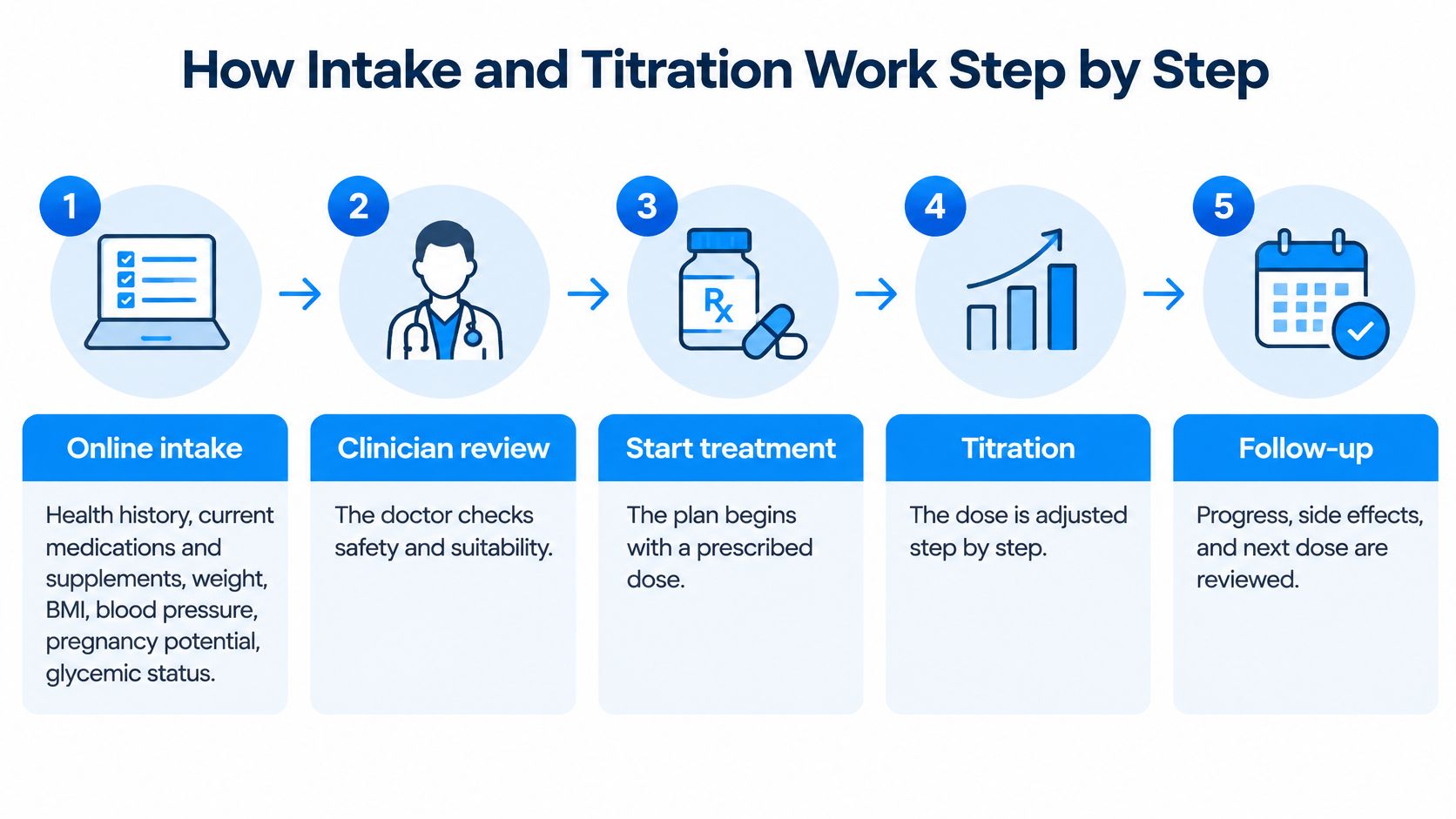
Complete the medical intake.
Vials + Vitals starts with a quick, private online assessment covering health history, symptoms, and treatment goals. An independent, licensed healthcare provider reviews those answers against the patient's chart to determine whether treatment is appropriate.The clinical record should include weight, BMI, blood pressure, medications and supplements, pregnancy potential, glycemic status, and gastrointestinal and gallbladder history. Kidney-function testing may be appropriate when the history or symptoms warrant it.
Resolve missing information before approval.
The clinician reconciles medications, reviews relevant records, and identifies contraindications or reasons for further evaluation. Approval isn't the only appropriate result; requesting laboratory testing or an in-person examination can be the safer decision.Complete the appropriate consultation pathway.
An asynchronous questionnaire may support care where permitted and clinically adequate. A live encounter is necessary when required by the applicable rules or when the clinician needs a more detailed discussion.
Understand the medication before initiation
Semaglutide is a GLP-1 receptor agonist with approximately 94% sequence homology to native human GLP-1, according to the FDA-reviewed prescribing information. Receptor activation supports glucose-dependent insulin secretion, reduces inappropriate glucagon signaling, slows gastric emptying, and influences appetite-regulating pathways.
Tirzepatide activates both GIP and GLP-1 receptors. Its clinical results must be considered separately rather than treated as interchangeable with semaglutide results.
Begin at the prescribed low dose.
Initiation allows assessment of tolerability before greater exposure. Different routes and formulations can have different absorption characteristics, so injectable trial results shouldn't automatically be assigned to compounded sublingual or tablet preparations.Schedule early safety reviews.
The American Diabetes Association's 2026 obesity standards recommend assessing effectiveness, tolerability, and safety at least monthly during the first three months, then at least quarterly; they also summarize evidence that stopping semaglutide or tirzepatide can lead to recurrence of roughly one-half to two-thirds of prior weight loss within one year.Escalate only when clinically appropriate.
The prescriber should confirm manageable adverse effects, adequate hydration and protein intake, and an acceptable medication-interaction profile. Persistent nausea isn't evidence that a higher dose is needed.Investigate a plateau before changing treatment.
Review missed doses, administration technique, food intake, constipation, sleep, and expectations. Medication works alongside nutrition, activity, and behavioral support, not instead of them.Plan maintenance before titration ends.
A metabolic reset isn't a defined endpoint after which obesity care becomes unnecessary. Maintenance requires a sustainable treatment strategy, continued monitoring, and a contingency plan if medication stops.
Prescription treatments and compounded formulations are prescribed strictly at the clinical discretion of licensed U.S. healthcare providers following an individualized telehealth intake and consultation. Trial benchmarks describe study populations, not assured individual outcomes.
Safety Monitoring and Symptoms That Need Urgent Care
| Symptom | Action | Why It Matters |
|---|---|---|
| Severe abdominal pain that persists or radiates to the back | Seek emergency care now. Hold the next dose until a prescriber reviews the symptoms. | Possible pancreatitis |
| Right upper abdominal pain with fever or yellow skin | Obtain same-day medical evaluation. | Possible gallbladder disease |
| Persistent vomiting or inability to keep fluids down | Contact the prescriber the same day. Seek urgent care if dizzy or urinating very little. | Dehydration and kidney strain |
| Swelling of the face, lips, or throat, or trouble breathing | Call emergency services now. | Possible allergic reaction |
| Confusion, shakiness, or fainting with glucose-lowering medication | Obtain emergency care. | Possible hypoglycemia |
| Pregnancy or planned pregnancy | Contact the prescriber before the next dose. | Medication review is required |
Emergency symptoms need a local response, not a routine message to a remote clinician. Do not drive if faint, confused, or having trouble breathing.
The minimum standard for remote care
An adequate program documents:
- Clinical responsibility: A licensed U.S. prescriber reviews the health history and reconciles medications.
- Medication instructions: The product, concentration, dosage form, and administration directions are clear in writing.
- Titration limits: The patient knows when to pause dose increases and contact the clinician.
- Follow-up ownership: The program identifies who reviews symptoms, home measurements, and laboratory results.
- Urgent escalation: Written guidance separates routine questions from symptoms requiring immediate assessment.
The discussion of semaglutide risks and safety should address individual risk, contraindications, formulation, and monitoring rather than label the medication universally safe or unsafe.
Asynchronous care can support clinical oversight when a clinician reviews the questionnaire and provides appropriate follow-up. The key test is whether someone is responsible for responding to symptoms and deciding what happens next.
Medical Economics' discussion of compounded-drug safety cites FDA counts of 990 adverse-event reports associated with compounded semaglutide and more than 730 associated with compounded tirzepatide as of May 31, 2026. These reports do not establish causation or comparative risk; they underscore why symptom review and clear escalation instructions matter.
Pharmacy Fulfillment, Privacy and Treatment Continuity
A vial arrives with a label that does not match the written order. Hold the dose and contact the dispensing pharmacy and prescriber to reconcile the medication, concentration, and instructions before use.
Compounded medications do not undergo FDA premarket review for safety, effectiveness, or quality. The FDA's information on compounded drugs provides context on the distinction between compounded medications and FDA-approved products. Check that the product received matches the prescription, and ask the prescriber or pharmacist to explain any difference in formulation or concentration.
Check fulfillment and privacy
Vials + Vitals prescriptions are dispensed by licensed U.S. pharmacies. Keep the pharmacy's contact information and compare the delivered label with the clinician's written instructions before administration.

Temperature-sensitive medication needs appropriate insulated transit. The guide to cold-chain shipping explains delivery considerations. Ask the dispensing pharmacist how to handle a warm, delayed, damaged, or questionable shipment before using it. Cooling a package after delivery may not restore product integrity.
Discreet delivery is available when treatment is prescribed. Review the service's privacy practices and notice of privacy practices, and do not enter identifying medical details on Vials + Vitals marketing pages.
Require a written interruption plan
A delayed dose and a prolonged interruption call for different decisions. Restarting depends on the medication, time off treatment, previous tolerability, and current health status.
- After an interruption: Contact the prescriber rather than resuming the previous dose on your own.
- After a pharmacy change: Confirm the formulation, concentration, supplies, and administration instructions before use.
- After relocation or insurance changes: Confirm clinician authorization, coverage, and a workable refill pathway.
- Before transferring care: Obtain the treatment history, last administered dose, adverse-effect record, and relevant laboratory results.
Continuity test: Ask what happens if the usual formulation or pharmacy is unavailable. A program should explain its interruption plan rather than promise uninterrupted access.
An alternative medication, another therapy, or supervised discontinuation may be appropriate. The prescriber should make that decision; a shipping substitution is not a clinical plan.
Telehealth Fit and Your Next Step
| Factor | Telehealth | In-Person Clinic |
|---|---|---|
| Initial evaluation | Online intake plus provider review; live visit required in some states | Face-to-face history and examination |
| Monitoring | Scheduled check-ins and uploaded weight and blood pressure | Scheduled clinic visits with measured vital signs |
| Labs | Local laboratory testing; prescribing may wait for results | Testing on site or at a nearby laboratory |
| Medication access | Licensed-pharmacy shipping, with cold-chain transit when needed | Local or retail pharmacy fulfillment |
| Physical examination | Limited remote assessment and home measurements | Hands-on examination and clinic measurements |
| Urgent escalation | Patient must reach local urgent or emergency care | Same-visit assessment may be available; emergencies still require escalation |
| Continuity | Relies on licensure, pharmacy access, and written handoffs | Relies on a local clinical relationship and accessible records |
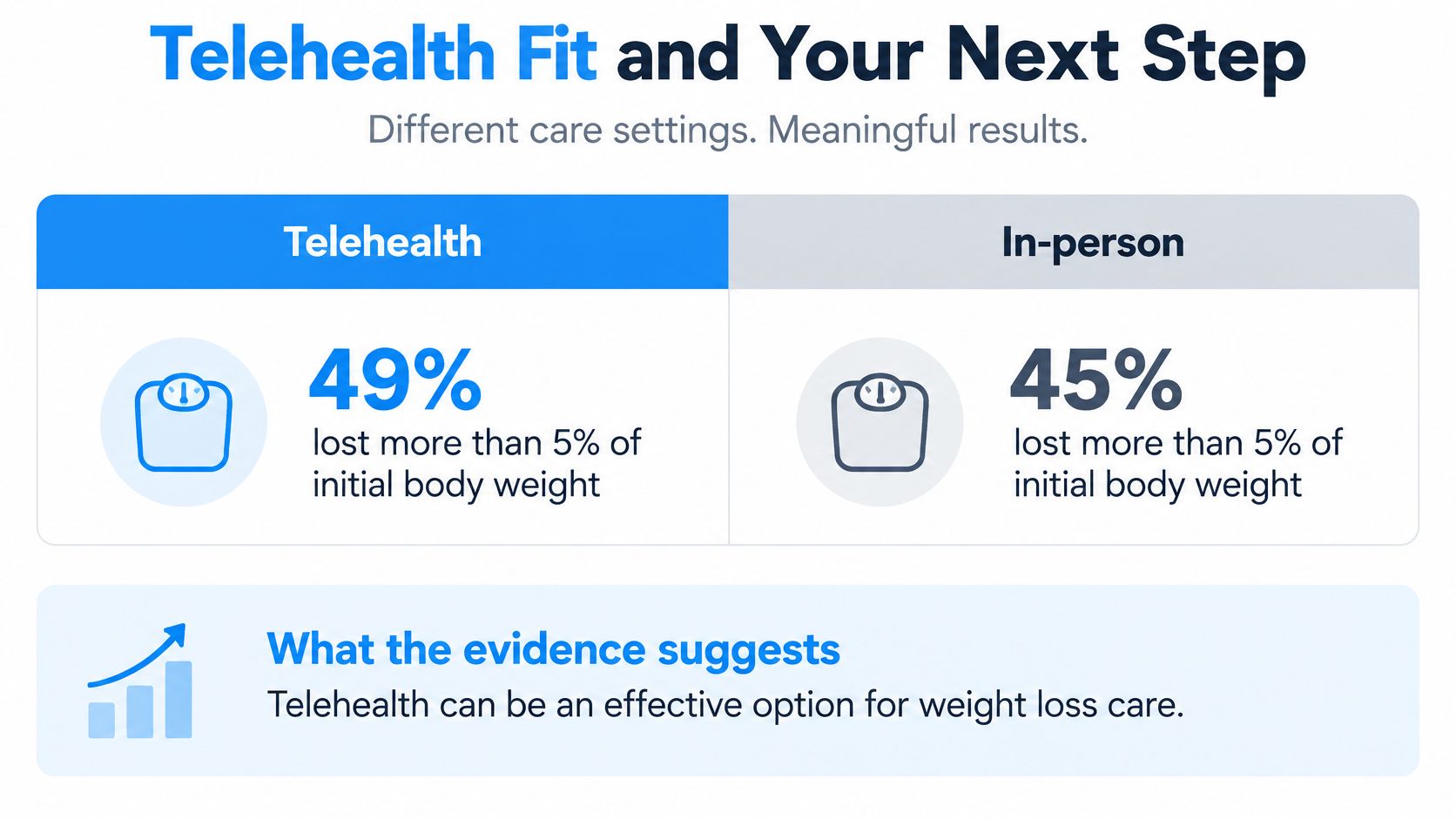
A peer-reviewed comparison of obesity-care delivery reported that 49% of telehealth patients lost more than 5% of initial body weight, compared with 45% of in-person patients. Results from these studied populations give a range to expect, not a guarantee for any individual or a measure of every online program. The comparison also does not establish that a prescription alone provides the monitoring, follow-up, and maintenance planning needed for long-term care.
Match the setting to clinical needs
Telehealth tends to fit adults with stable health, reliable pharmacy access, reachable laboratory services, and no immediate need for hands-on examination. Rural patients also need a realistic route to local urgent care.
A complex diabetes regimen, previous pancreatitis or gallbladder disease, unresolved pregnancy risk, an eating-disorder history, or symptoms requiring examination favor an in-person or coordinated hybrid assessment.
Other therapies require separate evaluations, not automatic additions to a weight-loss protocol:
- Hair retention: Finasteride and dutasteride inhibit conversion of testosterone to DHT; minoxidil acts through a different follicular-growth pathway, as described in a clinical review of androgenetic alopecia.
- Sexual wellness: Sildenafil and tadalafil inhibit PDE5, preserving signaling that supports vascular smooth-muscle relaxation during sexual stimulation; the American Urological Association guideline emphasizes individualized selection and interaction screening.
- Menopausal hormone care: Bio-identical doesn't mean risk-free. The North American Menopause Society position statement distinguishes local vaginal estrogen for genitourinary symptoms from systemic treatment for broader symptoms.
- Longevity and cellular optimization: NAD+, sermorelin, glutathione, and MIC + B12 injections aren't substitutes for established obesity care. Biochemical roles or growth-hormone secretagogue activity alone don't establish meaningful clinical benefit.
Vials + Vitals begins with a private online assessment reviewed by an independent licensed clinician, who determines whether treatment is appropriate and may decline a request. Tirzepatide costs from $299 per month for a 1-month supply. Choose a service that can explain how clinical follow-up and maintenance planning will work after treatment begins.
Informational purposes only. Compounded medications are evaluated by a licensed provider for individual suitability and are fulfilled by state-licensed partner compounding pharmacies.
Vials + Vitals offers physician-directed telehealth evaluation for weight management, with licensed-provider review and pharmacy fulfillment when treatment is appropriate. Visit Vials + Vitals to begin a private assessment and discuss eligibility, monitoring, and a treatment plan that accounts for maintenance and continuity.