Best Weight Loss Injections Compared for 2026
See how the best weight loss injections compare on trial weight loss, side effects, persistence, and a safe prescribing visit.

The most popular advice about the best weight loss injections is incomplete: choose the medication with the largest trial percentage. That approach overlooks whether a patient can reach the studied dose, tolerate treatment, afford continued access, and maintain progress if injections stop.
A more useful clinical definition of best combines efficacy with sustained treatment exposure. Tirzepatide and semaglutide have substantial evidence behind them, but a population average can't determine an individual prescription. The stronger choice is the medically appropriate regimen a patient can realistically continue, with a clear monitoring and maintenance plan.
Best Weight Loss Injections Compared by Goal
There isn't a single winner for every patient. Semaglutide provides an established weekly GLP-1 benchmark, while tirzepatide offers dual-receptor activity and higher average weight reduction in a direct comparison. Daily liraglutide remains an alternative for patients whose circumstances favor a daily regimen, though daily dosing shouldn't be assumed to improve tolerability.
Quick comparison of leading weight-loss injections
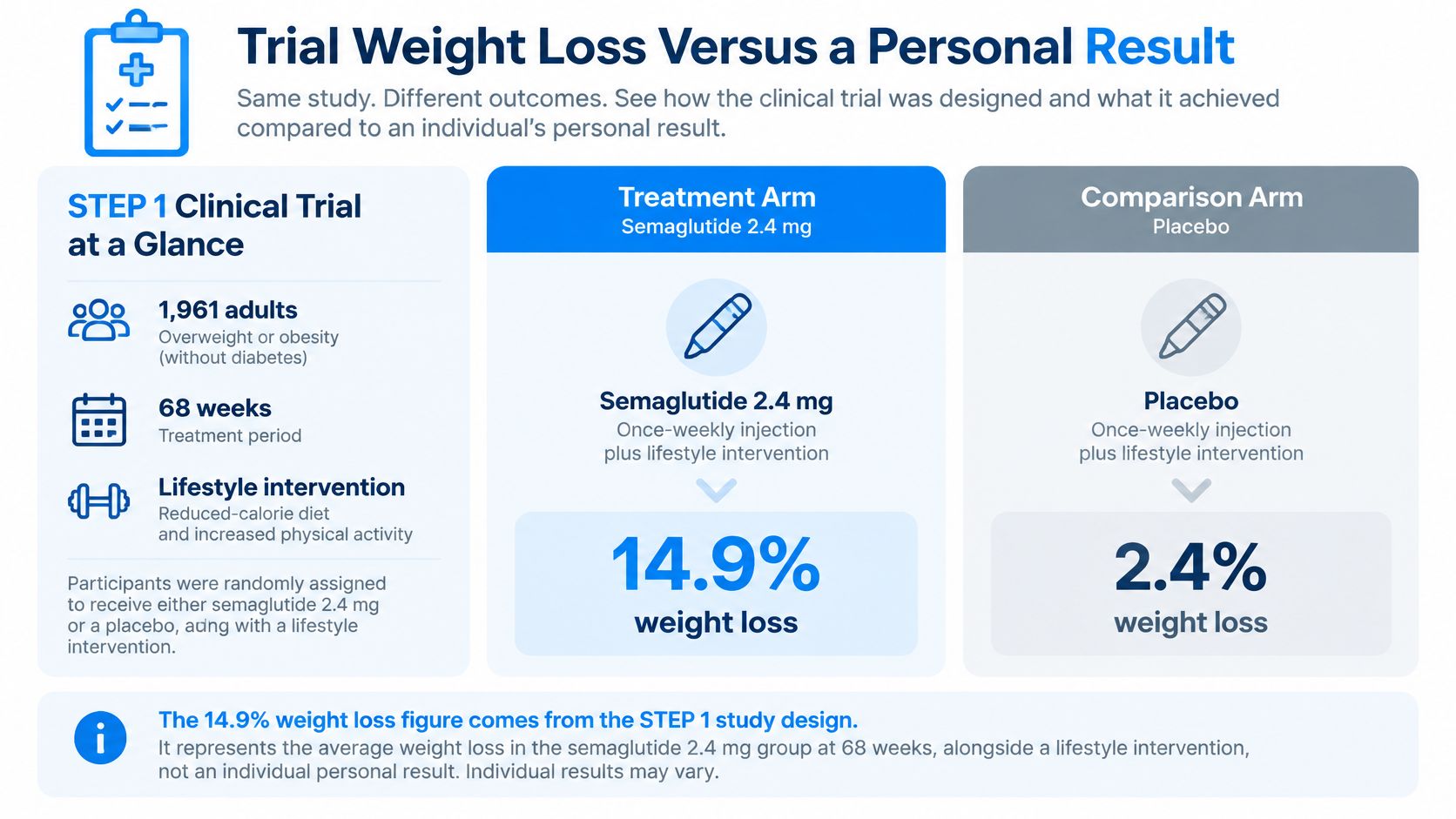
The semaglutide benchmark below comes from the STEP 1 randomized trial, which reported 14.9% mean loss at 68 weeks, compared with 2.4% with placebo, alongside lifestyle intervention. The tirzepatide benchmarks come from the SURMOUNT-1 efficacy analysis, which reported approximately 16.0%, 21.4%, and 22.5% mean loss at 72 weeks across the studied doses, versus 2.4% with placebo.
| Option | Mechanism | Schedule | Landmark mean loss | Practical fit |
|---|---|---|---|---|
| Semaglutide 2.4 mg | GLP-1 receptor agonist | Once weekly after titration | 14.9% at 68 weeks in STEP 1 | Benchmark weekly GLP-1 when gastrointestinal effects are manageable |
| Tirzepatide 5 mg | Dual GIP and GLP-1 agonist | Once weekly after titration | About 16.0% at 72 weeks in SURMOUNT-1 | Lower studied maintenance dose for dual-incretin treatment |
| Tirzepatide 10 mg | Dual GIP and GLP-1 agonist | Once weekly after titration | About 21.4% at 72 weeks in SURMOUNT-1 | Intermediate maintenance option if titration is tolerated |
| Tirzepatide 15 mg | Dual GIP and GLP-1 agonist | Once weekly after titration | About 22.5% in SURMOUNT-1; 20.2% in a maximum-dose head-to-head trial | Higher-efficacy option when indicated and tolerated |
| Liraglutide 3 mg | GLP-1 receptor agonist | Once daily | Not benchmarked in this comparison | Daily GLP-1 when a weekly injection is a poor fit |
No average is an individual forecast. These rows describe study regimens, not starting instructions, and the lower tirzepatide maintenance option isn't its initiation dose.
Match the formulation to the treatment plan
Branded Wegovy and Zepbound should be distinguished from compounded vials. Branded products have product-specific labeling and delivery instructions; compounded formulations require separate attention to the dispensing pharmacy, concentration, syringe measurement, storage, and patient-specific prescription. A compounded preparation shouldn't inherit a branded product's trial results as proof of equivalent performance.
Every prescription, including a compounded formulation, follows individualized telehealth intake and consultation and remains strictly at the clinical discretion of a licensed U.S. healthcare provider. The medication name alone doesn't establish eligibility or an appropriate dose ceiling.
The practical comparison should include gastrointestinal tolerance, the highest appropriate tolerated dose, monthly affordability, and whether treatment is expected to continue beyond a year. A weight-loss injection pricing review can help organize cost questions, but current access and total expenses need confirmation before treatment begins.
How GLP-1 and GIP Injections Regulate Appetite
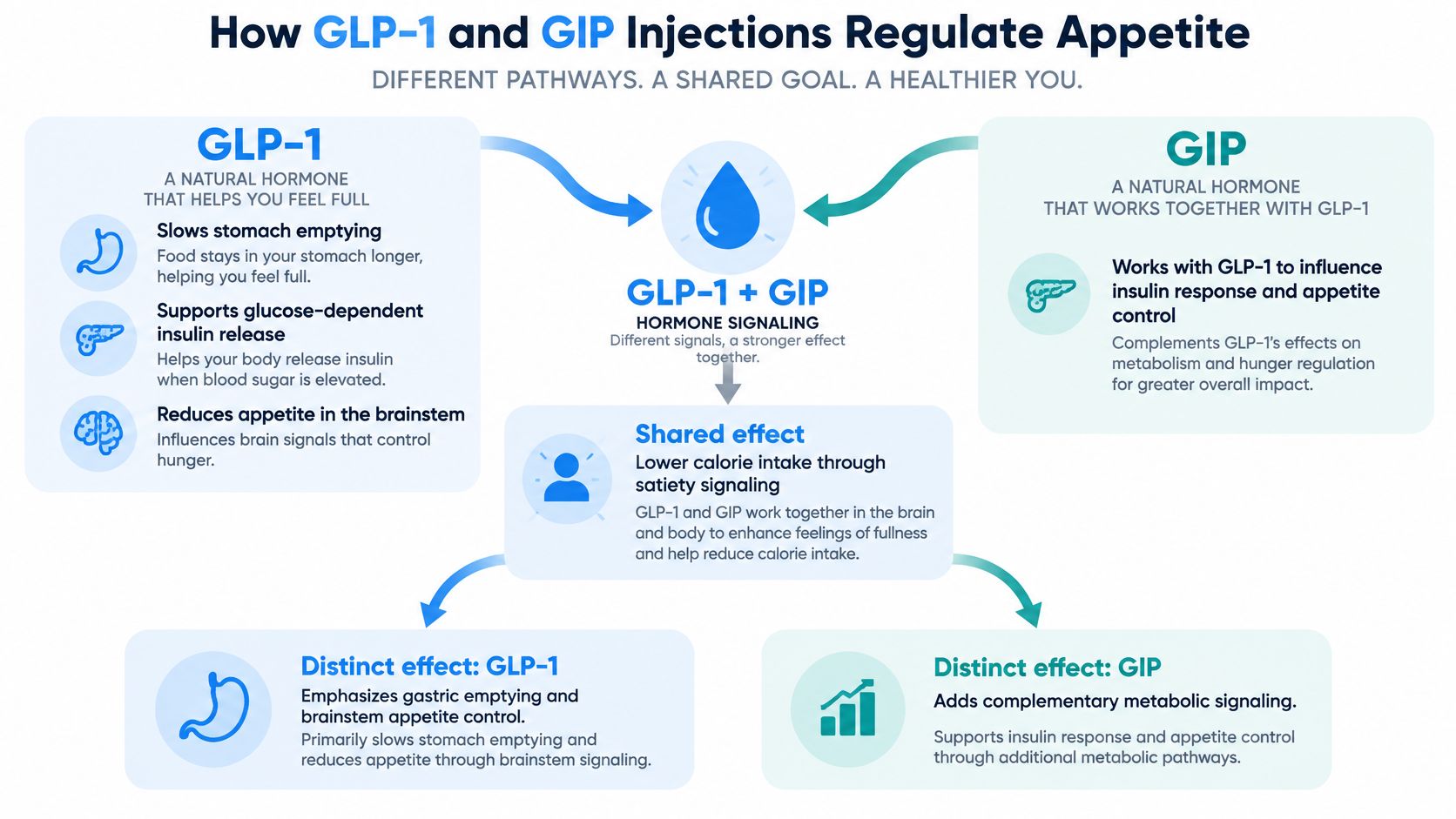
GLP-1 receptor agonists act on hormone receptors involved in appetite and glucose regulation. Their effects include slowing gastric emptying, supporting glucose-dependent insulin release, and influencing appetite signaling in the brainstem and hypothalamus. Patients may experience less hunger or earlier fullness, but the intensity of those sensations isn't a dosing target.
Semaglutide is a long-acting GLP-1 analogue. Tirzepatide activates both GLP-1 and glucose-dependent insulinotropic polypeptide, or GIP, receptors. GIP activity complements insulin signaling and energy regulation, although the clinical effect can't be reduced to doubling appetite suppression.
Receptor activity doesn't determine the right dose
The FDA prescribing information for tirzepatide describes a 72-week weight-management program with reduced-calorie eating and increased physical activity in adults with BMI at least 30 kg/m², or 27 to under 30 kg/m² with a weight-related condition. In the larger trial without diabetes, the label reports 18% average weight loss with 15 mg and at least 5% loss in 85.1%, 88.9%, and 90.9% at 5, 10, and 15 mg, respectively, versus 34.5% with placebo.
That population-level dose response doesn't establish that every patient should advance to the highest dose. A prescriber must balance response with symptoms, medical conditions, and the product's dosing requirements.
Weekly administration reflects the medications' long-acting pharmacokinetics, meaning their absorption and elimination support prolonged exposure. Titration serves a different purpose: gradual escalation helps clinicians assess tolerance before increasing treatment intensity.
Practical counseling should address:
- Missed doses: The patient needs product-specific instructions rather than doubling or improvising a replacement injection.
- Injection technique: Site rotation, syringe selection, and concentration verification belong in the dispensing instructions.
- Temperature handling: Temperature-sensitive vials require appropriate cold-chain transit and pharmacy-specific storage guidance.
- Nutrition and activity: Appetite suppression should support an adequate eating pattern and feasible activity, not replace them.
These drugs are ongoing medical-management tools, not a one-time metabolic reset. Any compounded formulation requires provider determination of individual suitability and pharmacy-specific oversight.
Trial Weight Loss Versus a Personal Result
A trial average is a population benchmark, not an individual forecast. Response thresholds add context: the share of participants reaching a meaningful weight-loss level can differ from the mean, and very large losses are less common.
Read averages alongside response thresholds
The STEP 1 and SURMOUNT-1 trials assessed weight change during sustained treatment alongside lifestyle support. The head-to-head trial compared semaglutide with tirzepatide directly, making its results more informative for comparing those options than results from separate studies.
Trial response figures by option and study
Each study row links to its report. “Not reported here” means the linked source does not provide that threshold.
| Study and option | Mean loss | At least 5% loss | At least 25% loss |
|---|---|---|---|
| STEP 1 semaglutide 2.4 mg, 68 weeks (trial report) | 14.9% (placebo 2.4%) | 86.4% (placebo 31.5%) | Not reported here |
| SURMOUNT-1 tirzepatide 5 mg, 72 weeks (trial report) | 16.0% (placebo 2.4%) | 89% (placebo 28%) | Not reported here |
| SURMOUNT-1 tirzepatide 10 mg, 72 weeks (trial report) | 21.4% (placebo 2.4%) | 96% (placebo 28%) | Not reported here |
| SURMOUNT-1 tirzepatide 15 mg, 72 weeks (trial report) | 22.5% (placebo 2.4%) | 96% (placebo 28%) | Not reported here |
| Phase 3b semaglutide 2.4 mg, 72 weeks, head-to-head (Weill Cornell Medicine account of the trial) | 13.7% | Not reported here | 16% |
| Phase 3b tirzepatide 15 mg, 72 weeks, head-to-head (Weill Cornell Medicine account of the trial) | 20.2% | Not reported here | 32% |
The threshold figures show why averages alone can obscure the range of responses. In the head-to-head study, the proportions reaching at least 25% loss differed between treatment groups, while the mean captures a different summary of the same trial.
Translate the trial into a monitoring question
A personal result depends on whether treatment can be started, titrated, tolerated, and continued. Trial percentages describe outcomes under study conditions; they do not predict an individual's response or establish that a particular dose is appropriate.
Clinicians can track percentage body-weight change after titration, with waist circumference and symptoms providing additional context. Appetite reduction alone does not establish adequate benefit, and limited appetite change does not by itself establish treatment failure.
The practical comparison is therefore not only which option reached the higher trial threshold. It is which prescribed treatment a patient can access and tolerate over time, with a clinician-guided plan for ongoing use and eventual discontinuation.
Side Effects Titration and Safety Screens
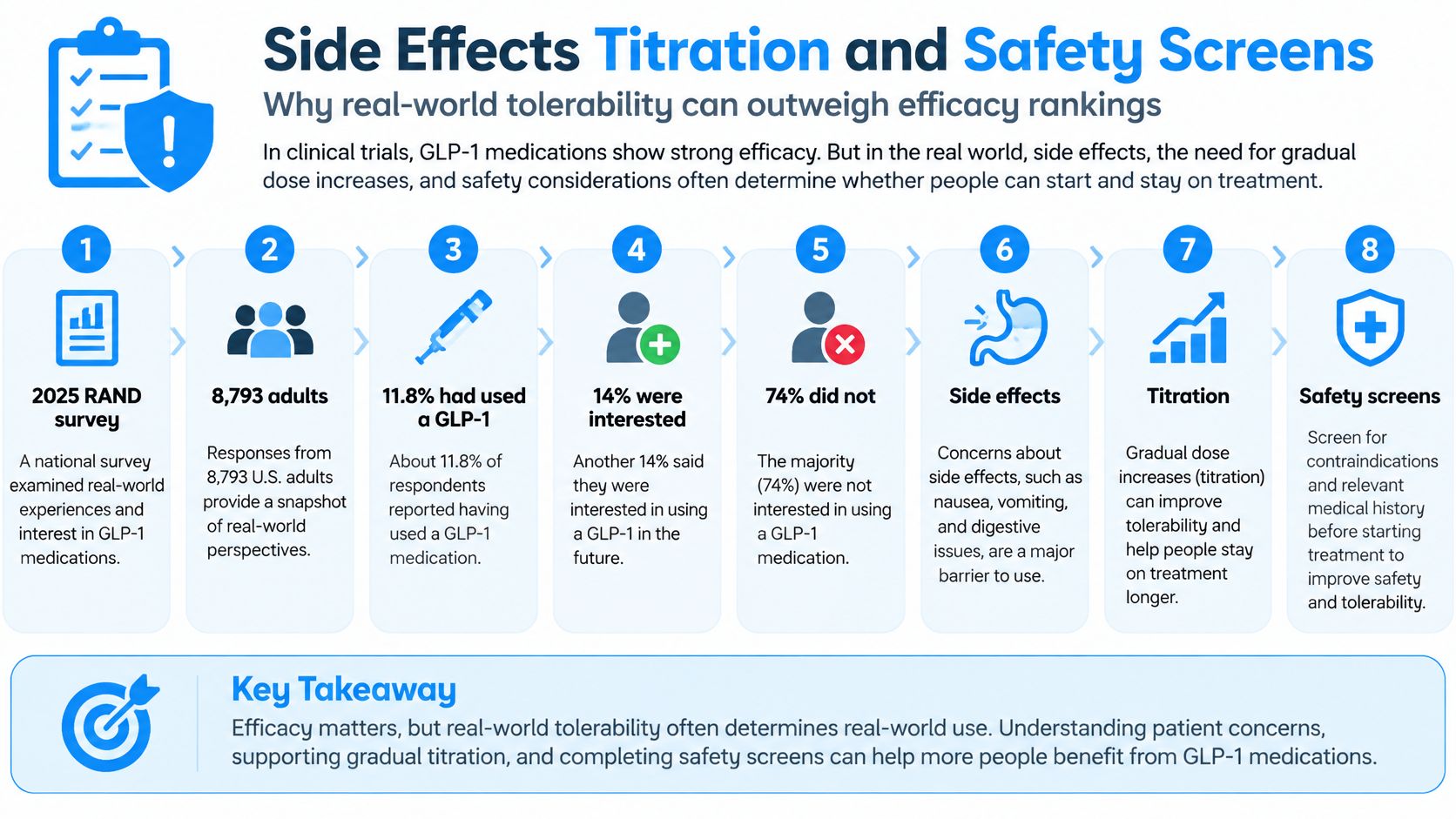
Tolerability can determine whether a medication's efficacy becomes clinically useful. In a nationally representative RAND survey of 8,793 adults conducted in April–May 2025, 11.8% had used a GLP-1 medication, 14% were interested, and 74% didn't plan to take one; among users, approximately half reported nausea and one-third reported diarrhea. Those self-reported experiences describe real-world burden, not comparative adverse-event rates for individual drugs.
Nausea, fullness, constipation, diarrhea, and vomiting warrant active follow-up, particularly around dose increases. Injection-site irritation also belongs in the symptom review, including for patients using vials.
Establish safety before escalation
A clinician needs a complete history rather than a checklist limited to current weight. Relevant intake screens include:
- Thyroid cancer history: Personal or family history of medullary thyroid carcinoma or multiple endocrine neoplasia syndrome type 2 requires specific review.
- Pancreatic and gastrointestinal history: Prior pancreatitis, severe gastrointestinal disease, and gallbladder disease can change the assessment.
- Pregnancy considerations: Current pregnancy, pregnancy plans, and contraception belong in medication selection.
- Glucose-lowering treatment: Insulin and other glucose-lowering medications may require additional hypoglycemia precautions.
These findings don't all carry identical implications. Some represent contraindications, while others call for caution, additional evaluation, or another treatment choice.
Baseline review should document weight, waist circumference, blood pressure, current medications, and clinically relevant laboratory testing. Check-ins during each titration step should assess food and fluid intake, bowel symptoms, missed doses, and whether escalation remains appropriate.
Respond to symptoms rather than pushing through
Smaller meals, hydration, and slower clinician-directed escalation may help manage gastrointestinal burden. A prescriber may also hold treatment or reconsider the regimen. Patients shouldn't independently alter doses or assume persistent vomiting is an acceptable price for weight loss.
Severe abdominal pain or vomiting that prevents fluid intake requires prompt medical assessment. Concerning changes in glucose, heart rate, or mood also deserve review rather than automatic attribution to the injection.
A practical weight-loss injection side-effect guide can support symptom recognition, but urgent symptoms need clinical care. Before the next visit, the patient should record missed doses, the symptom limiting escalation, and any reason for considering discontinuation, including cost or difficulty obtaining medication.
Weight Change After Injections Stop
Stopping treatment changes the conditions under which weight loss occurred. Pharmacologic appetite regulation is removed, so hunger and weight may increase even when a patient continues making substantial efforts with food choices and activity.
The STEP 1 extension examining semaglutide withdrawal supports discussing maintenance before treatment begins. Continued follow-up matters because initial weight reduction doesn't establish that the same result will persist without medication.
Trial withdrawal and real-world stopping aren't equivalent
A Cleveland Clinic analysis of 7,938 adults who stopped injectable semaglutide or tirzepatide found that patients treated for obesity had lost an average of 8.4% before stopping and regained 0.5% on average one year later, yet 55% gained weight and 45% maintained or continued losing. The same report contrasts those observations with earlier randomized evidence showing regain of more than half of lost weight within 12 months after withdrawal.
The small real-world average doesn't establish that stopping is usually consequence-free. Opposing individual trajectories can produce a reassuring-looking mean while leaving many patients with clinically important regain.
Real-world patients may restart medication, switch therapies, receive different lifestyle support, or stop after different treatment durations. Reasons for stopping also differ, including adverse effects, affordability, supply problems, and reaching a treatment goal. These factors make observational discontinuation different from a controlled withdrawal experiment.
Maintenance planning: A stopping outcome reflects what happens after the prescription ends, including any replacement treatment, not simply whether an injection was discontinued.
Monitor the trajectory after a pause
A clinician may recommend recording weekly weight trends, waist measurements, appetite changes, dietary protein intake, and activity. Patients with diabetes or hypertension may also need glucose or blood-pressure monitoring adjusted for their other treatments.
The decision to restart, switch between a GLP-1 and a dual agonist, or continue without medication should consider the direction of change and the original reason for stopping. A patient who stopped because of persistent gastrointestinal symptoms requires a different reassessment from someone whose medication became temporarily unavailable.
Stopping, tapering, and restarting are licensed-provider decisions. A previous prescription doesn't establish that the same dose is appropriate after an interruption.
Before starting, the useful planning question is concrete: if supply or tolerance fails during treatment, what maintenance path remains available? The answer should include follow-up access, nonmedication support, and criteria for reconsidering pharmacotherapy.
Who Can Realistically Stay on Treatment
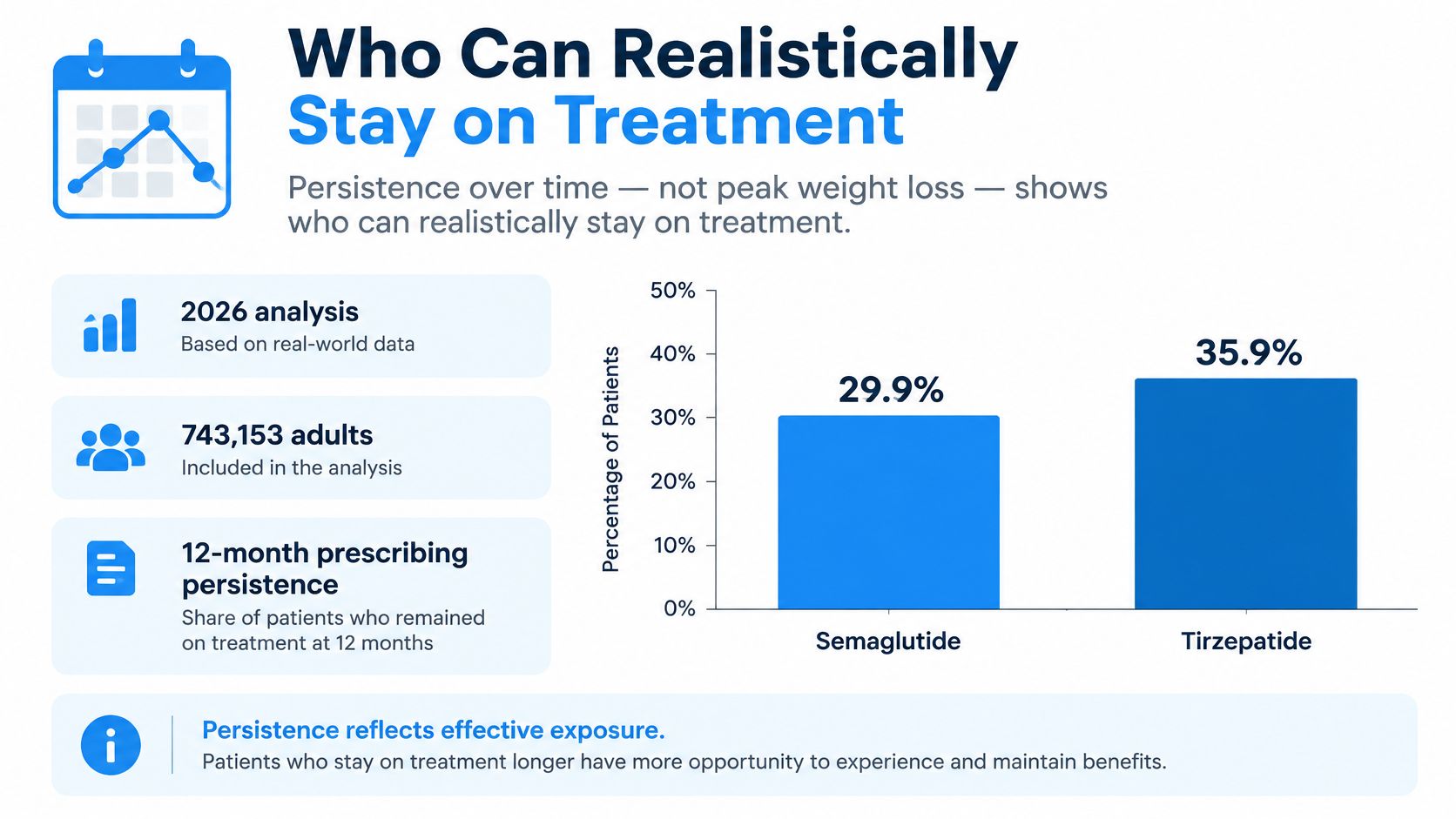
Persistence decides whether a large trial percentage ever becomes a personal result. A 2026 real-world analysis of 743,153 adults found 12-month prescribing persistence of 29.9% for semaglutide and 35.9% for tirzepatide, and, summarizing a separate review, reported a median 43.5% first-year discontinuation among semaglutide users; the maintenance-dose measures appear below.
Twelve-month prescribing and maintenance measures in the 743,153-adult analysis
| Medication | 12-month prescribing persistence | Reached labeled maintenance dose | Persistent at maintenance with a documented weight |
|---|---|---|---|
| Semaglutide | 29.9% | 28.3% | 8.8% |
| Tirzepatide | 35.9% | 55.0% | 16.4% |
The figures track prescribing and documentation. They cannot confirm that every patient took every prescribed dose, and because the final column also requires a documented weight, it reads lower than a pure continuation rate.
Three situations that change the choice
Strong early loss with repeated interruptions. A patient may initially lose weight but miss injections whenever nausea interferes with work or meals. The relevant question becomes whether a tolerable, consistent regimen is possible; reaching the advertised dose is a secondary target.
A plateau at an intermediate dose. Stable weight doesn't automatically mean treatment has stopped providing value. If waist measurements or glucose control are improving and adverse effects limit escalation, the clinician may consider continued treatment appropriate rather than automatically increasing the dose.
A regimen that exceeds the monthly budget. The prescriber and patient should consider whether an appropriate lower tolerated dose, a switch, or another formulation is sustainable. A needle-free tablet can be discussed at intake, although its eligibility, dose ceiling, and formulation-specific evidence require confirmation; injectable trial results don't establish tablet equivalence.
A high rank in a clinical trial does not equal durable treatment success. Effective exposure is the medication a patient actually receives and can continue.
Define success beyond the peak dose
A realistic continuation assessment considers expected titration time, gastrointestinal burden, monthly affordability, follow-up access, missed-dose instructions, and a reason to continue after the first plateau. Each factor belongs in the prescribing decision from the start.
Monthly cost is an input to that decision; it does not rank one medication above another. Price comparisons should use current published pricing and clarify the supply, formulation, and services included.
A useful early review documents dose reached, percentage weight change, adverse effects, and whether the regimen can continue. It should separate inadequate efficacy from inadequate exposure, because the two problems call for different responses.
Prepare for a Licensed Prescribing Review
Arriving with a preferred drug name gives the prescriber little to work with. A measurable goal, a complete medication history, and a clear account of the barrier most likely to interrupt treatment give the review something concrete to decide.
Five preparation steps
Define a medical goal. A target can be expressed as percentage body-weight change, waist change, glucose control, or blood-pressure improvement, which gives the clinician a measurable endpoint to judge. A guide to planning a substantial weight-loss goal can help frame the discussion. The clinician determines whether the proposed target and timeline are appropriate.
Prepare the safety history. Current prescriptions, nonprescription products, allergies, pregnancy plans, prior pancreatitis, gallbladder disease, and thyroid history all belong in the intake. A personal or family history of medullary thyroid carcinoma or MEN2 should be stated explicitly, since it changes the risk calculation for this drug class.
Name the limiting factor. Needle aversion, nausea, frequent travel, or a previous plateau can change which regimen is practical to stay on. A specific barrier gives the prescriber something actionable to assess, where a general preference does not.
Clarify the proposed regimen. The consultation should establish which agent and dose ceiling fit the patient's circumstances, how titration will be supervised, and when follow-up occurs. If injection burden is the stated barrier, asking whether a non-injectable formulation is appropriate belongs on the question list.
Record the baseline. A starting weight, waist measurement, relevant laboratory results, and current blood pressure give the prescriber a reference point. Without it, the first follow-up has nothing to compare against, and response becomes harder to distinguish from exposure alone.
Confirm access without assuming approval
Vials + Vitals lists semaglutide from $199 per month for a one-month supply and tirzepatide from $299 per month for a one-month supply. A starting figure says nothing about eligibility, formulation, or the titration schedule a clinician may set. Discreet delivery applies only when a treatment is prescribed.
No prescription or specific outcome is promised. Prescription treatments, including any compounded formulations, are prescribed strictly at the clinical discretion of licensed U.S. healthcare providers following individualized telehealth intake and consultation. A licensed provider assesses compounded formulations for individual suitability before they are dispensed and shipped by a licensed U.S. pharmacy.
Vials + Vitals offers physician-directed telehealth assessment for weight-management options, with licensed providers determining eligibility, formulation, and individualized titration. Adults comparing the best weight loss injections can visit Vials + Vitals to complete an intake and discuss a regimen matched to their medical history, tolerability, budget, and maintenance needs.