How to Lose 30 Pounds Safely: A Medically Supervised Plan
A clinician-guided plan to lose 30 pounds safely, covering realistic timelines, calorie planning, muscle protection, medication options and red flags.

Losing 30 pounds over 15 to 30 weeks is the theoretical pace for a loss of 1 to 2 pounds weekly. For an adult starting at 200 pounds, that target equals 15 percent of their starting weight. The timeline is arithmetic, not a deadline; an appropriate pace depends on the individual.
Willpower alone may not be enough to sustain weight loss. In Pew Research Center's 2024 findings, 65% of U.S. adults said willpower alone wasn't enough for people trying to lose weight and keep it off. A useful plan also accounts for appetite, health conditions, medication effects, nutrition, and ongoing care.
Set a suitable target, protect strength, and plan for maintenance before reaching the goal. These steps help keep the focus on lasting progress, not just the number on the scale.
Realistic Timelines for Losing 30 Pounds
A 30-pound goal can represent 10% to 15% of a person's starting weight, depending on that starting point. The time needed also depends on the pace: dividing 30 pounds by weekly loss gives a useful estimate, not a deadline. The National Institutes of Health guidelines describe a pace of 1 to 2 pounds weekly, generally associated with an approximate daily calorie deficit of 500 to 1,000 calories.
Weekly pace and time to lose 30 pounds
| Pace | Weekly loss | Approximate daily calorie deficit | Weeks to lose 30 pounds |
|---|---|---|---|
| Slower pace | 0.5 lb per week | About 250 calories | About 60 weeks |
| Standard pace | 1 lb per week | About 500 calories | About 30 weeks |
| Faster pace | 1.5 lb per week | About 750 calories | About 20 weeks |
| Upper guideline pace | 2 lb per week | About 1,000 calories | About 15 weeks |
These are theoretical timelines, based on steady weekly loss. Actual progress can vary with adherence, metabolism, medications, medical conditions, and changes in body composition. A fixed calorie deficit does not produce the same scale change indefinitely.
The weekly average also does not set a requirement for every weigh-in. Water retention, bowel contents, and changes in eating patterns can temporarily obscure fat loss. A flat reading, by itself, does not show that treatment has stopped working.
What the target means at different starting weights
The percentage of starting weight gives more context than pounds alone. Divide the intended loss by starting weight, then multiply by 100:
| Starting weight | Calculation | Percentage represented by a 30-pound loss |
|---|---|---|
| 200 pounds | 30 ÷ 200 × 100 | 15% |
| 250 pounds | 30 ÷ 250 × 100 | 12% |
| 300 pounds | 30 ÷ 300 × 100 | 10% |
The CDC identifies a 5% to 10% reduction as a level associated with improved health and well-being, equivalent to 10 to 20 pounds for a 200-pound adult, according to its guidance on healthy weight loss. That range can help put a larger target into perspective: progress toward 30 pounds may matter before the full amount is reached.
The National Institutes of Health guidelines describe an initial checkpoint of approximately 10% of baseline weight over about 6 months, followed by reassessment. For the same illustrative adult weighing 200 pounds, that checkpoint would be 20 pounds. It is a point to review progress and needs, not an automatic instruction to keep dieting.
Clinical perspective: A smaller, maintainable loss with better function can be more useful than reaching a larger target through excessive restriction.
Before setting a target, a clinician should review starting BMI, medical history, current medications, and whether intentional weight loss is appropriate. Thirty pounds is an individual goal, not a universal medical benchmark.
How to Build a Calorie Deficit You Can Sustain
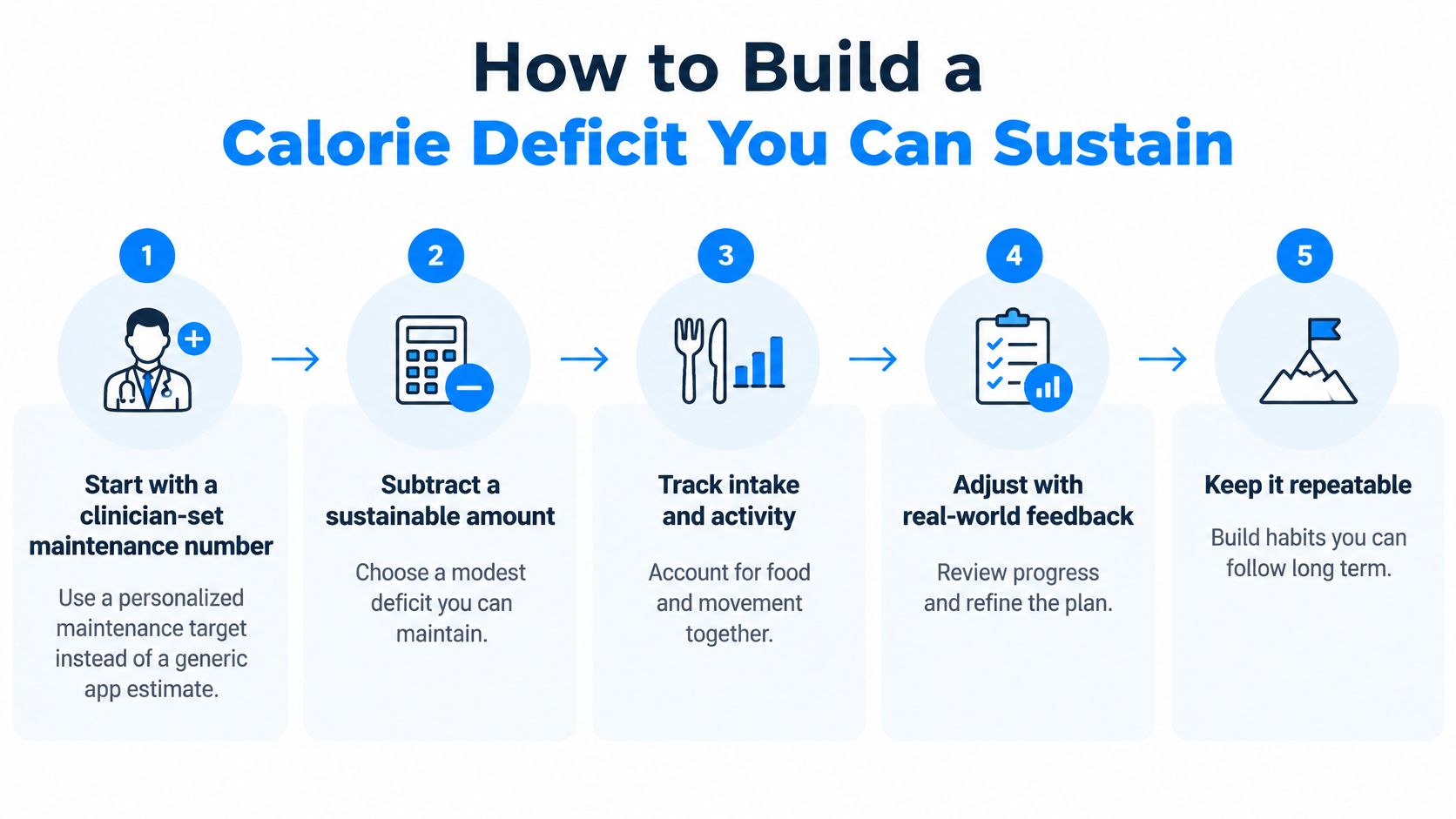
A calorie deficit combines the amount you eat with the energy you use through activity. Start with a clinician-reviewed estimate of your maintenance needs, then adjust it to fit your health, routine, and nutritional needs. A generic app target may not reflect those factors.
The goal is a manageable change that supports daily life. If the plan repeatedly leaves you exhausted or leads to compensatory eating, review the size and structure of the deficit with your clinician.
A practical intake and activity sequence
Establish maintenance needs. A clinician can estimate them using a validated equation, weight history, activity, and medical conditions. The metabolic calorie calculator can help organize an initial estimate, but follow-up helps determine how well it fits real-world needs.
Choose a sustainable reduction. Your clinician should help set a deficit and minimum intake that allow adequate nutrition. Smaller portions, fewer calorie-containing drinks, and regular walking can contribute without relying on skipped meals.
Plan protein intake. Daily needs depend on body size, health status, and kidney function. Distributing protein across meals can help maintain a consistent routine. Reduced appetite during prescription treatment does not remove the need to meet nutritional needs.
Make meals repeatable and track intake. Vegetables, fiber-rich foods, lean protein, and whole grains offer a practical foundation. Keep a food log for two weeks, including cooking oils, drinks, snacks, and portion sizes. Small omissions can make it harder to understand whether the intended deficit matches what you are eating.
Measure consistently. If daily weighing is appropriate for you, weigh in the morning after using the bathroom and before eating. Choose less frequent weighing if tracking increases distress.
Review the trend before adjusting. NIDDK's diabetes prevention guidance supports structured food and activity habits, consistent weight monitoring, and reviewing a stalled 2-to-4-week trend. If your clinician recommends an adjustment, reducing an evening snack by about 100 to 150 calories or adding manageable activity could be tested, then reviewed after two weeks.
Recognizing an excessive deficit
Persistent fatigue, dizziness, intense rebound hunger, or difficulty with normal activities can signal that the deficit is too large or needs clinical review. A clinician can assess intake, hydration, medication effects, and other possible explanations.
A workable deficit leaves enough nutritional and physical capacity for ordinary life. If you feel progressively worse, seek reassessment rather than pushing through.
The routine should remain feasible during work, travel, and family responsibilities. Tracking is useful when it helps you make adjustments you can maintain.
Protecting Muscle and Strength During Weight Loss
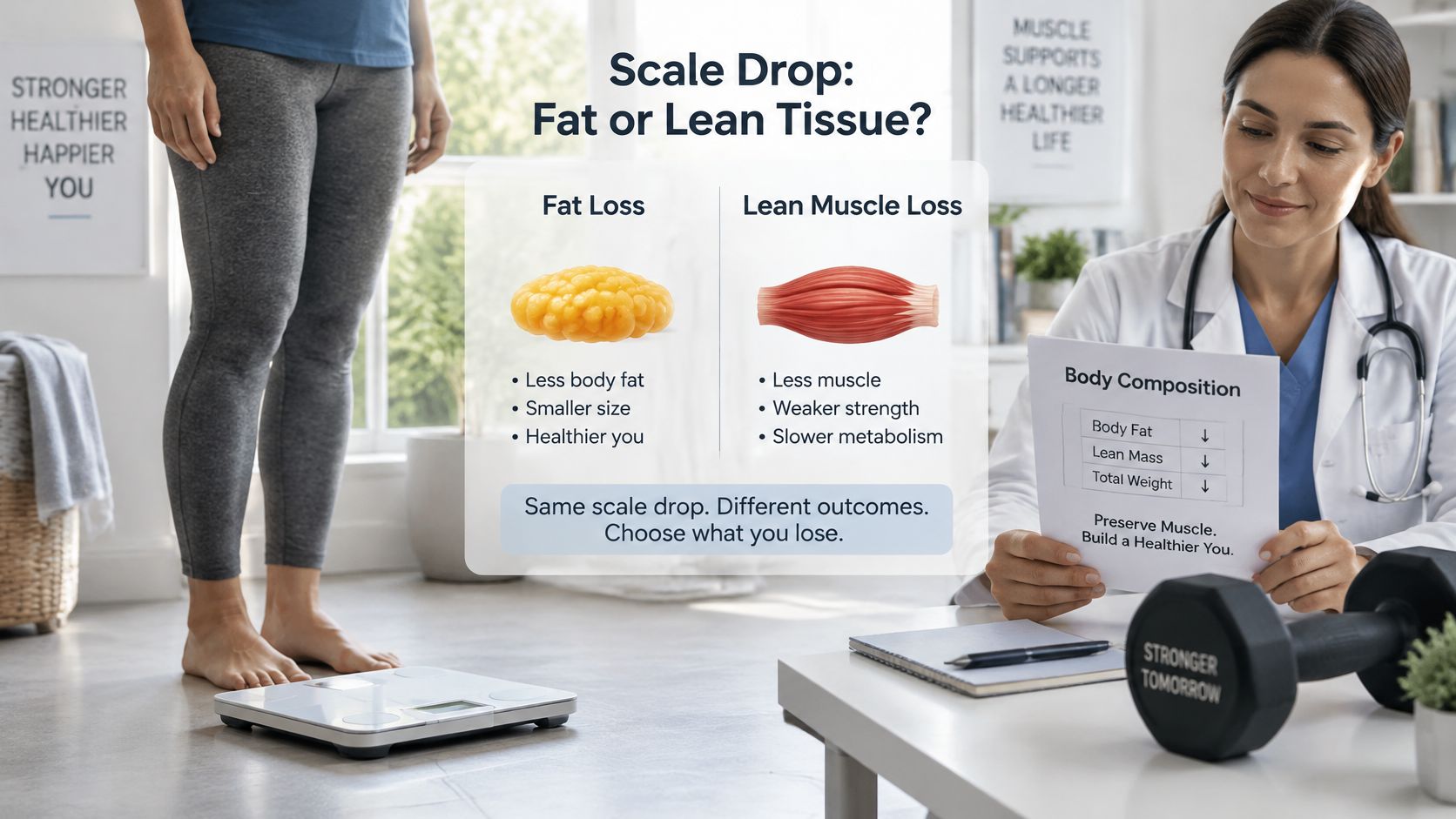
A falling scale reading doesn't identify what was lost. Fat mass, water, and lean tissue can all contribute, so weight alone can't establish whether a plan is protecting muscle.
A review of body composition during GLP-1 treatment describes estimates that roughly 30% to 40% of lost weight may be fat-free mass, with substantial variation; it also discusses a 2025 study of 40 adults in which older age, female sex, and lower protein intake were associated with greater muscle loss among semaglutide users. These findings don't mean every patient loses that proportion, and fat-free mass isn't synonymous with skeletal muscle.
A muscle-protection routine
- Individualized protein: A clinician or registered dietitian should set the target using body size, dietary pattern, and health status. Kidney disease requires particular attention rather than an automatic high-protein prescription.
- Progressive resistance training: An illustrative routine could include two to three weekly sessions covering major muscle groups. Sit-to-stand movements, rows, presses, hip hinges, and supported carries can be adapted to ability, with load increased only when technique remains controlled.
- Recovery between sessions: Rest days and adequate sleep support training consistency. Severe soreness, poor balance, or worsening performance should prompt modification rather than forced progression.
- Adequate overall intake: Protein alone can't compensate for a diet that provides too little energy or lacks essential nutrients. Medication-related fullness may require smaller, planned meals rather than eating less whenever appetite falls.
Tracking what the scale misses
Scale weight measures total body mass. Fat mass is stored body fat, while lean mass includes nonfat tissues and water; skeletal muscle is a specific component of lean tissue.
A practical example of a monitoring schedule includes:
- Weight trend: A weekly average, when regular weighing is suitable.
- Waist measurement: Every two weeks, using the same anatomical location and tape tension.
- Strength check: Every two weeks, comparing repetitions at a fixed load on two or three familiar exercises.
- Daily function: Changes in stair climbing, rising from a chair, carrying groceries, or usual walking tolerance.
These observations complement one another; none independently proves the amount of fat or muscle lost. Home body-composition devices can fluctuate with hydration and shouldn't override a clear decline in function.
Weakness, excessive fatigue, or reduced daily function calls for prescriber reassessment, not more aggressive dieting. The clinician may need to adjust nutrition, exercise, treatment, or the pace of loss.
GLP-1 Medication Options and Prescriber Oversight
GLP-1 medicines affect appetite and glucose regulation through several pathways. They increase glucose-dependent insulin secretion, reduce inappropriate glucagon release, slow gastric emptying, and influence appetite-regulating neural pathways.
Semaglutide activates GLP-1 receptors. Tirzepatide activates both GIP and GLP-1 receptors, so the medicines have different mechanisms and dosing schedules. Each is started at a prescribed dose and adjusted according to the clinician's schedule and the patient's response and tolerability.

Trial benchmarks and their limits
In the STEP 1 trial, adults with obesity or overweight plus a weight-related condition received semaglutide 2.4 mg or placebo alongside lifestyle intervention. Mean weight loss was 14.9% with semaglutide and 2.4% with placebo over 68 weeks. In the company-reported SURMOUNT-1 efficacy analysis, adults with overweight or obesity receiving tirzepatide 15 mg had 22.5% mean weight loss over 72 weeks, compared with 2.4% with placebo.
GLP-1 options and their trial benchmarks
| Option | Mechanism | Trial benchmark | Prescriber consideration |
|---|---|---|---|
| Semaglutide injection, once weekly | GLP-1 receptor activation | 14.9% mean loss at 68 weeks, STEP 1, 2.4 mg | Dose escalation guided by tolerability |
| Tirzepatide injection, once weekly | GIP and GLP-1 receptor activation | 22.5% mean loss at 72 weeks, SURMOUNT-1, 15 mg, company-reported | Titration guided by response and tolerability |
These figures are trial averages, not individual predictions. The trials were separate, so their results are not a direct head-to-head comparison. Trial duration also differs from a simple pace calculation: treatment includes time at introductory doses, and individual responses vary.
How prescribers manage treatment
Dose increases follow the clinician's schedule. Persistent gastrointestinal symptoms warrant review; the prescriber may hold escalation rather than increase the dose to pursue a scale target.
Before prescribing, clinicians assess medical history, current medications, contraindications, nutritional intake, and the ability to attend follow-up. A plateau alone does not establish that medication has failed.
The GLP-1 weight care area compares semaglutide, tirzepatide, and a needle-free tablet option. Compounded preparations and other formulations need their own suitability assessment. Trial benchmarks for injections should not be assumed to apply to a compounded product or tablet. A specific treatment plan identifies the agent, formulation, dose, monitoring, and ongoing clinical support.
Plateaus, Regain and Maintenance After 30 Pounds
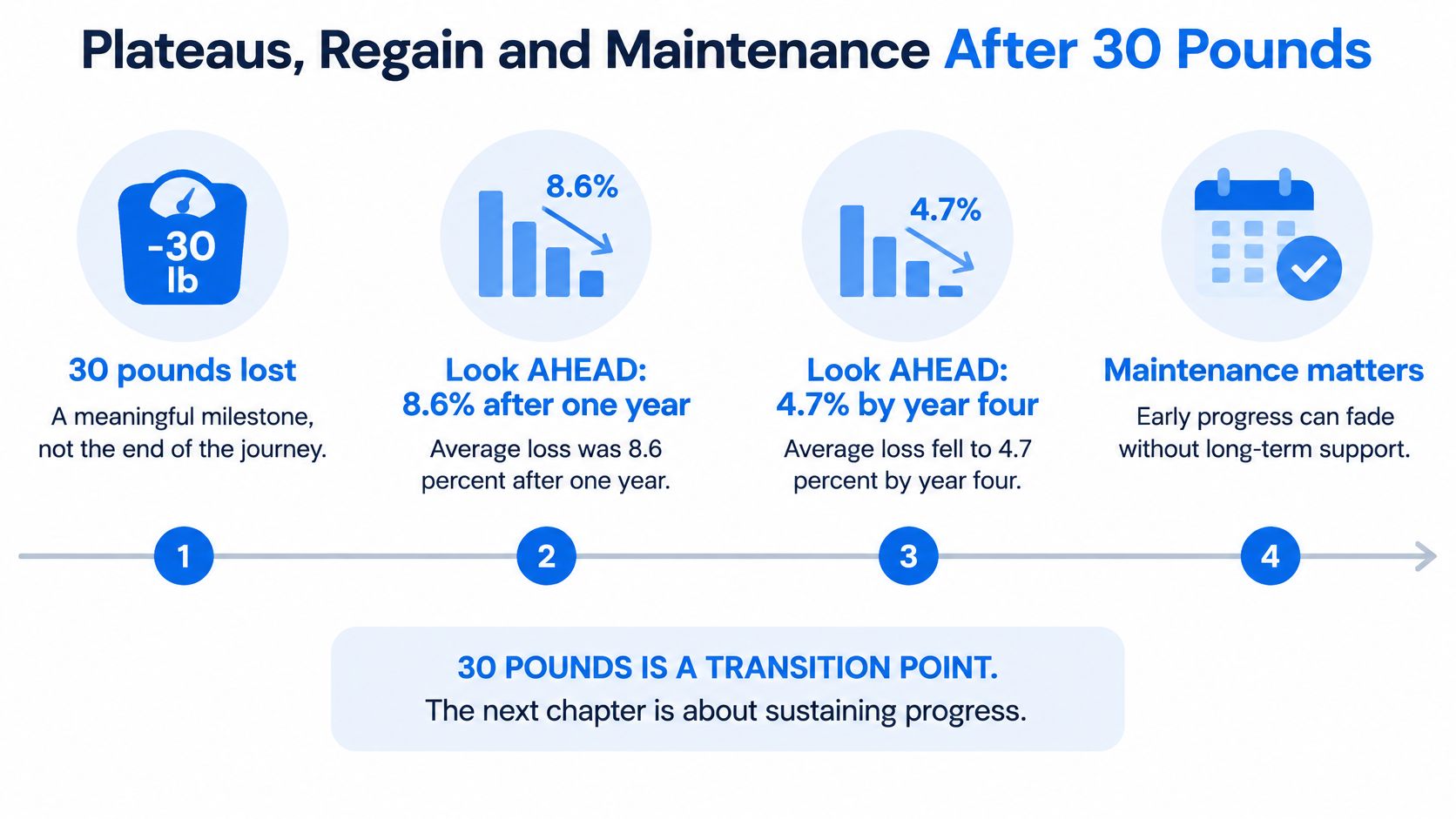
Reaching the target changes the treatment task; it doesn't remove the need for care. The person now needs an eating pattern, activity routine, and treatment strategy that can support stability.
In the Look AHEAD trial, adults with type 2 diabetes assigned to intensive lifestyle intervention had average losses of 8.6% after one year and 4.7% by year four. Partial regain occurred despite structured intervention, illustrating why maintenance requires continuing attention rather than a return to previous habits.
Match the response to the cause
- Appetite rebound: The prescriber should review hunger patterns, meal timing, protein, fiber, and ongoing treatment needs.
- Loss of structure: Keeping meal planning and a regular weighing routine can identify drift before it becomes difficult to address.
- Restriction followed by compensatory eating: Intake may need a gradual, supervised increase rather than another crash diet.
- Medication interruptions: The patient should contact the prescriber before stopping or restarting. Resuming a previous dose without guidance may be inappropriate.
- An unrealistic target: A clinician can help establish a maintainable range that accounts for health, function, and treatment burden.
The 2025 VA/DoD obesity guideline finds insufficient evidence to recommend for or against reducing medication dose or frequency specifically to preserve loss and prevent regain. That uncertainty argues against assuming that everyone can taper successfully or that one maintenance schedule suits all patients.
Stopping anti-obesity medication can be followed by substantial regain. The timing and extent aren't predictable for an individual, so discontinuation requires a plan rather than an unmonitored experiment.
A planned transition
Stabilization means keeping intake and activity consistent while the clinician reviews the emerging weight pattern. Maintenance retains regular weighing, periodic waist and strength checks, adequate sleep, and sustainable meals.
Clinical review determines whether treatment should continue, change, or be cautiously reduced when appropriate. Decisions should reflect adverse effects, appetite, function, access, and health outcomes, not just the target weight.
Maintenance principle: The response to regain should address its cause, not automatically intensify restriction.
For a stalled trend, the GLP-1 weight-loss plateau guide offers additional context. Intake records, protein adequacy, activity, and adherence should be reviewed before considering a dose change.
Red Flags That Need Prompt Medical Care
Emergency symptoms require immediate care, not a message left for the next routine appointment. Severe or sudden symptoms warrant calling emergency services, particularly when breathing, consciousness, or personal safety is affected.
The table distinguishes emergencies from symptoms requiring same-day contact or prompt reassessment. It isn't a diagnostic tool and doesn't replace emergency services.
Symptoms that need prompt action
| Symptom | Action |
|---|---|
| Chest pain, shortness of breath or fainting | Seek emergency care now |
| Facial, lip or throat swelling, or hives | Seek emergency care now |
| Severe abdominal pain, especially with vomiting | Seek urgent care and contact the prescriber immediately |
| Persistent vomiting or inability to keep fluids down | Contact the prescriber the same day |
| Dizziness on standing or very low urine output | Contact the prescriber the same day |
| Thoughts of self-harm | Call or text 988, the U.S. crisis line; call emergency services for immediate danger |
| Sudden mood or behavior change | Contact the prescriber the same day |
| Unusual weakness or loss of function | Schedule prompt reassessment with the prescriber |
Persistent vomiting can lead to dehydration, and severe abdominal pain can signal complications requiring examination. Symptoms shouldn't automatically be dismissed as expected effects of appetite treatment.
Details that help clinical triage
- Medication record: Product name, prescribed dose, most recent administration, and any missed or extra doses.
- Symptom timeline: Onset, duration, severity, and whether symptoms are worsening.
- Food and fluid intake: Meals, vomiting episodes, ability to drink, and noticeable changes in urination.
- Weight and function: Recent weight readings, dizziness, falls, or difficulty with usual activities.
A clinician may need to distinguish inadequate intake from dehydration, medication intolerance, or another illness. Self-directed dose increases, restarts, or formulation changes can complicate that assessment.
The weight-loss injection side-effects guide provides educational context, but reading guidance shouldn't delay urgent evaluation. When the level of urgency is unclear, the patient should call the prescriber's office and describe the symptoms directly.
Changing symptoms shouldn't wait until the next scheduled visit. Immediate danger always takes priority over completing a log or contacting the routine care team.
Start Your Plan With a Licensed Provider
A supervised weight-loss plan starts by assessing whether the target is appropriate for the person. Clinical review comes first; medication choices follow from that assessment.
Vials + Vitals provides physician-directed telehealth care. Its GLP-1 weight care area compares semaglutide, tirzepatide, and a needle-free tablet option. Tirzepatide costs from $299 per month for a 1-month supply.
Preparing for assessment
Gather the clinical history. Share weight history, current medications and supplements, medical conditions, and a recent BMI. These details help the physician assess potential risks and contributors to weight change.
Complete the confidential intake. A U.S.-licensed physician reviews eligibility and prescribes only when clinically indicated. Medication choice, formulation, dose, and schedule are clinical decisions.
Set practical tracking measures. Track waist, strength, and daily function alongside weight. A target date should not take priority over tolerability or adequate nutrition.
Arrange follow-up. Reviews at four and twelve weeks, with additional visits if symptoms or weight trend change. Visits can assess symptoms, weight trend, intake, waist, strength, and whether the plan remains feasible.
Keep treatment matched to the diagnosis
Other health concerns need their own assessment rather than being treated as shortcuts to weight loss. Hair health and sexual wellness are separate care areas. Menopause care may include bio-identical hormone therapy for women, while longevity services include NAD+.
Informational purposes only. Compounded medications are evaluated by a licensed provider for individual suitability and are fulfilled by state-licensed partner compounding pharmacies.
Adults considering how to lose 30 pounds can visit Vials + Vitals to complete a confidential intake and discuss an appropriate target, treatment options, and monitoring plan with a licensed provider.