GLP 1 Weight Loss Plateau: Proven Breakthrough Tips
Stuck on a GLP 1 weight loss plateau? Learn practical strategies to reignite fat loss, overcome stalled progress, and keep results moving forward.

The pattern is familiar. Weight drops steadily for months on Semaglutide or Tirzepatide, clothes fit differently, hunger is quieter, then the scale sits still for several weeks and panic sets in. Many patients read that pause as proof the medication has stopped working, when in clinical practice it's often the point where treatment shifts from rapid loss to a more measured phase that needs verification, not improvisation.
The safest way to approach a GLP 1 weight loss plateau is to stop reacting to single weigh-ins and start using a structured review. That means separating true plateau from short-term fluctuation, auditing adherence and tolerability before changing dose, and planning for maintenance rather than assuming every stall needs escalation. For patients who are also rebuilding activity after early weight loss, structured movement support such as smart training for weight loss goals can be helpful when it complements, rather than replaces, clinician-directed treatment.
Why the Scale Stops Moving on GLP 1 Therapy
A stalled scale after early success is frustrating, but it isn't unusual. In a post hoc analysis of SURMOUNT-1 and SURMOUNT-4, investigators defined plateau as less than 5% body-weight change across a 12-week interval, with later 12-week intervals also staying below that threshold. Among adherent participants in SURMOUNT-1 who had already achieved at least 5% weight loss by week 72, 90.2%, 88.9%, 87.6%, and 87.8% reached a plateau across four baseline BMI categories, which shows that most patients eventually experience a meaningful slowdown even while continuing therapy and still having achieved important weight reduction [plateau analysis in Clinical Obesity].

What a pause usually means
A flat week, or even several, often reflects ordinary shifts in hydration, bowel contents, menstrual-cycle timing, or changing body composition rather than pharmacologic failure. A scholarly review focused on plateau interpretation notes that scale weight can slow while waist circumference, glucose markers, strength, and body composition continue improving, so “no further scale loss” doesn't automatically equal treatment failure [review in American Journal of Lifestyle Medicine].
That matters because treatment success on GLP-1 therapy isn't defined by endless weekly losses. It's defined by durable reduction, metabolic improvement, and prevention of regain.
Practical rule: A few quiet weeks on the scale are a signal to assess, not a reason to self-increase dose.
Why early expectations can mislead
Longer trials show that a slowing rate of loss can coexist with substantial total benefit. In SURMOUNT-1, mean weight reduction reached about 15.0% with tirzepatide 5 mg, 19.5% with 10 mg, and 20.9% with 15 mg, compared with 3.1% with placebo. The proportions achieving at least 5% weight loss were 85.1%, 88.9%, and 90.9% across those tirzepatide doses [SURMOUNT-1 and SURMOUNT-4 maintenance analysis in Obesity]. Those numbers support a more useful interpretation. Weight loss may slow because the patient has already captured a large share of the medication's active-loss effect.
For many patients, the right question isn't “Why didn't the scale drop this week?” It's “Has the overall trend remained clinically meaningful, and what should happen next to protect it?”
Defining a True Plateau Using the Evidence
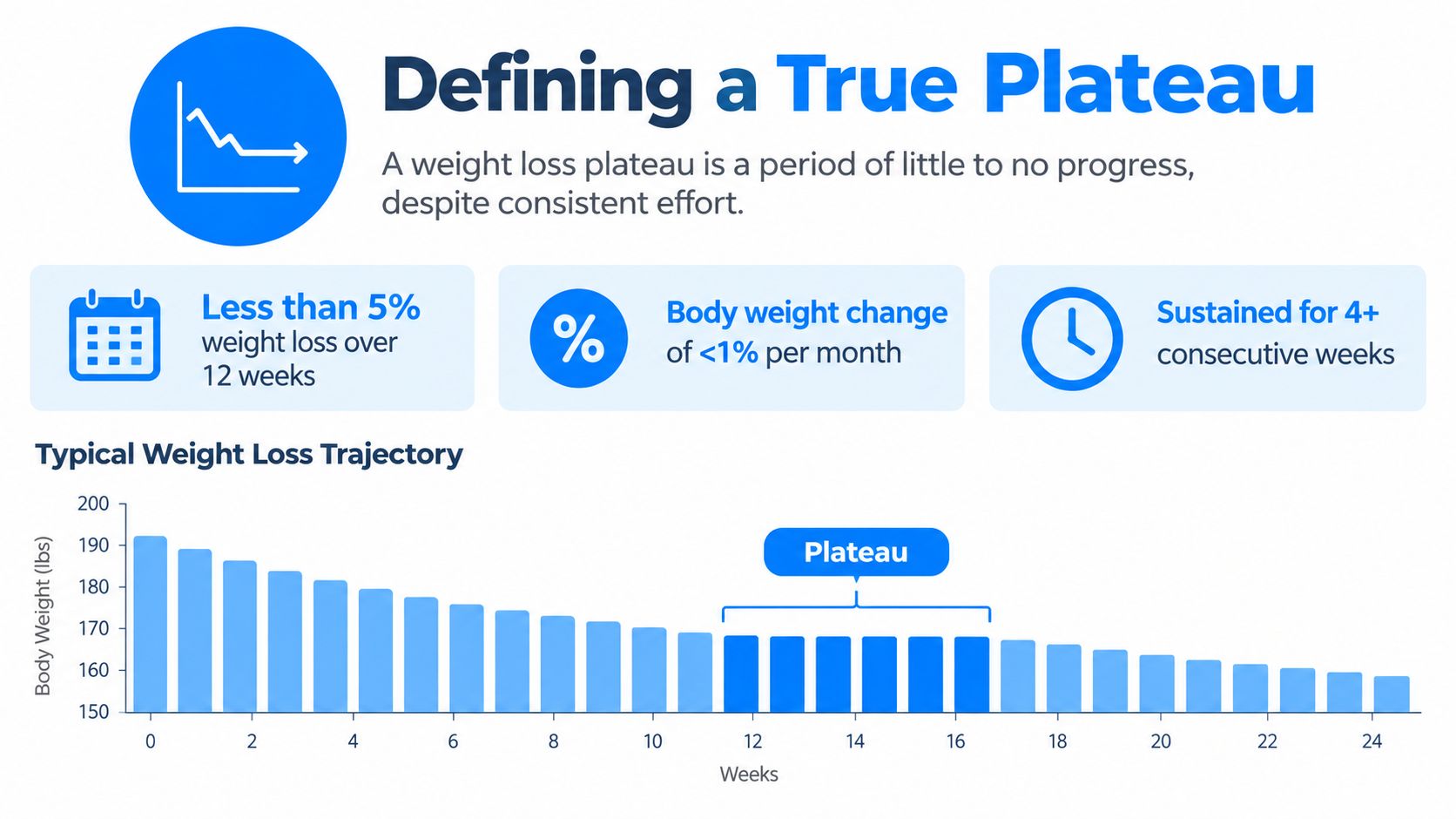
A patient reports three unchanged weigh-ins and asks for a higher dose. That pattern may reflect ordinary fluctuation, not a GLP-1 weight loss plateau. A more defensible definition requires sustained change over time. In the full SURMOUNT plateau analysis, researchers defined a plateau as less than 5% body-weight change over a 12-week interval, followed by less than 5% change in each subsequent 12-week interval [full SURMOUNT plateau analysis]. That standard helps prevent scale noise from driving premature treatment changes.
Why the 12-week standard matters
A rolling 12-week review smooths short-term water shifts and shows whether the overall trend remains clinically meaningful. It also gives the clinician time to assess medication exposure, adherence, side effects, and the patient's ability to maintain the regimen. A short period of stable weight can occur during otherwise successful treatment.
A true plateau is sustained, documented, and interpreted alongside the patient's broader response.
Several unchanged weekly weigh-ins do not establish a plateau.
Plateau timing varies between patients
The same analysis found that median time to plateau differed by baseline BMI. It was 24.3 weeks among participants with overweight, 26.0 weeks among those with class I obesity, and 36.1 weeks among those with class II or class III obesity. The timing analysis is reported in Clinical Obesity's plateau timing analysis. A slowdown that seems late for one patient may fall within the expected treatment timeline for another.
An exploratory analysis also identified differences associated with maintenance dose and patient characteristics. Compared with the 5 mg maintenance group, estimated mean time to plateau was 4.4 weeks longer with 10 mg and 6.7 weeks longer with 15 mg. Each 10-year decrease in age corresponded to an average 0.9-week longer time to plateau, while female participants reached plateau an estimated 4.2 weeks later than male participants.
These are population-level associations, not prescribing instructions. Higher doses were linked with later plateau timing, but that does not mean every patient should escalate. Age, sex, and baseline BMI can provide context without determining an individual treatment decision.
How to apply the evidence
- Use a 12-week lens: Compare the current trend with the preceding three months, not with the previous few days.
- Confirm adequate exposure: Judge a regimen only after considering consistent use, tolerability, and sufficient time at the current dose.
- Separate measurement from management: Establish that a plateau is real before discussing dose changes, formulation changes, or other interventions.
- Prioritize maintenance: Once weight has stabilized, the immediate clinical task is to preserve adherence and prevent regain, not to chase weekly scale movement.
This approach keeps a temporary slowdown from becoming an automatic escalation trigger.
Auditing Habits and Adherence Before Changing Dose
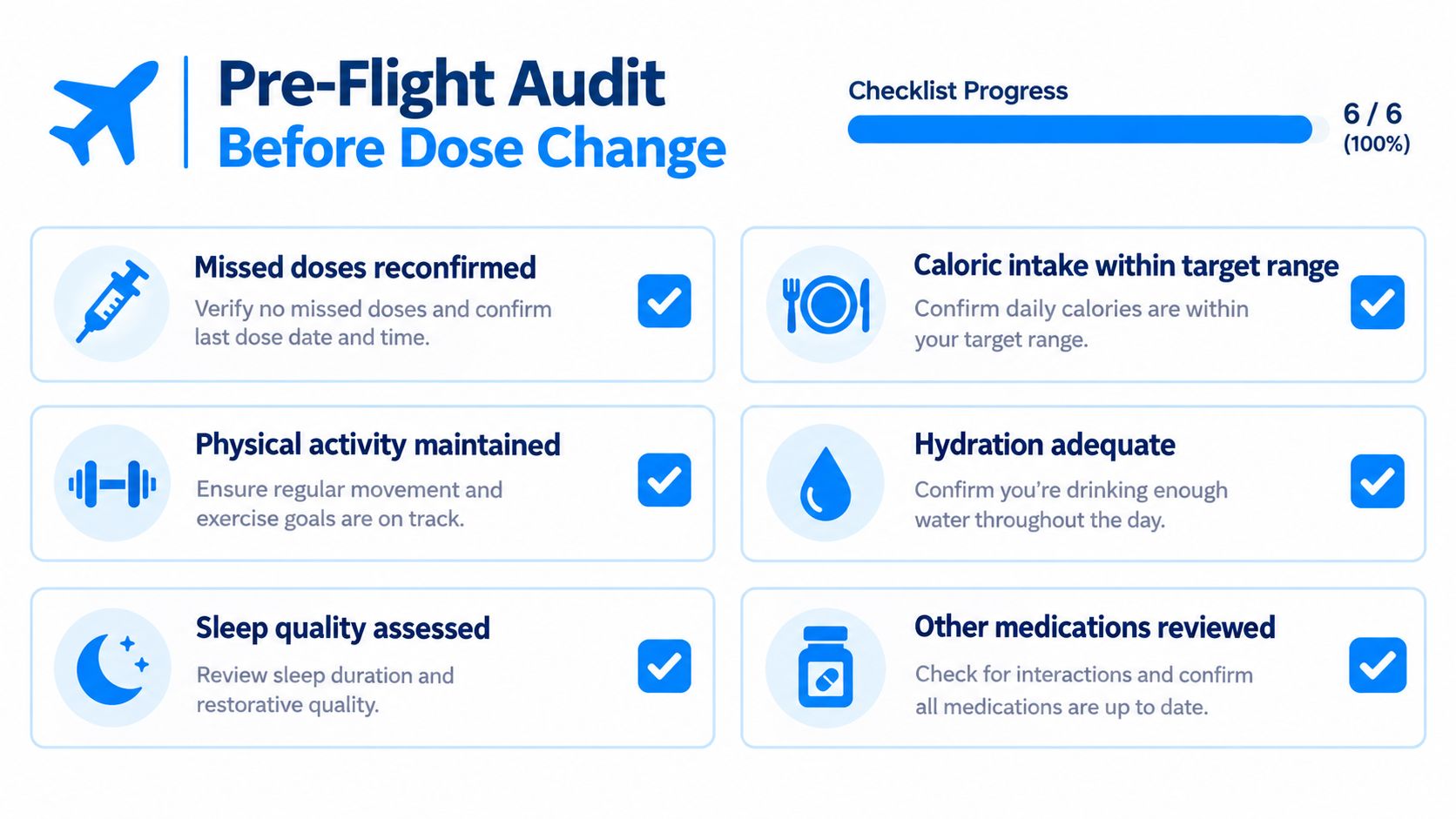
Before a prescriber changes the dose, the first task is an audit of adherence, tolerability, and the behaviors that support the medication's effect. A stable scale reading can reflect missed injections, administration errors, appetite returning, constipation, or changes in activity rather than treatment failure. The review should also ask what happens after weight stabilizes, because preserving progress is part of effective plateau management.
The pre-dose-change checklist
A plateau-oriented maintenance workflow in the clinical literature recommends confirming the pattern over at least 12 weeks, reconciling missed doses and administration errors, reviewing appetite return, alcohol intake, caloric beverages, reduced activity, constipation, sleep disruption, depression, endocrine disease, and weight-promoting medicines. It also calls for measuring waist circumference and metabolic markers alongside scale weight [plateau maintenance workflow in Current Obesity Reports].
The sequence matters. A hurried dose change can obscure the actual problem and expose a patient to avoidable adverse effects.
What clinicians should verify first
- Dose execution: Missed injections, delayed weekly dosing, or inconsistent administration can flatten progress even when the prescribed dose appears appropriate.
- Storage and handling: Temperature-sensitive products require correct storage. For shipped medication, reviewing cold-chain handling for GLP-1 shipments can clarify why handling details belong in the adherence assessment.
- Appetite rebound: Grazing, liquid calories, and alcohol can narrow the energy deficit that previously supported weight loss.
- Measurement quality: Weighing under different conditions can conceal a genuine trend. Pair scale readings with waist measurements and the broader clinical picture.
What often gets missed
- Bowel regularity: Constipation can temporarily increase scale weight and hide fat loss.
- Sleep and mood: Sleep disruption and depression may affect appetite, activity, and treatment consistency.
- Exercise interpretation: Resistance training can support lean-mass retention, limiting scale change while waist measurements improve.
A plateau review should examine behavior, biology, and measurement quality in the same visit.
Hunger and side effects deserve equal attention
Appetite returning is clinically relevant. Persistent nausea or vomiting matters just as much, because feeling unwell can reduce protein intake, activity, and treatment consistency. Patients can use this clinician's guide to hunger to prepare focused questions about appetite signals and eating patterns.
Patients troubleshooting semaglutide response patterns may also find this review of why weight loss can stall on semaglutide useful when preparing for a medical visit.
Unsupervised dose escalation should never occur during active gastrointestinal adverse effects, dehydration risk, or adjustment of other diabetes medications. The appropriate response is clinical review, correction of the underlying issue, and a maintenance decision grounded in safety.
Why the Body Fights Back With Adaptive Thermogenesis
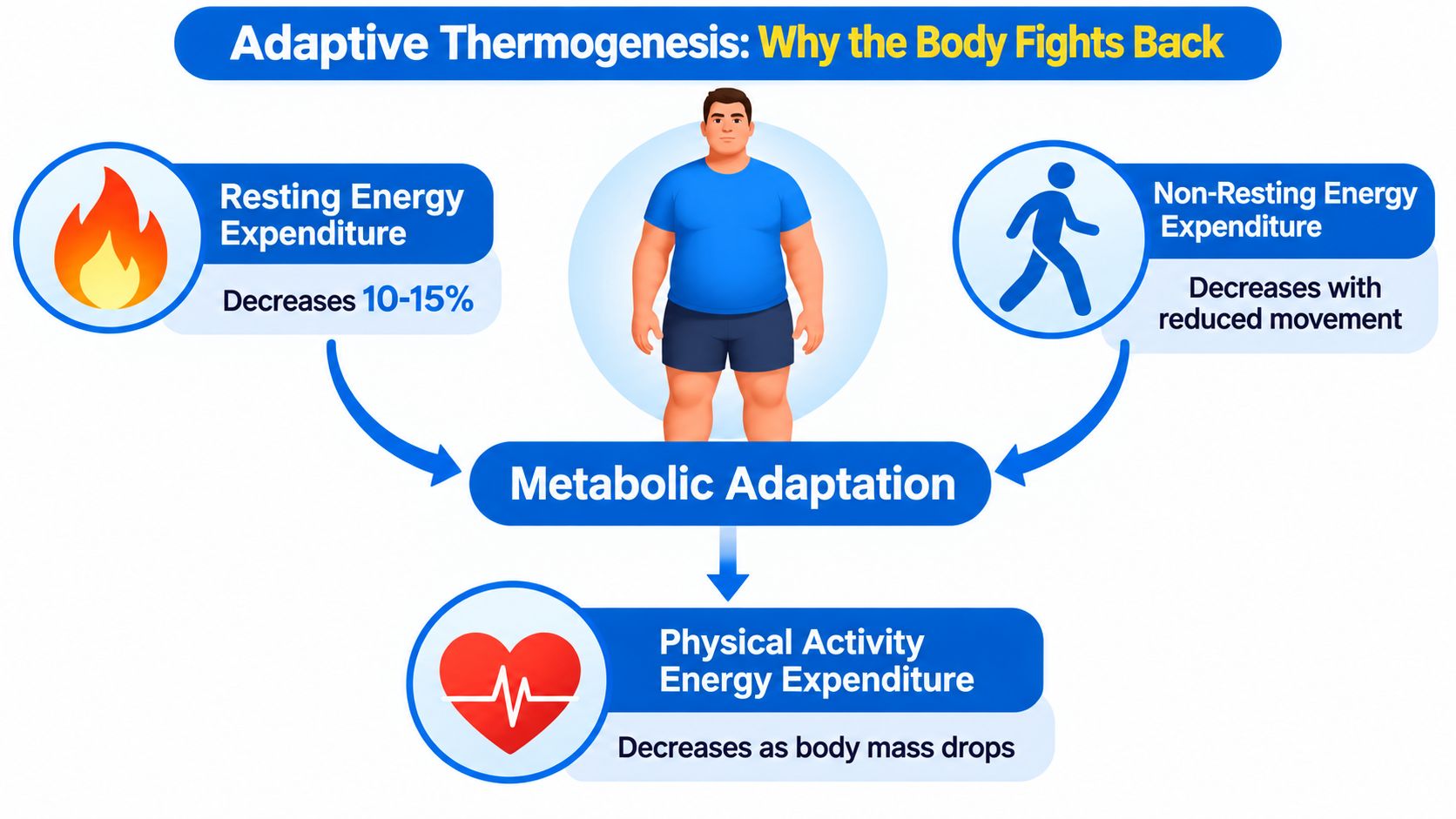
A patient can be doing everything right and still see the scale slow. That is often the point where physiology starts to matter more than willpower. As body weight falls, energy expenditure falls too, not only because the body is smaller. A mechanistic review describes adaptive thermogenesis as a reduction in resting or total energy expenditure beyond what would be expected from reduced body size and altered body composition alone [mechanistic review on metabolic adaptation].
Why the same routine stops producing the same result
With GLP-1-based weight loss, lower intake is usually paired with lower non-resting and activity-related energy expenditure. The same review reports an estimated drop of about 170 kcal per day after only about 2 kg of weight loss, and it also notes lower sleeping and total energy expenditure with tirzepatide-related weight loss after adjustment for fat-free mass and fat mass [mechanistic review on metabolic adaptation].
That narrows the deficit that worked earlier. The routine may look unchanged, yet the energy math has changed underneath it.
Lean mass is part of the plateau conversation
Lean tissue loss can slow progress further because lean mass contributes to total energy requirements. Aggressive unsupervised restriction is a poor plateau strategy. It may push scale weight down for a short time while worsening the biologic conditions that make maintenance harder.
A safer response focuses on preserving metabolically active tissue:
- Protein adequacy: Review intake when appetite suppression has led to very small meals or low protein density.
- Resistance training: Structured strength work helps preserve lean mass and can improve how progress looks beyond the scale.
- Calorie recalibration: After substantial weight loss, old intake targets may no longer create the same deficit.
- Body composition tracking: If available, it can separate “not losing weight” from losing fat while retaining more lean tissue.
A narrowing deficit after significant loss is expected physiology, not a dosing failure.
The scale can stall while treatment still has a metabolic effect. That is the point to review maintenance, adherence, and body composition before assuming the medication has stopped working.
Titration, Formulation, and Adjunctive Strategies
Once a true plateau has been confirmed and the audit is clean, medication strategy can be discussed. The order matters. Clinicians should start with what is already prescribed, verify that it has been used correctly and tolerated adequately, then consider whether titration within the intended plan is appropriate. A plateau is not a license for self-experimentation.

Start with dose position and tolerability
The first question is whether the patient has reached the prescribed maintenance or maximum tolerated dose. In the semaglutide withdrawal trial STEP 4, adults completed a 20-week run-in to 2.4 mg weekly before randomization. Those who continued semaglutide with lifestyle intervention maintained their loss and continued losing weight, reaching an estimated mean reduction of 17.4% from baseline by the end of the 68-week trial, with weight generally leveling between about weeks 60 and 68 [STEP 4 randomized withdrawal trial in JAMA]. That pattern supports patience with proper maintenance dosing and cautions against assuming several stable weeks equal treatment resistance.
If the patient is still titrating, or has backed down because of side effects, the plateau conversation is different from the one had at full tolerated maintenance.
Formulation can affect adherence
Some patients aren't failing pharmacology. They're struggling with delivery format. Needle aversion, administration friction, travel, or handling confusion can all undermine consistency. In those cases, a clinician may review alternatives that fit the patient's constraints better. That can include oral or needle-free options where clinically appropriate, but the key principle is the same. The prescriber chooses the formulation based on adherence reality, safety, and indication.
One option in this category is Vials + Vitals, a physician-directed telehealth service that evaluates eligibility, titration guardrails, and formulation fit, including injectable formats and needle-free orally disintegrating tablet pathways for some metabolic protocols.
Adjuncts should support the medication, not compete with it
When dose and formulation are appropriate, adjunctive strategies usually matter more than a dramatic switch. The best additions are boring and effective:
- Resistance training with progression: This supports lean-mass retention and helps address adaptive slowdown.
- Protein review: Low-protein intake is common once appetite suppression becomes strong.
- Behavioral support for appetite return: Patients often need structure when satiety becomes less automatic.
- Medication reconciliation: Weight-promoting medications, endocrine issues, and sleep disruption can all blunt response.
A practical comparison helps:
| Clinical question | More appropriate response |
|---|---|
| Stable weight for a few weeks, active GI side effects | Improve tolerability first, don't escalate impulsively |
| Needle aversion causing inconsistent use | Review formulation options with the prescriber |
| Adequate adherence, plateau confirmed, dose not yet optimized | Consider cautious clinician-led titration |
| Hunger returning with worsening dietary drift | Audit intake, structure meals, review behavioral supports |
Patients should never raise dose on their own, borrow a different regimen, or combine products without medical supervision. That is especially important when gallbladder symptoms, persistent vomiting, dehydration risk, or concurrent diabetes medications are in the picture.
The Next Plateau Question Is What Happens After the Plateau
A plateau is often the moment to protect what has already been gained. In SURMOUNT-4, after a 36-week tirzepatide lead-in that produced about 21% mean weight loss, participants switched to placebo regained about 14% of body weight. Among participants who had already plateaued, continuing the maximum tolerated dose preserved about 96% of the initial reduction, compared with 68% after reducing to 5 mg and 43% after switching to placebo [SURMOUNT-4 plateau maintenance findings].
That makes the next conversation less about forcing more loss and more about whether the current benefit can be maintained safely.
Discontinuation is common, and regain can be fast
A 2025 review on obesity pharmacotherapy discontinuation reports real-world discontinuation estimates of roughly 50% to 75% at 12 months, and summarizes randomized discontinuation evidence showing rapid regain after stopping semaglutide or tirzepatide. A newer synthesis cited in that review reported average regain of 0.4 kg per month after stopping weight-loss medication, with projected return to baseline weight in about 1.7 years and cardiometabolic markers moving back toward baseline within about 1.4 years [JAMA review on discontinuation and maintenance].
Those figures change how plateau care should be framed. The harder question is usually not how to push past the plateau, but how to avoid losing the progress already earned.
Maintenance is treatment, not an afterthought
A patient whose weight has stabilized after meaningful loss has not failed therapy. That patient may have reached the point where obesity should be managed as a chronic disease with an explicit maintenance plan.
That plan can include continued effective dosing, monitoring after any dose reduction, and contingency planning for appetite rebound, access interruptions, surgery, or pregnancy planning. Patients who want a clear discussion of why long-term maintenance matters can review this internal analysis of metabolic reset claims versus clinical reality.
The plateau often marks the handoff from active loss to long-term disease management.
Stopping an effective incretin regimen without a physician-directed plan is one of the most common ways patients lose ground.
Clinical Takeaways for Your Next Provider Visit
A productive plateau visit starts with a better definition. A true GLP 1 weight loss plateau is a sustained pattern, not a frustrating week. The most clinically grounded standard is less than 5% body-weight change across 12 weeks, confirmed over continued follow-up rather than inferred from daily scale swings.
Patients should arrive ready to review the factors that change decisions:
- Adherence details: missed doses, injection timing, and administration technique
- Tolerability: nausea, vomiting, constipation, hydration, and food avoidance
- Behavioral drift: appetite return, caloric beverages, alcohol, sleep loss, and reduced activity
- Non-scale response: waist circumference, glycemic markers, strength, and body composition where available
- Medication context: other prescriptions that may promote weight gain or alter glucose management
Several red flags warrant prompt clinician contact rather than waiting for the next routine follow-up. These include persistent vomiting, gallbladder-type symptoms, dehydration, and changes to concurrent diabetes medications. Those situations can alter whether a patient should continue, pause, or titrate treatment.
A responsible program doesn't improvise around plateaus. It verifies eligibility, uses prescriber-directed titration guardrails, and monitors weight, waist circumference, glycemic response, and tolerability over time. That is how a plateau becomes a clinical checkpoint rather than a treatment mistake.
Vials + Vitals provides physician-directed telehealth evaluation for GLP-1 and dual-incretin care, including adherence review, titration oversight, formulation selection, and maintenance planning when weight loss slows. Patients who want a structured, medically supervised next step can visit Vials + Vitals to start a confidential assessment and see whether a clinician-guided plateau strategy is appropriate.