Is Peptide Therapy Safe: Risks, Screening and Safeguards
Is peptide therapy safe? Learn the known side effects, contraindications, compounding risks and monitoring steps that shape a physician-directed plan.

Peptide therapy is not risk-free, and it is not uniformly dangerous. Safety depends on the specific molecule, how it is compounded and dispensed, the dose and titration speed, the patient's health history, and whether a licensed clinician screens and monitors treatment.
Why do so many conversations treat a peptide as safe because the body already makes short chains of amino acids? A chain that occurs in nature can still be a potent drug once it is synthesized, concentrated, and injected on a schedule the body did not design. The same molecule can be tolerable in one person and harmful in another when the dose, the vial, or the medical history changes.
The Short Answer on Peptide Therapy Safety
Asking is peptide therapy safe only makes sense once the peptide, the vial, and the patient are named. A peptide is a short chain of amino acids that binds a specific cell receptor and starts a defined signal. This article covers two groups that show up in supervised care: GLP-1 and GIP receptor agonists such as semaglutide and tirzepatide, used for metabolic care, and growth hormone secretagogues such as sermorelin, used in some longevity protocols.
Think of the receptor as a lock, the peptide as the key, and the prescription as the blueprint. A key cut from the wrong blueprint can fail even when the original design is sound. A dose copied from a different concentration, or a schedule copied from a different product, is that kind of mismatch.
Two layers have to stay separate.
- Intrinsic drug effects can occur even when the dose is measured correctly. Nausea after a planned increase is one example. These risks are managed by selection, titration, and follow-up. They are not erased by careful technique.
- Delivery-system errors come from converting milligrams, milliliters, and syringe units incorrectly. Those mistakes are preventable when the prescription, the device, and the teaching match.
A physician-directed protocol can control the second layer tightly and can only reduce, not remove, the first. The pages ahead separate known risks, the arithmetic behind compounding errors, who needs screening, how to check a vial, which symptoms need same-day action, and how a clinician decides whether treatment should start at all.
Known Side Effects and How Serious Each Risk Is
Every row in this table is an intrinsic drug effect: something the molecule itself can cause even when the dose is measured perfectly. A miscounted syringe belongs to a different failure category, and Section 4 covers that arithmetic and how to verify a vial.
| Risk | Where It Applies | How It Usually Presents | Main Safeguard |
|---|---|---|---|
| Nausea, vomiting, constipation, diarrhea | Semaglutide and tirzepatide, oral and injectable | Common, often at start or after a dose increase | Gradual titration and review of tolerance at follow-up |
| Acute pancreatitis | GLP-1 and dual GIP/GLP-1 agonists | Persistent or severe abdominal pain, possibly radiating to the back | Pancreatitis history screen, stopping the drug and urgent evaluation if suspected |
| Gallbladder disease | GLP-1 and dual GIP/GLP-1 agonists | Right upper abdominal pain, gallstones | Review of prior biliary disease before starting |
| Dehydration and kidney injury | GLP-1 and dual GIP/GLP-1 agonists | Persistent vomiting or diarrhea, reduced urine output | Written fluid instructions and prompt review of persistent symptoms |
| Hypoglycemia | Patients on concurrent diabetes medicines | Shakiness, sweating, confusion | Review of all diabetes medications before the first dose |
| Thyroid C-cell tumor boxed warning | Semaglutide labeling | Based mainly on rodent findings; human relevance uncertain | Contraindicated with personal or family history of medullary thyroid carcinoma or MEN 2 |
| Sermorelin and other GH secretagogues | Longevity protocols | Risk profile not established in the evidence reviewed here | Individualized screening before any protocol; do not assume safety |
Read the left columns as what can happen and the right column as what a clinician does. Frequency and severity are not the same thing.
Common reactions versus events that change care
The most common adverse reactions in semaglutide prescribing information are gastrointestinal: nausea, abdominal pain, diarrhea, reduced appetite, vomiting, and constipation. They cluster around the first doses and around each increase, which is why titration is slow and tolerance is reviewed before the next step up. An expected reaction is still a real one, but it is manageable in a way a rare event is not.
Serious events are less common and still clinically important. The same labeling identifies pancreatitis, gallbladder disease, kidney injury associated with dehydration, severe gastrointestinal reactions, and hypersensitivity as risks that need attention for GLP-1 or dual GIP/GLP-1 medicines. In one 40-week clinical study of 959 patients receiving Ozempic 1 mg or 2 mg with metformin, with or without a sulfonylurea, the FDA reported no new safety signals. That result means the known pattern held under those conditions. It does not set a ceiling on risk.
The thyroid boxed warning rests mainly on rodent findings of C-cell tumors, and human relevance remains uncertain. The medication is contraindicated with a personal or family history of medullary thyroid carcinoma or multiple endocrine neoplasia type 2 (MEN 2). That exclusion is firm regardless of how the underlying evidence evolved.
Practical rule: Peptide therapy should never be presented as risk-free. The safeguard column is the work a clinician does before the first dose and at each increase.
Sermorelin and other growth hormone secretagogues do not inherit the GLP-1 safety record. The evidence reviewed here does not establish their adverse-effect profile, so that row stays unknown rather than being filled with reassurance. Each protocol needs its own history, exclusion review, and follow-up.
The larger point is that a side-effect profile belongs to a drug class, not to peptides as a group. A GLP-1 agonist acts on gut and appetite pathways, a growth hormone secretagogue acts on growth hormone signaling, and a prescription treatment for thinning hair works through a different mechanism entirely, with its own side effects and monitoring plan. Knowing the class tells a clinician which rows of this table apply and which do not.
How Receptor Binding and Half-Life Shape Risk
GLP-1 receptors sit on pancreatic islet cells, along the gastrointestinal tract, and in appetite-regulating centers of the brain. When an agonist binds those receptors, gastric emptying slows and calorie intake falls. Early nausea and fullness are the felt result of that intended signal, not a random side effect.
Tirzepatide is a dual incretin agonist. It activates both the glucose-dependent insulinotropic polypeptide (GIP) receptor and the GLP-1 receptor. Its C20 fatty diacid component promotes albumin binding, which prolongs exposure and supports once-weekly dosing. Activation reduces calorie intake through appetite-related pathways and produces greater fat-mass loss than lean-mass loss. In a 72-week trial described in the FDA label for tirzepatide, the 5 mg, 10 mg, and 15 mg doses each produced significantly greater weight reduction than placebo, with higher proportions of participants reaching at least 5% weight loss.
Why the calendar matters as much as the milligrams
A long-acting peptide does not leave the body between weekly injections. Drug still present from earlier doses adds to the next one. Steady state, the point where intake and clearance balance, generally takes about five half-lives. Raising the dose before that balance is reached stacks exposure, and a dose that tested fine last week can produce stronger effects once earlier drug is still circulating. That pharmacokinetic fact is the reason titration is measured in weeks rather than days, and the reason an excess dose can keep causing symptoms after the injection itself is over.
Growth hormone secretagogues such as sermorelin use a different receptor pathway, so their clearance and stacking behavior sit outside the GLP-1 evidence above.
The distinction that matters for safety is which risks a molecule carries and which risks a regimen adds. Nausea from slowed gastric emptying is intrinsic to receptor binding and persists however carefully the prescription is written. Stacked exposure from escalating before steady state, or symptoms that linger because a long half-life extends every error, is introduced by the protocol itself. A clinician who spaces each increase across enough weeks controls the second category. Receptor pharmacology sets the floor. Dose, titration speed, and formulation decide how far above that floor a given patient ends up.
Compounded Dosing Errors and How to Verify a Vial
Say a clinician intends 1.25 mg. The patient draws 0.5 mL from a vial labeled 2.5 mg/mL and gets that 1.25 mg. The next shipment is 5 mg/mL. The same 0.5 mL now delivers 2.5 mg, double the intended dose, with no change in how full the syringe looks. Milligrams, milliliters, and syringe units are three different measures. A concentration change forces a new conversion every time.
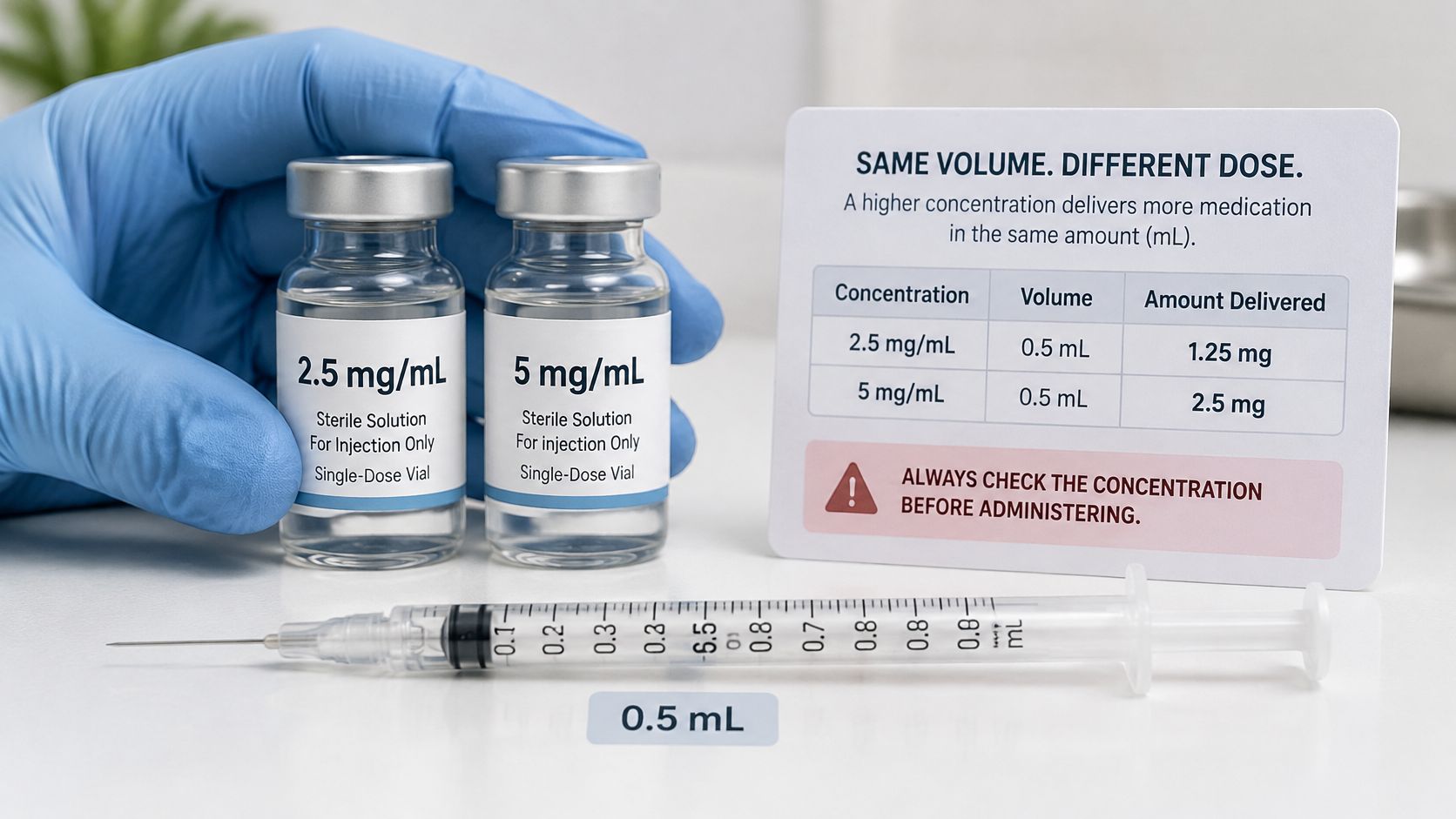
Compounded drugs are not FDA-approved or evaluated by FDA for safety, effectiveness, or quality. Concentration and device presentation are not standardized the way approved pens are. The FDA alert on compounded semaglutide dosing errors describes patients and clinicians giving incorrect doses from multidose vials, with some cases requiring hospitalization. The usual mechanism is a mismatch among milligrams, milliliters, and syringe units, made worse by an unfamiliar concentration or a schedule that climbs faster than the patient tolerates. A comparison of Zepbound vials and pens shows why the device itself changes the arithmetic.
A 2025 University of Illinois Chicago Drug Information Group review reported that, as of April 30, 2025, the FDA had received 520 adverse-event reports for compounded semaglutide and 480 for compounded tirzepatide. Those counts are why vial checks belong in routine care, not only after something goes wrong.
Seven checks before the first injection
All consultations at Vials + Vitals are conducted by licensed U.S. healthcare providers, and all prescriptions are dispensed by licensed U.S. pharmacies. Use that standard as the floor, then verify the vial in hand.
- Confirm a real consultation. A licensed U.S. clinician should have completed an individualized review, not a form-only order. The history is what makes the dose appropriate.
- Confirm the pharmacy. Ask whether the dispensing pharmacy is state-licensed and what potency and sterility testing applies to the lot. Identity of the drug is not the same as a correct fill.
- Read mass and volume. The label should state the dose in milligrams and milliliters, not in units alone. One unambiguous pair stops the three-way conversion error.
- Match the syringe. Markings must fit the vial concentration. A syringe sized for a different strength makes the correct volume look wrong, or the wrong volume look familiar.
- Teach back the dose. Written injection instructions and a demonstration come first. Then repeat the milligrams, the milliliters, and the plunger line to the clinician before any injection at home.
- Check the cold chain. Temperature-sensitive products need documented storage and shipping. A vial that warmed in transit is a quality problem even when the math is right.
- Write the after-error plan. Record the missed-dose rule and the number to call after any suspected dosing error, before the first dose, not during the symptoms.
These steps cut preventable overdose. They do not make a compounded product equivalent to an FDA-approved product.
Clinicians should not copy an approved titration schedule onto a non-equivalent concentration, and they should not escalate faster than the patient tolerates. Accelerated titration raises harm even when each individual draw is calculated correctly. Screening and active follow-up still sit on top of the checklist.
Who Needs Screening Before a First Dose
A first-dose screening should establish what the clinician needs to decide whether treatment is appropriate. Disclose every medication, health condition, prior treatment reaction, and relevant change in health. Withholding this information can make a protocol unsafe and is grounds for declining or ending care.
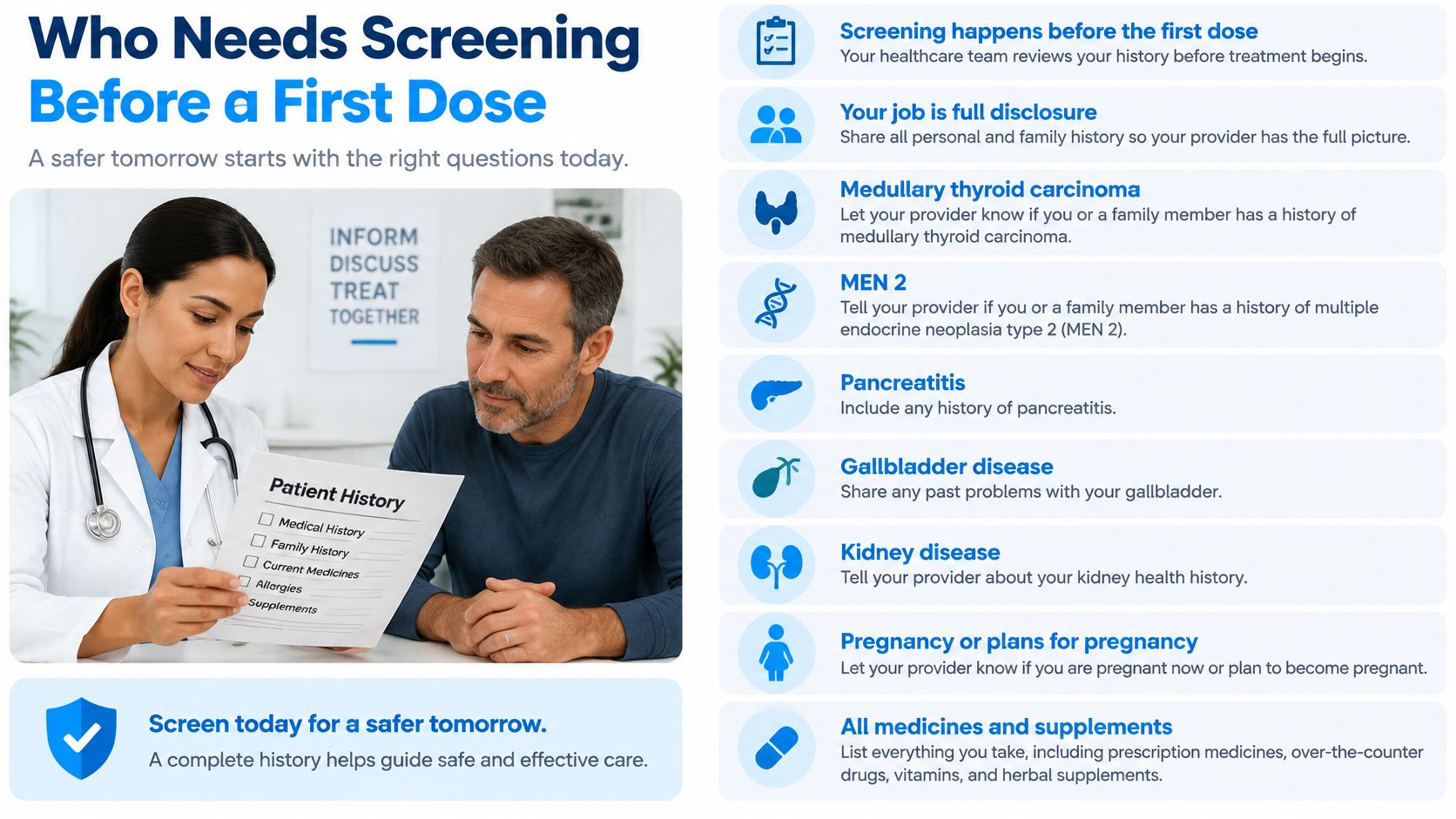
What the history is looking for
For GLP-1 treatment, the intake should clarify the patient's medical history, current medicines, and pregnancy plans. The specific risks of pancreatitis, gallbladder disease, thyroid history, low blood sugar, and dehydration are covered in the earlier side-effects table. The screening conversation helps the clinician assess how those risks apply to the individual.
Bring these details to the consultation:
- Thyroid history: Report any personal or family history of medullary thyroid carcinoma or MEN 2. The clinician needs this information to assess eligibility.
- Previous treatment reactions: Describe what medicine caused the reaction, what happened, and when. Include reactions to earlier GLP-1 treatment.
- Current medicines: Provide the names and doses of prescription medicines, over-the-counter drugs, and supplements. Include medicines used to manage diabetes.
- Alcohol use and relevant medical history: Share information that may affect the clinician's assessment, including prior pancreas or gallbladder conditions.
- Pregnancy plans: Report a current pregnancy or plans to conceive. The clinician will assess whether treatment is appropriate.
The clinician uses these answers to make an individualized decision, not to guarantee a prescription. A complete, accurate history gives the provider a better basis for deciding whether treatment is clinically appropriate.
Red-Flag Symptoms and What to Do Next
Some symptoms require immediate action, even when the dose seemed correct. Use this guide for urgent warning signs that call for a response beyond routine follow-up.
| Red flag | Action now |
|---|---|
| Fainting or severe headache after an injection | Seek emergency care and report the dose to the prescriber and pharmacy. |
| Swelling of the face, lips or throat, or trouble breathing | Call emergency services immediately. |
| Neck swelling, hoarseness or trouble swallowing | Contact the clinician promptly for evaluation. |
A suspected dosing error should be reported to the prescriber the same day, even if symptoms ease. The FDA alert on dosing errors with compounded injectable semaglutide describes confusion involving dose units, syringe sizes and product concentrations. These factors can make the amount injected differ from the intended dose.
The FDA alert also notes that some reported errors required medical care or hospitalization. Because semaglutide remains in the body for an extended period, symptoms after an overdose may not resolve quickly and may require ongoing medical attention. Follow the prescriber's instructions for monitoring and care.
For any severe or persistent symptom, contact the prescriber promptly. Call emergency services for fainting, trouble breathing or facial swelling. A planned dose increase that causes mild nausea can be discussed at follow-up; the clinician may adjust the titration.
Confirm Eligibility Before You Start Treatment
A licensed U.S. provider determines eligibility by reviewing your medical history, current medicines, prior reactions, and treatment goals. They also decide whether a prescription is appropriate and, if so, which formulation and titration schedule to use. Follow-up helps assess how you respond over time; visible changes may take months, and results are not guaranteed.
Vials + Vitals offers an online assessment for people seeking clinician review. Learn what to expect from a telehealth weight-loss doctor visit.
Three steps this week
- Complete the intake fully. List all medicines and supplements, current conditions, relevant family history, and any prior pancreatitis, gallbladder disease, or medication reaction. Withholding this information can make a protocol unsafe.
- Ask how the protocol will be managed. Have the clinician explain the titration schedule, maximum dose, and reasons to stop or adjust treatment. These details clarify how the plan will be monitored.
- Confirm the dose instructions before the first injection. Make sure the written directions specify the dose and how to measure it with the supplied syringe. If treatment is prescribed, you will receive use instructions and next steps. Completing an assessment does not guarantee a prescription.
This information is for general education. Compounded drugs are not FDA-approved or evaluated by the FDA for safety, effectiveness, or quality.
Vials + Vitals provides physician-directed telehealth across its care areas, with treatment decisions made by licensed U.S. providers when clinically appropriate and permitted by law. You can begin with an assessment at Vials + Vitals. A prescription or specific outcome is not guaranteed.