Is Semaglutide Dangerous? Side Effects and Real Risks
Is semaglutide dangerous? Common side effects, rare serious risks, contraindications and monitoring explained with the evidence behind each one.

Is semaglutide dangerous? The answer depends less on the drug itself than on which symptom you are facing and what that symptom calls for. Nearly every side effect sorts into one of three tiers: expected effects you can manage at home, warning signs that warrant a same-day call to your prescriber, and red flags that require emergency care.
Start with the expected tier, because it is by far the largest. In the FDA prescribing information for Ozempic, nausea, vomiting, diarrhea, abdominal pain, and constipation each occurred in at least 5% of treated patients. The serious complications are rare, recognizable, and monitorable. The most preventable harm sits between the two, in dosing and vial-measurement errors rather than in the drug alone. The safety profile works like a dashboard: most warning lights call for routine attention, while a few mean pull over and get help now.
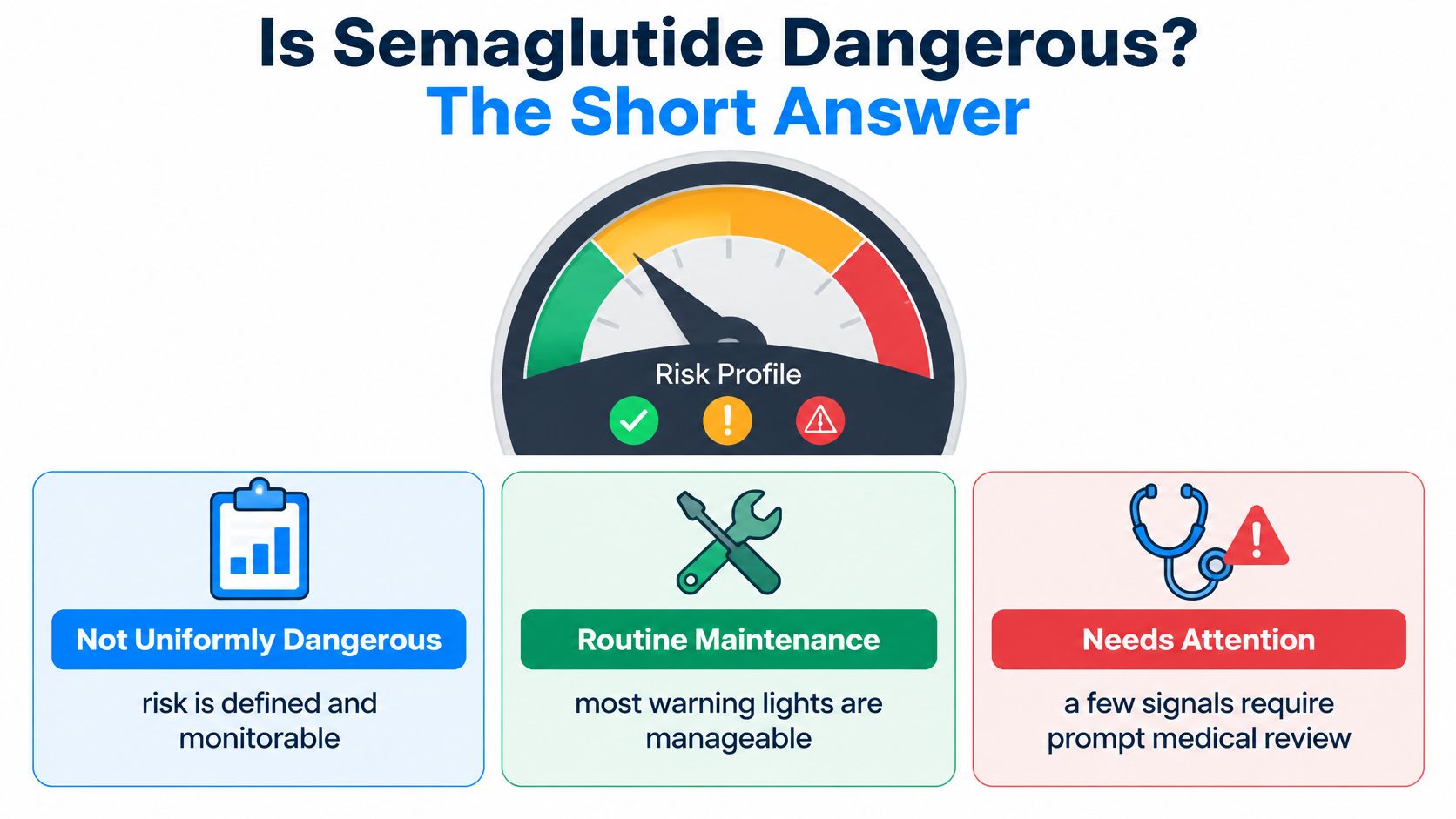
Is Semaglutide Dangerous? The Short Answer
What separates a nuisance side effect from a genuine danger? Consider a typical dose-escalation week: nausea picks up for a day or two after the increase, then settles as the body adjusts. Mild nausea, loose stools, constipation, or bloating during treatment initiation and dose increases usually ease with smaller meals and time. Risks such as pancreatitis, gallbladder disease, kidney injury from dehydration, severe gastrointestinal reactions, and serious allergic reactions can require prompt clinical attention. The FDA prescribing information for Ozempic also includes a boxed warning: semaglutide caused thyroid C-cell tumors in rodents, while whether it causes medullary thyroid carcinoma in humans remains unknown.
Before deciding how urgently to respond, ask which tier a symptom belongs to.
| Risk tier | Examples | Typical response |
|---|---|---|
| Expected | Mild to moderate nausea, loose stools, constipation, bloating | Track symptoms, adjust meal size and pace, and mention persistent effects at the next contact. |
| Call your provider | Persistent vomiting, inability to keep fluids down, dizziness on standing, reduced urination | Contact the prescriber the same day. The clinician may adjust dose timing or escalation. |
| Emergency | Severe or persistent abdominal pain, facial or throat swelling, trouble breathing, neck mass with hoarseness | Seek emergency care now. Stop the medication when pancreatitis or a serious allergic reaction is suspected, and get medical guidance. |
These tiers translate FDA labeling into practical next steps, though individual assessment by a licensed provider still matters. Risk shifts with medical history, other medicines, hydration, the pace of dose increases, and measurement mistakes that deliver more drug than intended. The practical skill is matching each symptom to its tier.
Common Side Effects and How to Manage Them
The FDA prescribing information for Wegovy separates common gastrointestinal reactions from rarer problems such as pancreatitis, gallbladder disease, acute kidney injury from volume depletion, hypoglycemia, and serious hypersensitivity reactions. For day-to-day management, the frequent effects often follow the escalation schedule like a staircase: each step asks the stomach to adapt again. Semaglutide activates GLP-1 receptors, slows gastric emptying, and reduces appetite, so food may sit longer and fullness can arrive sooner.
The risk rises when fluid loss continues through an escalation window and intake drops. Persistent vomiting or diarrhea can deplete volume, lower blood pressure, and strain kidney function; reduced urination, dizziness on standing, or inability to keep fluids down calls for same-day contact with the prescriber. Expected nausea becomes dangerous mainly when dehydration follows or when someone responds by changing the dose, compressing the schedule, or measuring a vial without guidance.
| Side effect | Typical pattern | Practical management | Escalate when |
|---|---|---|---|
| Nausea | Builds with a dose step, then settles while the dose holds | Eat smaller meals slowly and keep high-fat meals modest. | Vomiting persists or fluids will not stay down. |
| Vomiting | Often accompanies nausea during escalation | Take small sips, choose bland foods, and log episodes against the dose date. | Fluids will not stay down, standing causes dizziness, or urination drops. |
| Diarrhea | Loose stools cluster early or around dose changes | Replace fluids and electrolytes; report stools that keep recurring. | Persistent loose stools appear with dry mouth, weakness, or reduced urination. |
| Abdominal pain | Mild cramping may track meals or dose timing | Note timing, meal size, and triggers for mild discomfort. | Pain is severe, persistent, or worsening rather than settling. |
| Constipation | Slower motility, often mild | Use fiber, fluids, and regular activity. | Symptoms persist despite the routine or pair with marked bloating and pain. |
A practical routine is to shrink the meal before changing the dose: eat slowly, stop at comfortable fullness, keep high-fat meals small, sip fluids across the day, choose bland foods during nausea, and use fiber plus activity for constipation. Keep a brief symptom log with dose date, triggers, urine output, and whether fluids stayed down. If mild symptoms fade while the dose stays level, they fit the expected pattern; keep the prescribed schedule unchanged unless the prescriber adjusts it.
Rare Serious Risks and What Each One Looks Like
A low rate in clinical trials does not mean an individual's risk is zero. In adult weight-management trials, the FDA prescribing information for Wegovy reports adjudicated acute pancreatitis in 4 Wegovy-treated patients, or 0.2 cases per 100 patient-years, compared with fewer than 0.1 cases per 100 patient-years with placebo. The FDA recognizes pancreatitis, including fatal and nonfatal hemorrhagic or necrotizing cases, as a risk. Trial results help describe observed events in the study population, but they can't rule out risk for a particular patient.
| Risk | Warning signs | Documented evidence | Required response |
|---|---|---|---|
| Acute pancreatitis | Severe abdominal pain, possibly radiating to the back, with persistent vomiting | 0.2 versus fewer than 0.1 cases per 100 patient-years in adult Wegovy trials, compared with placebo | Stop the drug and seek urgent evaluation. |
| Gallbladder disease | Right upper abdominal pain, fever, or yellowing of the skin or eyes | Gallbladder-related disease is a labeled risk. | Get urgent clinical evaluation; the prescriber decides whether treatment can continue. |
| Acute kidney injury | Reduced urination, dizziness, confusion, or poor fluid intake | Postmarketing reports include cases requiring hemodialysis, often in the setting of dehydration. | Address dehydration promptly and seek renal evaluation. |
| Hypoglycemia | Shakiness, sweating, or confusion, especially with insulin or a sulfonylurea | Risk may increase with other glucose-lowering medicines. | Contact the prescriber to review and adjust combined therapy. |
| Severe gastrointestinal reactions | Persistent vomiting, severe constipation, or a swollen abdomen | Severe reactions, ileus, and intestinal obstruction are listed risks. | Seek urgent evaluation for possible ileus or obstruction. |
| Serious allergic reaction | Hives, facial or throat swelling, or trouble breathing | Anaphylaxis and angioedema have been reported. | Seek emergency care and stop the drug. |
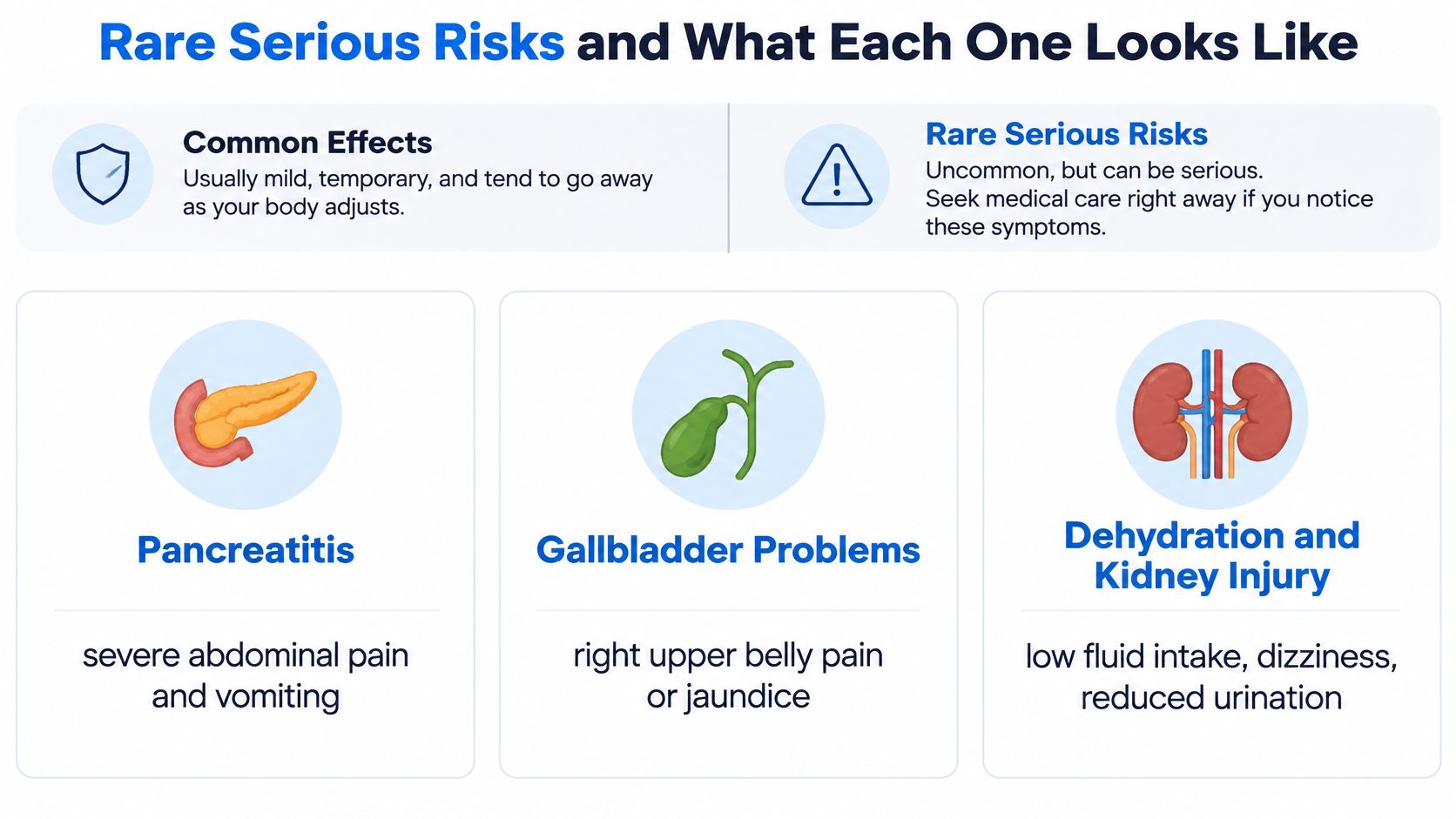
Severe or persistent abdominal pain, jaundice, facial or throat swelling, and breathing difficulty need urgent evaluation. Don't restart after a suspected serious complication until the prescriber has assessed the situation.
Who Should Avoid Semaglutide and What Gets Screened
Screening sorts risk rather than issuing one verdict: a few histories make semaglutide off-limits, while several others change the plan around it. The FDA-approved Wegovy labeling lists three contraindications, even though an intake often asks them as four separate questions: a personal history of medullary thyroid carcinoma (MTC), a family history of MTC, personal or family history of multiple endocrine neoplasia syndrome type 2 (MEN 2), and a prior serious hypersensitivity reaction to semaglutide or one of its ingredients.
The boxed warning exists because thyroid C-cell tumors appeared in rodents; whether the same risk applies to humans is unknown. That uncertainty is why MTC and MEN 2 histories are treated as absolute stops. During use, a new neck mass, hoarseness, or trouble swallowing should be evaluated by a healthcare provider rather than watched at home.
Other findings move the decision from “never” to “how”:
| Screening item | Status | Why it matters | Clinical implication |
|---|---|---|---|
| Personal history of medullary thyroid carcinoma | Contraindicated | Boxed warning for thyroid C-cell tumors seen in rodents | Do not prescribe. |
| Family history of medullary thyroid carcinoma | Contraindicated | Hereditary thyroid cancer risk is part of the labeling | Do not prescribe. |
| Personal or family history of MEN 2 | Contraindicated | Named contraindication in labeling | Do not prescribe. |
| Prior serious hypersensitivity to semaglutide or an excipient | Contraindicated | Anaphylaxis and angioedema risk | Do not prescribe. |
| History of pancreatitis | Clinical review | Acute pancreatitis is an identified risk | Individual risk-benefit decision; stop if pancreatitis is suspected. |
| Gallbladder disease | Clinical review | Acute gallbladder disease is a labeled risk | Ask about prior biliary symptoms and monitor for new ones. |
| Diabetic retinopathy | Clinical review | Retinopathy complications are a labeled risk | Include eye assessment in diabetes care. |
| Dehydration risk or kidney vulnerability | Clinical review | Acute kidney injury can be tied to volume depletion | Plan hydration and renal monitoring. |
| Insulin or sulfonylurea use | Clinical review | Hypoglycemia is a labeled risk | Review and adjust combined glucose-lowering therapy. |
A good intake also covers reproductive plans, every prescription, and supplements; one concrete question is whether the patient uses insulin or a sulfonylurea, because that combination changes the hypoglycemia plan. The intake should record the exact product and who measures each dose, since dosing accuracy is part of risk. To prepare, bring a current medication list, diabetes history, thyroid and pancreatic history, and details of recent dehydration or gastrointestinal illness.
How Dosing Errors Cause Overdoses and How to Prevent Them
An FDA-described dosing error shows how a simple conversion mistake can have serious consequences: an intended 0.25-milligram dose was written as 25 syringe units instead of 5, giving the patient five times the intended dose and causing severe vomiting. In its July 26, 2024 FDA alert about compounded semaglutide, the agency reported that conversion errors between milligrams, units, and milliliters produced five- to 10-fold overdoses, and that patients drawing their own doses from multidose vials injected five to 20 times the intended amount.
Converting a semaglutide prescription into an injection works like a currency exchange. Three numbers have to agree: the prescription states a dose in milligrams, the vial label gives a concentration, and the syringe measures volume or units. Mixing up any step in that chain can turn a small arithmetic slip into a large overdose. This risk applies to compounded injectable semaglutide in multidose vials, not standard FDA-approved prefilled products.
Reported consequences of these overdoses ranged from severe nausea and vomiting to abdominal pain, headache or migraine, dehydration, fainting, acute pancreatitis, and gallstones. As a practical rule, treat persistent vomiting or abdominal pain as a same-day call to the prescriber, and treat fainting or signs of significant dehydration as a reason to seek urgent care rather than waiting for a callback.
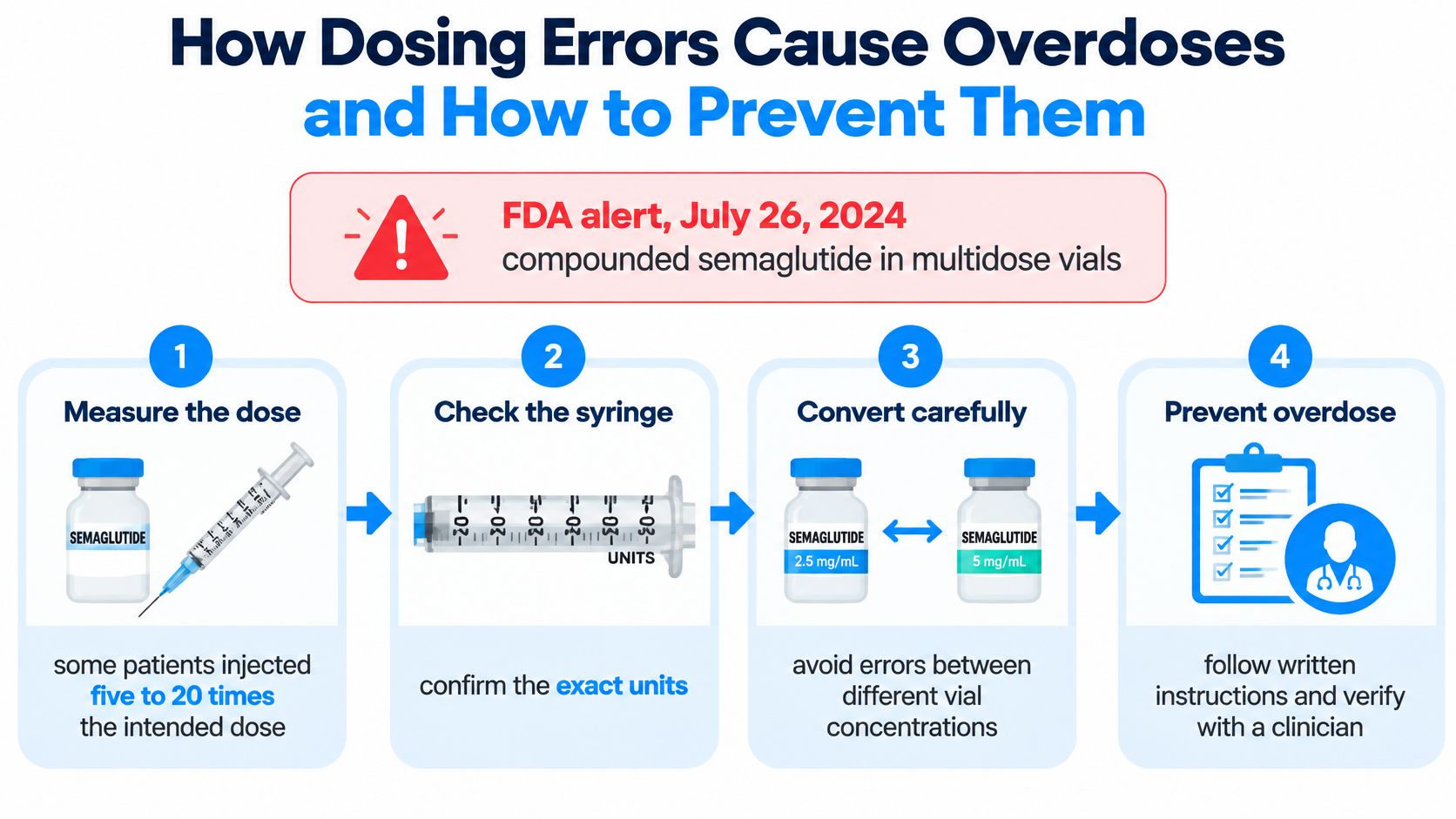
Before injecting from a vial, confirm these details with the dispensing pharmacist or prescriber:
- Confirm the prescribed dose in milligrams. This is the amount of medication prescribed, not the syringe volume.
- Confirm the vial concentration on the label. The concentration determines how much liquid contains the prescribed dose.
- Calculate the required volume in milliliters. Ask the pharmacist or provider to confirm the calculation.
- Convert the volume to syringe units using the markings on that syringe. Read the syringe units as a volume measurement, then convert back to milligrams using the vial concentration.
- Have the pharmacist verify the written conversion. Don't rely on memory or an informal instruction.
- Record the dose and date, and recheck a new vial or syringe. Concentration and syringe markings may not match a previous supply.
Safe handling also means following the product's specific storage and shipping instructions, since temperature-sensitive formulations depend on cold-chain shipping from the pharmacy to the patient. FDA adverse-event reports can't establish the incidence of dosing errors among all users or prove every compounded product is unsafe. What they do show is that the most preventable harm in this risk profile comes from measurement, not the molecule: clear instructions, calibrated syringes, pharmacist review, and clinician-supervised escalation remove nearly every step where the exchange can go wrong.
Stopping Semaglutide and Planning for Weight Regain
Stopping treatment does not close the risk question. Appetite signals, weight, and metabolic markers all shift once the drug is withdrawn, and the size of that shift is well documented. A 2025 systematic review and meta-analysis found that people who had used semaglutide or tirzepatide regained an average 9.69 kg after stopping, although the estimate had wide confidence intervals. Earlier follow-up studies point in the same direction, with a substantial share of the lost weight returning within a year of withdrawal.
That pattern has a practical meaning. Regain reflects the chronic biology of obesity reasserting itself once an effective treatment is removed, much the way blood pressure drifts back up when an antihypertensive is stopped. The medication did its job while it was onboard; the underlying condition it was managing remains. The safety issue is whether the change is planned and monitored.

Bring the reason for considering a pause or stop to the prescriber, along with a specific question:
- Side effects that don't settle: Could the dose schedule or treatment plan be changed?
- Cost or access interruption: What alternative or continuity plan can reduce a gap in care?
- Pregnancy planning: When should treatment be stopped, and what follow-up is needed?
- Planned surgery or procedure: What instructions should the treating team provide?
- Reaching a goal weight: What maintenance strategy will support appetite, nutrition, and weight?
A clinician may recommend a guided taper or discontinuation where appropriate, alternative obesity treatment, or adjustments to diabetes medicines that were reduced while semaglutide controlled glucose. Adequate protein, resistance training, and regular tracking of appetite, weight, and blood glucose give the follow-up period structure, so regain is caught early rather than discovered months later. The Metabolic Reset review offers additional context on supporting metabolism during this phase, though medication decisions stay with the treating provider. After stopping, contact the care team about a rapid rise in blood glucose, persistent appetite changes, or new symptoms.
Confirm Your Risk Profile Before You Start
Starting semaglutide is a weighing exercise, and the scale has two unequal sides. On one side sits the expected benefit for the individual: clinically meaningful weight reduction, improved glycemic control, or both. On the other side sit the risks that screening found, and each one is judged by two questions that matter more than the risk's name. How likely is it for this person, and how quickly would monitoring catch it? A common, mild effect that resolves on its own carries far less weight than a rare, severe one, and either weighs less again when a follow-up schedule is already in place.
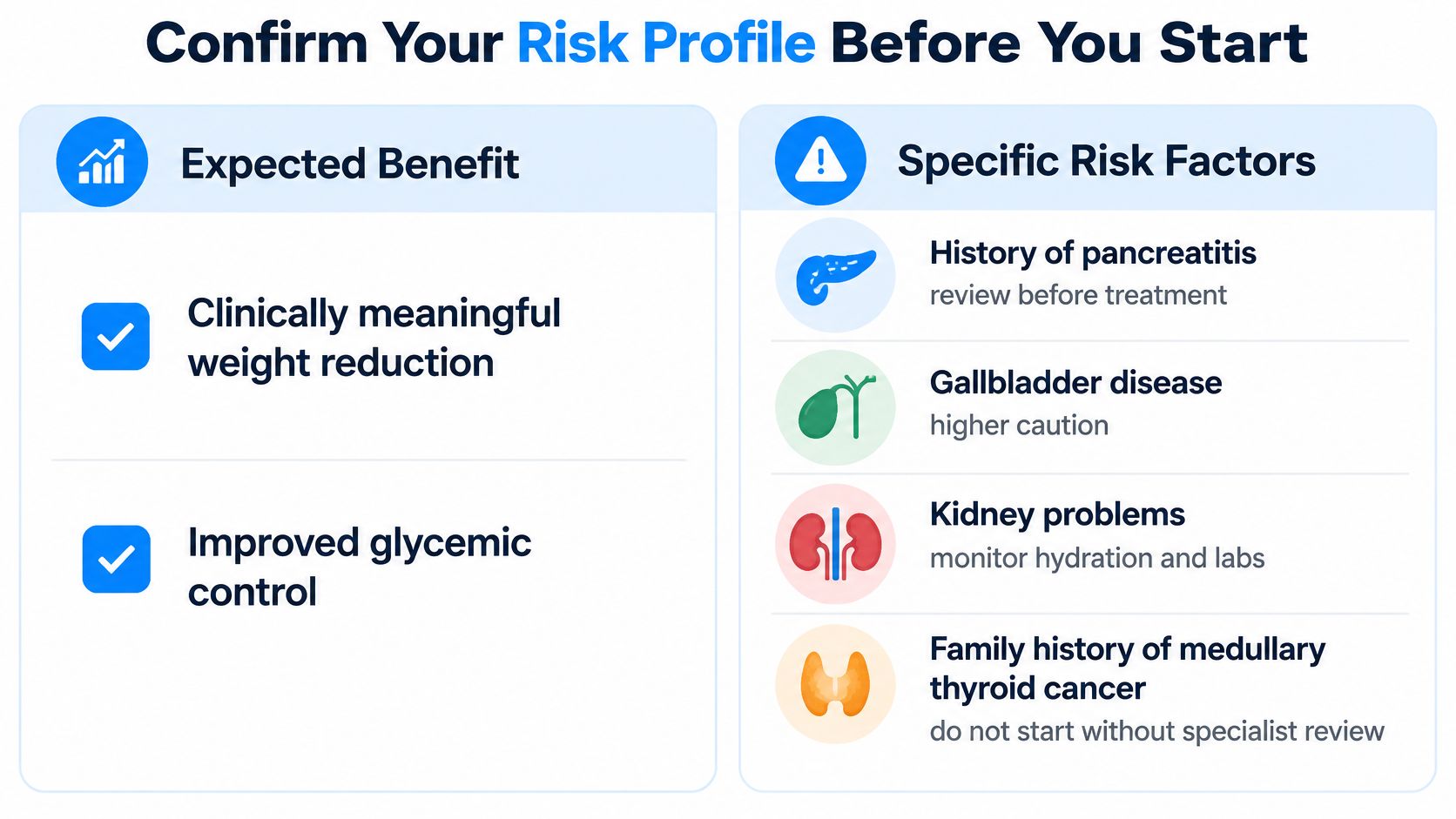
That weighing only works if the intake produces clear answers to a short set of questions before the first dose is prescribed:
- Does anything in the screening rule out treatment entirely?
- Which cautions apply, and what monitoring schedule addresses each one?
- Who adjusts the dose if symptoms appear, and how is that person reached?
- How is each dose measured and confirmed, especially when the medication is drawn from a vial, where measuring errors are the preventable part of the risk profile?
Dual incretin options such as tirzepatide also act on appetite and gastrointestinal function, so the choice between agents belongs in the same intake conversation, where the prescriber weighs the person's full medical history and treatment goals. A personalized metabolic health plan can help frame the questions for that visit, while the eligibility assessment itself remains a clinical decision.
Prescription treatments and compounded formulations are prescribed strictly at the clinical discretion of licensed U.S. healthcare providers following an individualized telehealth intake and consultation. Informational purposes only. Compounded medications are evaluated by a licensed provider for individual suitability and are fulfilled by state-licensed partner compounding pharmacies.
For an individualized review of semaglutide risks, eligibility, and dose monitoring, visit Vials + Vitals. Its physician-directed telehealth service evaluates treatment options through a clinical intake, with U.S.-licensed providers determining whether a prescription and monitoring plan are appropriate.