Metabolic Reset Review: GLP-1 Evidence
Read our clinical metabolic reset review evaluating GLP-1 evidence, weight regain data, and physician-directed telehealth protocols for sustainable care.

The most popular advice about a “metabolic reset” is also the least reliable: complete a short diet phase, take a medication course, or add a supplement stack, then expect metabolism to remain permanently improved. Human physiology doesn't work that way. A credible metabolic reset review must examine appetite control, energy expenditure, lean mass, metabolic markers, treatment tolerability, and what happens after therapy ends.
The need for better standards is substantial. In 2024, approximately 2.6 billion adults, representing 45% of the global adult population, were overweight, including about 940 million adults living with obesity, or 16% of adults worldwide, according to the World Health Organization's obesity and overweight fact sheet. The proportion of overweight adults rose from 25% in 1990 to 45% in 2024, while worldwide obesity prevalence more than doubled during that period. These figures support sustained medical attention, not a promise of a one-time reset.
Defining the Metabolic Reset Concept
“Metabolic reset” isn't a standardized medical diagnosis. It's a consumer-facing phrase used to describe a collection of goals, including weight reduction, improved appetite regulation, better glycemic control, and reduced cardiometabolic risk. A responsible clinician can work toward those outcomes, but no established intervention permanently returns the body to a fixed metabolic state.
The distinction matters because weight management is governed by several interacting systems. Body size influences resting energy expenditure. Appetite signals respond to energy restriction and weight loss. Medication can alter satiety and food intake while it's active. Sleep, physical activity, dietary composition, illness, and lean mass also influence the result. Calling the entire process a reset makes a continuing management problem sound finite.
What the term can reasonably mean
A clinically useful interpretation treats metabolic improvement as an ongoing process with measurable targets:
- Appetite and intake: The patient can follow an eating pattern that supports adequate nutrition without relying on extreme restriction.
- Glycemic control: Clinicians monitor relevant markers and interpret them alongside medical history, medications, and body-composition changes.
- Body composition: Treatment aims to reduce excess adiposity while limiting unnecessary loss of lean tissue.
- Functional health: Strength, activity tolerance, sleep, and daily energy matter alongside the scale.
- Maintenance capacity: The plan includes monitoring and a response if appetite or weight begins to change.
The WHO data establish the scale of excess adiposity as a global population-health issue, but they don't prove that a single protocol can reset metabolism permanently. They support a more cautious conclusion: many adults may benefit from structured weight management, nutrition support, physical activity, and clinical monitoring, depending on their individual risk profile.
Clinical rule: A metabolic program should describe what it measures, how often it reassesses the patient, and what happens if the initial intervention stops working.
This framework also separates legitimate treatment from marketing language. A short protocol may produce meaningful weight loss, and improved weight can improve metabolic risk factors. That doesn't establish permanent metabolic-rate normalization. The relevant question isn't whether a program creates an impressive early result. It's whether the patient can preserve health gains while appetite, energy requirements, and treatment needs evolve.
Evaluating GLP-1 Clinical Trial Outcomes
Short-term weight loss is the easy part of the story. The harder question is whether a protocol preserves lean mass, remains tolerable long enough to matter, and includes a realistic plan for what happens after the initial loss.
Controlled trials are the right benchmark. They do not predict an identical result for every patient, but they are far more useful than testimonials or before-and-after photos because they show dose, duration, adverse effects, and the proportion of participants who reached clinically meaningful thresholds.
In the 68-week STEP 1 randomized trial, 1,961 adults with overweight or obesity without type 2 diabetes received once-weekly semaglutide 2.4 mg or placebo with lifestyle counseling. Mean body-weight reduction was 14.9% with semaglutide and 2.4% with placebo, a between-group difference of 12.4 percentage points, with p < 0.001, according to the American College of Cardiology's summary of the STEP 1 trial.
The New England Journal of Medicine's STEP 1 report adds the detail that matters in clinical review. At least 5% weight loss occurred in 86.4% of semaglutide participants and 31.5% of placebo participants. Those are meaningful outcomes under defined trial conditions. They do not establish a permanent metabolic reset, and they do not answer what proportion of the loss came from fat mass versus lean tissue.
Dose, response, and tolerability
Tirzepatide provides a second benchmark from the 72-week SURMOUNT-1 randomized trial. Mean weight loss rose with weekly dose: 15.0% with 5 mg, 19.5% with 10 mg, and 20.9% with 15 mg, compared with 3.1% with placebo. At least 5% weight reduction occurred in 85%, 89%, and 91% of the respective tirzepatide groups, compared with 35% with placebo, as reported in the SURMOUNT-1 trial report.
More exposure produced greater average weight loss. It also came with trade-offs. Gastrointestinal adverse events occurred mainly during dose escalation, and treatment discontinuation because of adverse events was 4.3% with 5 mg, 7.1% with 10 mg, and 6.2% with 15 mg, compared with 2.6% with placebo. In practice, that means the highest dose is not automatically the best dose. The right dose is the one a patient can tolerate while preserving function, hydration, protein intake, and adherence.
| Medication | Mean Weight Loss | Patients Achieving >5% Loss |
|---|---|---|
| Semaglutide 2.4 mg | 14.9% at 68 weeks | 86.4% |
| Tirzepatide 5 mg | 15.0% at 72 weeks | 85% |
| Tirzepatide 10 mg | 19.5% at 72 weeks | 89% |
| Tirzepatide 15 mg | 20.9% at 72 weeks | 91% |
Source for semaglutide: the STEP 1 trial report cited above. Source for tirzepatide: the SURMOUNT-1 trial report cited above.
A credible protocol should document the medication, dose, duration, baseline clinical status, adherence, dietary support, and adverse effects. It should also explain how body composition and functional status are tracked, because scale weight alone can hide clinically relevant muscle loss. Any program that promises a rapid “reset” without those details is asking patients to accept the marketing and ignore the physiology.
Understanding Weight Regain and Adaptive Thermogenesis
The hardest part of obesity treatment often starts after the lowest weight is reached. A review that stops there misses the physiology that determines whether weight loss lasts, whether lean mass is protected, and whether stopping treatment triggers a predictable rebound.
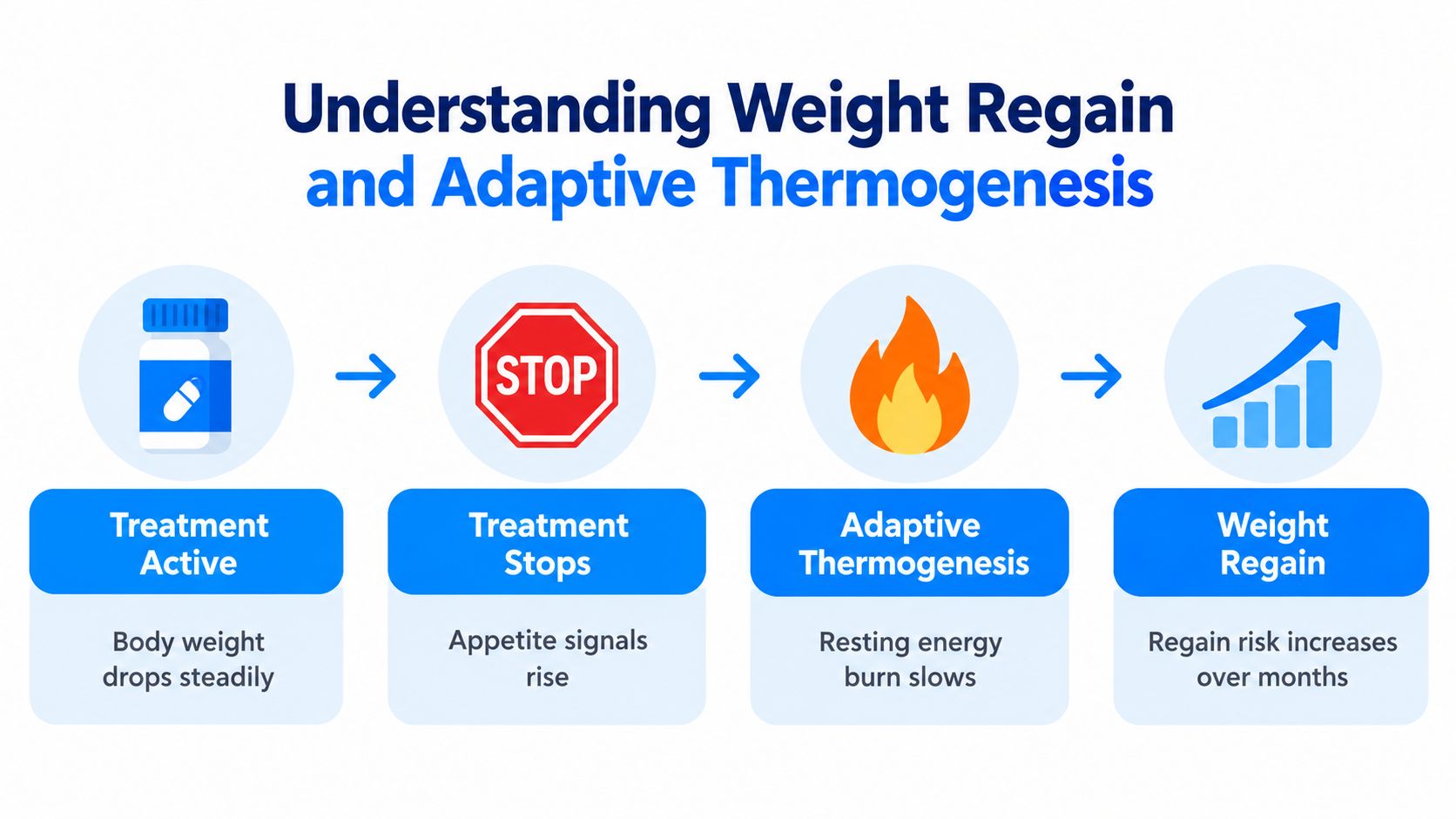
In the STEP 1 extension, participants who discontinued semaglutide and structured lifestyle support regained approximately two-thirds of their previous weight loss within one year, as discussed in the STEP 1 extension analysis. The proportion retaining at least 5% weight loss fell from 86.4% at week 68 to 48.2% at week 120. Those numbers do not mean every patient returns to baseline on the same timetable. They do show that withdrawal is a metabolic transition, not a routine administrative endpoint.
Why the body resists the new weight
Part of the drop in energy expenditure is expected. A smaller body usually burns fewer calories. The more difficult issue is adaptive thermogenesis, a further reduction in resting energy expenditure beyond what body-size change alone would predict. A systematic review summarized this added reduction at roughly 15 kcal per kilogram of weight lost, although the effect varies by study design and by the person.
That variation matters clinically. Some patients plateau early. Others become markedly hungrier while their measured or estimated expenditure stays lower than expected. Another study found that participants who lost an average of 18.4 kg had a statistically significant reduction in resting energy expenditure of approximately 121 kcal per day. Greater metabolic adaptation was also associated with stronger post-weight-loss appetite drive, as reported in the study indexed by PubMed. In practice, that means a stalled scale or increased hunger after weight loss is not automatically a failure of effort.
The same pattern appears after incretin withdrawal. A meta-analysis of weight regain after incretin discontinuation reported pooled regain of 9.69 kg after semaglutide or tirzepatide discontinuation, compared with 2.20 kg after liraglutide. Withdrawal trials in that review also described approximately 6.9% regain over 48 weeks after semaglutide was replaced with placebo and 14.0% over 52 weeks after tirzepatide withdrawal.
The practical conclusion is straightforward. Exit planning belongs at the start of treatment, not after rebound begins. Patients need a structured plan for maintenance, body composition monitoring, protein intake, resistance training, activity, and follow-up if appetite rises or weight starts to return.
Assessing Telehealth Protocol Quality and Safety
Telehealth can improve access to physician-directed weight management, but convenience doesn't replace clinical standards. A patient evaluating an online protocol should determine who makes the prescribing decision, how dose changes occur, which pharmacy dispenses the medication, and what follow-up exists after treatment begins.
Six questions for patient safety
Are clinicians licensed for the patient's location? The provider should identify the prescribing clinician and confirm active licensure where the patient receives care.
Does a real clinical evaluation occur? A health history, medication review, contraindication screen, and relevant symptom assessment should precede prescribing. A checkout page alone isn't a medical consultation.
Are baseline and follow-up measurements defined? Depending on the patient's history, clinicians may need laboratory monitoring, review of glycemic markers, assessment of adverse effects, and evaluation of nutritional adequacy.
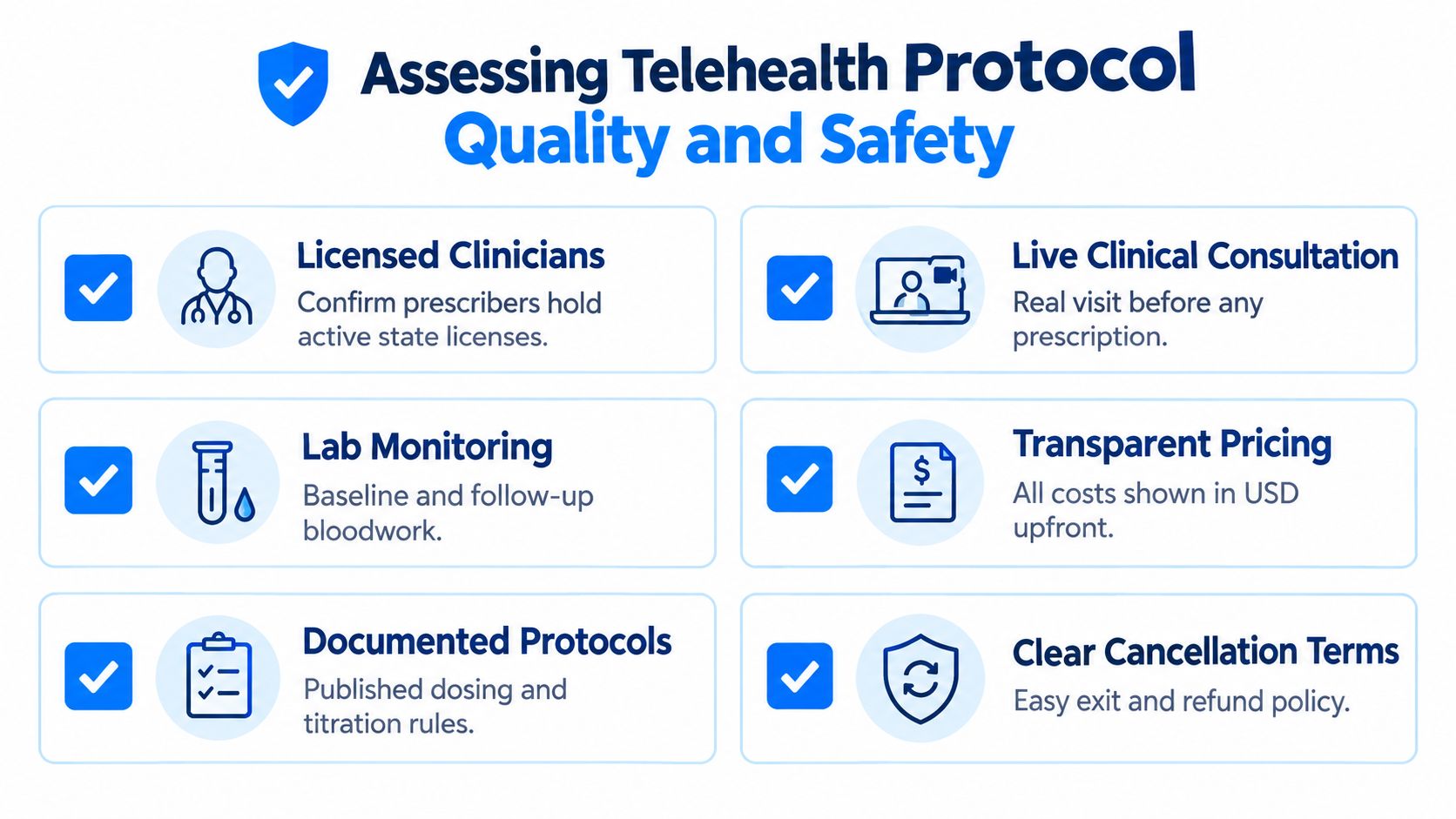
Are titration guardrails documented? Dose escalation should account for response, gastrointestinal symptoms, hydration, concurrent medications, and clinical suitability. “Faster” isn't a safety criterion.
Can the pharmacy and formulation be verified? Patients should receive clear information about dispensing, storage, shipping conditions, labeling, and quality processes. When compounded medication is used, the provider should explain the relevant pharmacy standards, potency testing, sterility testing, and the circumstances in which the formulation is appropriate.
Does the service provide an exit route? Patients need cancellation terms, access to clinical messaging, instructions for missed doses, and a plan for maintenance or transition. A service that focuses only on initiating therapy leaves a major safety question unanswered.
An independent medical advisory board can help define protocols, exclusion criteria, and titration limits, but governance doesn't replace individualized care. The patient still needs a clinician who reviews the actual history and adjusts treatment when symptoms, weight trajectory, or laboratory findings change.
The strongest telehealth model treats the digital platform as an access pathway, not as a substitute for medical judgment. Vials + Vitals offers physician-directed GLP-1 and dual incretin pathways, individualized titration, telehealth assessment, accredited U.S. pharmacy fulfillment, and monitoring tools for metabolic care. Patients should still verify eligibility, formulation, follow-up, and the exact prescribing process for their location.
Comparing Formulations and Delivery Methods
Medication delivery affects adherence, but formulation isn't a shortcut around pharmacology or clinical supervision. Injectable vials remain a familiar route for GLP-1-based treatment and may suit patients who prefer a clearly defined administration schedule. They also require correct measurement, injection technique, storage, and attention to temperature-sensitive shipping when applicable.
Needle-free sublingual orally disintegrating tablets, or ODTs, may appeal to patients with needle aversion or difficulty managing injections. Their practical value is primarily behavioral: a route that a patient can use consistently may be more useful than an injectable format that creates avoidance. However, a tablet should not be assumed to have the same absorption, exposure, or evidence base as an injectable product just because the active ingredient has a familiar name.
Choosing the route clinically
A clinician should assess:
- Administration reliability: Can the patient follow the instructions consistently?
- Dose clarity: Does the patient understand the strength, timing, and titration schedule?
- Adherence barriers: Are needles, travel, storage, swallowing, or routine disruption likely to interfere?
- Response quality: Is appetite control adequate without unacceptable adverse effects?
- Plateau interpretation: Has the patient reached a true plateau, or are adherence, dose timing, hydration, diet, sleep, or measurement issues contributing?
A plateau shouldn't automatically trigger a higher dose or a new formulation. The provider should first review the complete treatment picture. ODT options may be considered for selected patients, but evidence, availability, compounding quality, and patient-specific suitability must guide the decision.
The most defensible comparison is therefore not “injection versus tablet.” It is appropriate exposure, reliable use, verified quality, and ongoing monitoring versus an attractive format used without adequate clinical oversight.
Managing Hair Retention During Rapid Weight Loss
Hair shedding during weight treatment deserves a measured response. Diffuse shedding commonly raises concern about permanent follicle damage, yet rapid weight reduction can trigger telogen effluvium, a stress-related shift in which more follicles enter a resting phase. That process differs biologically from patterned androgenetic alopecia, which follows a different distribution and progression.
A systematic review identified telogen effluvium and androgenetic alopecia as the predominant reported hair-loss subtypes in the reviewed GLP-1 treatment literature. Tirzepatide, which produced the greatest average weight loss in that literature, was most frequently linked with telogen-effluvium reports. The review also described a dose-related signal for semaglutide. Doses below 2 mg weekly were rarely implicated, while higher obesity-treatment doses were more commonly associated with hair-loss reports, according to the systematic review of hair loss with GLP-1 therapies.

What a responsible evaluation includes
The association doesn't establish direct follicle toxicity. A separate scholarly review of GLP-1 therapies and hair loss reports that no prospective controlled studies have specifically evaluated the question and that causality hasn't been established. Shedding may reflect rapid weight loss, reduced intake, inadequate protein, iron deficiency, thyroid disease, underlying illness, androgenetic alopecia, medication effects, or several factors at once.
Clinical assessment should document the baseline density and pattern, then compare the timing of shedding with dose escalation and weight change. Useful evaluation may include:
- Pattern assessment: Diffuse shedding differs from patchy or patterned loss.
- Nutritional review: Protein intake and overall dietary adequacy matter during reduced appetite.
- Medical review: Iron status, thyroid function, illness, and other medications may require assessment.
- Time course: Persistent or worsening shedding needs follow-up rather than reassurance alone.
New, severe, patchy, scarring, or persistent hair loss warrants diagnostic evaluation. Automatic discontinuation isn't always necessary, and automatic dose escalation is rarely a rational response. Hair retention depends on identifying the cause while preserving the metabolic benefits that make treatment clinically valuable.
Designing a Sustainable Metabolic Exit Strategy
A metabolic program proves its value at the transition point, when early weight loss slows, medication intensity changes, or treatment stops. Any protocol can look effective during the easiest phase. The harder question is whether it preserves function, limits predictable rebound, and gives the patient a clear plan for what happens next.
Exit planning starts before any dose reduction. Patient and clinician should decide whether continued pharmacotherapy still fits the clinical picture, which markers will be tracked, how appetite and satiety changes will be monitored, and what specific response follows if weight or hunger begin to rise. The ideal treatment duration and the safest tapering method are still unsettled, so no clinician should present dose withdrawal as a universally validated formula.
Preserving lean mass and function
Lower body weight does not automatically mean better metabolic health. A sustainable strategy protects lean tissue, because loss of muscle and strength can lower function and make long-term maintenance harder. That means adequate protein intake, resistance training scaled to the patient's capacity, and progressive activity that can be sustained rather than abandoned after a short burst of motivation.
Sleep matters here too. In practice, poor sleep often worsens hunger control, recovery, and adherence at the same time.
A maintenance plan should include:
- A defined monitoring schedule: Track weight trend, appetite, symptoms, adherence, and relevant clinical markers at pre-agreed intervals.
- A regain threshold: Set the point at which the patient contacts the care team, before a modest increase turns into a larger reversal.
- A nutrition strategy: Maintain meal quality and protein intake even during periods of reduced appetite.
- Resistance training: Use supervised or appropriately scaled strength work to support lean-mass preservation and physical function.
- Medication review: Decide with the prescriber whether therapy continues, is adjusted, or is discontinued.
- A rapid-response plan: Address renewed hunger early, while the problem is still manageable.
The regain meta-analysis discussed earlier supports making discontinuation an explicit clinical discussion. Current evidence does not support promises that a short treatment course will permanently reset appetite or energy expenditure. It does support a structured exit process that anticipates adaptive pressure and defines the next step before regain accelerates.
The most meaningful endpoint isn't the lowest number on the scale. It's the patient's ability to maintain health, strength, appetite control, and appropriate medical monitoring over time.
A high-quality metabolic reset review should ask whether the program measures more than weight alone. It should assess lean mass, resting energy expenditure when clinically relevant, glycemic markers, functional capacity, hair and nutritional health, treatment tolerability, and the plan for life after the initial phase. Treat renewed regain as a physiological signal that triggers the pre-agreed response plan, not as a failure of discipline.
Vials + Vitals provides physician-directed GLP-1 and dual incretin protocols with individualized titration, telehealth clinical review, and formulation options that include injectable and selected needle-free ODT pathways. Patients seeking a medically supervised metabolic plan with an explicit maintenance discussion can visit Vials + Vitals to begin the clinical assessment.