Switching from Wegovy to Mounjaro: Clinical Guide
Learn the clinical protocol for switching from Wegovy to Mounjaro. Discover titration schedules, side-effect management, and telehealth steps for 2026.

A patient who has spent months taking Wegovy may reach a frustrating point: weight loss has slowed, appetite suppression feels less reliable, or gastrointestinal symptoms have become difficult to manage. Switching to Mounjaro can seem like the obvious next step, but the first injections may bring an unexpected experience, more hunger rather than less.
The transition window matters as much as the eventual maintenance dose. A cautious starting regimen can temporarily provide less appetite control than an established semaglutide regimen. Safe prescribing means anticipating that possibility, protecting hydration and nutrition, and distinguishing an expected adjustment from symptoms that need medical evaluation.
Wegovy and Mounjaro Titration Schedules Compared
| Step | Wegovy (Semaglutide) Dose | Mounjaro (Tirzepatide) Dose | Duration |
|---|---|---|---|
| Step 1, weeks 1–4 | 0.25 mg weekly | 2.5 mg weekly | 4 weeks |
| Step 2, weeks 5–8 | 0.5 mg weekly | 5 mg weekly | 4 weeks |
| Step 3, weeks 9–12 | 1 mg weekly | 7.5 mg weekly | 4 weeks |
| Step 4, weeks 13–16 | 1.7 mg weekly | 10 mg weekly | 4 weeks |
| Step 5, weeks 17–20 | 2.4 mg weekly, maintenance | 12.5 mg weekly, if escalation is prescribed | 4 weeks |
| Step 6, week 21 onward | 2.4 mg weekly, maintenance | Up to 15 mg weekly, labeled maximum | Ongoing |
The table summarizes the labeled escalation pathways alongside the FDA prescribing information: Wegovy begins at 0.25 mg weekly, with escalation at four-week intervals toward its usual 2.4 mg maintenance dose, while Mounjaro begins at 2.5 mg weekly, advances to 5 mg after four weeks, and permits subsequent 2.5-mg increases only after at least four weeks at the current dose.
These rows show the earliest routine progression when escalation remains appropriate. They aren't instructions to advance automatically, and the highest labeled dose isn't necessarily the right maintenance dose for every patient. Persistent nausea, inadequate intake, or troublesome constipation can justify a slower plan.
Why milligrams don't translate between medicines
Semaglutide is a GLP-1 receptor agonist. Tirzepatide activates both GLP-1 and GIP receptors. These receptors participate in glucose-dependent insulin signaling, while incretin treatment also affects appetite regulation and gastric emptying.
A milligram measures molecular mass, not equivalent biological activity. Different molecular weights, receptor-binding characteristics, exposure profiles, and elimination half-lives prevent a direct mathematical conversion between the medicines. Dual receptor activity also doesn't mean that tirzepatide doubles semaglutide's effect.
Both medicines remain active beyond the moment of injection. Stopping the old prescription doesn't immediately remove its effects, and administering the new medicine doesn't immediately establish a stable maintenance exposure. The prescriber must account for residual activity and gastrointestinal tolerance rather than matching the numbers printed on the packages.
Practical rule: The new medicine requires its own titration plan. Prior tolerance of Wegovy isn't permission to begin Mounjaro at a high dose.
A supervised switch therefore resets the prescribing decision and escalation ladder, not necessarily every patient's plan in an identical way. The licensed clinician selects the starting regimen after reviewing the treatment history, rather than carrying the previous milligram dose across.
How to Transition from Semaglutide to Tirzepatide
A safe transition begins with medication reconciliation, not an injection date. The clinical review of semaglutide-to-tirzepatide transitions emphasizes individualized timing and titration rather than a milligram-for-milligram substitution; it doesn't establish an FDA-labeled Wegovy-to-Mounjaro conversion schedule.
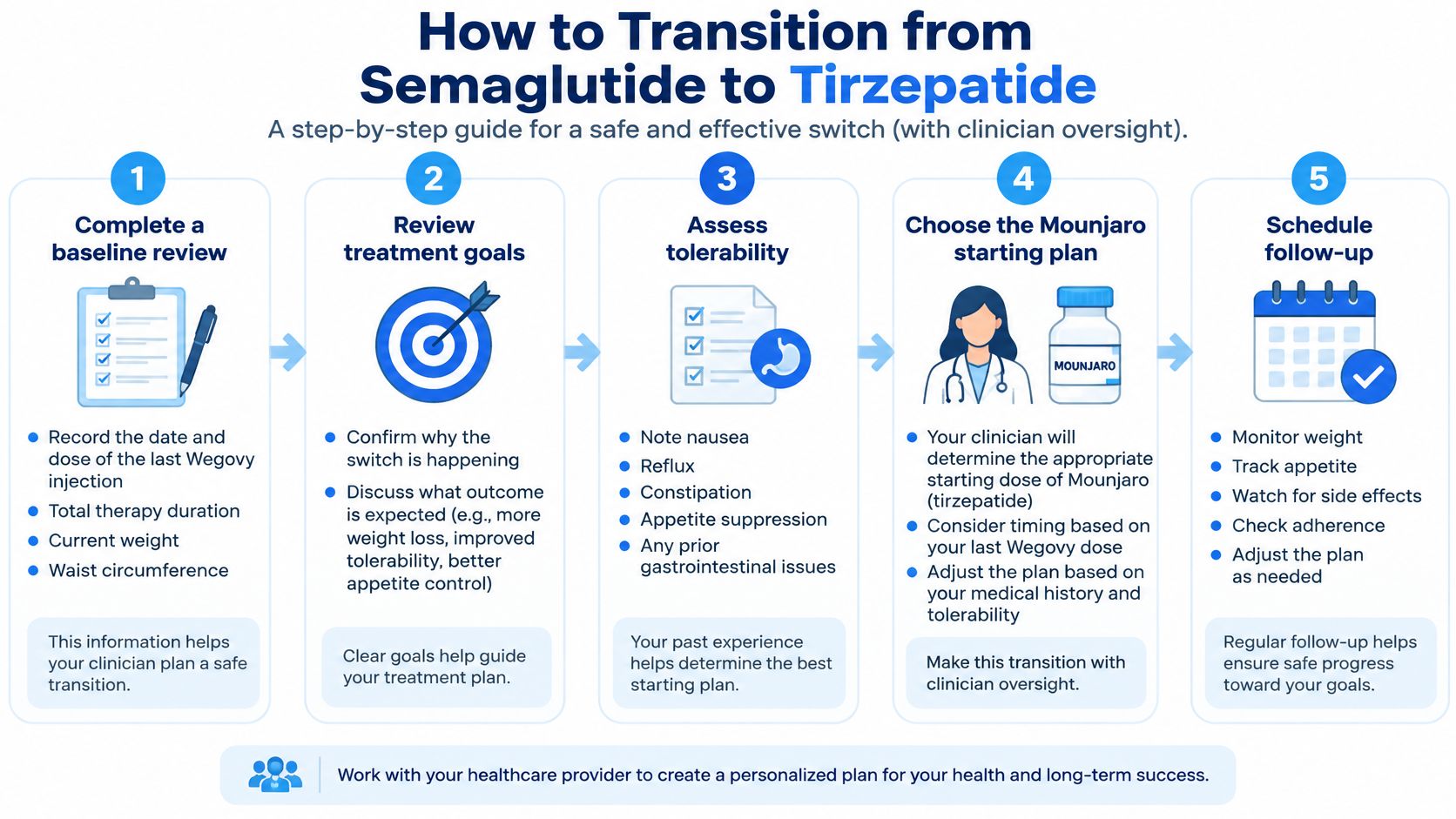
The prescriber's workflow
Complete the baseline review. Record the last Wegovy injection date and strength, total treatment duration, current weight, waist circumference, adherence, missed injections, and reason for switching. The review should include gastrointestinal history, diabetes status, recent glucose readings, other medicines, and relevant contraindications.
Investigate the apparent plateau. Before attributing poor response to semaglutide, check whether the patient reached an appropriate tolerated dose and used it consistently. Review dietary intake, medicines associated with weight gain, and symptoms suggesting a secondary medical cause.
Set the first injection date. The prescriber determines timing from the last semaglutide exposure, treatment interruption, and remaining symptoms. An interval resembling the usual weekly injection schedule is sometimes selected, but it isn't a universal conversion rule or a reason to ignore unresolved vomiting.
Prescribe a new starting regimen. The standard initiation pathway is the reference point unless the clinician makes an individualized decision otherwise. Previous high-dose treatment doesn't establish tolerance to the new molecule.
Reassess before escalation. Follow-up should examine appetite, hydration, bowel function, food intake, weight trajectory, and glucose when relevant. A calendar reminder alone isn't sufficient authorization to increase the dose.
Safety screening changes the plan
The intake must specifically ask about a personal or family history of medullary thyroid carcinoma or multiple endocrine neoplasia type 2, along with pregnancy plans, previous pancreatitis, gallbladder disease, and serious gastric-emptying problems. These findings may rule out treatment or require additional evaluation.
Neither medication should be overlapped, alternated, or supplemented with leftover injections without explicit prescribing instructions. Confusion about the last dose warrants a message to the clinical team before another injection, not an estimate made from memory.
Navigating Appetite Rebound and Gastrointestinal Shifts
More hunger during a switch doesn't automatically mean tirzepatide is ineffective. A patient leaving a fully established Wegovy regimen may initially receive a lower-intensity treatment exposure while the new medicine is introduced cautiously.
The FDA labeling document supports gradual initiation and escalation rather than immediate high-dose treatment, including a 2.5 mg weekly tirzepatide starting dose and increases separated by at least four weeks. That cautious pathway can leave a temporary gap between the appetite control previously experienced and the control eventually achieved.
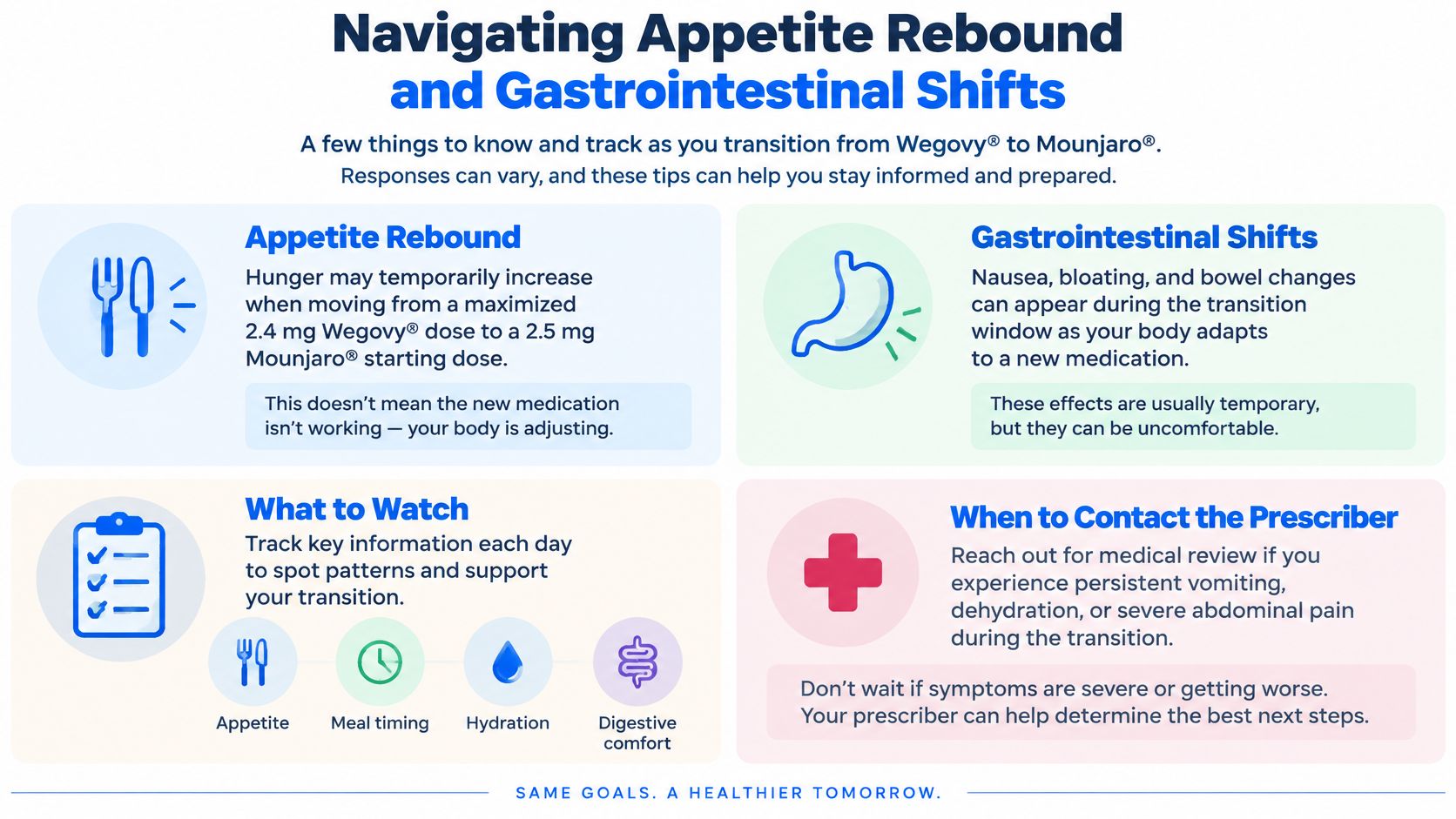
What the physiological step-down means
Semaglutide exposure declines after discontinuation while tirzepatide exposure builds with repeated dosing. These overlapping processes don't establish a measurable, universal reduction in receptor activation for every patient, but they can produce temporarily weaker appetite suppression.
Hunger, earlier return of interest in food, or a change in comfortable meal size can occur during introductory treatment. Nausea, reflux, bloating, constipation, or loose stools may also change. Prior tolerance of one medicine doesn't reliably predict the experience with the other.
Temporary hunger can be compatible with an appropriate transition. It shouldn't be labeled treatment failure before the clinician has assessed adherence, tolerability, and response at a suitable maintenance regimen.
Nutrition that supports the transition
- Anchor meals with protein. Eggs, fish, poultry, tofu, beans, or yogurt can help make meals satisfying without relying on appetite suppression alone.
- Use vegetables thoughtfully. High-fiber vegetables add volume, but patients with bloating may tolerate cooked vegetables and gradual fiber increases better than large raw salads.
- Avoid heavy meals during nausea. Fried foods, high-fat meals, and heavily processed snacks can worsen digestive discomfort. Smaller portions eaten slowly are generally more manageable.
- Maintain fluid intake. Regular small drinks may be easier than large amounts at once, particularly when nausea limits intake.
- Keep a symptom record. Meal timing, injection timing, bowel movements, appetite, and hydration help the prescriber identify patterns.
The guide to weight-loss injection side effects provides additional context for separating manageable symptoms from problems requiring review.
Hunger alone isn't a reason to accelerate treatment. Persistent vomiting or inability to maintain hydration is a reason to seek medical advice.
Patients with diabetes should check glucose more frequently during the early transition according to their clinician's plan, particularly when insulin or other glucose-lowering medicines are involved. Below-target readings or symptoms such as sweating, shaking, confusion, or marked weakness require prompt action under the patient's hypoglycemia plan.
Severe or persistent abdominal pain, especially pain extending to the back, repeated vomiting, or signs of dehydration warrant urgent medical evaluation. Severe symptoms shouldn't wait for a routine portal response. Evidence involving a switch from oral semaglutide in older adults with diabetes also shouldn't be treated as proof of the outcome after injectable Wegovy.
Clinical Criteria and Realistic Weight Loss Expectations
Switching from Wegovy to Mounjaro may be reasonable when a patient has a documented plateau despite an adequate tolerated regimen, an insufficient response relative to agreed goals, or adverse effects that make continued treatment impractical. None of these situations makes a switch automatic. The clinician must weigh the likely benefit against tolerability, treatment continuity, and the patient's broader metabolic needs.
What the comparative trial establishes
In the SURMOUNT-5 phase 3b trial, adults with obesity but without diabetes receiving maximum tolerated treatment had average weight reductions of 20.2% with tirzepatide versus 13.7% with semaglutide over 72 weeks, according to the published trial results announcement. The trial's outcome measures are summarized below.
SURMOUNT-5 Outcomes at 72 Weeks
| Measure | Tirzepatide | Semaglutide |
|---|---|---|
| Average weight reduction | 20.2% | 13.7% |
| Average weight lost | 22.8 kg (50.3 lb) | 15.0 kg (33.1 lb) |
| Average waist reduction | 18.4 cm | 13.0 cm |
| Participants with at least 10% weight loss | 81.6% | 60.5% |
| Participants with at least 15% weight loss | 64.6% | 40.1% |
| Participants with at least 20% weight loss | 48.4% | 27.3% |
These are group averages from separate treatment strategies, not predicted additional losses after switching. They aren't biological ceilings, and they don't establish what a patient already treated with semaglutide will lose after changing prescriptions.
Direct switching evidence remains more limited. In a retrospective cohort of 61 people switching because of nonresponse or a plateau, additional total-body-weight loss averaged 5.3%; those switching at a plateau lost 8.1%, compared with 2.9% among semaglutide nonresponders. The observational design and small cohort limit how confidently those averages can predict an individual result.
Define success beyond immediate appetite suppression
A useful follow-up assessment compares weight and waist measurements with metabolic markers, nutritional intake, daily function, and treatment tolerability. A patient who eats adequately and maintains a sustainable regimen may be progressing even without dramatic appetite suppression.
The discussion of planning to lose 30 pounds can help frame a weight goal, but a fixed target shouldn't dictate faster escalation. The clinical priority is a tolerable treatment course, not reproducing a trial average or reaching a particular scale reading on a deadline.
Escalating despite significant gastrointestinal symptoms can interrupt treatment and obscure whether the medication is helping. Early hunger and genuine lack of response are different clinical questions.
Coverage, Insurance and Monitoring Requirements
Coverage should be checked before the patient schedules the switch. Wegovy is used for chronic weight management, while Mounjaro's approved indication centers on type 2 diabetes, so the same insurance plan may treat the prescriptions differently. Tirzepatide eligibility, prescribing appropriateness, and insurance approval are separate decisions.
A patient seeking weight management shouldn't assume that coverage for semaglutide transfers to a different branded product. The payer determines benefits and authorization requirements; the prescriber determines whether the proposed treatment is clinically appropriate.
Questions for the health plan
- Confirm the indication. Ask whether the exact requested product is covered for the patient's diagnosis.
- Request documentation requirements. Obtain the prior authorization checklist, including any required treatment history or evidence of response.
- Clarify the total cost. Confirm pharmacy benefits, patient responsibility, refill restrictions, and what happens if authorization is denied.
- Identify the product. Establish whether the proposed prescription is brand-name Mounjaro or compounded tirzepatide before comparing costs.
Compounded tirzepatide isn't the same product as brand-name Mounjaro. Compounded medicines aren't FDA-approved, and they shouldn't be presented as interchangeable branded products. Product suitability, lawful availability, pharmacy sourcing, and coverage require separate review.
Build monitoring into the prescription
| Monitoring area | Practical requirement |
|---|---|
| Baseline measurements | Record weight, waist circumference, heart rate, and blood pressure |
| Laboratory review | Review kidney function as clinically appropriate and HbA1c or glucose for diabetes |
| Treatment response | Compare measurements at dose-review appointments |
| Daily tolerability | Track nausea, vomiting, diarrhea, constipation, appetite, and fluid intake |
| Escalation decision | Confirm adequate intake and acceptable symptoms before increasing treatment |
Kidney monitoring becomes particularly relevant when vomiting or diarrhea causes dehydration. Baseline testing should reflect medical history and risk rather than an identical laboratory panel for every patient.
The discussion of semaglutide safety considerations can support an informed consultation, but it doesn't replace individualized evaluation. Persistent vomiting, inability to keep fluids down, severe abdominal pain, faintness, or substantially reduced urination requires prompt clinical assessment.
Monitoring priority: A patient who can't maintain hydration needs evaluation, not reassurance that stronger side effects mean stronger weight loss.
Securing a Supervised Switch Through Telehealth
A typical telehealth pathway begins with a patient submitting a confidential assessment rather than selecting a replacement dose. The intake captures the complete incretin treatment history, current metabolic goals, diabetes status, other prescriptions, and conditions that could make treatment inappropriate.
For example, a patient may report that weight loss slowed after a prolonged period of consistent treatment, but also disclose ongoing reflux and constipation. That combination calls for a tolerability discussion before a starting date is finalized. A prescription history alone doesn't answer whether the patient is ready to transition.
From intake to dispensing
- Clinical review establishes eligibility. A US-licensed provider reviews the assessment and requests missing records, laboratory results, or a live consultation when needed.
- The provider selects the treatment plan. Starting dose, injection timing, escalation intervals, and follow-up depend on the individual assessment.
- Product sourcing is made explicit. The patient should know whether the prescription is for an approved branded medicine or an individually evaluated compounded formulation.
- The pharmacy fulfills the prescription. Approved prescriptions are dispensed with discreet packaging and temperature-controlled shipping when the formulation requires it.
Follow-up remains part of treatment
Asynchronous messaging or scheduled live consultations can support symptom review and dose decisions, subject to state requirements and clinical needs. Patients should receive clear instructions identifying which concerns belong in routine messaging and which require urgent local care.
Prescription treatments and compounded formulations are prescribed strictly at the clinical discretion of licensed US healthcare providers following an individualized telehealth intake and consultation. Online completion doesn't establish eligibility, assure a prescription, or authorize a patient to change doses independently.
A supervised pathway should also provide a clear contact route for delayed deliveries, missed doses, or uncertainty about storage. Those practical problems can affect treatment continuity just as much as the initial prescribing decision.
Prepare Your Records and Start the Clinical Assessment
An organized record helps the clinician distinguish inadequate response from interrupted treatment, unresolved adverse effects, or a mismatch between the medicine and the patient's goals. Preparation also reduces the chance of conflicting instructions from different prescribers.
Pre-assessment checklist
- Gather prescription records. Include the Wegovy strength, treatment start date, dose changes, and last injection date.
- Record current measurements. Use the same scale and tape-measure method used for previous readings whenever possible.
- Describe lingering symptoms. Note nausea, constipation, diarrhea, reflux, and any possible gallbladder symptoms, including upper abdominal pain.
- Document diabetes care. Include recent glucose readings and a complete list of glucose-lowering medicines when applicable.
- Check coverage status. Keep the plan's authorization requirements and any approval or denial correspondence available.
- Complete the clinical assessment. Submit accurate records and identify the main reason for requesting a change.
Define the question for the clinician
The most useful request isn't just for a stronger medication. It identifies what needs to improve: a sustained plateau, difficulty tolerating treatment, inconsistent appetite control, or a metabolic goal that remains unmet.
A medically supervised switch allows the prescriber to calibrate the dual-incretin protocol to that history and those goals. Once the checklist is complete, the patient can begin the assessment with enough information for a meaningful prescribing discussion.
Informational purposes only. Compounded medications are evaluated by a licensed provider for individual suitability and are fulfilled by state-licensed partner compounding pharmacies.
Vials + Vitals offers physician-directed telehealth assessment and individualized prescribing review for patients considering a change in incretin therapy. Patients considering a supervised switch can visit the platform to submit their treatment records and begin a clinical assessment of eligibility, product options, and follow-up needs.