How to Sleep for a Long Time: Evidence-Based Steps
Learn how to sleep for a long time safely: target the right 7–9 hour range, extend sleep in small steps, and know when to seek clinical evaluation.

The usual advice for how to sleep for a long time is to stay in bed until the tiredness fades. That treats extra hours as automatically healthier. They aren't. A long stretch in bed can be real sleep, or it can be wakefulness, a shifted body clock, or a medical problem that a later bedtime will not fix.
A safer plan is a measured experiment. Match the window to age, move bedtime earlier in small steps, and stop if daytime alertness doesn't improve. Longer sleep helps only when the added time is genuine sleep, and only when the next day is clearer.
Sleep Duration Targets That Protect Your Health
Adults 18 to 60 should regularly get 7 or more hours. Adults 61 to 64 are guided toward 7 to 9 hours, and adults 65 and older toward 7 to 8 hours. For most adults, 7 to 9 hours is the working target, not an open-ended stretch.
In 2015, a 15-member panel convened by the American Academy of Sleep Medicine and Sleep Research Society used a modified RAND Appropriateness Method over about 12 months and finished with a consensus meeting in Chicago in February 2015. The panel judged 6 hours or less inappropriate for adult health and 7 to 9 hours appropriate. That same methods report carries current CDC age guidance: 7 or more hours for ages 18 to 60, 7 to 9 hours for ages 61 to 64, and 7 to 8 hours at 65 and older.
Routine sleep of 9 or more hours hasn't been shown to benefit healthy adults. The aim is a steady window of good-quality sleep at or above the 7-hour floor, with individual need shaped by age and biology.
A 2024 analysis of U.S. National Health and Nutrition Examination Survey data found that 56.33% of adults aged 20 or older reported 7 to 8 hours, while 31.73% reported short sleep of 5 to 6 hours, according to the study authors. Many readers can add time, but only in a measured way. Short sleep also sits beside metabolic strain, so duration belongs with a plan for how to improve metabolic health.
Before changing anything, run three checks.
- Log the average. Record total sleep for 7 to 14 days, including naps.
- Judge the day. Note whether alertness, mood, or function is poor.
- Screen for warning signs. If a red flag below applies, pause schedule changes.
Write the current average next to the target range, then find the age row.
| Age group | Recommended total sleep | Practical note |
|---|---|---|
| Adults 18-60 | 7 or more hours | 7-9 hours is the appropriate range; 6 hours or less is judged inadequate |
| Adults 61-64 | 7-9 hours | Sleep within this range is the target; need above 9 hours warrants review |
| Adults 65 and older | 7-8 hours | Sleep well beyond this range warrants clinical review |
| Adults sleeping 9+ hours routinely | Not shown to benefit healthy adults | Evaluate for an underlying cause before extending further |
Practical rule: Protect a consistent window inside the age range. Don't treat an unusually long night as proof that more hours would be healthier.
Signs That Long Sleep Needs Clinical Evaluation
More time in bed is the wrong response when a medical or sleep-related cause is driving the hours. Match each warning sign to its next step, and don't add bedtime while that step is still open.
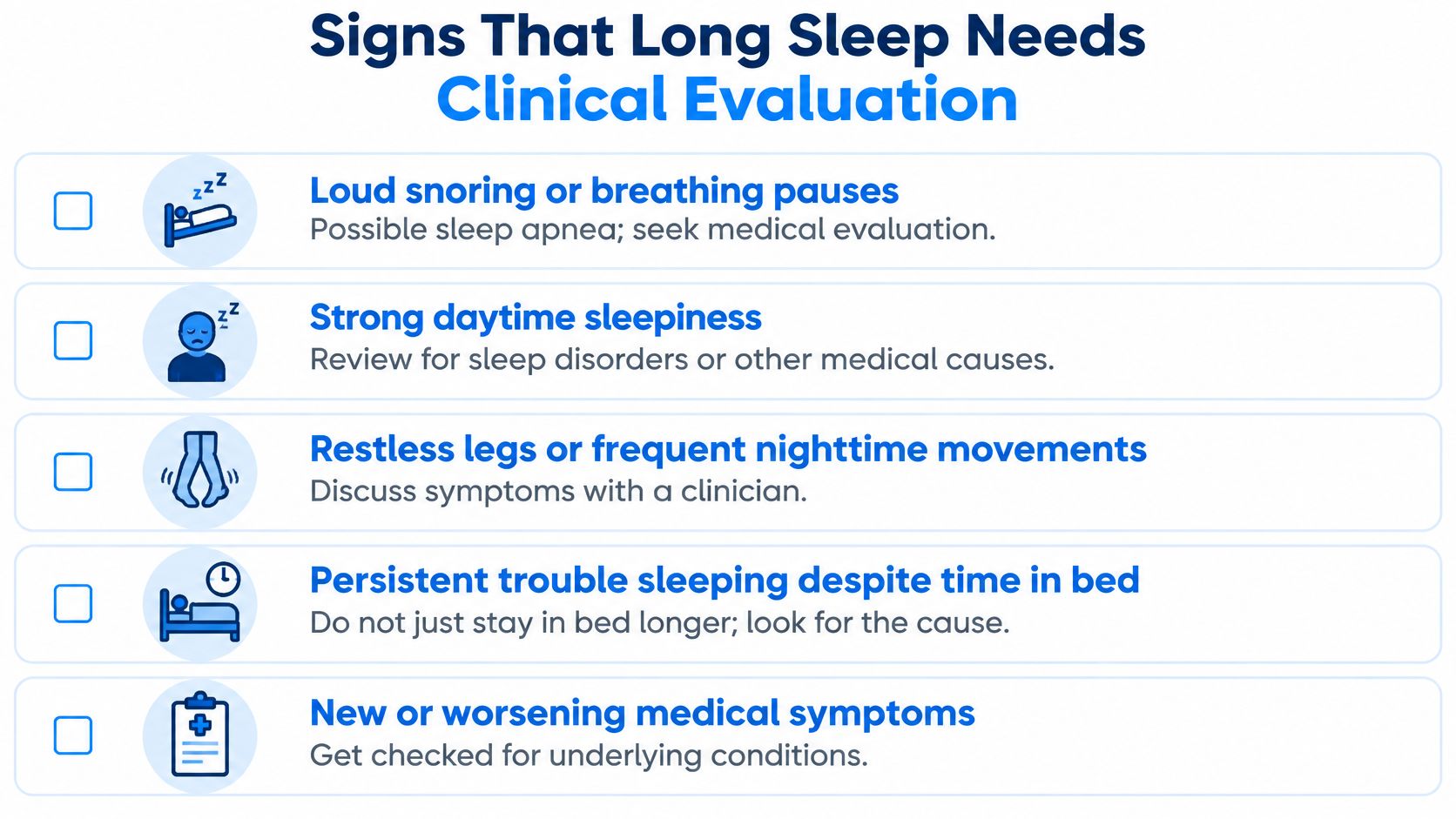
What to do with each warning sign
- Need for more than 9 hours on most nights, or waking unrefreshed after long sleep: Book primary care to screen for mood disorders, thyroid problems, medications, and sleep apnea.
- Loud snoring, gasping, or witnessed breathing pauses: These point to obstructive sleep apnea and call for a sleep medicine referral, which may include an in-lab or home sleep apnea test.
- Morning headaches: Use that same referral pathway rather than a later bedtime.
- Severe daytime sleepiness, or drowsiness while driving: Get clinical review before any further schedule change.
- Restless legs or leg movements at night: Take these to primary care or sleep medicine for assessment.
- New low mood, anxiety, or loss of interest: Arrange primary care or behavioral health evaluation.
- Persistent trouble staying asleep despite enough time in bed: Look for the cause. Staying in bed longer often adds wakefulness, not sleep.
A 2023 National Heart, Lung, and Blood Institute-supported study followed 2,574 adults with obstructive sleep apnea for a median of 11.7 years and recorded 688 deaths. Participants sleeping fewer than 7 hours had a significantly higher all-cause mortality risk than those sleeping at least 7 hours. In that group, both very short sleep and untreated breathing pauses matter. Extending bedtime without treating the airway doesn't replace that evaluation.
New or worsening medical symptoms belong with a clinician, not with another hour in bed.
A clinician evaluates these symptoms before any medication decision. Sedating products can mask apnea, restless legs, or a mood disorder, and they can make morning driving less safe. If one item on the list is already present, stop the extension experiment and get tested.
How to Extend Sleep Time Over Four Weeks
A nurse averages 5 hours 45 minutes of sleep a night and wakes at 5:30 a.m. for work. She needs a window she can hold on shift nights, a stepwise way to build it, and a rule that tells her when to stop. That last part matters most: sleep extension works like a measured experiment, with a hypothesis, a log, and an endpoint decided in advance.
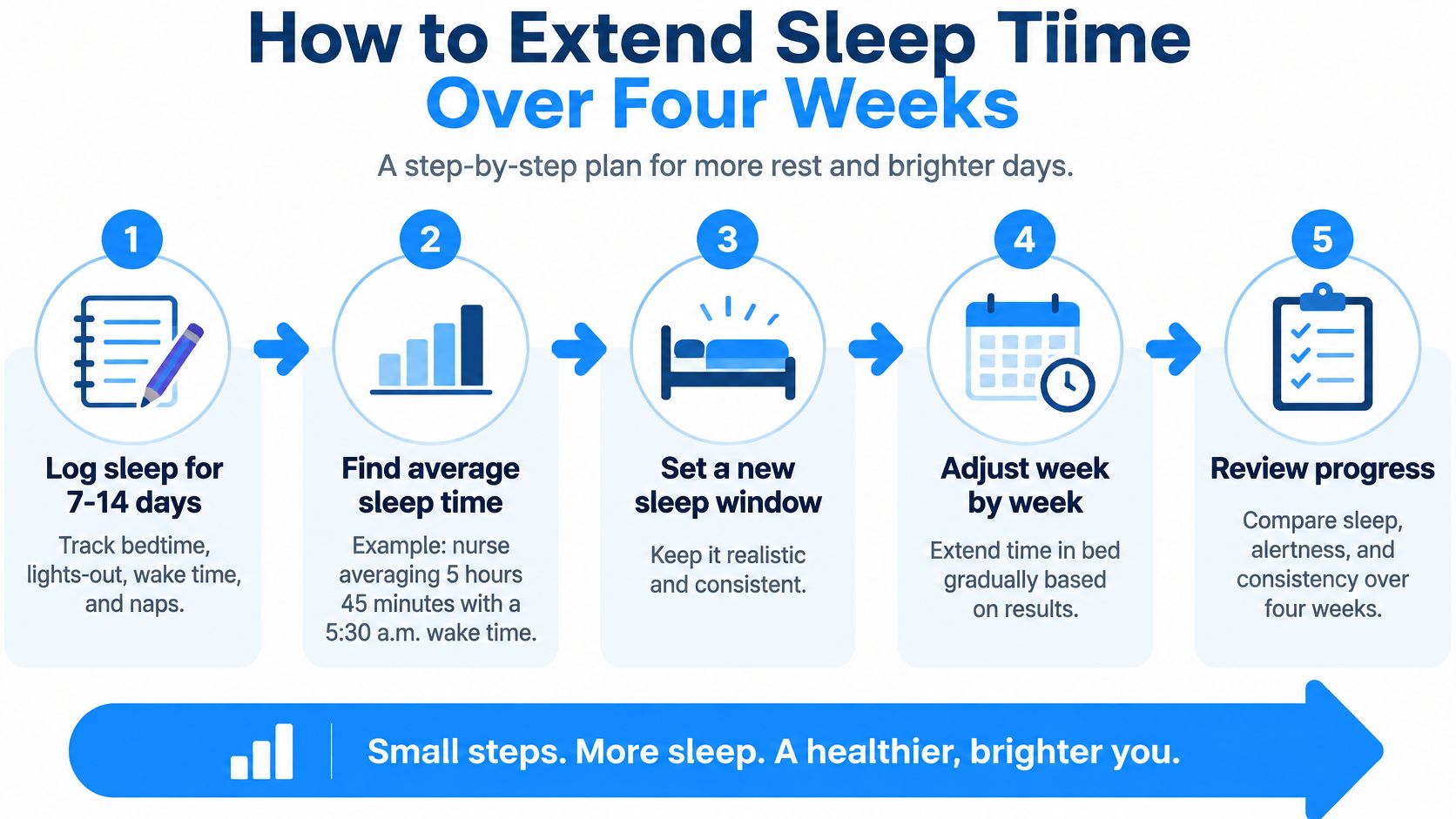
Before the first earlier bedtime, check the warning signs listed above. Snoring, witnessed breathing pauses, or severe daytime sleepiness mean testing comes first and the experiment waits.
The four-week sequence
- Log the baseline. For 7 to 14 days, record bedtime, lights-out, wake time, and naps, then average total sleep. The nurse's 5 hours 45 minutes is an average across those nights, the number every later change is measured against.
- Fix wake time first. Keep 5:30 a.m. within about 30 minutes on weekends. A stable rise time anchors the body clock, giving an earlier bedtime something to attach to.
- Move bedtime earlier in small steps. Shift lights-out by 15 to 30 minutes every three to four days until the planned opportunity is about 7 to 9 hours. For this nurse, a first step is lights-out near 10:45 p.m., with anything earlier reached gradually as the log improves.
- Protect the last hour. Stop work and screens, and dim lights, 60 minutes before lights-out. A new window fails when the added time gets spent on a bright phone.
- Guard sleep pressure. Limit naps to 20 minutes and end them before 3 p.m., and keep alcohol away from bedtime. Both draw down the pressure that fills the new window.
- Score the day after 2 to 3 weeks. Rate alertness and mood against the baseline log. A single long night tells you little; the average across the log is the result.
- Apply the stopping rule. If total sleep hasn't risen by at least 30 minutes, or alertness hasn't improved, stop extending and seek evaluation.
Why the math disappoints people
Sleep opportunity and total sleep are different numbers. The first is time in bed with lights out; the second is what the body does with it.
In a randomized 3-week study of middle-aged and older adults, summarized in the American Academy of Sleep Medicine and Sleep Research Society consensus materials, a fixed schedule with sleep opportunity extended by 2 hours raised actual total sleep by an average of 66.33 minutes, from roughly 420 to 486.5 minutes per night, while sleep opportunity itself rose by about 81.63 minutes. Two extra hours in bed produced roughly one extra hour of sleep, and the study's own figures show the rest of the added window stayed awake time in bed.
For the nurse, that gap sets expectations. Success under her stopping rule is 6 hours 15 minutes of measured sleep, a gain she can feel, and reaching it still counts even when the window looks bigger on paper.
Irregular weekend lie-ins and long naps fragment sleep and shift timing, so the weekday window has to be rebuilt every Monday. Judge the experiment at the stopping rule, where the log decides whether the extension worked.
Environment and Evening Habits That Lengthen Sleep
A late-evening phone check can subtly cut 30 minutes from the night, and the trigger usually sits outside the schedule itself. Run this part of the experiment one input at a time: change a single variable, give it a week in the log, and keep it only if the record shows a gain. A sleep routine guide holds up only when the room and the evening support it.
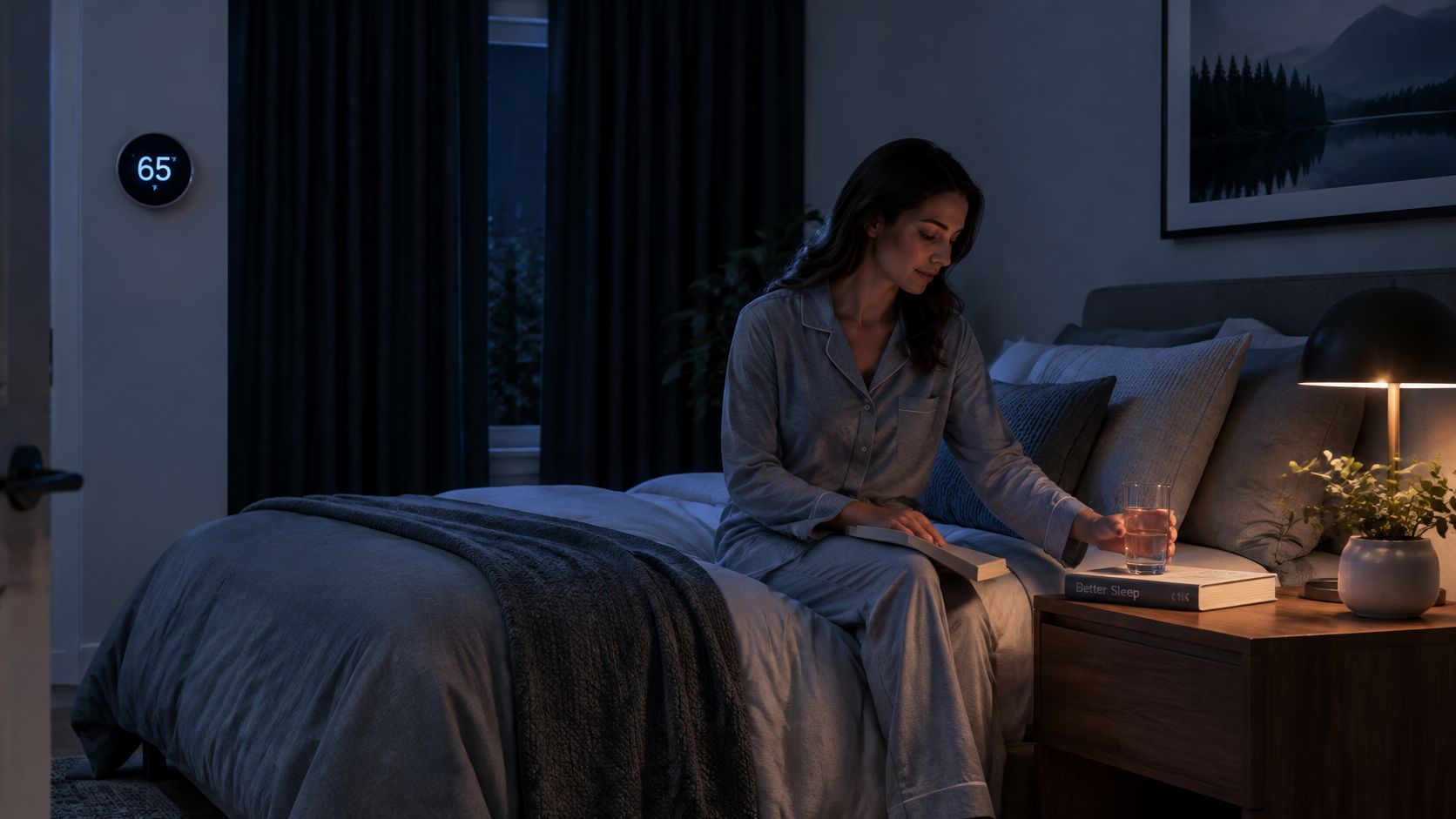
Where the habit acts
In the bedroom, set the temperature around 60 to 67 F (15.5 to 19.4 C). If overheating wakes you, move toward the cooler end of that range or switch to breathable bedding. Block light with blackout curtains or an eye mask. Cut noise with earplugs or a fan, and address a partner's snoring or a pet's schedule when those interruptions show up in the log. The room sets the conditions every other change is tested under.
In the evening, keep ambient light low in the last hour and note in the log whether a dimmer room moves sleep onset earlier. Finish meals 2 to 3 hours before bed. Alcohol speeds sleep onset and then fragments the second half of the night, which is why a nightcap so often pairs with 3 a.m. waking.
During the day, set a caffeine cutoff about 8 hours before bed. Caffeine can stay active through much of the night even when you still fall asleep on time. Keep vigorous exercise earlier: a hard workout near lights-out raises body temperature and alertness just as the window is opening.
Each week, score three items against the log: temperature and light, caffeine and alcohol timing, and noise or interruptions. Keep a change that adds sleep or steadies next-day alertness, and drop the rest. Stacking three new habits in the same week makes the log unreadable, because you cannot tell which variable did the work.
Behavioral Fixes for Bedtime Wakefulness
It's 1:40 a.m. You've been in bed since midnight, checked the clock three times, and each check raises the stakes on the next hour. That loop is what cognitive behavioral therapy for insomnia (CBT-I) is built to break. It is the treatment clinicians start with for chronic trouble falling or staying asleep, and the steps below are the parts an adult can begin while arranging care.
Stimulus control and a steady clock
Use the bed only for sleep and sex. If you've been awake for about 20 minutes, get up, sit in dim light, and return only when drowsy. The bed works like any cue: paired with enough frustrated wakefulness, it starts triggering alertness instead of sleep. Each get-up-and-return cycle retrains the association.
Keep one wake time every day, inside the weekend range you set during the extension weeks, and keep naps within the cap from that same plan. Long, empty time in bed lowers sleep drive, so the fixed window comes before any attempt to widen it. A 15-minute worry period earlier in the evening, with tomorrow's unfinished tasks written down, moves problem-solving out of lights-out.
Sleep restriction, which shortens time in bed on purpose to rebuild sleep pressure, is a structured CBT-I component and should be clinician-guided. A shorter window works like a smaller container, packing the same sleep into a denser block. Cut too far and fatigue and mood worsen, especially for people who drive early or care for others at night.
| Pattern | Likely behavioral cause | Sign it's time to escalate |
|---|---|---|
| Awake in bed for more than about 20 minutes | Bed has become linked with wakefulness | Still happening on most nights despite the get-up rule |
| Long time in bed but short sleep | Excess wakefulness in bed lowers sleep drive | Ask a clinician about supervised sleep restriction |
| Afternoon fatigue with long naps | Late or long naps reduce nighttime sleep pressure | Sleepiness that survives the nap cap belongs in the log |
| Racing thoughts at lights-out | Evening worry and physiological arousal | The worry period is filled in nightly but the mind still races at bed |
| Good sleep on weekdays, poor sleep after weekends | Circadian shift from weekend lie-ins | Wake time already holds steady and Mondays still stay rough |
If these changes haven't improved sleep within about four to six weeks, move to a clinical evaluation. These fixes are a trial with an end date: keep what the log shows helped, drop what didn't, and let the result decide whether to escalate.
Choosing a Provider for Persistent Sleep Problems
Start with the least involved option and step up only if the problem remains.
Primary care comes first. A clinician can screen for mood disorders, thyroid problems, current medications, and sleep apnea, and can decide whether bloodwork or a breathing test is warranted. Many long-sleep complaints stop here, once a sedating medicine or an untreated mood disorder is identified. Arrive with specifics: the date your sleep started stretching, any medication changes around that time, and whether a partner has heard you snore or stop breathing at night. That detail turns a vague report of tiredness into a testable lead.
Sleep medicine is the next step when testing or specialized therapy is needed. That visit can include an in-lab or home apnea study and CBT-I from a trained therapist, including accredited digital CBT-I with clinician oversight. Telehealth can cover intake and follow-up, which matters for patients far from a sleep center.
Broader telehealth is separate from a sleep clinic. Vials + Vitals is a physician-directed telehealth service that starts with an online clinical assessment reviewed by licensed U.S. providers, and it has no sleep-specific protocol. Sleep enters the intake only where it overlaps the concerns the service does treat, which is exactly what makes the distinction useful: weight gain that worsens sleep-disordered breathing belongs in a metabolic evaluation, and night waking from vasomotor symptoms belongs in a hormonal one.
Where weight is part of the picture, GLP-1 and dual incretin protocols such as semaglutide and tirzepatide are titrated for appetite and glycemic control over roughly 12 weeks. That pathway addresses the weight side of sleep-disordered breathing; it is prescribed on metabolic grounds rather than as a way to add hours in bed.
Menopause is the other overlap worth naming. The North American Menopause Society 2022 position statement finds menopausal hormone therapy most favorable for healthy symptomatic women younger than 60, or within 10 years of menopause onset, who have no contraindications. Night sweats break sleep directly, so when a clinician weighs hormone therapy, the target is the symptoms fragmenting the night rather than the length of the night itself.
Order matters because each step rules something out. If the four-week experiment and the behavioral trial both stall, the useful visit is the one that tests breathing, mood, medications, and hormones before anyone reaches for a sleeping pill. More information on structured care is in this overview of insomnia treatment online.
Informational purposes only. Compounded medications are evaluated by a licensed provider for individual suitability and are fulfilled by state-licensed partner compounding pharmacies.
Vials + Vitals provides physician-directed telehealth for metabolic, hormonal, hair, sexual wellness, and longevity protocols, with sleep considered only where it intersects those concerns. Care starts with an individualized intake, and any prescription is made only when a licensed U.S. provider finds it appropriate. If a longer sleep window hasn't improved your days, visit Vials + Vitals to begin that clinical review.