Horsetail Extract for Hair: What the Evidence Shows
Horsetail extract for hair: silica may support fiber strength, but regrowth evidence is limited. Review studies, dosing and safety.
The popular advice to take horsetail because it contains silica skips the most important question: does the ingredient improve the hair fiber, or does it treat the follicle producing it? Those aren't interchangeable outcomes. An ingredient can have a plausible structural role without being an established treatment for thinning or baldness.
For adults considering horsetail extract for hair, the useful distinction is between mineral content, resistance to breakage, and actual regrowth. A clinical assessment should treat those as separate claims, each requiring its own evidence.
Evidence Behind Horsetail Extract for Hair
Horsetail extract has a plausible but unproven role in hair-fiber quality, while strong human evidence that it regrows hair or reverses pattern hair loss hasn't been established. The strongest reason for caution isn't that every reported outcome was negative. It's that the studies often tested something other than horsetail alone, measured something other than regrowth, or had important methodological limitations.
The 2025 systematic review of dietary factors and hair health identified 17 studies involving 61,332 participants, 97% of whom were women, but substantial heterogeneity prevented a meta-analysis. That large combined population shouldn't be mistaken for a large horsetail trial. The review covered dietary factors broadly, and the studies didn't all examine the same ingredient, population, or outcome.
Three claims that require different evidence
Silica content is a composition question. A laboratory can establish that a plant contains silicon-containing compounds, but that finding doesn't establish whether a finished supplement delivers a useful amount.
Hair-shaft strength is a physical-performance question. Researchers can examine fiber thickness, tensile properties, or brittleness without demonstrating that treatment increases the number of growing hairs.
Follicle regrowth is a clinical-treatment question. That requires evidence in people with a defined hair-loss condition, using outcomes that distinguish retained or newly growing hairs from stronger existing fibers.
Horsetail and silicon studies compared
The trials below illustrate why ingredient identity and outcome selection matter as much as a positive result.
| Study | Population | Ingredient and dose | Duration | Result and limit | Evidence strength |
|---|---|---|---|---|---|
| 2007 nine-month silicon trial | 48 women with fine hair | 10 mg/day silicon as choline-stabilized orthosilicic acid, placebo-controlled | 9 months | Greater hair cross-sectional area; not a trial establishing treatment of clinical hair loss | Limited; silicon compound, not horsetail |
| 20-week brittleness trial | Participant details aren't specified in the available clinical summary | 10 mg/day silicon as orthosilicic acid | 20 weeks | Lower hair and nail brittleness; not evidence of follicle regrowth | Limited |
| 2015 randomized trial | 60 women with temporary alopecia | Marine proteins, vitamin C, biotin, zinc, and horsetail; individual ingredient doses aren't specified | 3 months | Improved growth and less loss; high risk of bias | Very low for attributing benefit to horsetail alone |
| 2024 registered trial | Planned enrollment of 45 men aged 18 to 45 | Horsetail-containing supplement in 30 participants versus placebo in 15 | 6 months planned | Results haven't been reviewed here; registration isn't an efficacy finding | Pending |
| 2025 systematic review | 17 studies, 61,332 participants, 97% women | Dietary factors, including supplement studies | Study-specific follow-up; no single treatment duration | Substantial heterogeneity; no meta-analysis | Limited for a horsetail-specific conclusion |
The silicon trial details and distinction between standardized silicon and botanical extracts are summarized in the silica clinical evidence overview, including the nine-month study using 10 mg/day and the 20-week brittleness trial. The registered horsetail supplement study describes the planned 45-man population, treatment allocation, and six-month assessment, not a completed demonstration of benefit.
The temporary-alopecia study assessed hair through clinical examination and phototrichogram, but its combined formulation prevents a horsetail-specific conclusion. A favorable result could reflect another ingredient, the combination, or factors the study design didn't adequately control.
Evidence rule: A positive trial supports the formulation, population, and outcome actually studied. It doesn't automatically support every ingredient on the label.
No well-designed human trial in this evidence set establishes improved follicle density from horsetail in androgenetic alopecia. Fine hair, temporary shedding, and androgen-driven miniaturization aren't interchangeable diagnoses.
The same endpoint discipline applies when evaluating whether exercise helps hair growth. A health-supporting activity and a treatment that changes a diagnosed hair-loss disorder require different kinds of proof.
Three reading rules prevent most overinterpretation: combination formulas prevent ingredient attribution, high risk of bias reduces confidence, and studied silicon compounds aren't equivalent to horsetail extract.
How Silica From Horsetail Might Affect the Hair Shaft
The hair shaft and the follicle are different targets. The follicle produces the fiber, while a change in fiber strength would affect breakage and retained length. Evidence for one outcome does not establish the other.
The chemistry behind the structural hypothesis
The horsetail clinical monograph describes stems containing approximately 5–8% silica and silicic acids, while some preparations provide approximately 2–3% elemental silicon. These figures measure different chemical quantities. A silica percentage cannot be read as an equivalent percentage of elemental silicon.
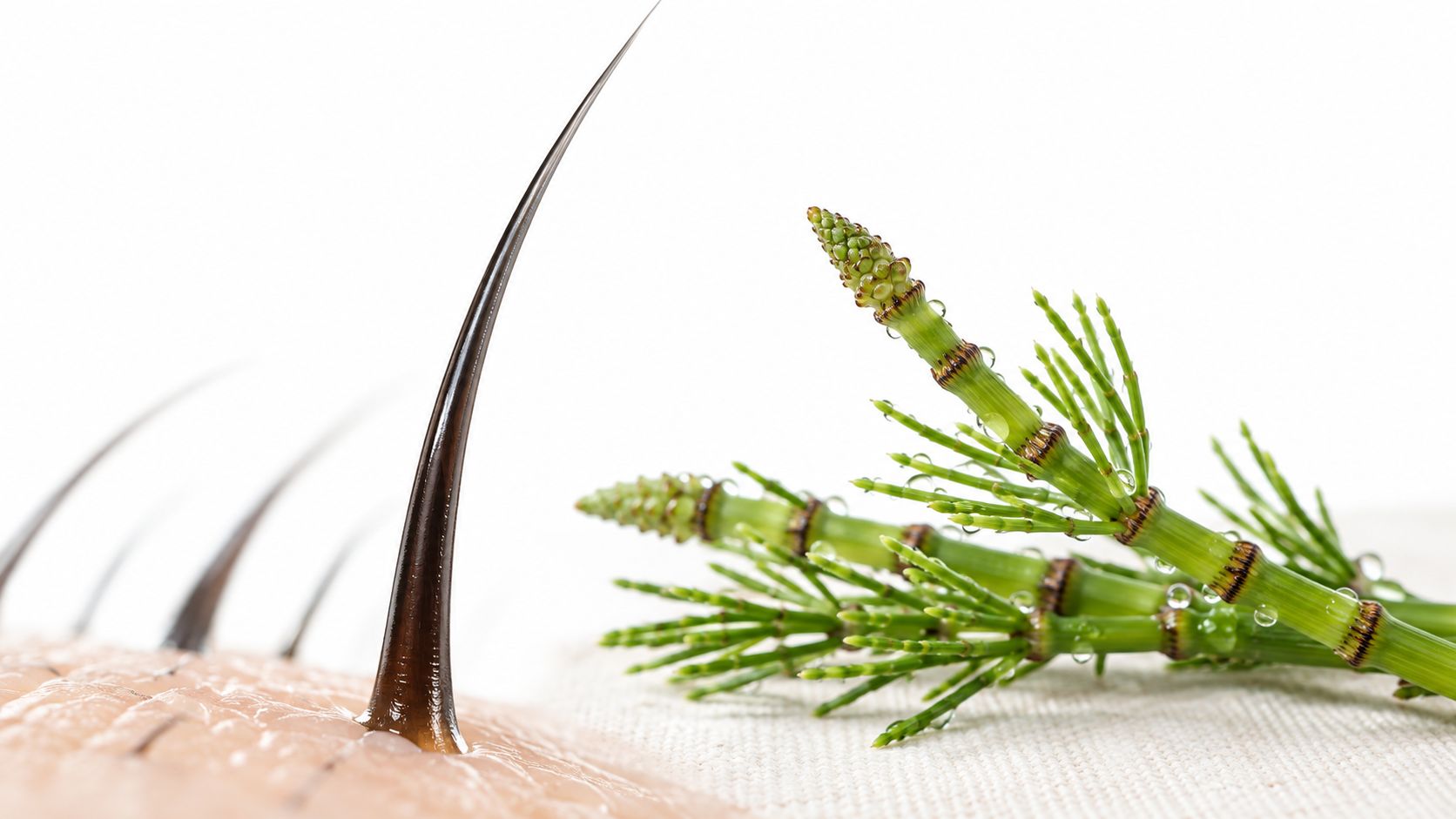
Silicon is an element; silica is a silicon-containing compound. Total extract weight also includes other plant constituents, so neither that weight nor the plant's silica content alone shows how much silicon the body can use.
The proposed mechanism is that bioavailable silicon may contribute to connective-tissue and collagen-related processes. Researchers have examined physical properties such as fiber thickness, tensile strength, and resistance to breakage. These properties relate to the hair shaft, not directly to follicle production.
In clinical studies, use the elemental silicon delivered in a standardized orthosilicic-acid formulation to understand the studied exposure. That figure helps interpret the trial's formulation; it does not establish a comparable amount in a botanical capsule, tea, shampoo, or scalp serum.
A change in fiber properties could affect how much length is retained, even if follicle number remains unchanged. That is a different outcome from regrowth.
The proposed mechanism provides no evidence of altered androgen signaling, dormant-follicle reactivation, or reduced DHT-driven miniaturization. Calling horsetail a DHT blocker would go beyond what this structural hypothesis supports.
Oral silicon findings also do not establish that topical horsetail coats, repairs, or strengthens hair. Route, formulation, absorption, and measured outcome all affect what a finding can support. The defensible conclusion is potential support for fiber quality, not demonstrated reversal of androgenetic alopecia or telogen effluvium.
Dosing and Label Checks Before You Buy
There's no established horsetail dose for treating hair loss. A licensed clinician should determine whether a product belongs in an individual's plan and, if so, set the product choice, dose, duration, and review criteria.
A capsule's extract weight isn't enough to compare products. Even equal extract weights may represent different plant material, extraction methods, and elemental-silicon content.
In a 2024 extraction study published by Springer Nature, silicon recovered from common horsetail extract ranged from 1.1 to 56 mg/L, depending on the solvent, with aqueous extraction yielding the most. Those are extraction-solution concentrations, not recommended human doses or proof that a water-extracted product improves hair.
A practical label-reading routine
Confirm the species. The label should identify Equisetum arvense, not merely horsetail or a proprietary botanical blend. Botanical identity establishes which plant the manufacturer intends to supply.
Find elemental silicon per serving. The amount should be stated in milligrams. A total extract weight or a silica percentage alone doesn't provide the same information.
Identify the extraction method. Documentation should name the solvent, such as water or alcohol, and describe the preparation. A concentrated extract and dried plant powder shouldn't be treated as equivalent.
Request batch standardization. A stated silicon range and a batch-specific result are more informative than an unsupported claim of high silica content. The documentation should correspond to the product and lot being considered.
Review a certificate of analysis. Independent testing documentation should address botanical identity, potency, and relevant contaminants. A testing logo without an accessible report leaves important questions unanswered.
Keep research dosing separate from product dosing. The standardized orthosilicic-acid exposure used in trials is a research reference point. Converting it into a horsetail dose requires information about composition and availability that many labels don't supply.
What documentation cannot establish
A certificate of analysis can help establish what a product contains. It can't prove that the product regrows hair, and a well-standardized extract can still lack clinical efficacy evidence.
The same distinction applies to processing claims. A manufacturer may document a carefully controlled preparation without having tested that preparation in adults with diagnosed alopecia.
Purchasing rule: Missing composition or testing information is a reason to pause, not a reason to estimate a dose.
A sensible sequence is to confirm the species and elemental-silicon amount, examine extraction and testing records, and then bring the shortlist to a clinician. The clinician can decide whether any candidate fits the goal, rather than selecting a product first and trying to justify its use afterward.
Safety, Interactions and Who Should Avoid It
The main safety concerns are not evidence that horsetail regrows hair. They involve possible thiamine loss from crude preparations, uncertainty about use in higher-risk groups, and the risk of misidentified plants. People who are pregnant or breastfeeding should not start horsetail without prescriber advice because adequate safety data are lacking. People with kidney or heart conditions, or taking medicines that affect fluid or electrolyte balance, should also seek review first.
Processing and botanical identity are separate safety issues. A correctly identified plant may still be poorly processed, while careful packaging does not establish that the species has been verified.
Processing and species risks
Crude horsetail contains thiaminase, an enzyme that can destroy thiamine, or vitamin B1. The mineral-analysis paper and associated horsetail safety context discusses processing and botanical identification, including reported inactivation through heat at approximately 100°C, alcohol, or alkaline conditions.
This supports choosing an appropriately processed preparation, not attempting to detoxify horsetail at home. Enzyme inactivation cannot generally be judged by appearance or taste, and home brewing does not establish that a preparation is safe.
Equisetum palustre is a different species that contains toxic alkaloids associated with livestock poisoning. This does not quantify human risk from verified Equisetum arvense, but it makes foraged or unidentified material an avoidable risk.
Safety concerns by group
| Group or situation | Concern | Practical action |
|---|---|---|
| Pregnancy or breastfeeding | Adequate safety data are lacking | Avoid self-starting; ask a prescriber |
| Low thiamine intake or thiamine-dependent conditions | Crude preparations can destroy thiamine | Discuss suitability with a clinician; use a processed product only if approved |
| Kidney or heart conditions | Diuretic activity may affect fluid balance | Obtain clinician review before use |
| Diuretics or lithium | Fluid or medication effects may change with combined use | Ask a pharmacist or prescriber to review the combination |
| Diabetes medication | Glucose effects and interaction data are limited | Use only with a prescriber-directed monitoring plan |
| Foraged or unverified plant material | Equisetum palustre contains toxic alkaloids | Avoid; choose botanically verified products |
The medication cautions are precautionary; hair trials do not establish how often these interactions occur. Bring a list of every prescription, nonprescription medicine, and supplement to a pharmacist or prescriber for review. Include any hair-loss treatment side effects you are managing, so the full regimen can be considered rather than treating a botanical as separate from medical care.
Verified species, appropriate processing, and clinician review can address controllable risks. They do not resolve the uncertainty around long-term use.
How Horsetail Compares With Prescription Hair-Loss Treatments
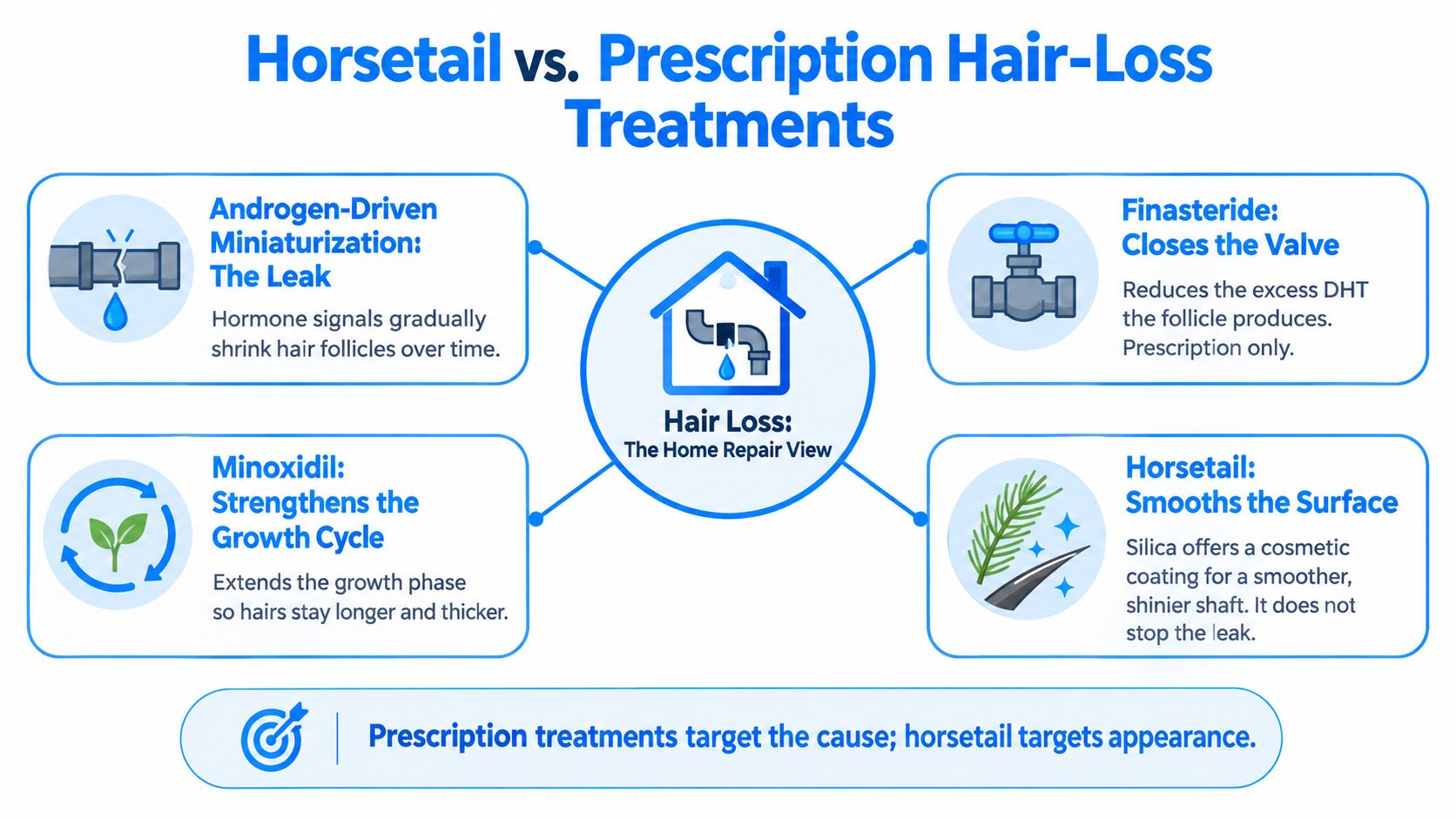
Silica content, hair-shaft strength, and follicle regrowth are separate claims, and evidence for one does not establish the others. Horsetail is proposed as a source of silicon-related structural support for the hair fiber. Prescription treatments target follicular processes involved in pattern hair loss.
Different targets require different protocols
Finasteride inhibits type II 5-alpha-reductase, reducing the conversion of testosterone to dihydrotestosterone, or DHT. The American Academy of Dermatology's male-pattern hair-loss guidance reports that it slows further loss in approximately 80% to 90% of men taking it. Continued treatment is generally needed to maintain benefit.
This figure describes slowing further loss among men taking finasteride. It is not a promise of restored hair or evidence that the same outcome applies to every population.
Dutasteride inhibits both type I and type II 5-alpha-reductase. Topical minoxidil acts through a separate follicular pathway, promoting anagen activity and prolonging the growth phase rather than suppressing DHT production. These differences help explain why a clinician may consider more than one treatment, while a combination is not appropriate or necessary for everyone.
Horsetail and prescription hair-loss options
| Option | Primary target | Mechanism | Evidence for pattern hair loss | Prescribing considerations |
|---|---|---|---|---|
| Horsetail extract | Fiber strength and breakage | Proposed silicon-linked structural effects | No randomized regrowth trials identified in this review | Optional adjunct, not a substitute for diagnosis or treatment |
| Finasteride | Androgenetic alopecia in men | Inhibits type II 5-alpha-reductase, lowering DHT | Evidence supports slowing further loss in men | Prescription; assess pregnancy potential, medications, and individual risks |
| Dutasteride | Androgen-driven hair loss | Inhibits type I and type II 5-alpha-reductase | Discussed as a hair-loss treatment in this comparison of dutasteride versus finasteride; suitability and regulatory status vary | Requires individualized provider judgment |
| Topical minoxidil | Follicular growth phase | Prolongs anagen and supports follicular activity | Evidence supports use for pattern hair loss | Requires consistent use; clinician guidance helps establish suitability |
Choosing between prescription options depends on diagnosis, medical history, pregnancy potential, and regulatory status, not merely on how many enzyme types a drug inhibits. Cardiovascular history also belongs in treatment planning, particularly when a clinician considers minoxidil formulations.
Topical and oral routes are not interchangeable. A compounded combination also needs assessment of its ingredients, formulation, and suitability for the patient. Combining agents does not establish that every outcome will improve.
The practical choice depends on the presentation. Progressive crown or temple thinning calls for evaluation of prescription treatment rather than reliance on a supplement. Breakage without visible thinning may warrant discussion of fiber-directed care. Horsetail or standardized silicon may be considered as optional adjuncts for that purpose, but evidence for shaft support does not demonstrate follicle regrowth. Combinations require individualized judgment.
Confirm the Cause Before Adding Horsetail to Your Routine
The hair pattern should guide the evaluation before a supplement is selected. A receding hairline, diffuse shedding, and broken ends can look like the same problem to a patient while requiring different clinical responses.
Hair pattern and the cause to rule out
| Hair pattern | Causes to rule out | Next step |
|---|---|---|
| Gradual thinning at crown or temples | Androgenetic alopecia | Evaluation by a dermatologist or prescriber |
| Sudden, diffuse shedding | Telogen effluvium, iron deficiency, thyroid disease | Clinician-directed blood work and medication review |
| Patchy hair loss | Alopecia areata and other inflammatory conditions | Dermatology referral |
| Brittle hair, breakage at the ends, no visible thinning | Mechanical or chemical damage, fiber fragility | Gentler care; discuss silicon-based options with a clinician |
The table supports triage, not self-diagnosis. Iron status and thyroid function may warrant assessment in diffuse shedding, but a clinician should select tests from the history and examination rather than order the same panel for everyone.
A cause-first assessment
Document the change. Record the pattern, duration, and timing relative to illness, medication changes, pregnancy, or a new styling routine. Consistent photographs can help separate perceived change from visible progression.
Arrange the appropriate workup. Sudden, patchy, or unexplained diffuse loss warrants clinical evaluation. Medication review, scalp assessment, and selected laboratory testing can be more useful than adding another supplement.
Define the adjunct's purpose. Once the likely cause is clearer, any discussion of horsetail should specify the goal, such as less breakage, rather than use hair growth as an undefined endpoint.
A physician-directed telehealth intake can review eligibility and individual suitability before any prescription or compounded option is considered. Some presentations still require an in-person scalp examination or dermatology referral.
Prescription treatments and compounded formulations are prescribed strictly at the clinical discretion of licensed US healthcare providers following an individualized telehealth intake and consultation.
Informational purposes only. Compounded medications are evaluated by a licensed provider for individual suitability and are fulfilled by state-licensed partner compounding pharmacies.
Vials + Vitals offers physician-directed telehealth assessment and individualized consideration of hair-health treatment options. Adults considering horsetail alongside prescription care can visit Vials + Vitals to begin a confidential clinical intake and discuss whether a supplement, prescription treatment, or further evaluation fits their presentation.