Best Hair Comb for Your Hair Type and Goals
Find the best hair comb for your texture, with tooth-gap ranges, material trade-offs, detangling steps and cleaning guidance from a clinical perspective.
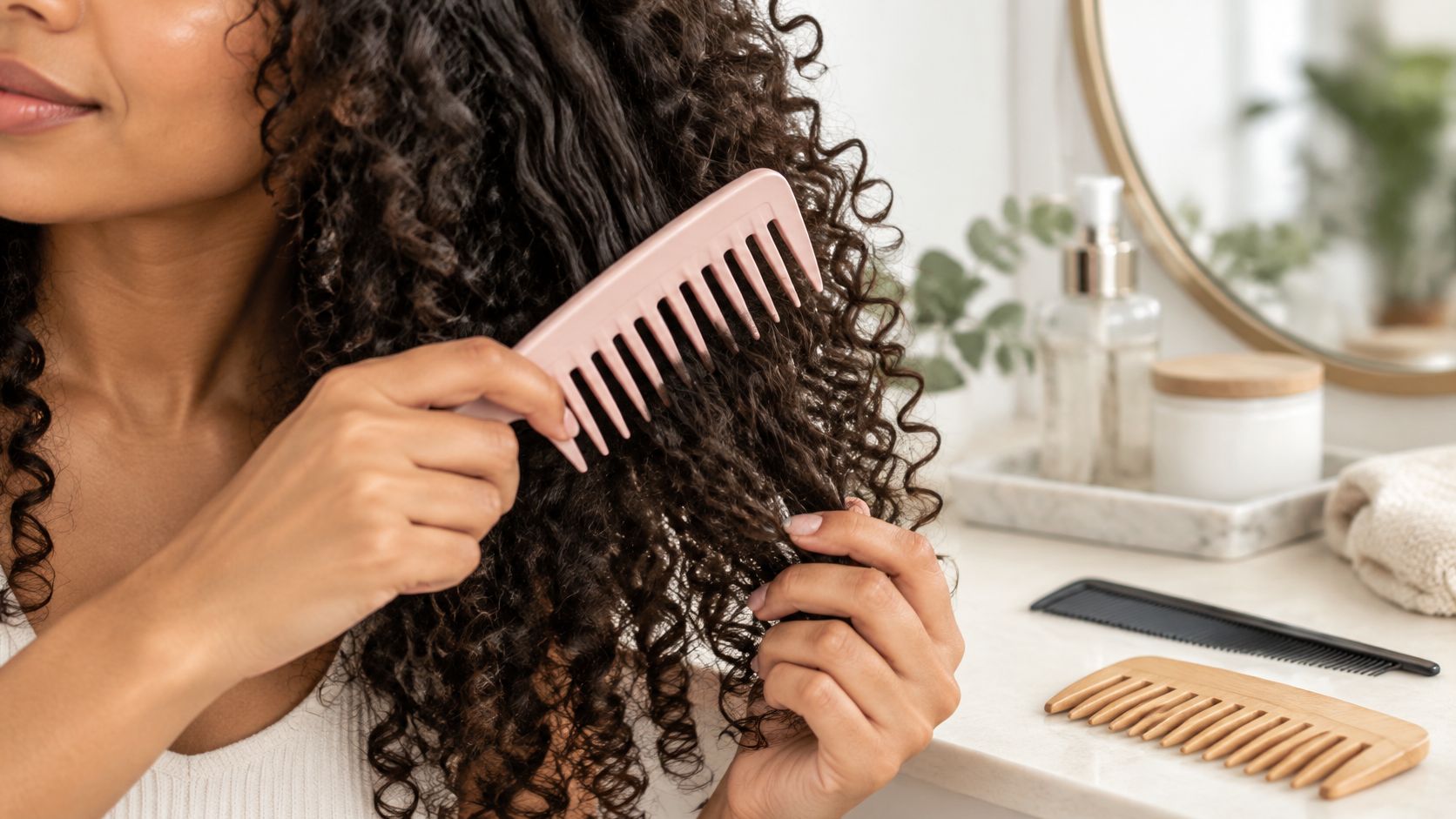
“Use a wide-tooth comb on wet hair” is popular advice, but it isn't a universal rule for preventing breakage. The best hair comb depends on hair texture, chemical processing, the amount of tangling, and whether the task is detangling or styling. A comb that moves quickly through hair isn't necessarily the one that creates the least mechanical stress.
A clinically useful approach separates tool selection from technique and hygiene. Tooth spacing determines how hair enters the comb, surface finish affects snagging, and maintenance determines whether the tool remains suitable for continued use. None of these features makes a comb a treatment for follicular hair loss.
Best Hair Comb by Hair Type at a Glance
Comb type and tooth gap by hair profile
| Hair profile | Comb type | Approximate tooth gap | Detangling timing |
|---|---|---|---|
| Straight, fine or oily | Fine-tooth for parting, standard-tooth for lengths | 1-2 mm for parting; 2-3 mm for lengths | Dry, or lightly misted with leave-in |
| Straight, medium to thick | Standard-tooth with rounded tips | 2-3 mm | Dry, with a compatible conditioning product on the ends |
| Wavy | Wide-tooth comb | 3-4 mm | Dry for knots; damp with conditioner for clumps |
| Curly | Wide-tooth comb or flexible detangling brush | 4-6 mm | Damp, with leave-in conditioner |
| Coily | Wide-tooth comb with smooth, rounded teeth | 5-7 mm | Wet, with a slip product |
| Bleached or chemically treated, any texture | Wide-tooth comb with smooth finish | 4-6 mm | Conditioner applied before combing; reassess slip before each pass |
These gap ranges are approximate practical reference values, not manufacturer specifications, validated clinical thresholds, or proof that a particular measurement prevents breakage. The timing recommendations are starting points rather than instructions to continue through resistance.
The broad selection rule is to choose the widest gap that still provides adequate control. Hair must fit between the teeth, and compressing a bundle into those spaces contributes to combing force. Technical work identifies friction, curvature, stiffness, and tooth geometry as relevant variables, rather than material alone, in models and experimental assessments of combing force.
Checks before the first pass
- Identify the hair profile. Consider strand thickness and curl pattern separately, then note bleaching or other chemical processing. Fine strands can still have a tightly coiled pattern.
- Name the task. Detangling requires space for hair to move. Parting requires precision, so a fine-tooth end shouldn't automatically become the tool for working through tangled lengths.
- Inspect the working surface. A fingertip passed gently along the teeth can reveal rough spots or sharp edges before hair encounters them.
Wet appearance also shouldn't determine comb choice by itself. Guidance on why hair looks thin when wet can help separate an appearance concern from the practical task of removing knots.
The most important texture caveat comes from a technical review of hair-combing behavior: highly coiled African hair required less combing work when wet, whereas wavy-to-straight hair required less work when dry. The same comb can therefore suit one routine and work poorly in another.
How Tooth Spacing and Material Change Breakage
In controlled testing with a 33-gram load, hair-on-hair contact produced 9 impacts and 11 broken hairs, compared with 109 impacts and 9 broken hairs when fibers struck a comb tooth; the mechanical-damage research also describes compression and abrasion at the tooth interface. These findings identify different damage pathways, not a direct ranking of retail combs.
Tangles can concentrate stress where strands encounter one another. The tooth surface adds another contact point, which is why both spacing and finish matter. A wide gap doesn't compensate for a rough edge.
The same research describes increased short- and long-segment breakage after bleaching, reduced breakage with commercial conditioner, and repeated grooming as a fatigue process modeled using Weibull analysis. In plain language, repeated loading can extend microscopic flaws until a fiber fails. Conditioning before working through treated hair is therefore more defensible than relying on a premium material label alone.
Material trade-offs for comb construction
The following comparisons are practical purchasing considerations, not evidence that one material produces superior clinical outcomes. Actual construction quality and manufacturer care instructions remain important.
| Material | Strength | Trade-off | Best hair match |
|---|---|---|---|
| Wood, such as beech | Smooth when well sanded; useful for distributing natural oils during dry styling | Porous; soaking can encourage swelling, warping, or cracking | Straight to wavy hair, particularly dry styling |
| Smooth plastic or polymer | Often affordable, with consistent tooth shape | Static can be troublesome on fine hair; molding burrs require inspection | Everyday use, including curly hair when spacing is suitable |
| Stainless steel | Rigid, durable, and accessible for cleaning | Rigid teeth offer little flexibility through knots; rough edges are unsuitable | Precise parting and controlled work on already-detangled straight hair |
| Silicone or flexible rubber | Flexible construction and a useful wet grip | Thin teeth may tear; residue requires attention | Conditioned detangling routines, including coily hair |
A flexible tool may feel more comfortable than a rigid comb, but flexibility isn't proof of lower cumulative breakage. A reasonable comparison uses similar sections and conditioning, with attention to catching and pulling rather than speed alone.
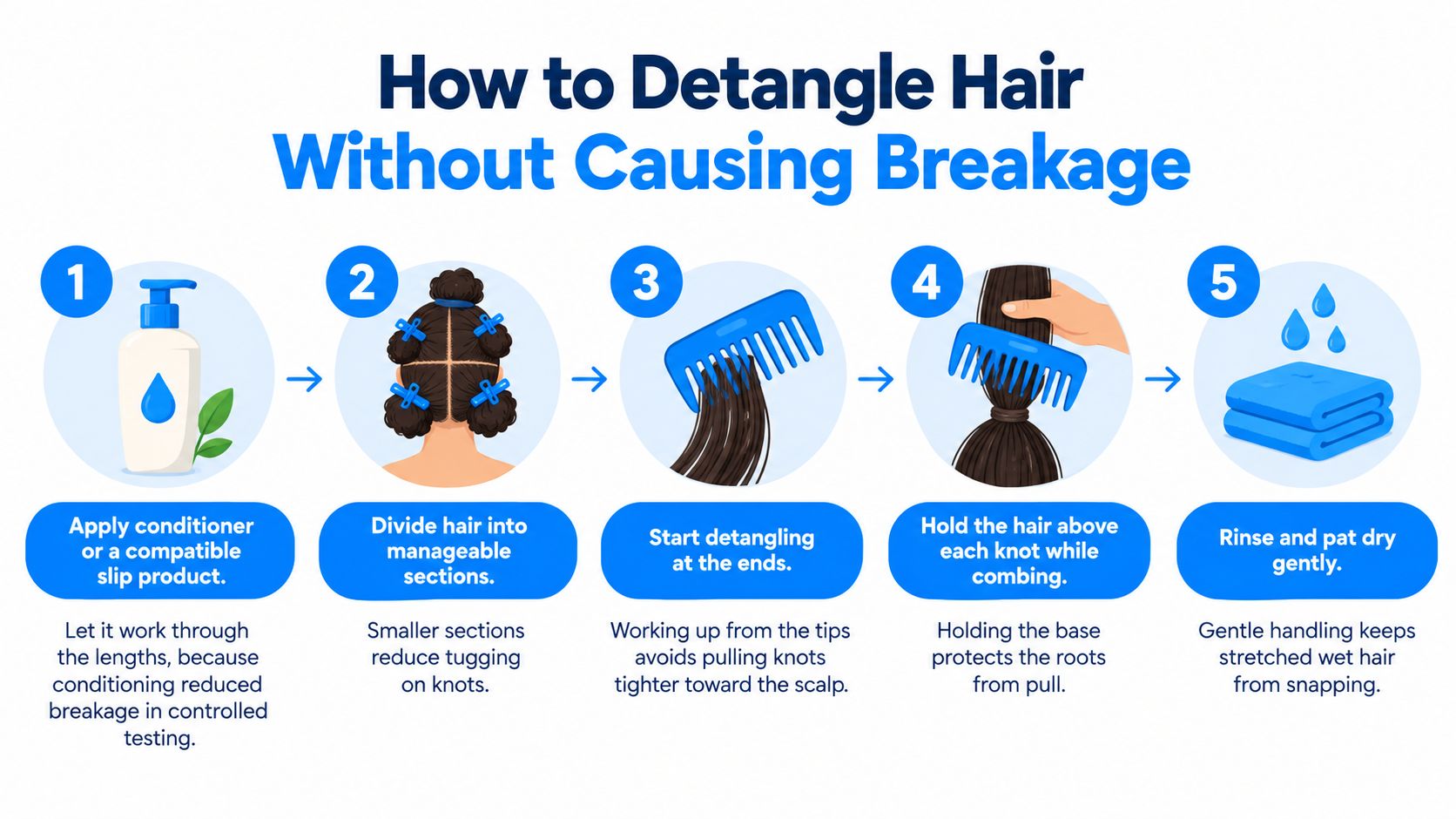
Inspection rule: A material label can't establish whether an individual comb has smooth, evenly finished teeth.
Before purchase and periodically afterward, the inspection should include rounded tips, molding seams or burrs visible under light, and teeth that sit evenly. Bent teeth that create irregular spaces are a reason to retire the tool, not press harder.
How to Detangle Hair Without Causing Breakage
No technique can promise breakage-free grooming. A useful protocol instead reduces avoidable pulling and gives the person handling the comb clear stopping points.
A low-tension detangling procedure
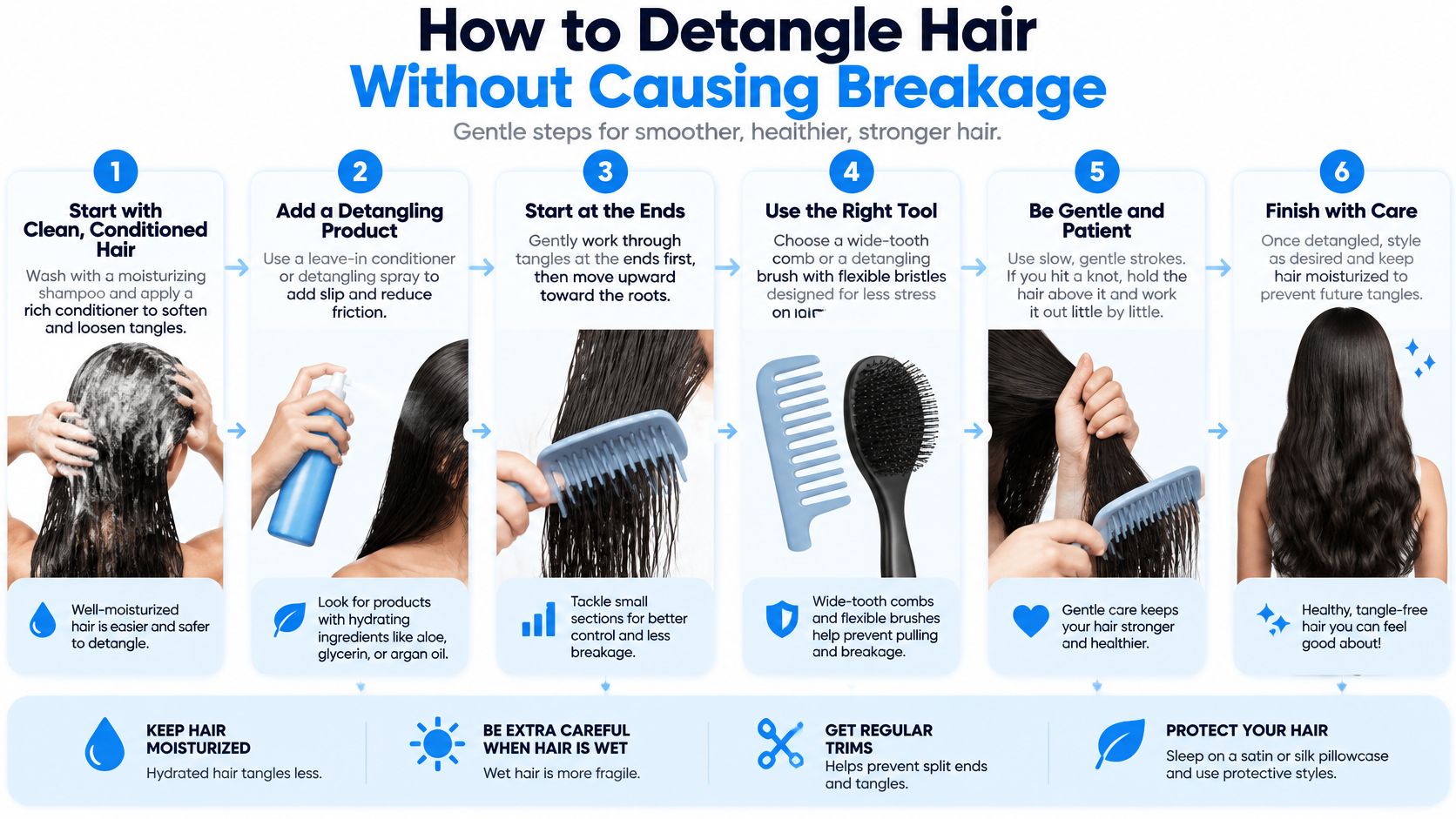
Apply conditioner or a compatible slip product. The product should reach the tangled lengths rather than remain only on the outer surface. The conditioning evidence described above supports preparing the hair before attempting knot removal.
Divide hair into manageable sections. Four to six sections can serve as a practical starting arrangement, not a clinically established requirement. Dense or heavily tangled hair may need smaller working areas.
Begin at the ends with a wide gap. Starting below a knot avoids dragging the comb from the scalp through every obstruction at once. The first movement may involve only a short portion of the ends.
Hold the section above the working area. Stabilizing the hair limits how much pulling reaches the scalp. The hand should support the section without stretching it taut.
Progress upward in short strokes. Once the lower portion releases, the next pass can begin slightly higher. Long, uninterrupted pulls aren't necessary to demonstrate progress.
Stop when resistance increases. More slip, a smaller section, or gentle manual separation is preferable to forcing the teeth through a knot. Pain is a reason to stop, not evidence that detangling is working.
Finish when the section is adequately detangled. Repeated polishing passes aren't required. The fatigue mechanism described earlier supports avoiding unnecessary loading.
The wet-versus-dry decision
Water changes the mechanical behavior of hair rather than making it safer or less safe on its own. In controlled wet- and dry-combing research, wetting reduced short-segment breakage through clumping and reduced end wrapping, but could increase longer breaks as water plasticized the fiber and contributed to more severe snags; reported center-bundle forces were approximately 33.1 ± 3.9 and 49.0 ± 3.2 gram-force under dry conditions, versus 146.2 ± 21.2 gram-force when wet.
Those measurements describe tested conditions, not a prediction for every head of hair. They explain why wet detangling still requires sufficient slip, low tension, and a suitable tooth gap.
The texture findings in the first comparison provide the starting branch: wavy-to-straight hair can begin with dry knot removal, while coily hair may be more manageable in a conditioned wet routine. Chemically treated or highly porous hair warrants particularly cautious handling whichever branch is chosen. A section that repeatedly catches needs reassessment rather than more force.
For styling after knot removal, guidance on how to get wavy hair for men can help keep shaping decisions separate from detangling decisions.
Fewer visible fragments after wet combing don't necessarily mean less damage. Wet clumping can conceal short fragments while some breaks occur farther up the strand.
Comb Choices for Styling and Thinning-Prone Hair
No evidence presented by the combing studies establishes that a comb prevents follicular hair loss or regrows hair. Its role is narrower: supporting grooming while limiting avoidable shaft damage. Reduced breakage and improved follicular growth are different outcomes.
A fine-tooth end is useful for defining a part after tangles have been removed. A tail comb can separate sections for braids or twists without requiring repeated passes through the lengths. Neither task requires pulling a section tightly against the scalp.
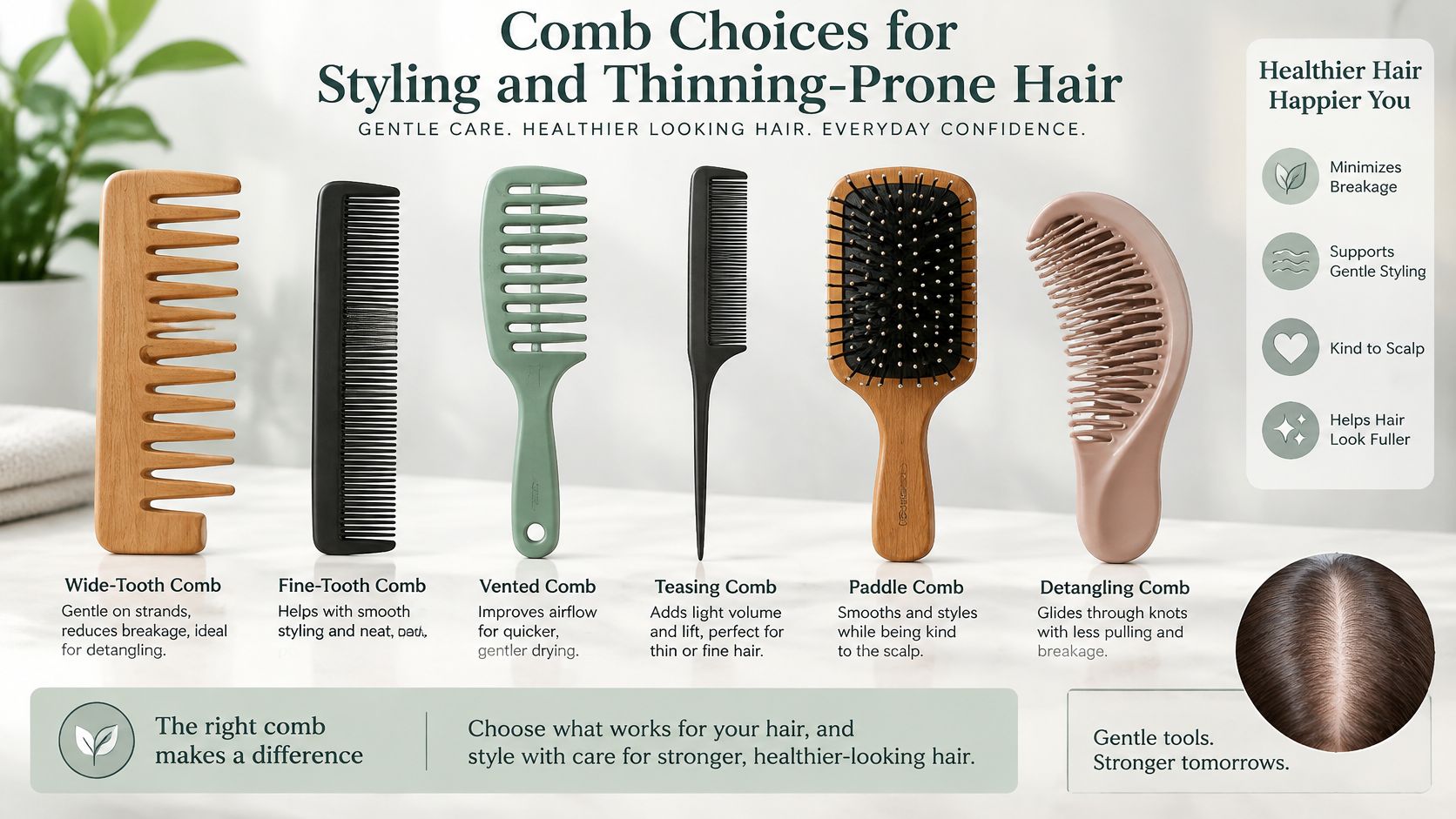
Styling goals and treatment goals differ
For someone concerned about thinning, the styling goal is control without repeated root tension. Guidance on how to give hair more volume can inform appearance choices, but a fuller-looking style doesn't establish a change in hair growth.
Prescription decisions require a different assessment. The American Academy of Dermatology's male-pattern hair-loss guidance reports that finasteride slows further loss in approximately 80% to 90% of men who take it, with some experiencing regrowth, and describes topical minoxidil as requiring once- or twice-daily application with approximately 6 to 12 months before visible improvement; complete regrowth shouldn't be expected.
Finasteride addresses the DHT-related pathway involved in androgenetic hair loss rather than the friction encountered during combing. Minoxidil is used to support follicular growth, not to lubricate knots or repair damaged lengths. Medication selection should therefore follow evaluation of the loss pattern, timing, contraindications, and likely adherence.
Finasteride also carries pregnancy-related precautions because it can cause birth defects. Finasteride, dutasteride, minoxidil, and topical or oral combinations aren't interchangeable choices to make from a grooming guide. Prescription treatments and compounded formulations are prescribed strictly at the clinical discretion of licensed U.S. healthcare providers following an individualized telehealth intake and consultation.
- Keep styling tension low. Sections should remain comfortable at the scalp rather than tightly stretched.
- Allow breaks between tight styles. Repeated pulling on the same area isn't a useful strategy for maintaining a neat appearance.
- Arrange clinical review for change. Rising shedding or a widening part warrants assessment, supported by the monitoring log described below.
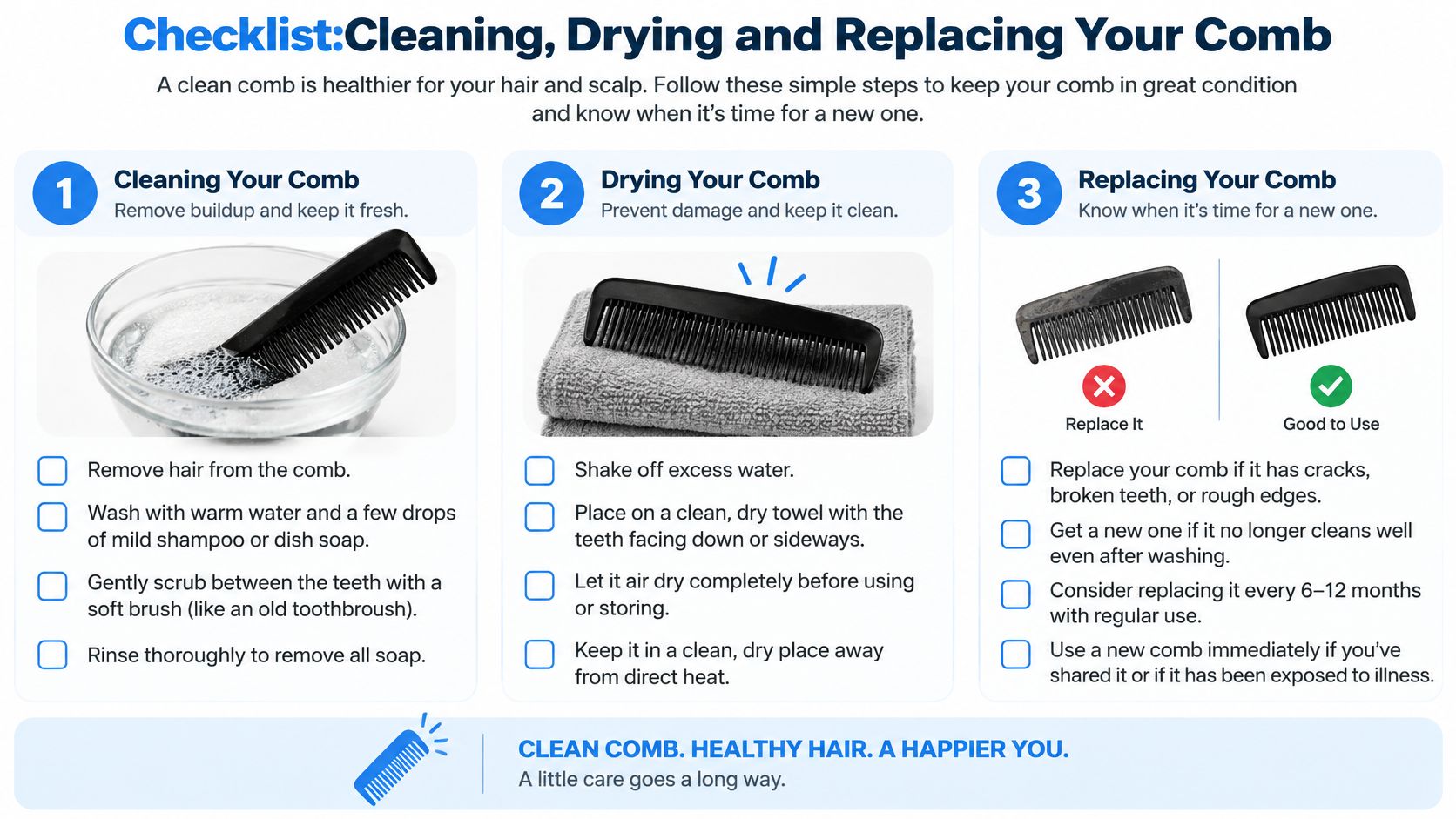
Cleaning, Drying and Replacing Your Comb
One examination found fungal contamination on 111 of 120 combs, or 92.5%, including Microsporum, Trichophyton, Aspergillus, and Candida, as reported in the hair-tool contamination literature. That finding doesn't prove an ordinary household comb causes infection. The same literature supports water plus detergent for reducing microbial content on tested tools, not a claim that household washing sterilizes them.
A practical maintenance routine
Trapped hair should be removed after each use, followed by cleaning appropriate to product buildup and the material. A weekly deeper wash is a practical starting schedule for a daily-use comb, not a research-established interval. Fully drying the tool before storage matters, especially when it has porous components.
Cleaning method and replacement triggers by material
| Material | Cleaning method | Replace when |
|---|---|---|
| Wood | Brief hand wash with warm water and mild detergent, if permitted by the manufacturer; air dry flat without soaking | Cracks, splits, loose teeth, or persistent odor |
| Smooth plastic | Warm detergent water, followed by rinsing and complete drying | Burrs, cracked teeth, or buildup that won't rinse away |
| Stainless steel | Warm detergent water; dry thoroughly | Bent teeth, rust, or pitting |
| Silicone or flexible rubber | Mild detergent after use, particularly when coated with product; rinse and dry | Tearing, thinning teeth, or persistent sticky residue |
Common hygiene questions
Can a comb spread dandruff or scalp fungus? The contamination findings don't establish that ordinary household use causes either condition. Avoiding shared tools during an active scalp condition is a reasonable precaution without treating all flaking as an infection.
How can a comb be disinfected without damage? Routine washing and true disinfection aren't equivalent. Warm water and mild detergent provide a supported cleaning approach; any disinfectant should be compatible with the manufacturer's instructions.
Should wooden combs be replaced sooner? Replacement should follow condition rather than a fixed calendar. Porous wood requires complete drying and retirement at the first sign of cracking, and soaking should be avoided because it can damage the construction.
Replacement threshold: A comb that can't be cleaned thoroughly or no longer has an intact, smooth working surface has reached the end of its useful life.
- Surface damage: Cracks, splits, or burrs.
- Tooth damage: Loose, bent, or uneven teeth.
- Persistent residue: Buildup or odor that remains after appropriate cleaning.
Confirm Your Comb and Plan the Next Review
The final choice should be a tool-and-technique combination, not just a material or a tooth count. A reasonable starting comb matches the hair profile, passes inspection, and can be cleaned and dried reliably within the person's routine.
A practical review sequence
- Match the profile and task. Select the comb category and approximate gap from the first table, distinguishing knot removal from precision styling.
- Check construction and maintenance. Smooth teeth and a manageable cleaning routine take priority over claims printed on packaging.
- Keep a short trial log. A two-week observation period can serve as an organizational tool, not a validated clinical test. Entries can record visible broken fragments, detangling time, scalp comfort, product use, and whether hair was dry, damp, or wet.
- Change one variable when possible. Continued catching despite conditioning may justify a wider gap, smaller sections, or a different moisture state. Changing everything at once makes the result harder to interpret.
- Escalate a changing pattern. Increasing shedding or a widening part should prompt clinical review rather than repeated purchases of different combs.
A count of collected hairs isn't a diagnosis, and home observation may not reliably distinguish shedding from breakage. The log is most useful as a description of what changed and under which grooming conditions.
The best hair comb is the one that provides necessary control with tolerable resistance, an intact surface, and a sustainable hygiene routine. Continued thinning deserves a follicular assessment even when grooming technique has improved.
Vials + Vitals offers individualized telehealth intake and consultation, with a licensed U.S. provider reviewing the history and determining eligibility for hair-retention care; prescription treatments and compounded options are prescribed strictly at that provider's clinical discretion. Adults concerned about persistent thinning can visit Vials + Vitals and use its Follicular Retention Index to organize their history before consultation.
Informational purposes only. Compounded medications are evaluated by a licensed provider for individual suitability and are fulfilled by state-licensed partner compounding pharmacies.