Why Hair Looks Thin When Wet and What to Do About It
Find out why hair looks thin when wet, when it signals real loss, and what actually helps. Clear clinical guidance with practical fixes that work.
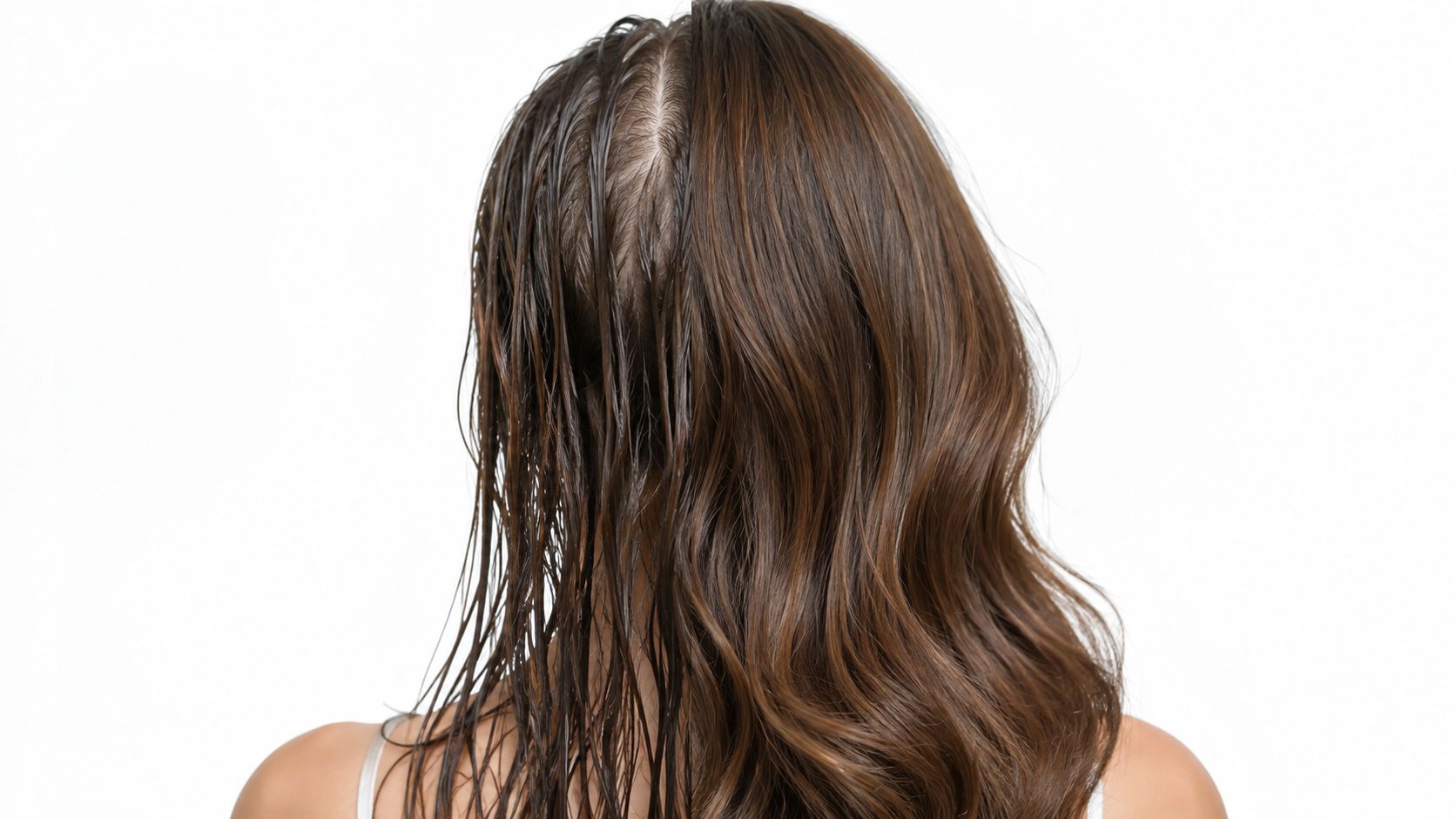
A wet mirror is one of the least reliable places to diagnose hair loss. When hair looks thin when wet, the immediate change usually reflects fiber optics and mechanics, not a sudden reduction in follicle activity. Water makes strands heavier, closer together, and more visibly grouped, so the scalp can show through even when dry-hair density is stable.
That reassurance has limits. Wet clumping can expose an existing low-density area, and persistent shedding, breakage, scalp inflammation, or progressive changes deserve assessment. The useful question isn't whether the scalp is visible after shampooing. It's whether the hair looks different when dry, and whether that difference persists.
The Wet-Hair Panic That Usually Isn't Warranted
The popular advice is often too simple: “Wait until it dries.” That advice can prevent unnecessary panic, but it doesn't provide a way to distinguish a temporary appearance from a genuine change. A wet reflection is a lighting-and-mechanics snapshot, not a clinical examination.
Water separates the visual question from the biological one. A follicle produces a fiber below the scalp. Once that fiber emerges, its appearance can change with water, friction, chemical treatment, heat, styling, and breakage. The number of active follicles doesn't suddenly drop because the shaft became saturated.
Practical rule: Judge density with dry hair under consistent lighting and a similar part, not from a single shower mirror.
Wet hair can still be useful as an observation point, especially if it reveals a new pattern. A part that has progressively widened, a crown that remains more visible after drying, or an area with short broken hairs tells a different story from strands that gather into narrow bundles during washing.
The distinction matters because false reassurance and unnecessary alarm cause opposite problems. Assuming every wet-hair change is hair loss can lead to frantic product switching and excessive checking. Assuming every change is harmless can delay evaluation of pattern loss, telogen shedding, shaft breakage, or an inflamed scalp.
The rest of the assessment should follow a simple order:
- First, examine the fiber. Ask whether water, porosity, friction, or damage explains the temporary appearance.
- Next, assess the dry hair. Compare the part, temples, crown, hairline, and overall volume over time.
- Finally, screen for symptoms. Ongoing shedding, bald patches, pain, scale, redness, or systemic changes shift the question from cosmetic appearance to medical evaluation.
A calm approach doesn't dismiss the concern. It places the concern in the right biological compartment. Wet-hair thinness usually begins with the shaft, while genuine hair loss involves the follicle, the growth cycle, or the scalp environment.
What Water Actually Does to a Single Hair Fiber
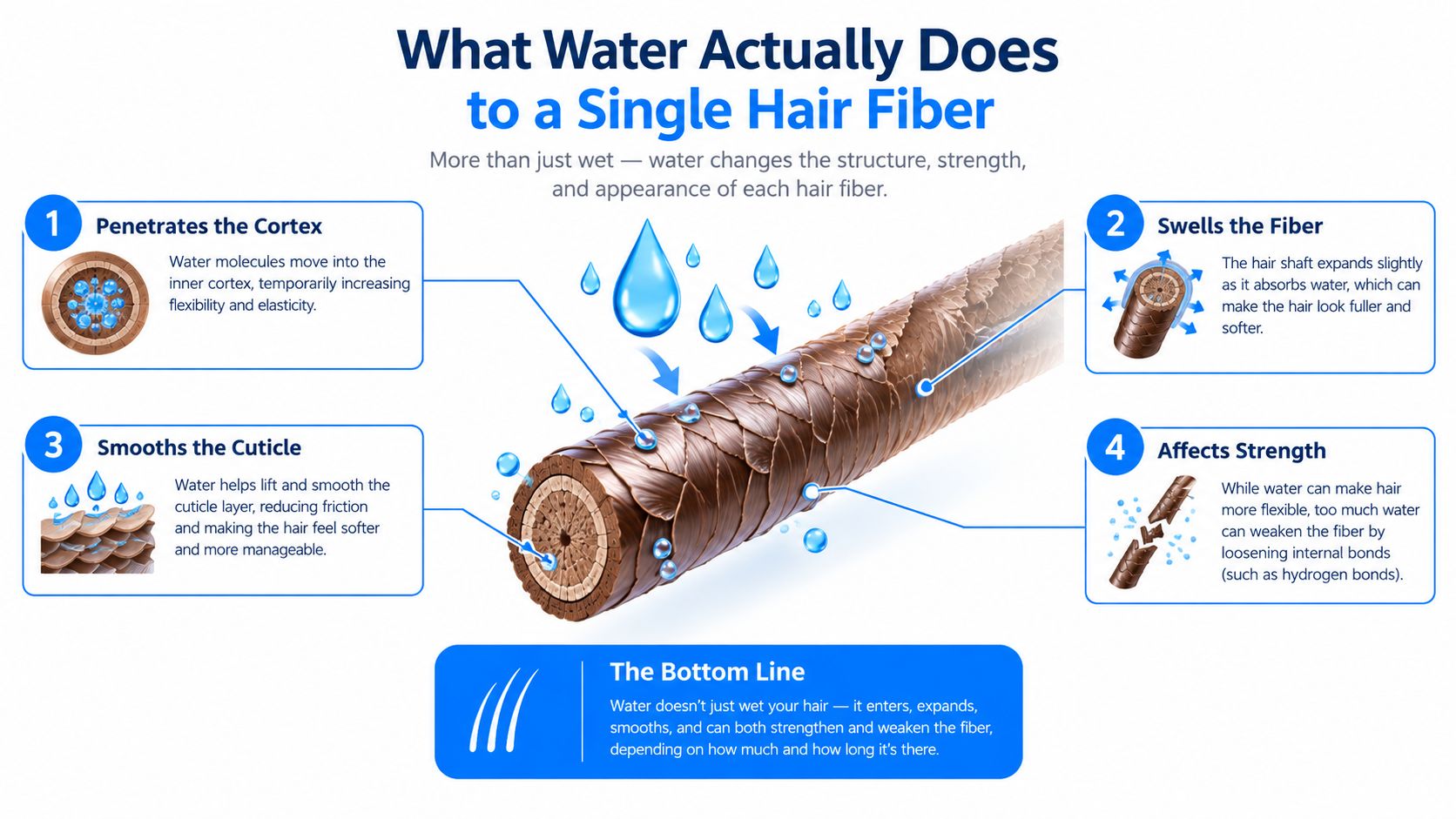
Wet hair can look thinner without any immediate change at the follicle. The apparent loss begins with the fiber's interaction with water, then becomes more noticeable as neighboring strands gather together. Hair is hydrophilic, so its keratin structure readily takes up water. That absorption can reach 40% of the fiber's own weight, changing how the shaft behaves and feels. (Scholarly hair-science review)
Dry hair behaves like separate threads spread across a surface. Each strand catches air and occupies some space around its neighbors. Water makes those threads heavier and more cohesive, so they settle into narrower groups. The amount of hair is unchanged, but the same material covers less visible area.
Swelling changes the visual geometry
Water also changes the shaft's dimensions. Dedicated hair-swelling measurements report an increase of roughly 10–15% in thread diameter and 0.5–1.0% in length, with results varying according to hair condition and measurement method. The useful distinction is that diameter changes more visibly than length. A strand may therefore appear fuller when dry and more compact when wet, even though its follicle remains unchanged.
Hydrated fibers also retain liquid. A historical hair study reported approximately 31–33% liquid retention after 30 minutes of equilibration in water. A wet shaft is consequently heavier and more vulnerable to mechanical stress, especially during rubbing, brushing, or detangling.
Clumping reduces apparent coverage
Dry hair has more loft. Air and friction keep fibers separated in three dimensions. Saturated strands lie closer together and align into visible strings or clumps. Each group leaves wider spaces around it, increasing the contrast between scalp and hair.
Wet hair can also appear darker and flatter, which makes exposed scalp easier to notice. Curls and coils may show the strongest shift because water encourages definition and compact grouping. This change is a fiber-optic effect, similar to viewing separate threads after they have been pressed into bundles.
Mineral deposits can create another source of roughness and buildup. Readers with hard water can review guidance on how to stop mineral buildup from tap water, although reducing deposits will not alter baseline follicle density.
The sequence is simple:
- Water enters the keratin structure.
- The fiber swells and gains weight.
- Neighboring fibers align into bundles.
- Air space and root lift decrease.
- The scalp becomes easier to see between clumps.
For that reason, wet-hair thinness should first be interpreted as a temporary optical and mechanical change. Persistent thinning becomes more concerning when the dry appearance, shedding pattern, or scalp findings also change.
Normal Hair Counts on a Healthy Scalp
A wet reflection needs context before it can say anything useful about hair loss. A Harvard-hosted biological reference reports an average density of approximately 223 terminal hairs per square centimeter, with a broad normal range of 175–300 hairs/cm². (Harvard BioNumbers reference)
That range is a reference, not a pass-or-fail test. Density varies across the scalp. The temples and crown can reveal more scalp because of parting, growth direction, regional density, or naturally finer coverage. Strand diameter also changes the visual result. A dermatology review describes typical fiber diameters of 57–90 micrometers among Europeans and up to about 120 micrometers among Asians, showing why thickness affects fullness alongside strand count. (Scholarly hair-science review)
A 2020 study of 239 adults, including 79 men and 160 women, with an average age of 37.9 years, measured density and diameter at several scalp sites. Its regional means were:
| Scalp Region | Mean Density (hairs/cm²) | Mean Diameter (µm) |
|---|---|---|
| Frontal | 154.3 | Approximately 80–81 |
| Vertex | 162.9 | Approximately 80–81 |
| Temporoparietal | 133.7 | Approximately 80–81 |
| Occipital | 160.2 | Approximately 80–81 |
These values describe group averages, not a personal diagnosis. A lower temple density can be normal, especially if the area has looked similar for years. Wet clumping may make that baseline variation easier to see.
Density and diameter create fullness together
Two people can have similar strand counts but different apparent coverage when one has finer fibers. Fine hair can still be healthy and relatively dense. Water reduces the separation and lift that help fine or medium fibers look fuller when dry.
Compare the dry part, hairline, crown, and overall shape rather than judging one shower photograph. Consistent dry photographs taken under similar lighting can show whether the part is widening or the crown is changing over time. That comparison helps separate a temporary optical effect from a persistent shift that deserves clinical assessment.
Why Damaged Hair Looks Even Thinner in the Shower
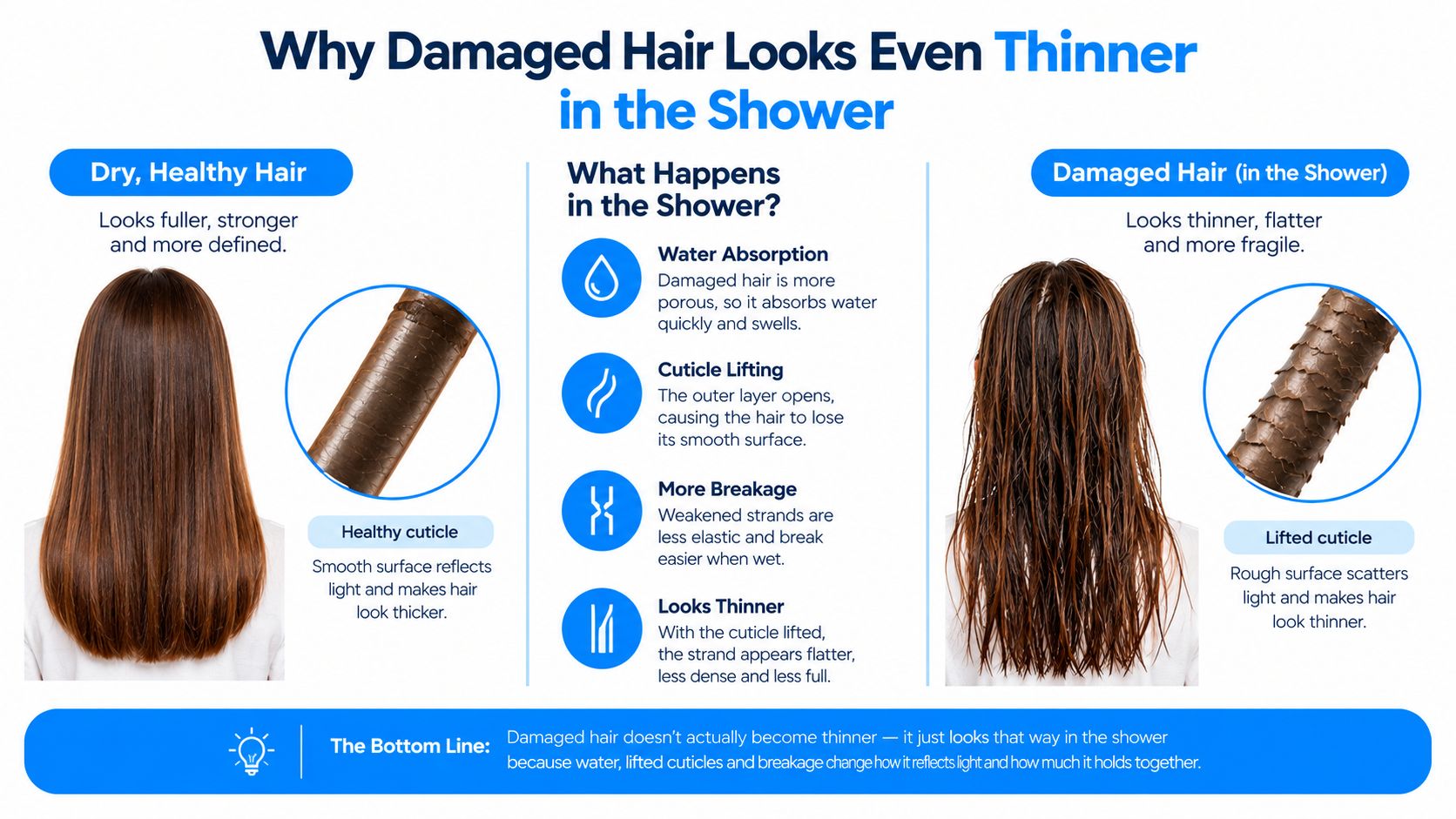
Wet-hair thinning is often a fiber-optic effect before it is a follicle problem. Water changes how individual fibers bend, cling together, and reflect light. If the shaft is already porous or rough, those changes become more visible.
Virgin hair generally has a more intact cuticle and greater resistance to water entering the shaft. Chemical processing and repeated heat can disrupt that surface, allowing the fiber to take up water more readily. Straightening and bleaching also reduce hydrophobicity, the water-repelling behavior associated with a healthier cuticle. Research on treated fibers has found substantially greater water permeability than in virgin hair, so processed strands can become heavier and lose their dry shape sooner.
Intact and damaged fibers behave differently
| Fiber condition | Response to water | Expected wet appearance based on fiber behavior |
|---|---|---|
| Relatively intact | More controlled penetration and stronger surface cohesion | Bundles may look fuller and regain more spring after drying |
| Bleached or straightened | Greater permeability and more altered cuticle behavior | Clumps may look flatter, stringier, and more scalp-revealing |
| Repeatedly heat-stressed | Lower resilience and greater fragility | Irregular clumps, roughness, or short broken hairs may stand out |
These are behavior-based expectations, not measurements of every person's hair. A damaged fiber is not automatically a damaged follicle. The scalp can continue producing hair normally while the exposed shaft becomes rough, porous, and easier to break. That distinction matters because a cosmetic shaft problem does not prove follicle miniaturization.
Highly porous hair can absorb water quickly and lose dry volume sooner. Cuticle disruption also raises friction during handling, so the same clumping that creates a thinner wet appearance can increase the risk of breakage. Seeing more scalp while wet alongside short fragments after styling points toward a different concern than seeing fewer full-length hairs in the shower.
If dry density remains stable, begin with fiber protection: gentler handling, conditioner, fewer high-heat passes, and less overlapping chemical processing. General information about best serums and shampoos for hair loss can help with product context, but cosmetic shaft care is separate from treatment for diagnosed follicular loss.
Hair may look fullest after careful drying and arrangement, then most revealing when saturated. A stable dry appearance supports a fiber explanation. Progressive change in dry density, the part, or the hairline deserves clinical assessment.
A Gentle Post-Wash Protocol That Protects Each Strand
Wet hair is more vulnerable to mechanical damage. Water alters friction, extensibility, and the behavior of the cuticle, while combing and towel-rubbing add bending and tensile forces to a hydrated shaft. The American Academy of Dermatology advises handling wet hair as little as possible because it breaks more easily when combed or brushed. (American Academy of Dermatology hair-care guidance)
A practical routine can stay simple.
Use less force from the start
After rinsing, squeeze out excess water with the hands. Blot or wrap the hair instead of scrubbing it, and avoid twisting saturated hair tightly on top of the head.
Apply conditioner before detangling. Conditioner reduces friction and makes it easier for a comb or fingers to move through the shaft without pulling. A wide-tooth comb is generally less aggressive than a fine-tooth tool.
Detangle according to texture
For straight hair, allow partial air-drying before detangling. Begin at the ends, clear small knots, and work upward toward the roots. Starting at the scalp and dragging through every tangle concentrates force across the most vulnerable length.
Tightly curled or textured hair may be best detangled while damp, because attempting to separate it when fully dry can create more dry-friction breakage. The goal isn't to follow a rigid wet-versus-dry rule. The goal is to choose the state that gives the hair enough slip and flexibility with the least force.
- Blot first: Remove excess water without rough towel friction.
- Condition before combing: Reduce resistance before applying tension.
- Work in sections: Smaller sections improve control and expose fewer tangles at once.
- Start at the ends: Move gradually toward the roots.
- Limit heat: Avoid repeated high-heat styling, particularly before the hair has dried.
- Stop at resistance: Add conditioner or detangling slip rather than forcing a tool through a knot.
A person concerned about persistent thinning can review hair loss treatment that actually works for broader treatment context, but a post-wash routine cannot diagnose the cause of loss. It can reduce preventable shaft damage while the underlying question is evaluated.
How to Tell Clumping Aside From Real Shedding
The strongest clue is what remains after the hair dries and what changes over time. A wet part that closes visually after drying is different from a part that stays wider in standardized dry photographs. A bundle of long strands is different from a growing number of short broken pieces. A clean, comfortable scalp is different from a scalp with pain, redness, scale, pus, or sores.
Use pattern rather than drain counts
Shower counts are poor diagnostic evidence on their own. Hair retained between wash days can appear all at once, while the amount seen in the drain varies with wash frequency, detangling habits, and hair texture.
Clinical references describe a positive hair-pull test as roughly more than 4–6 hairs removed per pull and note that daily scalp-hair counts above 100 are generally abnormal, although up to 250 hairs after shampooing may still occur normally. (Merck Manual overview of alopecia) These figures should not be converted into a home diagnosis. A clinician interprets them alongside scalp examination, timing, density, medications, nutrition, and symptoms.
A useful home comparison includes:
- Dry part width: Is the part progressively wider under similar lighting?
- Crown and hairline: Does visibility persist after complete drying?
- Ponytail or braid size: Has the overall circumference consistently reduced, accounting for haircut and breakage?
- Shaft length: Are there many short fragments with varied lengths?
- Scalp condition: Is there itching, redness, thick scale, pain, pus, sores, or scarring?
- Timeline: Did the change begin after illness, major stress, childbirth, surgery, medication changes, or weight loss?
Separate shedding, breakage, and patterned thinning
Telogen effluvium usually produces diffuse, nonscarring shedding rather than a sharply defined bald patch. The scalp often looks healthy even though more full-length hairs are coming out. Breakage behaves differently. It leaves short, uneven fragments and may concentrate where heat, chemicals, tight styles, or rough detangling have stressed the shaft.
Patterned loss tends to appear as progressive miniaturization or distribution-specific change. A widening part, increasing crown visibility, or receding hairline after drying deserves a clinical assessment rather than repeated mirror checks.
Sudden bald patches, rapidly progressive loss, persistent shedding for several months, or hair loss accompanied by fatigue, weight change, menstrual changes, itching, or pain should prompt professional evaluation. A dermatologist may use scalp examination and pull testing, and may order blood tests or a biopsy when disease, nutrient deficiency, hormonal imbalance, or infection is possible.
A reader seeking additional context about hair appearing to fall out in clumps can see what PRP For HairLoss says, but online descriptions shouldn't replace examination when the pattern is new or progressive.
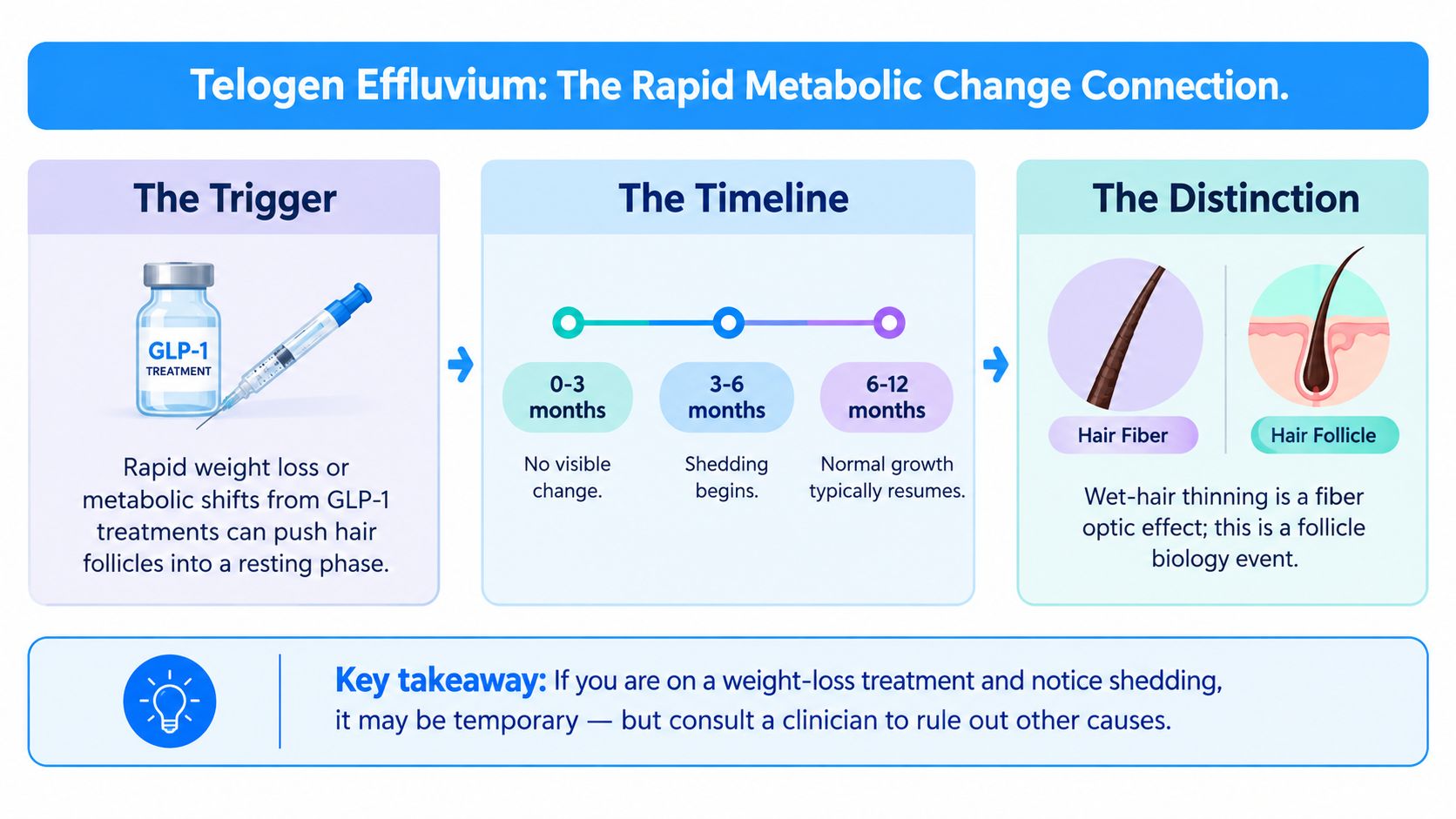
When Weight-Loss Treatment and Hair Loss Cross Paths
Hair can respond to major metabolic change even when the medication isn't directly toxic to follicles. Rapid or substantial weight reduction may shift the growth cycle, nutritional intake, and physiologic priorities. In that setting, shedding can reflect telogen effluvium, a follicle-cycle response that often appears after the triggering change rather than immediately during it.
Semaglutide trial summaries reported alopecia in 5.3% of participants who lost at least 20% of body weight, compared with 2.5% of participants who lost less. The comparison supports a possible relationship between substantial weight change and shedding, but it doesn't establish causation or prove a direct toxic effect on follicles. (Semaglutide trial summary)
The medication question needs context
A person taking semaglutide or tirzepatide shouldn't automatically stop treatment after noticing hair in the shower. The safer conversation includes the rate of weight change, calorie and protein adequacy, other medications, recent illness, baseline hair density, and whether the shedding is diffuse or patterned.
The clinician should also ask whether hair changes began after a dose adjustment or after a broader period of reduced intake. Treatment decisions depend on the full clinical picture, not on a wet-hair reflection or a single drain observation.
| Finding | More consistent with temporary shedding | More concerning for another process |
|---|---|---|
| Distribution | Diffuse across the scalp | Patchy, sharply localized, or patterned |
| Scalp | Looks healthy | Pain, redness, scale, pus, sores, or scarring |
| Shaft | Mostly full-length shed hairs | Numerous short broken hairs |
| Context | Follows major weight or metabolic change | Occurs with progressive dry-hair density loss |
| Next step | Review nutrition, timing, and monitoring | Arrange dermatology evaluation |
Hair is a useful physiologic signal during metabolic treatment. It can reveal that weight is changing quickly, intake is inadequate, or another condition deserves attention. A prescriber can assess whether titration, nutrition, laboratory testing, or a separate hair evaluation is appropriate.
Readers exploring structured metabolic care can review a metabolic reset review, then bring specific timing and symptom details to a licensed clinician. The purpose is not to dismiss shedding. It's to identify whether the trigger is rapid weight change, medication timing, nutritional stress, shaft damage, pattern loss, or an unrelated scalp disorder.
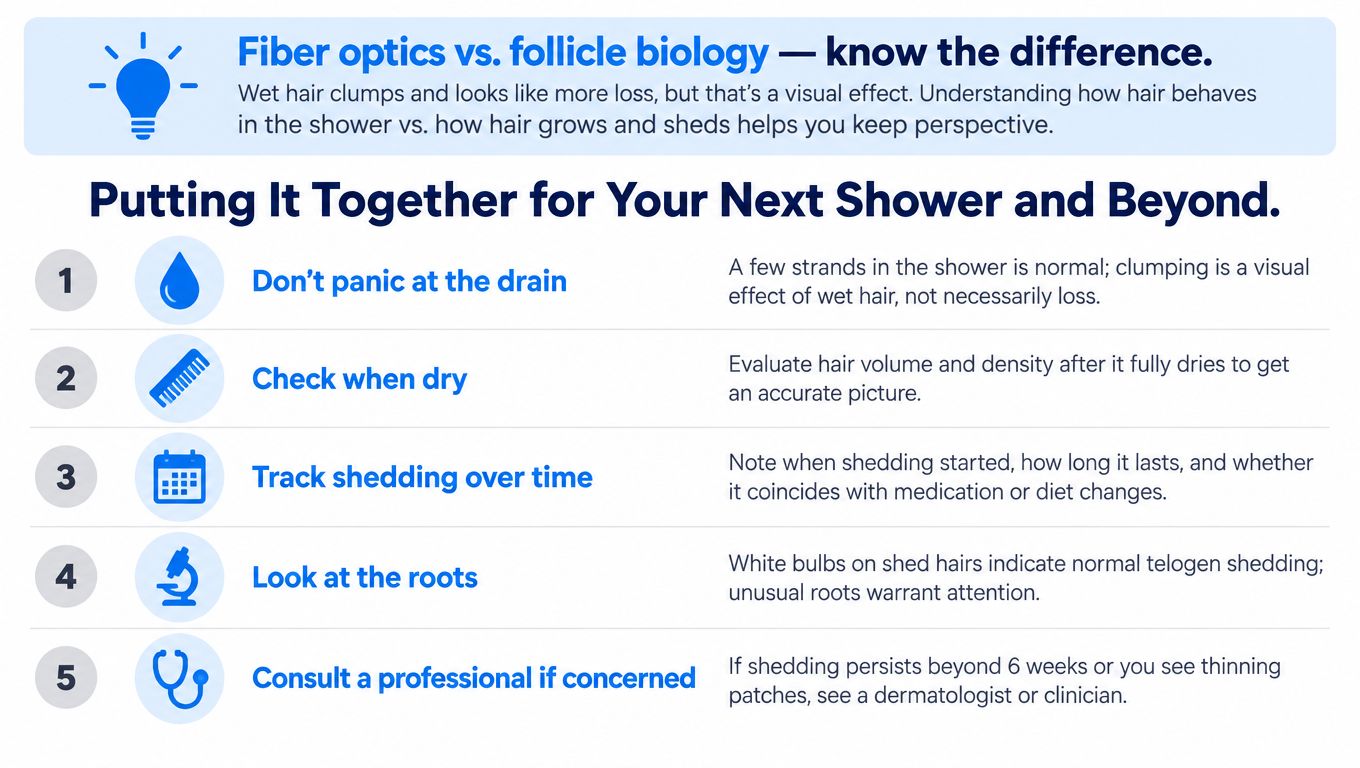
Putting It Together for Your Next Shower and Beyond
The most useful mental model is compact: fiber optics first, follicle biology second. Water can make normal hair look sparse by reducing loft and increasing clumping. Persistent dry-hair changes, ongoing shedding, broken shafts, or scalp symptoms require a different response.
A practical checklist keeps the next shower from becoming a diagnostic ritual:
- Assess after drying: Compare the part, crown, and hairline when the hair is fully dry.
- Handle gently: Blot, condition, and detangle from the ends upward with the least force that works.
- Track trends: Use consistent photographs rather than relying on memory or one drain count.
- Review metabolic timing: Note whether shedding followed rapid weight loss, reduced intake, illness, or a medication change.
- Escalate appropriately: Seek dermatology care for bald patches, progressive thinning, persistent shedding, pain, inflammation, or systemic symptoms.

For readers managing weight changes alongside hair concerns, a weight loss plateau guide can provide broader metabolic context. The clinician conversation should include the timing of shedding, the pace of weight change, dietary adequacy, current medications, and dry-hair photographs.
Vials + Vitals provides physician-directed telehealth assessment for metabolic health and hair-loss concerns, including individualized review of GLP-1 treatment factors and follicular changes. Visit Vials + Vitals to begin a confidential clinical assessment and discuss whether the next step is monitoring, laboratory evaluation, or a prescription-strength treatment plan.