Best Way to Masterbate Men: Technique, Safety and Care
Learn the best way to masterbate men with evidence-based technique, pressure control, safety steps and when to see a clinician. Non-graphic, practical guidance.

A man may notice that his usual masturbation routine feels less satisfying, requires more pressure, or doesn't translate comfortably to sex with a partner. Searching for “best way to masterbate men” often produces competing techniques, when the more useful question is which variable needs adjusting: pressure, speed, setting, or goal.
A clinical approach treats masturbation as sexual self-knowledge, not a performance test. The aim is a comfortable, repeatable pattern that supports the person's preferences without pain, loss of control, or pressure to reach a particular outcome.
Quick-Pick Guide to Techniques by Goal
There's no single best masturbation technique, because the appropriate approach depends on what a man wants to understand or change. Masturbation can help someone identify preferred pressure, speed, rhythm, and stimulation, but frequency alone doesn't determine whether the habit is healthy or satisfying, as explained in clinical guidance on masturbation and sexual health.
A useful starting point is a specific goal rather than a stronger sensation. Someone seeking comfort needs a different approach from someone practicing ejaculation control.
Masturbation Techniques by Goal
| Goal | Technique | How to start | Main caution |
|---|---|---|---|
| Comfortable baseline stroke | Light to moderate grip with water- or silicone-based lubricant | Gradually vary speed and pressure | A very tight grip may make other touch feel less responsive |
| Ejaculation control | Stop-start training | Short practice sessions with pauses before ejaculation becomes unavoidable | Waiting too long to pause |
| Ejaculation control with added pressure | Squeeze variation at the glans, the penile head | Gentle pressure followed by full rest | Painful or forceful squeezing |
| Longer plateau | Edging with breathing pauses | Pause when arousal rises steeply | Turning the session into a performance test |
| Non-ejaculatory orgasm exploration | Pelvic-floor awareness and slower rhythm, with toys optional | Low-intensity exploration without an outcome deadline | Pain, bruising, or numbness |
| Breaking a narrow pattern | Occasional sessions without pornography | Compare responses over several weeks | Treating abstinence as a universal solution |
Choosing a Useful Starting Point
The most useful row is the one that addresses the person's actual concern. A man who feels sore afterward shouldn't begin by trying to extend the session. Someone comfortable with his routine but curious about control can focus on recognizing rising arousal instead.
Progress is better judged through comfort, control, satisfaction, and everyday functioning than through duration or frequency. Relevant questions include whether the experience feels voluntary, whether recovery is comfortable, and whether the habit interferes with sleep, work, or relationships.
Practical rule: A technique that feels flat, sore, or compulsive calls for changing the variables, not increasing intensity.
Changing everything simultaneously makes the result difficult to interpret. Beginning with a comfortable baseline, then testing a single adjustment, gives a clearer picture of personal response.
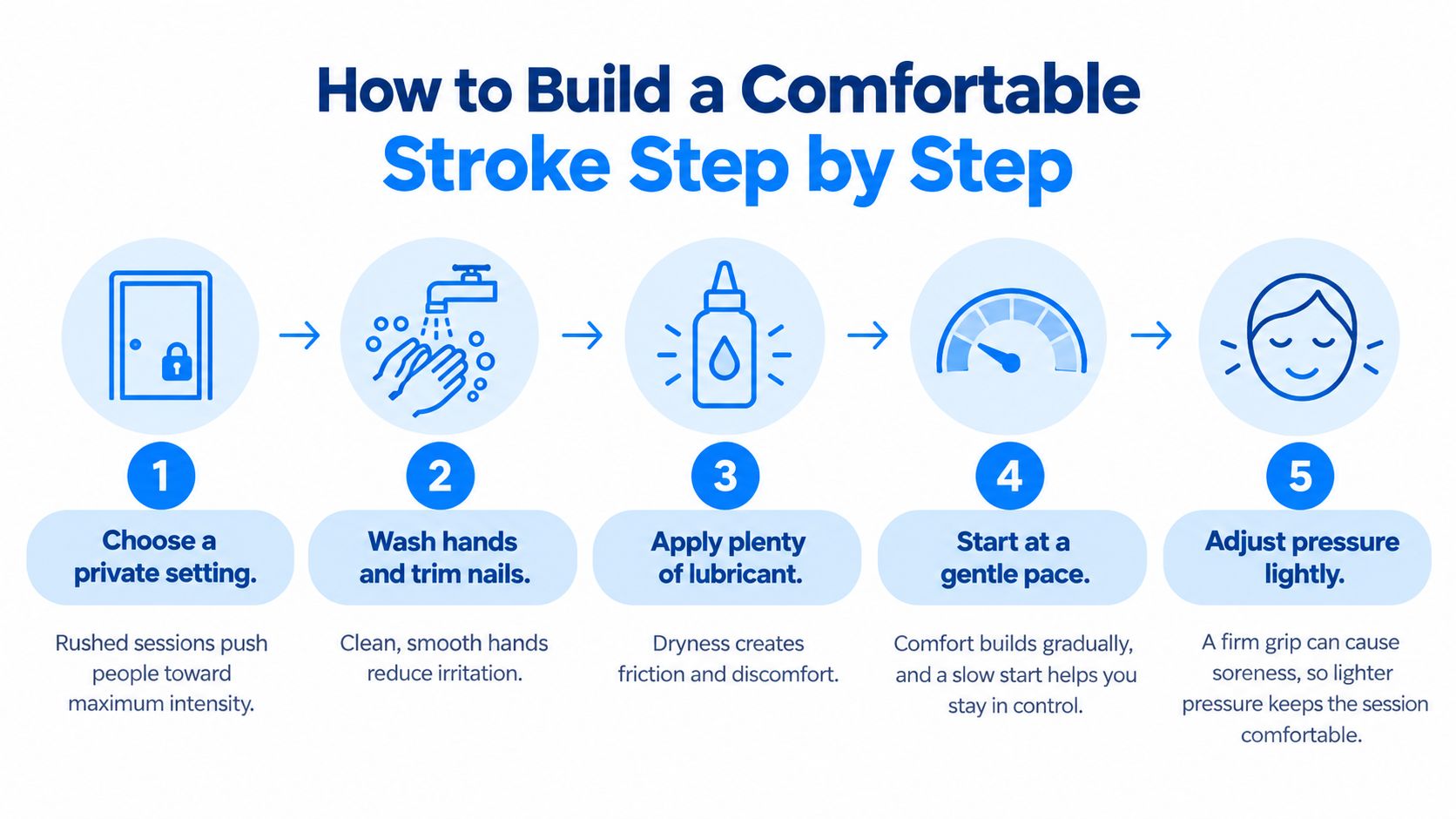
How to Build a Comfortable Stroke Step by Step
A comfortable baseline provides a reference point for later experimentation. NHS sexual-health guidance emphasizes individual preferences, gradual adjustments, and attention to irritation or persistent changes in sensation.
Establishing the Baseline
A private, interruption-free setting comes first. Enough privacy allows the person to notice sensations without rushing toward an outcome. A setting that encourages haste isn't ideal for comparing subtle differences in comfort.
Hands should be clean, with nails short and smooth. Basic preparation reduces avoidable scratching and irritation. Any existing skin injury is a reason to postpone practice rather than work around it.
Water- or silicone-based lubricant can reduce uncomfortable friction. Product labels should be checked for compatibility with condoms and toys. Oil-based products shouldn't be paired with latex condoms, and silicone lubricant should only be used with a silicone toy when the manufacturer confirms compatibility.
A loose grip and slow initial movement establish comfort. The early phase is an opportunity to assess friction, not to test maximum intensity. Pulling, burning, or uncomfortable skin stretching signals that the approach needs changing.
Pressure, speed, and rhythm should be tested separately. For example, pressure can become slightly lighter while speed stays unchanged. Only after that comparison should another variable change, making the result easier to interpret.
Pain, bleeding, swelling, or numbness ends the session. These aren't signs of productive training or barriers to push through. Persistent symptoms require clinical assessment.
Gentle cleaning and an afterward check complete the routine. The person can note whether normal touch remains comfortable afterward and the following day. Lasting sensitivity changes deserve evaluation rather than another experiment.
Recognizing an Overly Narrow Pattern
A common difficulty is relying on the same position, rapid movement, and high pressure every time. For some men, that unusually intense pattern may make other forms of stimulation feel less responsive.
That possibility doesn't establish nerve damage or mean that a preferred technique is inherently harmful. A reasonable adjustment is to reduce intensity and introduce variation while observing comfort.
A simple record might describe the session as “lighter pressure, unchanged speed, comfortable afterward.” Detailed scoring isn't necessary when a plain description captures the difference.
The useful outcome is a repeatable comfort baseline, not a perfected stroke. Masturbation can support self-knowledge, but it isn't established as a universal treatment or prevention method for erectile dysfunction.
How to Train Ejaculation Control With Stop-Start
Practice begins with lubricant and moderate stimulation. The pace should allow attention to changes in arousal rather than produce an immediate rush toward ejaculation.
All stimulation stops before ejaculation becomes unavoidable. The important cue is the rising sensation that ejaculation is approaching, not the moment when it has already begun.
The pause continues until arousal noticeably decreases. There's no need to fight the sensation with forceful pressure. The pause itself is part of the exercise.
Stimulation resumes, followed by further pause-and-resume cycles. Ejaculation may occur after several cycles, but completing a rigid sequence isn't necessary.
The squeeze variation is optional. The NHS ejaculation-problems guidance describes gentle pressure at the penile head for 10 to 20 seconds, followed by approximately 30 seconds of rest.

What the Exercise Trains
Stop-start practice focuses on recognizing the pre-ejaculatory plateau, the stage of sustained arousal before ejaculation becomes inevitable. The aim is greater awareness and less automatic escalation, not indefinite delay.
Short, regular practice over several weeks is more useful as a learning exercise than an occasional endurance attempt. Moderate pressure also makes it easier to distinguish rising arousal from discomfort.
Psychosexual counseling, which addresses psychological and relationship aspects of sexual difficulties, may include stop-go and squeeze methods for premature ejaculation. Outcomes vary with psychological factors, relationship context, erectile function, and consistency; there isn't a universal success rate.
Logging Progress Without Chasing Duration
A brief note can capture when the pause occurred and how it felt. “Paused early and settled comfortably” offers more useful information than recording only total session length.
Useful observations include:
- Timing of recognition: Whether the person noticed the approaching threshold before control was lost.
- Response to the pause: Whether arousal decreased without discomfort or urgency.
- Consistency across sessions: Whether the threshold became easier to recognize over time.
- Emotional response: Whether practice felt manageable or increasingly frustrating.
Common mistakes include waiting too long, squeezing painfully, practicing only at maximum speed, and expecting every session to last longer than the previous one.
A shorter session with earlier recognition can represent better learning than a longer session spent struggling against ejaculation.
A clinician can reassess the approach when several weeks bring no useful change. Erection problems, significant distress, or pain justify earlier review rather than continued self-training.
Pleasure Beyond Ejaculation and Edging Explained
Orgasm and ejaculation aren't interchangeable. Orgasm is the experience of sexual climax; ejaculation is the release of semen. They commonly occur together, but that overlap doesn't make them the same event.
The refractory period is the recovery interval after sexual climax during which another erection or orgasm may be difficult. It varies between individuals and with age, so another person's recovery pattern isn't a meaningful performance target.
What Multiple-Orgasm Research Can Establish
A 2025 qualitative study of men reporting multiple orgasms included 12 men, nine of whom reported experiencing multiple orgasms during solo masturbation. Participants described varied approaches involving abstinence, sex toys, mental or breathing control, and pelvic-floor contraction control.
The sample was small and self-selected. These accounts challenge the assumption that male orgasm must always be a single ejaculation-linked event, but they don't establish a reliable training method for most men.
The pelvic floor is the group of muscles at the base of the pelvis. Awareness of contraction and relaxation shouldn't become forceful, repetitive squeezing in pursuit of a particular outcome.

Edging as a Sequence of Checks
Edging means approaching ejaculation and then reducing or stopping stimulation. It overlaps with stop-start practice, but someone exploring it may be interested in sensation rather than treating a control problem.
A gradual exploration can follow these checks:
- Arousal check: Stimulation remains comfortable while arousal builds.
- Pause check: When arousal rises sharply, stimulation pauses rather than intensifies.
- Breathing check: Breathing stays unforced while the sensation settles.
- Adjustment check: Pressure, rhythm, or location changes before stimulation resumes.
- Comfort check: Any pain, bruising, numbness, or skin injury ends the attempt.
Forceful squeezing or bending isn't an appropriate way to prevent ejaculation. An erection lasting more than four hours requires urgent medical care, regardless of whether it followed edging or medication use.
An exploration goal might be noticing the difference between moderate and high arousal, rather than achieving multiple orgasms. A personal sensation scale can help, but the clock shouldn't become a scorecard.
The cited study doesn't establish that semen retention improves testosterone, vitality, or general health. An interesting experience isn't evidence for those broader promises.
Testing Whether Habits Shape Partnered Response
The popular claim that pornography or frequent masturbation directly causes erectile dysfunction or delayed ejaculation is too broad. An association between habits and sexual response doesn't establish which came first, or whether another factor explains both.
A systematic review of solitary masturbation and sexual satisfaction found that 71.4% of included studies involving men reported a negative association, 21.4% found no association, and 7.2% found a positive association. Those percentages describe studies, not the proportion of men who developed a sexual problem.
Association Isn't a Diagnosis
The research was observational. Stress, relationship difficulties, pornography use, and pre-existing sexual concerns may influence both masturbation frequency and satisfaction.
Research examining erectile difficulties also suggests that apparent relationships with pornography and masturbation can become negligible after other factors are considered. Psychological and relationship variables may show stronger associations.
A preferred high-pressure or fixed-speed pattern is therefore best treated as a possible modifiable habit, not proof of physical dysfunction. Neither automatic blame nor automatic dismissal helps clarify the concern.
A Structured Personal Experiment
An informal trial can run for four to six weeks. That interval is a practical observation window, not a validated treatment duration or a promise of recovery.
The person can vary pressure and speed across sessions, occasionally practice without pornography, and notice bodily sensations without demanding a specific response. Changing a single variable at a time keeps the comparison interpretable.
The log should distinguish:
- Orgasm: Whether climax occurred and whether it felt satisfying.
- Ejaculation: Whether semen release occurred, felt delayed, or happened sooner than intended.
- Erection quality: Whether firmness was sufficient and comfortable in the desired context.
- Partnered arousal: Whether desire and responsiveness changed during consensual partnered contact.
Comparing the early entries with later entries may reveal a useful pattern. For example, comfort might improve even if orgasm timing doesn't change, which is still relevant information.
Interpretation matters: A personal log can identify patterns worth discussing; it can't diagnose the cause of erectile or ejaculation difficulties.
If distress, loss of control, or compulsive urges develop, further self-testing isn't the appropriate next step. Persistent inability to respond in desired contexts also warrants clinical assessment, without imposing a universal frequency target or moral judgment.
Talking With a Partner About Practice Changes
Solo practice may involve changes that a partner notices, including slower movement, lubricant, or pauses. A brief conversation can clarify that these changes concern learning and comfort, not rejection or comparison.
A Consent-Based Conversation
The person names the goal plainly. A neutral explanation can identify improved comfort, greater control, or better understanding of preferred touch without promising a particular result.
The variables are described specifically. A partner can understand a request for a slower pace more easily than a vague statement that sex needs improving. The practice shouldn't be presented as something the partner must fix.
Both partners describe preferences and limits. Each can identify enjoyable touch, anything that feels rushed, and a clear signal for pausing. Consent remains necessary whenever the activity changes.
Partner-led touch stays optional and compatible with the pause. During a stop-start pause, non-genital affectionate contact may be welcome if it doesn't sustain escalating arousal. Genital stimulation resumes only after arousal settles and both partners agree.
A shared review point replaces ongoing monitoring. Partners can discuss the practice after the agreed observation period instead of evaluating every encounter. Either person can request an earlier conversation if the changes feel uncomfortable.
When Communication Needs Support
Solo exploration doesn't have to imply dissatisfaction with a partner. Framing the practice as learning avoids turning a partner's touch into a comparison test.
Neither person should feel pressured to participate in a technique, maintain an erection, or produce an orgasm. When communication repeatedly breaks down, couples counseling may help create space for the discussion.
Persistent erection difficulty, delayed ejaculation, or sexual distress belongs with a clinician or qualified sex therapist. Partners may attend together when both are comfortable, but individual confidential care remains appropriate.
Symptoms That Need a Clinician and Deciding Next Steps
| Symptom | Common contributors | Next step |
|---|---|---|
| Pain, bleeding, swelling, or bruising | Excessive pressure, friction, or injury | Stop, avoid stimulation until healed, and seek evaluation if symptoms persist or are substantial |
| Numbness or lasting sensitivity change | Sustained high grip or repetitive pressure on an area, among other possibilities | Pause practice and arrange clinical review if sensation doesn't return |
| Erection difficulty during solo or partnered sex | Vascular, psychological, medication, or relationship factors | Clinical evaluation; PDE5 inhibitors may be an option after screening |
| Delayed ejaculation or inability to climax in desired contexts | Psychological factors, conditioned patterns, or medication effects | Clinical evaluation and, where appropriate, sex therapy or targeted behavioral guidance |
| Compulsive urges or distress about frequency | Stress, relationship strain, pornography use, or pre-existing concerns | Confidential support from a clinician or sex therapist |
These contributors are possibilities, not diagnoses. A new symptom shouldn't automatically be attributed to masturbation, especially when it persists after the activity stops.
What Erectile Dysfunction Treatment Actually Targets
Erectile dysfunction, or ED, means difficulty obtaining or maintaining an erection adequate for the desired sexual activity. It requires assessment rather than an assumption that stronger stimulation is necessary.
The American Urological Association ED guideline-guideline) recommends informing men about FDA-approved oral phosphodiesterase type 5 inhibitors, commonly called PDE5 inhibitors, unless contraindications are present. The listed options include sildenafil, tadalafil, vardenafil, and avanafil.
During sexual stimulation, nitric oxide supports production of cyclic guanosine monophosphate, or cGMP, a chemical messenger that helps penile smooth muscle relax. PDE5 inhibition slows cGMP breakdown, supporting relaxation and increased blood flow.
This pathway targets erectile response. It doesn't establish that the medication treats every cause of low sensation, difficulty reaching orgasm, or relationship-related distress.
The guideline supports individualized instructions and dose adjustment. Nitrate therapy is a key contraindication, and cardiovascular history and other medication interactions require clinical screening before prescribing.
Choosing Between Practice and Evaluation
Self-practice is reasonable when the concern is mild, nothing hurts, and the aim is understanding comfort or control. The informal observation window described earlier shouldn't delay care for a worrying symptom.
Clinical review is appropriate in the following circumstances:
- Pain or injury: Bleeding, swelling, bruising, or recurring discomfort makes further experimentation inappropriate.
- Sensory change: Persistent numbness or reduced sensation deserves assessment rather than escalating pressure.
- Persistent sexual difficulty: Erection or ejaculation problems continue despite adjustments or cause distress at any stage.
- Loss of control: Compulsive urges interfere with responsibilities, relationships, or the person's ability to choose.
- Medication or cardiovascular concerns: Nitrates or cardiovascular conditions require medical discussion before ED treatment.
Educational guidance on changes in penile sensitivity can help organize questions, but it doesn't replace examination when symptoms persist.
Preparing for a Confidential Consultation
A useful preparation checklist includes medications and supplements, the symptom timeline, any pain or sensory changes, and the circumstances in which the difficulty occurs. The practice log and relevant partner concerns can provide context without requiring an exhaustive sexual history in advance.
A confidential online assessment can begin the process, followed by review and an individualized telehealth consultation with a U.S.-licensed provider. Depending on the findings, the appropriate next step may involve further evaluation, behavioral support, prescription treatment, or referral rather than medication alone.
Prescription treatments and compounded formulations are prescribed strictly at the clinical discretion of licensed U.S. healthcare providers following an individualized telehealth intake and consultation. Compounded formulations, when prescribed, are fulfilled by state-licensed partner compounding pharmacies, with patient information handled through HIPAA-compliant processes.
Vials + Vitals offers confidential online clinical assessments and individualized consultations with U.S.-licensed providers for sexual wellness concerns, including persistent erection difficulties. Adults seeking help distinguishing a technique concern from a problem needing medical assessment can visit Vials + Vitals to begin an intake and discuss appropriate next steps.
Informational purposes only. Compounded medications are evaluated by a licensed provider for individual suitability and are fulfilled by state-licensed partner compounding pharmacies.