Does Exercise Help Hair Growth? What Science Says
Does exercise help hair growth? Explore the evidence on circulation, hormones, and stress, plus what research really shows about exercise and hair health.
If better blood flow were enough to regrow hair, why would physically active adults still develop thinning? That question exposes the gap between a plausible biological explanation and a proven treatment. Exercise may support hair health, but it hasn't been established as a stand-alone treatment for hair regrowth, a distinction emphasized in a review of exercise and androgenetic alopecia.
The Question Behind the Headlines
A person starts exercising, improves eating habits, and expects healthier hair to follow. Another person increases training while losing weight, then notices more shedding. These hypothetical situations raise the same concern, but they don't necessarily involve the same biological process.
The question “Does exercise help hair growth?” contains several different questions. Can physical activity support the environment around a follicle? Can it reverse genetic thinning? Can changes surrounding a training program contribute to shedding? Those questions require different answers.
Hair Support Isn't the Same as Hair Treatment
The distinction starts with androgenetic alopecia, also called pattern hair loss. This condition involves genetically mediated follicular miniaturization. Improving general health doesn't establish that the underlying process has stopped.
The observational research discussed below offers reasons to investigate exercise, not grounds to prescribe workouts as a replacement for hair-loss care. A favorable association might reflect exercise itself, but it might also reflect differences in nutrition, sleep, treatment use, or baseline health.
| Question | Evidence-based interpretation |
|---|---|
| Can exercise support conditions relevant to hair health? | Plausible, particularly through general physiological health. |
| Has exercise been proven to reverse pattern baldness? | No. |
| Does shedding after a training change prove exercise caused it? | No. The surrounding nutritional and medical context matters. |
| Should exercise replace evaluation for progressive thinning? | No. |
For a patient, the practical difference is substantial. A workout can remain worthwhile even when hair density doesn't improve. Conversely, noticeable shedding shouldn't be dismissed because a person follows an otherwise healthy routine.
Clinical takeaway: Exercise belongs in a general-health plan. Progressive hair loss deserves its own assessment rather than an assumption that better fitness will correct it.
The most useful expectation is neither a promise of regrowth nor a warning against activity. It's a framework that separates plausible support, preliminary associations, and identifiable safety concerns. That framework becomes especially important when exercise accompanies appetite suppression or substantial weight loss.
How Exercise May Influence Hair Health
Hair follicles can be compared with garden plants. Healthy soil, available water, and stable weather support growth, but improving those conditions doesn't change every plant's inherited characteristics. Similarly, a healthier physiological environment doesn't necessarily reverse genetically driven follicular changes.
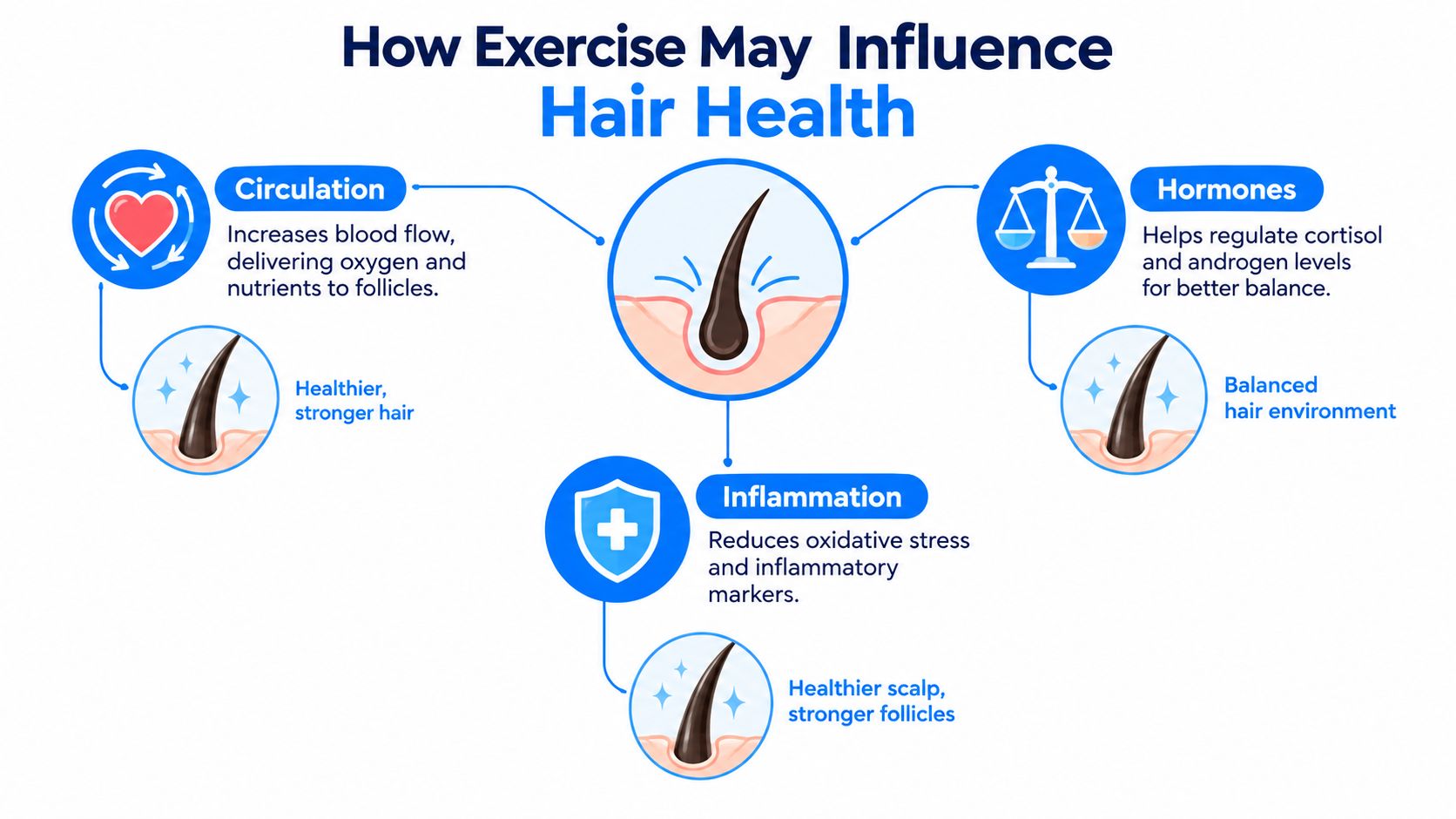
The proposed exercise pathways are interconnected: circulation helps deliver resources, metabolic regulation influences the internal environment, and recovery affects the body's overall stress burden. These are explanations for possible support, not established proof of regrowth.
Circulation Provides a Plausible Pathway
Improved systemic and scalp perfusion, oxygen delivery, and nutrient delivery are proposed mechanisms in the exercise literature. The important word is proposed. A plausible delivery mechanism doesn't demonstrate that a follicle will produce a thicker strand or remain in a growth phase longer.
A helpful analogy is a delivery network. Better transportation may improve access to supplies, but it can't guarantee that every receiving site will use those supplies differently. Likewise, circulation alone doesn't establish a treatment effect on follicular miniaturization.
The infographic illustrates a biological hypothesis. Its positive language shouldn't be interpreted as confirmation that exercise produces visible hair growth.
Hormones, Inflammation, and Stress Interact
Metabolic health and stress regulation provide other potential connections. However, “hormone balance” is too broad to serve as a clinical explanation by itself. Exercise doesn't turn all potentially unfavorable signals down and all favorable signals up.
The response depends on the activity and its surrounding circumstances. A manageable routine with adequate recovery is a different physiological situation from escalating training while underfed.
- Metabolic environment: General improvements in metabolic health may support follicular function without directly treating pattern hair loss.
- Stress regulation: Activity may help manage stress, but a hair benefit can't be inferred from mood improvement alone.
- Inflammatory signaling: This remains part of the proposed mechanism, not a validated marker that can predict exercise-related regrowth.
These pathways shouldn't be treated as separate switches. A person may improve fitness while simultaneously reducing food intake too aggressively, creating competing influences on hair retention.
The clinical interpretation is therefore conditional: exercise may improve the environment in which follicles function, but the response depends on more than blood flow. No circulation-based explanation should be used to promise restored density.
What Research Actually Shows About Exercise and Hair Growth
The most relevant studies don't support a simple claim that exercise regrows hair. They measured associations in people with different activity patterns, rather than establishing an independent treatment effect through randomized exercise assignment.
The Observational Findings Point in Different Directions
A 2017 observational study of 1,182 adults, including 600 men and 582 women, identified androgenetic alopecia in 534 participants, or 45.2%. Participants with alopecia reported more total exercise than those without it, with a statistically significant difference of p = 0.008, according to the cross-sectional study of exercise and pattern hair loss.
That finding doesn't mean exercise caused baldness. Because researchers assessed activity and hair loss cross-sectionally, they couldn't determine which came first. People with hair loss might have exercised more for unrelated reasons, and other differences could have influenced the association.
The study also didn't identify an association between exercise frequency and alopecia among moderate-to-high-intensity exercisers. Its results therefore don't justify either prescribing exercise for regrowth or discouraging activity to prevent thinning.
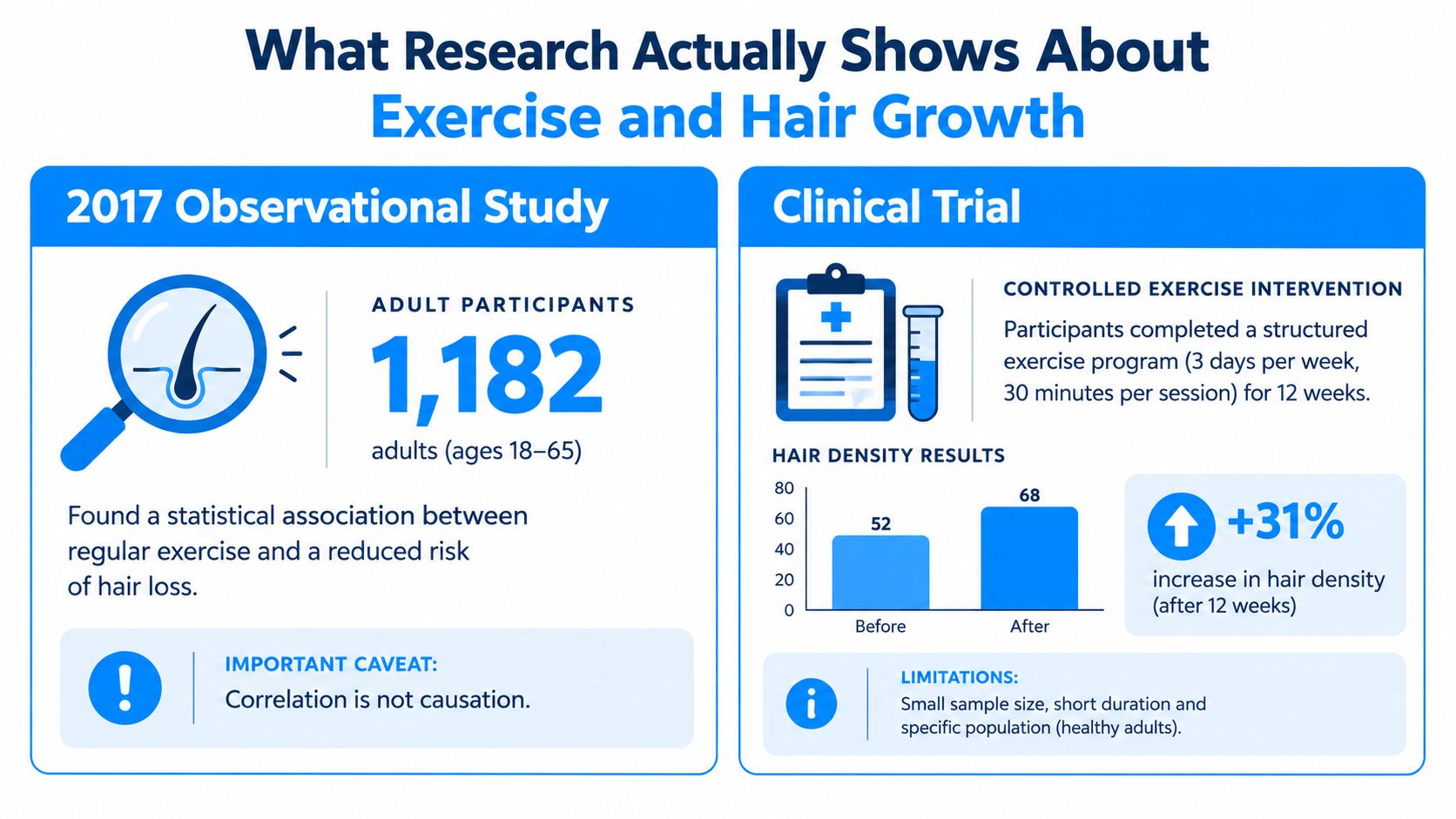
The evidence should take precedence over any stronger wording in the graphic: the earlier study didn't establish reduced hair-loss risk, and the follow-up research wasn't a randomized, controlled exercise intervention.
A 2021 clinical study followed 592 people with androgenetic alopecia for six months. Researchers classified 91 participants, or 15.37%, as improved, and reported 5.416-times higher odds of improvement with aerobic exercise than ordinary daily activity, plus 3.106-times higher odds with sessions exceeding 60 minutes compared with sessions shorter than 30 minutes, in the observational follow-up study.
Higher Odds Aren't Proof of Regrowth
An odds comparison isn't a promise that an individual will improve by a corresponding amount. It also doesn't mean hair density increased by that multiple. The reported outcome was disease-status improvement, not proof that exercise independently regenerated follicles.
An association identifies a relationship worth investigating. It doesn't establish which factor produced the outcome.
Diet, sleep, baseline health, and concurrent treatment could help explain the more favorable results. Hypothesis-generating evidence is the appropriate description: encouraging enough for further research, but insufficient to establish an exercise prescription for hair regrowth.
The Intensity Trade-Off Aerobic Versus Anaerobic
“More exercise means better hair” is an appealing rule, but the research doesn't establish it. Exercise type, training demand, recovery, and nutritional support need to be considered together.
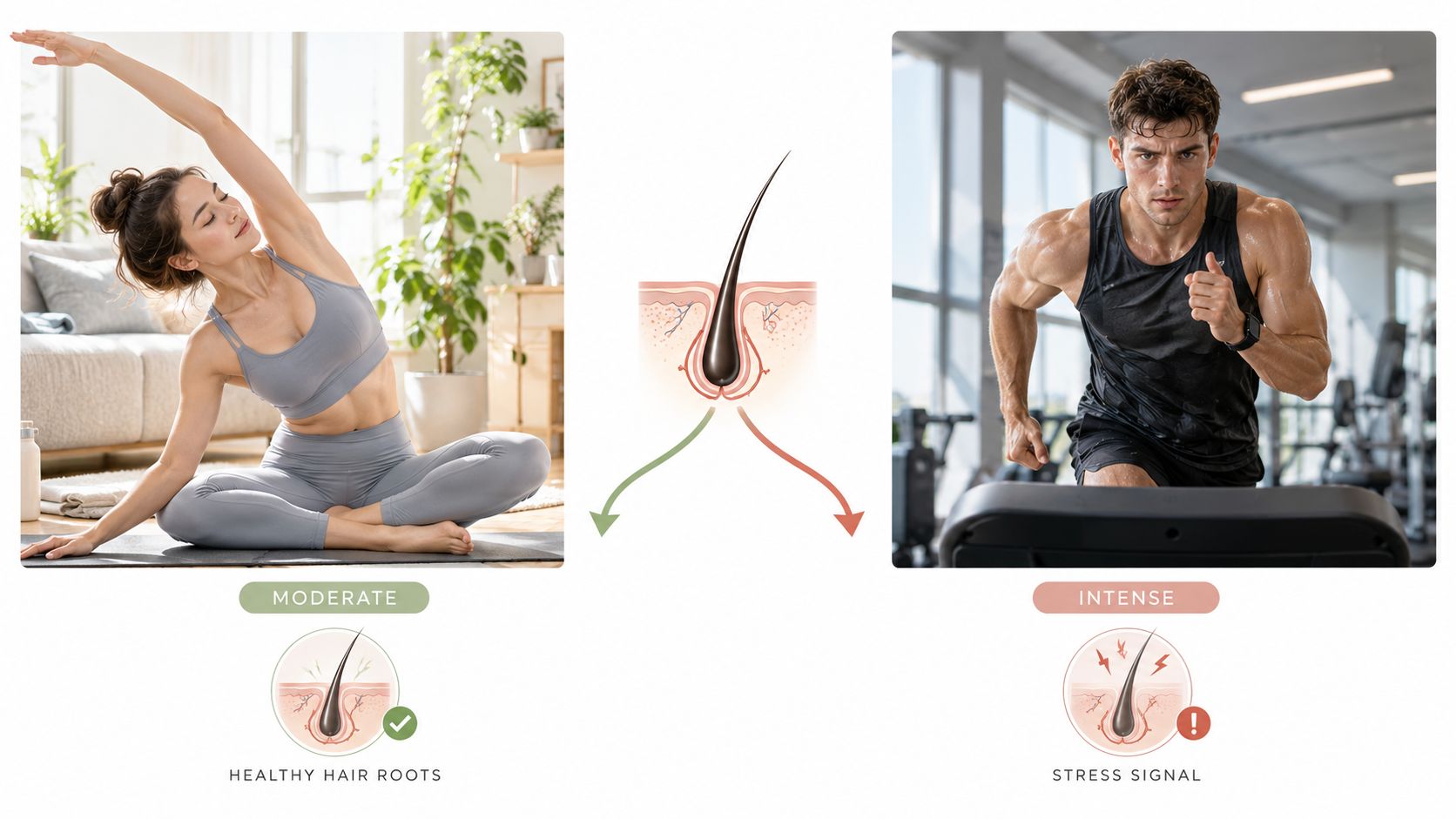
The review discussed earlier describes a theoretical contrast. Aerobic activity may support circulation and nutrient delivery, while high-intensity anaerobic training can transiently increase androgen signaling and exercise-related inflammatory mediators. A causal clinical effect on balding hasn't been demonstrated.
Temporary Signals Aren't Permanent Outcomes
A thermostat offers a limited but useful analogy. Physiological signals fluctuate as the body responds to activity, just as a thermostat responds to changing conditions. A temporary change doesn't establish that the system has developed a lasting problem.
That distinction matters for resistance training. The possibility of short-lived hormonal changes shouldn't be translated into a claim that ordinary strength exercise causes pattern hair loss. The comparison image is conceptual, not evidence that intense workouts damage follicles.
| Training consideration | Clinically useful interpretation |
|---|---|
| Aerobic activity | Has preliminary favorable associations, not proven regrowth effects. |
| High-intensity activity | Requires attention to recovery and fueling, not automatic avoidance. |
| Resistance exercise | Shouldn't be equated with anabolic steroid exposure. |
| Longer sessions | Aren't an established hair-treatment dose. |
Recovery Changes the Interpretation
The duration association in the earlier follow-up study doesn't establish that extending every session improves hair outcomes. Someone who tolerates longer activity may differ in meaningful ways from someone who doesn't. The observational design can't resolve those differences.
For readers considering accessible resistance options, SuperStrong on bodyweight training offers a separate training resource, not evidence for a hair-growth benefit. The relevant clinical question remains whether the program fits the person's health, available energy, and recovery.
A stalled scale reading also shouldn't automatically lead to harder workouts and less food. The discussion of why weight-loss plateaus happen provides context for reassessing a weight-management plan rather than escalating every variable at once.
The safest interpretation isn't that aerobic exercise is good and anaerobic exercise is bad. It's that preliminary hair research doesn't justify extreme training, avoiding strength work, or using longer sessions as a substitute for treatment.
Exercise, Weight Loss, and the Hidden Shedding Risk
The overlooked question isn't always whether exercise affects follicles directly. It's whether the person has enough nutritional support for the activity being performed, particularly during medically assisted weight loss.
Increasing training while sharply reducing intake can create a physiological stressor. In that setting, telogen effluvium is an important possibility: a reactive process in which a greater proportion of follicles prematurely enters the resting phase. This differs from the miniaturization associated with androgenetic alopecia.
Delayed Shedding Can Obscure the Trigger
Clinical reporting on GLP-1/GIP-associated weight loss found hair changes in 38.9% of participants, with shedding or thinning particularly common among those losing at least 40 pounds; 42% of reported shedding began within one to three months of treatment in the report on hair changes during pharmacologically assisted weight loss.
Those findings concern medication-assisted weight loss, not exercise alone. They shouldn't be presented as the likelihood of hair loss for everyone taking a GLP-1 medication, nor as proof that the drug directly harms follicles.
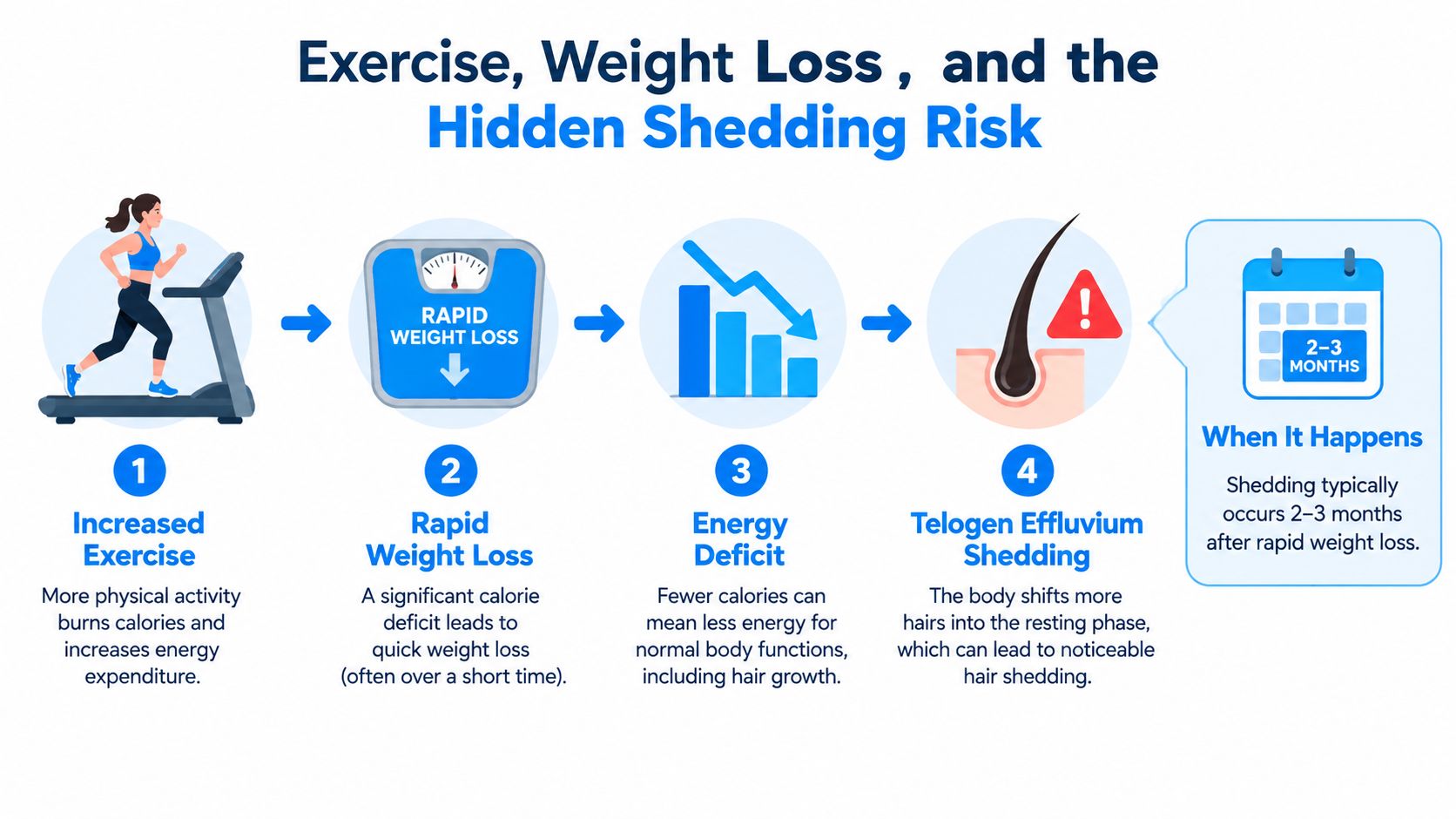
The illustration shows a possible sequence, not an inevitable outcome or a fixed timetable. Delayed shedding can make a recent workout seem responsible even when an earlier period of rapid weight reduction or dietary restriction is more relevant.
Safety principle: A lower appetite doesn't establish that nutritional needs have decreased enough to match the reduced intake.
The Whole Weight-Loss Context Matters
A useful review considers the combination rather than isolating exercise:
- Weight trajectory: Substantial or rapid changes deserve attention.
- Dietary adequacy: Protein and micronutrient intake matter alongside total calories.
- Associated changes: Menstrual or endocrine symptoms, illness, and changes in recovery should be included in the history.
- Loss pattern: Diffuse shedding and progressive patterned thinning require different interpretations.
For activity selection, Full Circle Function & Fitness provides a comparison of walking vs running for weight loss. That resource can inform an activity discussion, but it doesn't establish which option preserves hair.
Medication and treatment histories also belong in the assessment. A guide to hair-loss treatment side effects can help readers prepare questions without assuming that a recent treatment or workout explains every change.
Practical Exercise Guidelines for Protecting Your Hair
An exercise plan should be selected for overall health, capability, and sustainability, not for an unproven hair-growth target. Practical protection means reducing avoidable stressors while allowing a clinician to address the actual cause of thinning.
Match Activity With Nutritional Support
A review of hair retention during metabolic treatment emphasizes avoiding overly aggressive calorie restriction, preserving adequate dietary protein, and correcting documented deficiencies. These are safety measures, not guarantees that shedding won't occur.
A workable plan considers meals and training together. For example, a person whose appetite falls during treatment may need a nutritional review before adding demanding workouts, rather than assuming that feeling less hungry means less food is always appropriate.
- Maintain adequate intake: Exercise shouldn't be layered onto crash dieting.
- Review protein and micronutrients: Assessment should focus on dietary adequacy and documented deficiencies rather than indiscriminate supplementation.
- Include hydration and recovery: A training routine should remain compatible with adequate sleep and day-to-day function.
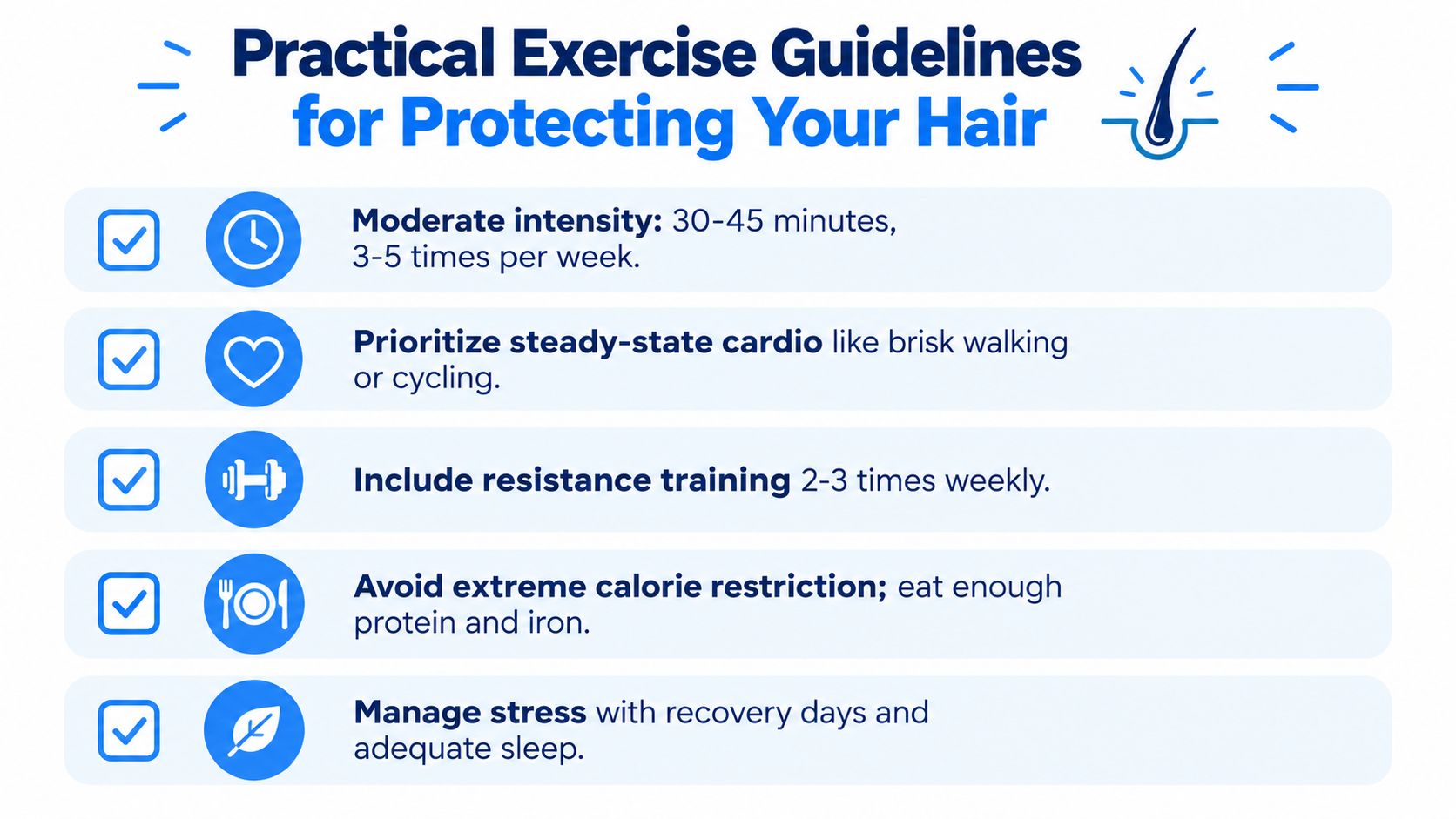
Any fixed schedule shown in the illustration is a general example, not a validated hair-retention prescription. The available studies don't establish a specific weekly exercise dose for preventing shedding or reversing pattern loss.
Choose Sustainable Activity and Meaningful Monitoring
Moderate aerobic options such as brisk walking, cycling, or swimming offer practical starting points. Resistance training can remain part of an individualized routine; the evidence doesn't support abandoning it because of theoretical hormonal concerns.
Unsupervised anabolic steroid use is different from ordinary exercise. Performance-enhancing androgen exposure can potentially worsen androgen-sensitive miniaturization and should be discussed openly during a medical assessment.
Shift workers may need particular attention to recovery. Empire Athletics' night shift friendly training strategies offers scheduling context, while any medical concerns about fatigue or under-recovery require individualized evaluation.
Monitoring should also be consistent. Standardized photographs over several months are more useful for tracking density than conclusions drawn from a single shower or brush. Comparable lighting, positioning, hairstyle, and part placement make the photographs easier to interpret.
A brief record of training changes, appetite, dietary restrictions, and weight trajectory can accompany those images. The purpose isn't constant surveillance; it's to provide a clinician with a coherent timeline if changes develop.
When to Seek Medical Evaluation for Hair Loss
New diffuse shedding after a major training increase, dietary restriction, or rapid weight loss warrants clinical assessment rather than self-treatment through exercise changes alone. Persistent or patchy loss also deserves evaluation, especially when the explanation remains unclear.
Build a Timeline Before Assigning Blame
The most useful history connects symptom onset with weight changes, food intake, illness, medication use, and baseline thinning. In patients receiving semaglutide or tirzepatide, clinicians should consider thyroid status and iron stores when appropriate rather than attributing shedding solely to the medication.
A 2026 systematic review summarized hair-outcome reports from 626,894 patients treated with GLP-1 receptor agonists: hair loss was reported in 9,933 patients, or 1.6%, while regrowth was reported in 52 patients, or 0.008%; pharmacovigilance signals were weak and didn't establish causation, according to the systematic review of GLP-1 therapy and reported hair outcomes.
Those pooled reports aren't directly interchangeable with the smaller clinical report discussed earlier. Different reporting methods and populations can produce different estimates, so neither figure should be treated as an individual prediction.
A separate retrospective cohort evaluating tirzepatide and telogen effluvium identified an observational association. Its design couldn't exclude influences such as weight-loss intensity or reduced nutritional intake.
Recognize Referral Priorities
- Scarring or inflammation: These findings warrant dermatologic assessment.
- Eyebrow loss or patchy loss: These shouldn't be assumed to result from a workout program.
- Prolonged shedding: Continuing loss deserves reassessment rather than repeated changes to supplements or training.
- Medication-associated concerns: Treatment decisions should be made with the prescribing clinician, not through abrupt self-directed discontinuation.
The appropriate treatment depends on the diagnosis. Information about hair-loss treatment that actually works can support that discussion, but it can't replace examination and clinical judgment.
Exercise remains a health behavior, not a diagnostic test or a proven regrowth therapy. Hair retention is best protected by identifying the process involved and addressing its relevant medical and nutritional contributors.
Vials + Vitals offers physician-directed telehealth assessment for metabolic health and hair-health concerns, with U.S.-licensed providers determining whether prescription treatment is appropriate. Adults managing weight loss alongside new thinning can visit Vials + Vitals to begin an online clinical assessment and discuss an individualized approach to treatment and monitoring.