Hair Loss Young Men: Causes, Diagnosis and Treatment
Hair loss young men: learn the causes, how clinicians confirm the diagnosis, and which prescription options have evidence behind them.

A young man notices more scalp under bathroom lighting, then compares a recent photograph with an older one. At twenty-two, a receding hairline can feel unexpected, and searching for treatments often creates more uncertainty than clarity.
Early thinning deserves a diagnosis, not an automatic prescription. Gradual temple recession, sudden shedding after illness, and smooth bald patches can represent different conditions. A physician-directed assessment separates those possibilities before a clinician discusses medication, monitoring, or referral.
Causes of Hair Loss in Young Men at a Glance
Male-pattern hair loss, clinically called androgenetic alopecia (AGA), can begin well before middle age. A clinical review in Mayo Clinic Proceedings61759-X/fulltext) describes estimates of 16% of White men aged 18–29 having at least moderate AGA, defined as Hamilton–Norwood grade III or higher, rising to 53% among those aged 40–49, alongside an estimate that approximately 30% of White men are affected by age 30.
These figures describe particular populations, not an individual prognosis. Severity differs with ancestry, family history, and age, while study estimates differ because researchers use different samples, definitions, examination methods, and thresholds.
Hair loss causes in young men by pattern and onset
| Cause | Typical pattern | Onset | Clues to check |
|---|---|---|---|
| Androgenetic alopecia | Frontotemporal recession, vertex thinning, gradual miniaturization | Months to years | Family history on either side; consistent progression; routine labs may be normal |
| Telogen effluvium | Diffuse shedding across the scalp, usually without a distinct receding line | About 2–3 months after a trigger | Recent fever, illness, surgery, crash dieting, or major psychological stress |
| Alopecia areata | Smooth round or oval patches; possible beard or eyebrow involvement | Sudden | Exclamation-mark hairs, nail pitting, personal or family autoimmune history |
| Nutritional deficiency | Diffuse thinning | Gradually over weeks to months | Restrictive or very low-protein diets; ferritin, B12, vitamin D, and zinc testing when indicated |
| Thyroid disease | Diffuse thinning, often with other symptoms | Gradual | Fatigue, weight change, heat or cold intolerance; TSH testing |
| Scalp inflammation or scarring | Scaling, redness, pain, or patchy loss | Abrupt symptoms or progressive patches | Itch, burning, follicular pustules; suspected scarring needs prompt dermatology review |
| Medication effects | Diffuse shedding or altered hair growth | Weeks to months after starting or stopping | New prescriptions, supplements, or recent dose changes |
Pattern, speed, and triggers belong together. A family history doesn't establish AGA by itself, and normal laboratory results don't confirm it. Several causes can also coexist, such as inherited thinning with additional shedding after illness.
Consider a hypothetical 23-year-old whose temples have gradually receded over two years, with a father who also lost hair early. That presentation fits AGA more closely than an abrupt shedding disorder.
A hypothetical 26-year-old instead describes handfuls of hair falling out about three months after severe flu and a crash diet. That history fits telogen effluvium more closely, although a clinician still needs to examine the scalp and assess other contributors.
The table narrows the possibilities. Confirmation requires a focused history and examination rather than choosing the nearest-looking photograph online.
How Clinicians Confirm the Cause
The diagnostic process connects what the patient notices with what the clinician can document. The European S3 guideline on androgenetic alopecia supports structured assessment and distinguishes patterned thinning from presentations that need investigation for another cause.
A focused diagnostic workflow
Take standardized baseline photographs. Capture frontal, temple, and vertex views with consistent lighting, camera distance, styling, and comparable hair length. Differences in wetness or lighting can exaggerate apparent change, especially when hair looks thin when wet.
Grade the pattern on the Hamilton–Norwood scale. The clinician matches hairline recession and crown thinning to a recognized pattern. The grade describes current appearance; it doesn't predict exactly how quickly an individual will progress.
Build a focused history. Relevant details include onset, speed, illness or fever, surgery, dieting, rapid weight change, prescriptions, supplements, stress, sleep, and mood. Family history should include both sides, rather than only the maternal grandfather.
Examine the scalp itself. Scaling, redness, pustules, tenderness, and loss of visible follicular openings can change the diagnosis. Painful or potentially scarring disease requires more than a routine prescription discussion.
Check beyond the hairline. Smooth patches, beard or eyebrow involvement, and short hairs that narrow near the scalp can suggest alopecia areata. Nail changes may add another diagnostic clue.
Use a gentle pull test when appropriate. A clinician gently applies traction to a small bundle of hairs to assess active shedding. The result contributes to the examination but doesn't independently establish telogen effluvium.
Order targeted laboratory tests. Depending on the history and examination, these may include CBC, ferritin and iron studies, TSH, vitamin D, B12, or zinc. A broad panel isn't automatically necessary for straightforward patterned loss, and supplements shouldn't substitute for identifying a deficiency.
Choose the appropriate care route. A consistent, gradually progressive pattern can proceed to a treatment discussion. Abrupt, patchy, painful, inflamed, or potentially scarring presentations generally need in-person dermatology; an uncertain diagnosis may require magnified scalp examination or biopsy.
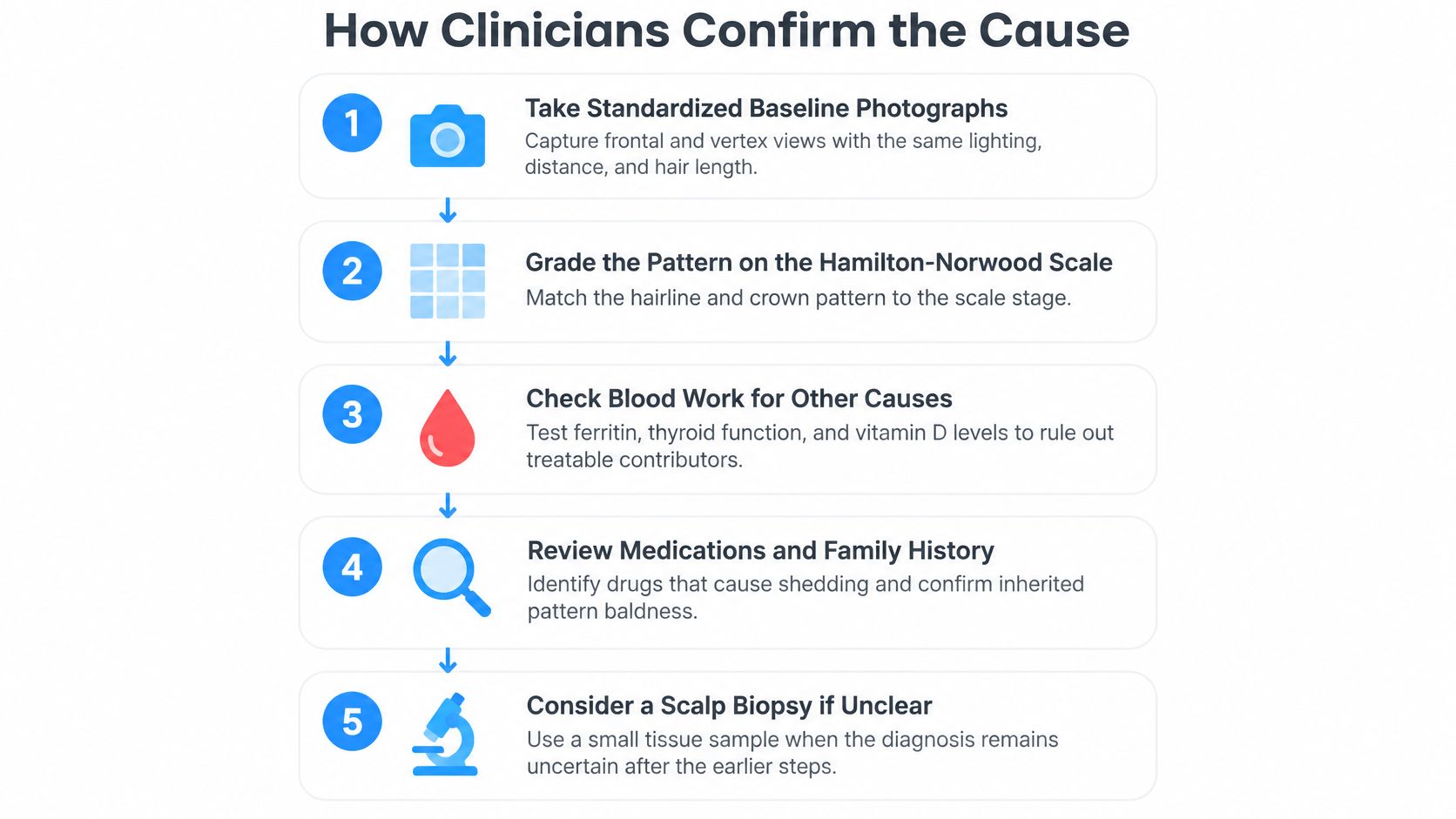
The graphic summarizes common assessment components, not a mandatory testing sequence for every patient. Blood work and biopsy are selected according to clinical findings, and inherited patterning can't be confirmed from family history alone.
Practical rule: A photograph records appearance. A diagnosis also requires the history, symptoms, and appropriate examination.
An assessment based only on age or a photograph is unreliable. Once a clinician establishes the likely cause, the baseline images become a consistent reference for subsequent reviews rather than a reason for daily checking.
Why DHT Shrinks Follicles Over Time
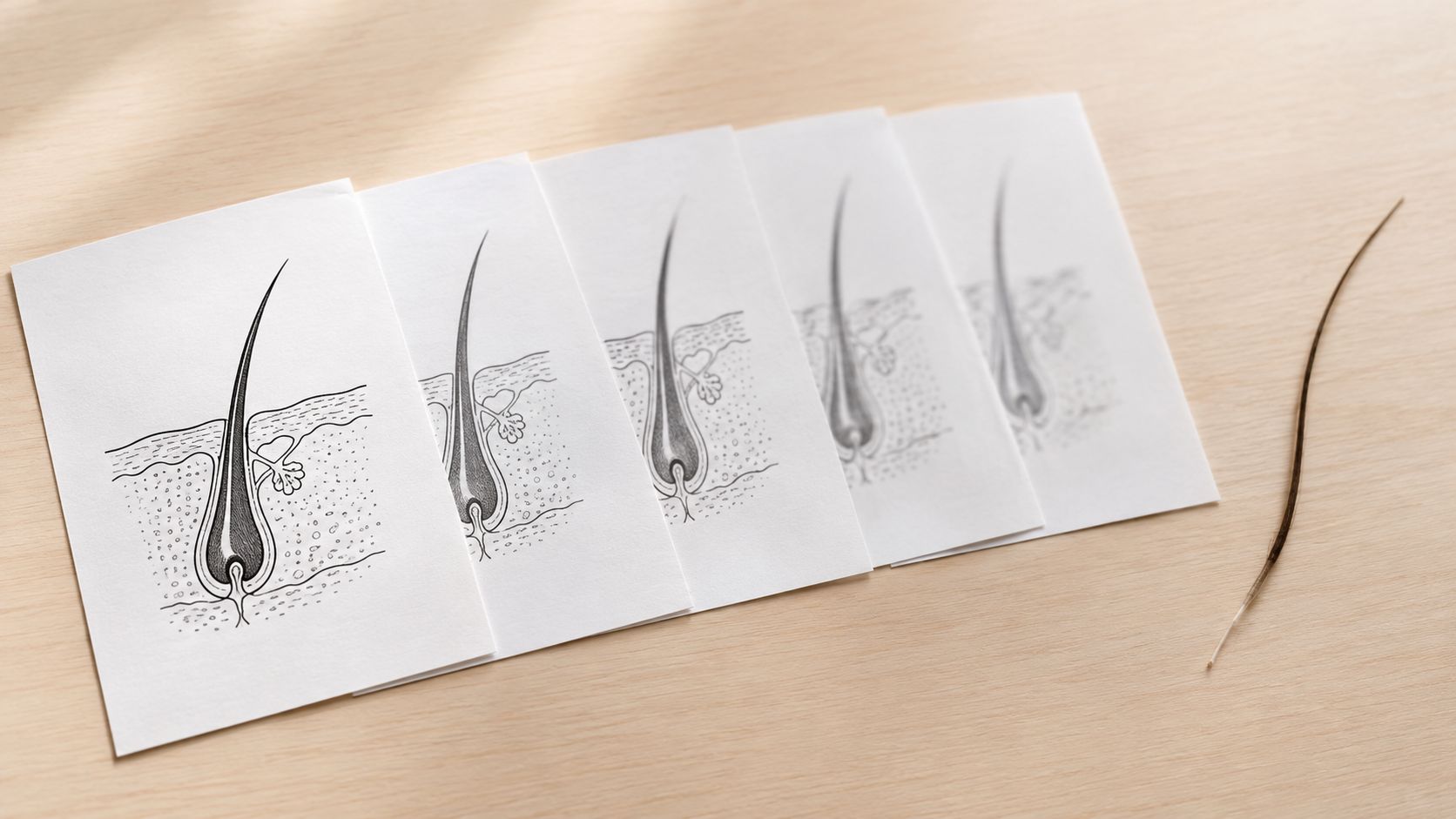
A photocopy of a photocopy can lose detail with each repetition. Follicular miniaturization is loosely comparable: across successive growth cycles, a susceptible follicle produces a smaller, finer hair rather than replacing a thick strand with an equally thick one.
The analogy has limits. A follicle is living tissue, and its behavior depends on biological signaling, not mechanical wear.
The enzyme and receptor pathway
5-alpha-reductase enzymes convert testosterone into dihydrotestosterone (DHT). DHT binds androgen receptors in genetically susceptible follicles, particularly around the frontotemporal hairline and vertex.
Susceptibility matters as much as the hormone's presence. AGA doesn't automatically mean that a young man has abnormally high testosterone or needs a broad hormone-treatment program.
The European evidence-based guideline characterizes AGA as a chronic, progressive, non-scarring disorder involving androgen signaling and follicular miniaturization. Thick terminal hairs become shorter and finer, the anagen growth phase contracts, and a greater relative proportion of hairs occupies the telogen resting phase.
What becomes visible
As neighboring follicles produce finer shafts, less hair volume covers the scalp. This can create the recognizable Hamilton–Norwood distribution, with temple recession, crown thinning, or both.
Androgen activity after puberty helps explain why typical male-pattern loss begins after puberty rather than in young children. Childhood hair loss requires assessment for other diagnoses.
Miniaturization is a gradual reduction in follicle size across many growth cycles, not a sudden event.
Because AGA is non-scarring, early treatment aims to preserve functioning follicles while meaningful activity remains. That isn't the same as promising recovery of every area that has already thinned substantially.
Treatment also can't instantly replace the visible hair shaft. A follicle may respond biologically before enough new hair grows to change apparent density, which explains why a mirror check soon after starting therapy provides little useful evidence.
First-Line Prescription Options Compared
A receding hairline at 22 can fit androgenetic alopecia (AGA), but appearance alone cannot confirm the cause. Prescription decisions follow a clinical assessment: the same thinning pattern can have different explanations, and treatments work through different pathways.
| Option | Mechanism | Usual dosing | Evidence and screening notes |
|---|---|---|---|
| Topical minoxidil 5% solution or foam | Supports the growth phase and enlargement of miniaturized follicles | Twice daily | The randomized comparison by Khandpur et al. reported regrowth at 12 months in 59.0% of participants receiving topical minoxidil; benefits can diminish after stopping |
| Oral finasteride | Inhibits type II 5-alpha-reductase, reducing testosterone conversion to DHT | 1 mg daily | Khandpur et al. reported regrowth at 12 months in 80.5% of participants; review sexual, psychiatric, reproductive, and cardiovascular history |
| Oral finasteride plus topical minoxidil | Combines DHT reduction with growth-phase support | Daily oral plus twice-daily topical | Khandpur et al. reported regrowth at 12 months in 94.1% of participants; consider added adverse-effect and adherence concerns |
The American Academy of Dermatology's guidance on male-pattern hair-loss treatment says finasteride slows further loss in roughly 80–90% of treated men. Separately, the randomized comparison by Khandpur et al. involving 428 men reported 12-month regrowth in 80.5% with finasteride, 59.0% with topical minoxidil, and 94.1% with combined treatment. These results describe study participants, not an individual's predicted outcome. Slowing further loss and regrowing hair are different measures.
Different mechanisms, different roles
Topical minoxidil supports follicles entering and remaining in the growth phase. Its local cellular effects involve activation to minoxidil sulfate and potassium-channel signaling, although its full hair-growth mechanism is not completely resolved.
Apply the solution or foam to the scalp, not just the hair. Consistent use matters, and benefits can fade over months after stopping. Minoxidil is available without a prescription, though a clinician can help assess whether it fits the diagnosis and treatment plan.
Finasteride acts on the androgen pathway. By inhibiting type II 5-alpha-reductase, it lowers DHT production and reduces a signal that contributes to follicle miniaturization.
Using oral finasteride with topical minoxidil combines DHT reduction with growth-phase support. The added treatment also means more cost, application steps, and opportunities for adverse effects or missed doses.
Screening and safety before prescribing
Before prescribing, a licensed clinician reviews sexual function, psychiatric history, reproductive plans, cardiovascular conditions, current medications, and treatment goals. Documenting baseline sexual function and mood makes it easier to assess any later changes.
Finasteride and dutasteride can cause sexual adverse effects in a minority of users, including reduced libido, erectile difficulty, and ejaculatory changes. Report symptoms promptly rather than assuming they must be tolerated.
Topical minoxidil commonly causes scalp irritation and can less often cause unwanted facial or body hair growth. New palpitations, dizziness, or swelling need medical review, particularly if an oral formulation is being considered.
A clinician can help decide whether a treatment should be adjusted, paused, or continued. This comparison of dutasteride and finasteride for hair loss can inform that discussion, but it does not replace individual medical advice.
These options are considered for appropriately selected adult men with mild-to-moderate AGA. Standardized photographs and clinical review provide a clearer way to assess progress than daily shower-hair counts.
When First-Line Treatment Is Not Enough
Before escalating therapy, a clinician asks three questions in order. Is the diagnosis correct? Was the treatment used consistently? Did the assessment run long enough to show a meaningful response? The answer to each one changes what comes next.
A regimen applied sporadically has not received the same test as one followed consistently. Scalp irritation, inconvenient application, or concerns about sexual function can all explain poor adherence, and each points to a different fix: a formulation change, a simplified routine, or a frank discussion of side effects. Skipping that conversation and reaching straight for a stronger medication treats the wrong problem.
Where dutasteride fits
Dutasteride inhibits both type I and type II 5-alpha-reductase, whereas finasteride primarily targets type II. Broader enzyme inhibition can produce greater suppression of DHT, but potency alone does not establish the most appropriate treatment for an individual patient.
A randomized trial indexed in PubMed compared dutasteride 0.02, 0.1, or 0.5 mg daily, finasteride 1 mg daily, and placebo in 917 men aged 20–50 over 24 weeks, finding that dutasteride 0.5 mg significantly improved hair count and hair width in a 2.54-cm-diameter target area compared with finasteride and placebo. That finding concerns a defined trial population and a measured scalp area, so it cannot be read as a promise about any one receding hairline.
Dutasteride use for hair loss is off-label in the United States. A clinician must assess suitability, discuss uncertainty and adverse effects, and determine whether escalation is justified.
Procedures don't replace disease management
Cosmetic fibers and concealers can reduce the appearance of visible scalp, but they don't alter ongoing miniaturization. They may still be reasonable appearance-management options while a patient considers medical care.
Transplantation requires a stable diagnosis and a long-term plan. Continued loss of surrounding native hair can undermine an initially satisfactory surgical appearance.
- Confirm the pattern: An unclear diagnosis should be resolved before surgery.
- Assess progression: Serial photographs help distinguish stable appearance from continuing loss.
- Plan beyond the hairline: Donor supply, likely future thinning, and willingness to maintain treatment all affect surgical planning.
In a typical transplant consultation for a younger patient, the surgeon may recommend 6–12 months of clinician-directed observation and treatment assessment before scheduling grafts. That interval guides planning for the individual case rather than setting an eligibility rule for everyone.
Escalation follows the record: how the first-line trial was used, how well it was tolerated, and what the patient actually wants. Earlier onset mainly raises the chance that loss will continue, which is exactly why documented progression matters before a second agent or a surgical plan.
Realistic Timeline and Long-Term Maintenance
A six-week trial can show tolerability and temporary shedding, but it cannot show whether density will improve. Side-by-side photographs taken too early may document churn rather than outcome: follicles have to complete cycling, then grow shafts long enough to change coverage.
The mistake is treating the first visible weeks as the final result. Bring the pattern, speed, and suspected triggers already identified to follow-up, then judge the regimen at checkpoints instead of day by day.
Expected timeline and what to measure
| Timepoint | What is typically happening | How to measure |
|---|---|---|
| Weeks 0–4 | Possible temporary shedding after topical minoxidil begins; visible benefit isn't expected yet | Establish baseline photographs rather than judge efficacy |
| Months 3–4 | Early changes in shedding or thickness may begin, but aren't assured | Compare same-angle photographs with baseline |
| Months 6–12 | Clinical evaluation window; visible density changes lag behind cycle changes | Standardized photographs and clinician review |
| Month 12 onward | Stabilization or maintenance may be the main benefit; stopping can reverse gains over months | Photograph review every 6 months, adjusted by the prescribing clinician |
These checkpoints guide monitoring rather than promise a particular appearance by a deadline. Stabilization can be a meaningful response even when the hairline hasn't visibly moved forward.
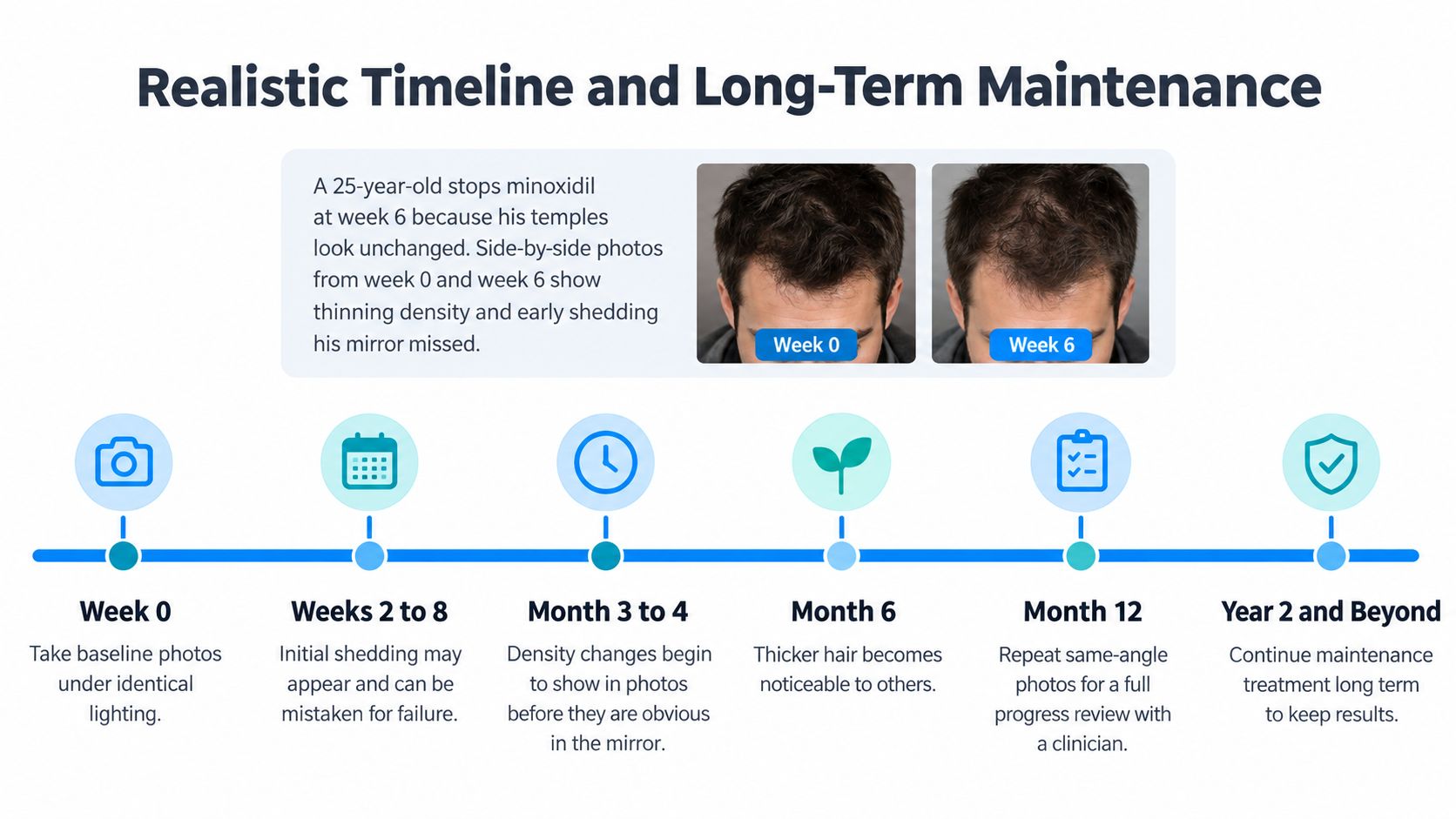
The illustrated milestones aren't universal outcomes. Noticeable thickening may occur later, remain subtle, or not occur despite appropriate use.
What measured improvement means
The FDA-reviewed finasteride prescribing information reports a 107-hair advantage over placebo at 12 months within a 1-inch-diameter circle measuring 5.1 cm² in men with vertex loss, with treatment groups separating at 6 and 12 months, and a separate 48-week study of 212 men finding increases of 7 total hairs and 18 anagen hairs per 1 cm² with finasteride versus decreases of 10 total hairs and 9 anagen hairs with placebo.
Those measurements describe small, defined scalp areas. The gap versus placebo combines treatment-associated improvement with continued loss among untreated participants, so it should be read as a group-level difference in a measured circle rather than a scalp-wide guarantee.
Maintenance perspective: Preventing further visible loss may be clinically valuable even when regrowth remains modest.
Long-term treatment remains an ongoing choice, balancing benefit, inconvenience, cost, and tolerability. Patients considering discontinuation should discuss expectations and hair loss treatment side effects with the prescribing clinician rather than repeatedly stopping and restarting without review.
Choosing Telehealth or In-Person Care Next
The setting should match the question still open after the diagnostic workflow. If pattern, speed, and trigger already point to stable, gradual thinning, a remote visit can supply the missing piece: licensed review of history, photographs, and goals. If the earlier workup leaves a scalp problem that needs touch, magnification, or testing, choose dermatology rather than forcing a prescription conversation online.
The purpose of the distinction is practical. It sends each presentation to the setting able to examine it properly.
What an online assessment should establish
A confidential online clinical intake can collect the history, medication list, photographs, symptoms, and treatment preferences before a U.S.-licensed physician evaluates clinical appropriateness. A strong intake reads like a timeline, not a vague complaint: temple or crown changes first noticed at twenty-two, shedding after a fever or rapid diet change, itching or scale, new medications or supplements, prior treatments tried, family pattern, and clear photos of the hairline, temples, crown, and part taken in the same light.
That gives the provider enough material for three outcomes: a treatment recommendation, a request for more information, or referral for examination and testing. An educational hair-density assessment can help organize concerns, but it cannot diagnose follicular activity or establish prescription eligibility by itself. A score also cannot check for scalp inflammation, patchy autoimmune loss, or a treatable systemic contributor.
- Clinical eligibility: The provider determines whether the presentation fits a condition suitable for remote management.
- Individualized selection: Formulation and dosing reflect medical history, contraindications, preferences, and the ability to follow the regimen.
- Defined follow-up: Photo-based monitoring and symptom review allow the clinician to assess benefit and tolerability.
- Referral when necessary: Diagnostic uncertainty should lead to an appropriate examination, not an automatic prescription.
Prescription decisions remain individualized
Prescription treatments and compounded formulations are prescribed strictly at the clinical discretion of licensed U.S. healthcare providers following an individualized telehealth intake and consultation. Compounded medications are fulfilled through state-licensed partner compounding pharmacies.
A familiar ingredient name does not make a compounded formulation interchangeable with an FDA-approved product. The provider should explain why that formulation is being considered, what it cannot establish, and what monitoring it requires.
For the young adult deciding what to do next, the useful starting point is a complete baseline photograph set and an accurate intake covering recent illness, dietary changes, medications, scalp symptoms, and family history. Bring those materials to the provider before any prescription decision, especially when more than one cause is plausible.
Vials + Vitals offers physician-directed online assessment and individualized hair-health treatment consideration, with licensed-provider review and follow-up monitoring. Adults concerned about early thinning can complete a confidential intake and submit baseline photographs for a clinical discussion before deciding whether prescription treatment is appropriate.