Does Prozac Make You Gain Weight? Trial Data
Does prozac make you gain weight? Early trials often show slight loss, while a year looks close to placebo. See timelines, comparisons, and when to call.

A statistic-driven answer needs a time frame: short-term Prozac may reduce appetite and cause slight weight loss, while longer-term weight patterns can differ. The key distinction is between early appetite suppression and the possibility that eating returns toward normal as depression improves.
For anyone asking, “Does Prozac make you gain weight?”, timing, appetite, and other changes during treatment all matter. Average effects can be modest, yet an individual's weight may change meaningfully.
Vials + Vitals' educational approach considers these factors without labeling Prozac weight-neutral. Protecting psychiatric stability remains central when assessing a persistent weight trend.
Short-Term Weight Change With Prozac
In U.S. trials for major depressive disorder, decreased appetite was reported by 11% of fluoxetine-treated patients versus 2% taking placebo. Reported weight loss occurred in 1.4% versus 0.5%, respectively, according to the FDA Prozac prescribing information. These reports describe events during treatment, not a measured weight change in every participant.
Prozac weight change by time window
| Window | Fluoxetine finding | Comparison | How to read it |
|---|---|---|---|
| Acute major depressive disorder trials, appetite | Decreased appetite in 11% | 2% on placebo | Adverse-event reports, not measured loss in everyone |
| Acute major depressive disorder trials, reported weight loss | 1.4% | 0.5% on placebo | Reports do not show how much weight each person lost |
| 16 weeks at 60 mg daily | Average loss 0.45 kg (1.0 lb) | Placebo gain 0.16 kg (0.35 lb) | Between-group gap about 0.61 kg |
| About 4 to 12 weeks, review estimate | About 0.94 kg loss | Placebo | Acute effect may not last |
A review published in Obesity estimates about 0.94 kg of loss versus placebo over 4 to 12 weeks. It also describes a different pattern in longer-term follow-up.
What the Early Findings Mean
A reported side effect and a measured average weight change answer different questions. An adverse-event percentage shows how often participants reported an event. It does not show that everyone else maintained the same weight or reveal the full range of changes.
The average change summarizes the group. Some participants may have lost weight, while others gained or stayed near baseline. Neither result predicts an individual response.
Think of appetite as a volume knob: early fluoxetine treatment may turn hunger down for some people. Less interest in food can reduce intake, but this effect varies and does not make fluoxetine a weight-management medication.
Practical rule: Treat an early drop on the scale as something to monitor, not as a reason to increase the antidepressant dose.
To interpret a change, record a starting weight, prescribed dose, and other medicines. A brief note about appetite, nausea, usual meals, and activity can add useful context. For example, weight gain after treatment begins may mean something different for someone who was already gaining than for someone who had been losing weight during depression.
The short-term findings suggest that clinically meaningful weight gain is not the usual pattern in initial treatment, but they cannot predict what will happen for an individual.
How Weight Changes Over Months to a Year on Prozac
Weight can follow different paths during a year of fluoxetine treatment. An early appetite drop may fade, while later weight gain can also occur in people taking a placebo after first receiving fluoxetine. The timeline matters more than any single weigh-in.
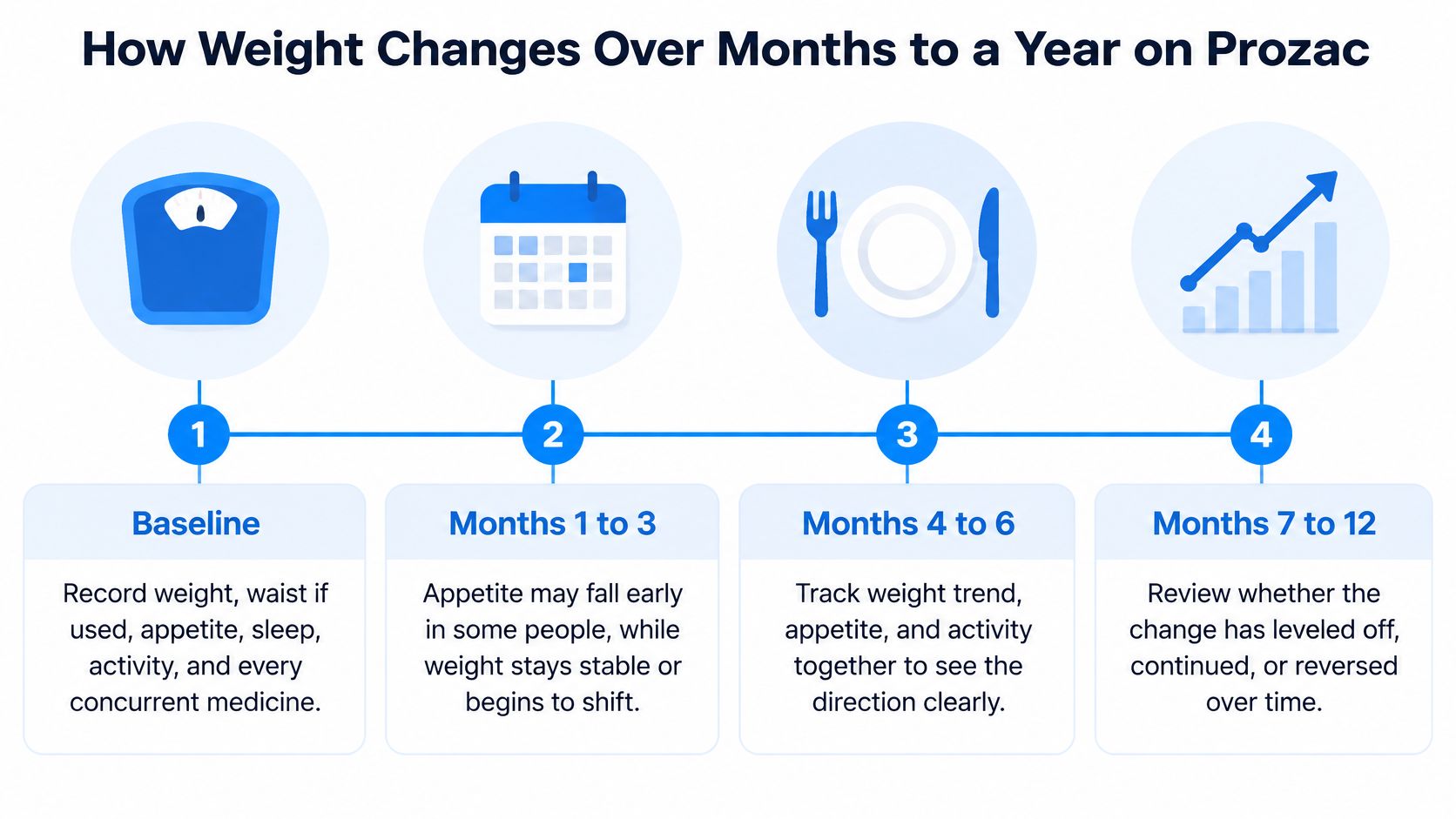
Baseline and early follow-up
At baseline, record weight, appetite, sleep, activity, and other medicines. A waist measurement and a brief description of usual eating patterns may also help. Depression can affect eating in different ways, so the starting point matters when interpreting later changes.
During months 1 to 3, reduced appetite or a small loss may be temporary. Track the trend rather than assuming that an early response will continue. For people also pursuing intentional weight management, how long weight loss may take to become noticeable offers context for distinguishing a short-lived fluctuation from a sustained change.
Later follow-up and the placebo comparison
At a mid-treatment check, the prescriber can review whether appetite has returned, activity has shifted, or eating has become more regular. Later, the useful question is whether weight has stabilized, continued rising, or started to fall.
A randomized trial summarized in Drugs.com's clinical overview of Prozac and weight followed patients for 50 weeks. Everyone initially took fluoxetine for 12 weeks; after improvement, some continued it and others switched to placebo. Average weight fell during the first four weeks. Later weight gain was similar in both groups, suggesting that the longer-term change was not unique to continued fluoxetine in this trial.
Weight change across later treatment windows
| Window | Fluoxetine finding | Comparison | How to read it |
|---|---|---|---|
| Months 1 to 3 | Appetite or weight may shift early | Responses vary | Monitor whether the change persists |
| Mid-treatment checkpoint | Review appetite, activity, and eating patterns | Compare with baseline | Look for a sustained trend |
| Later follow-up | Weight may level off, rise, or fall | Placebo participants also gained weight in the trial | Later gain does not necessarily mean fluoxetine caused it |
The placebo comparison needs context: participants who switched to placebo had first taken fluoxetine and improved. The trial cannot predict an individual's outcome or rule out a medication effect for a particular person.
A week-by-week log can help a prescriber distinguish a steady trend from isolated readings. Rapid or unexplained change warrants evaluation rather than being dismissed as ordinary fluctuation.
Prozac Compared With Other Antidepressants
Fluoxetine does not stand out as a lower-weight option compared with sertraline. In a large U.S. observational study of 183,118 new antidepressant users, discussed by Harvard Health Publishing, weight outcomes were similar for fluoxetine and sertraline at 6, 12, and 24 months. Bupropion was associated with approximately 0.22 kg less weight relative to the reference treatment. Because the study had no non-user control group, these associations do not establish that the medicines caused the differences.
Relative weight signals among common antidepressants
| Medicine | Relative weight signal | Evidence limit | Clinical reading |
|---|---|---|---|
| Fluoxetine (Prozac) | Similar to sertraline at 6, 12, and 24 months | Observational, no non-user control | Not clearly a lower-weight SSRI |
| Sertraline | Reference-like modest change in that analysis | Same observational limits | Often grouped with fluoxetine |
| Paroxetine | More pronounced gain in a 26- to 32-week comparison of 284 adults, as reported in the randomized trial | Different study from the large observational analysis | Higher concern if weight is already a priority |
| Bupropion | About 0.22 kg loss versus the reference treatment | Observational and not proof of cause | Sometimes discussed when weight is a major concern |
| Any switch | Guided by symptom control and safety history | Not a self-directed change | Prescriber weighs relapse risk against scale change |
In the randomized trial comparing fluoxetine, sertraline, and paroxetine, average weight increases with fluoxetine and sertraline were modest and not statistically significant; paroxetine showed more pronounced gain. The findings suggest differences between medicines, not a guaranteed outcome for an individual.
Choosing for the patient rather than the average
A prescriber weighs baseline body mass index, appetite, psychiatric response, dose, duration, and other medicines. If depression is well controlled, preserving that response may matter more than a small average difference in weight.
Bupropion may be discussed when weight is a concern, but a history of seizures or current or past eating disorders can affect whether it is suitable. Mirtazapine and some older antidepressants are also discussed as more appetite-promoting options. Appetite effects are only one part of the decision.
A smaller average weight effect does not automatically make a medicine safer or more effective for a particular patient.
Stopping an SSRI abruptly can cause discontinuation symptoms or allow depression or anxiety to return. A prescriber should guide any change rather than leaving the patient to switch medicines alone.
Continuing fluoxetine may make sense when mood is stable and weight change is limited or explainable. A discussion about alternatives becomes more relevant when gain is sustained, affects health or adherence, and remains concerning after other contributors have been assessed.
Why Appetite and Weight Can Move Either Way
Fluoxetine is a selective serotonin reuptake inhibitor, or SSRI. It blocks the serotonin transporter, slowing serotonin reuptake and increasing serotonin signaling between nerve cells. The FDA prescribing information describes decreased appetite and weight loss among possible effects. The effect is central, acting on hunger signals rather than energy expenditure.
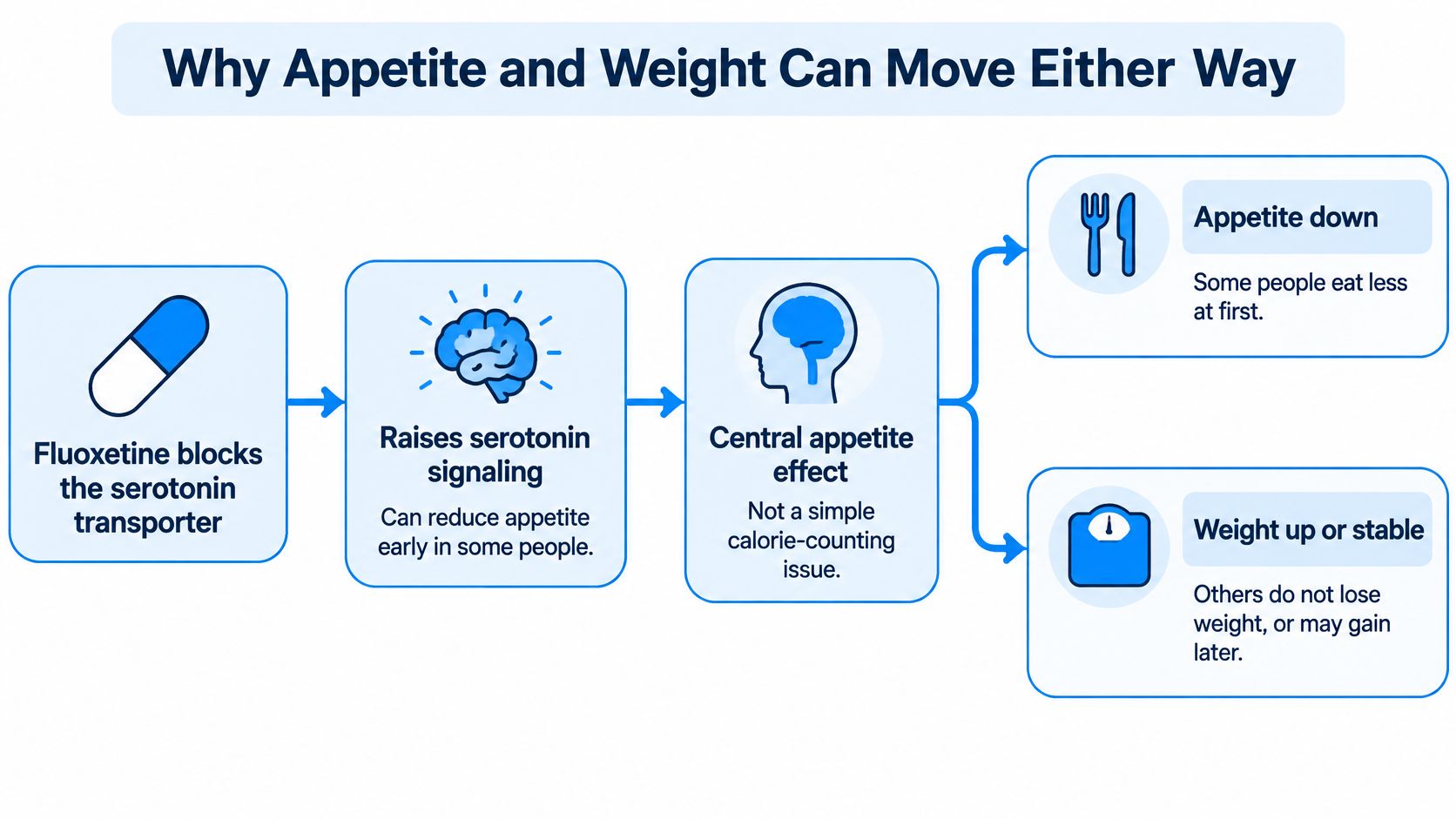
Recovery can change the direction
A person who skipped breakfast during depression might start eating it again as mood improves. Shared meals may become enjoyable, appetite may return, and daily movement can change too. Someone may become more active as energy returns; someone else may remain sedentary.
These changes help explain why early appetite suppression does not predict the later scale trend. Weight reflects food intake, activity, mood-related changes in routine, and other influences over time.
The FDA's fluoxetine prescribing information advises monitoring weight, particularly when reduced appetite or weight loss could be undesirable. For someone who is underweight, at risk of an eating disorder, or experiencing persistent nausea, the concern may be inadequate intake rather than weight loss.
Contributors worth reporting
A medication review should include other influences on weight:
- Eating and drinking changes: Larger portions, frequent snacks, alcohol, or calorie-dense comfort foods can change intake without a deliberate diet change.
- Sleep and movement: Poor sleep, fatigue, pain, or reduced activity can make weight management harder.
- Other prescriptions: Corticosteroids, some antipsychotics, and valproate can contribute to weight gain.
- Medical symptoms: Swelling, thyroid-related symptoms, or a history of glucose problems may warrant evaluation.
A rising weight trend that began before fluoxetine, a marked appetite increase, or use of other weight-promoting medicines calls for a closer look. None of these factors alone establishes the cause.
A metabolic calorie calculator can offer an estimated starting point for a nutrition discussion. Its estimate cannot diagnose medication-related weight change or capture every individual need.
Dose changes belong to the prescribing clinician. Increasing fluoxetine to suppress appetite or reducing it to lower the scale reading can disrupt psychiatric treatment. Documenting symptoms and patterns gives the prescriber useful information without experimenting with the dose.
Practical Steps if the Scale Is Rising
A rising trend calls for a structured review, not an automatic antidepressant change. The best plan preserves effective mental-health care while identifying treatable contributors to weight gain.
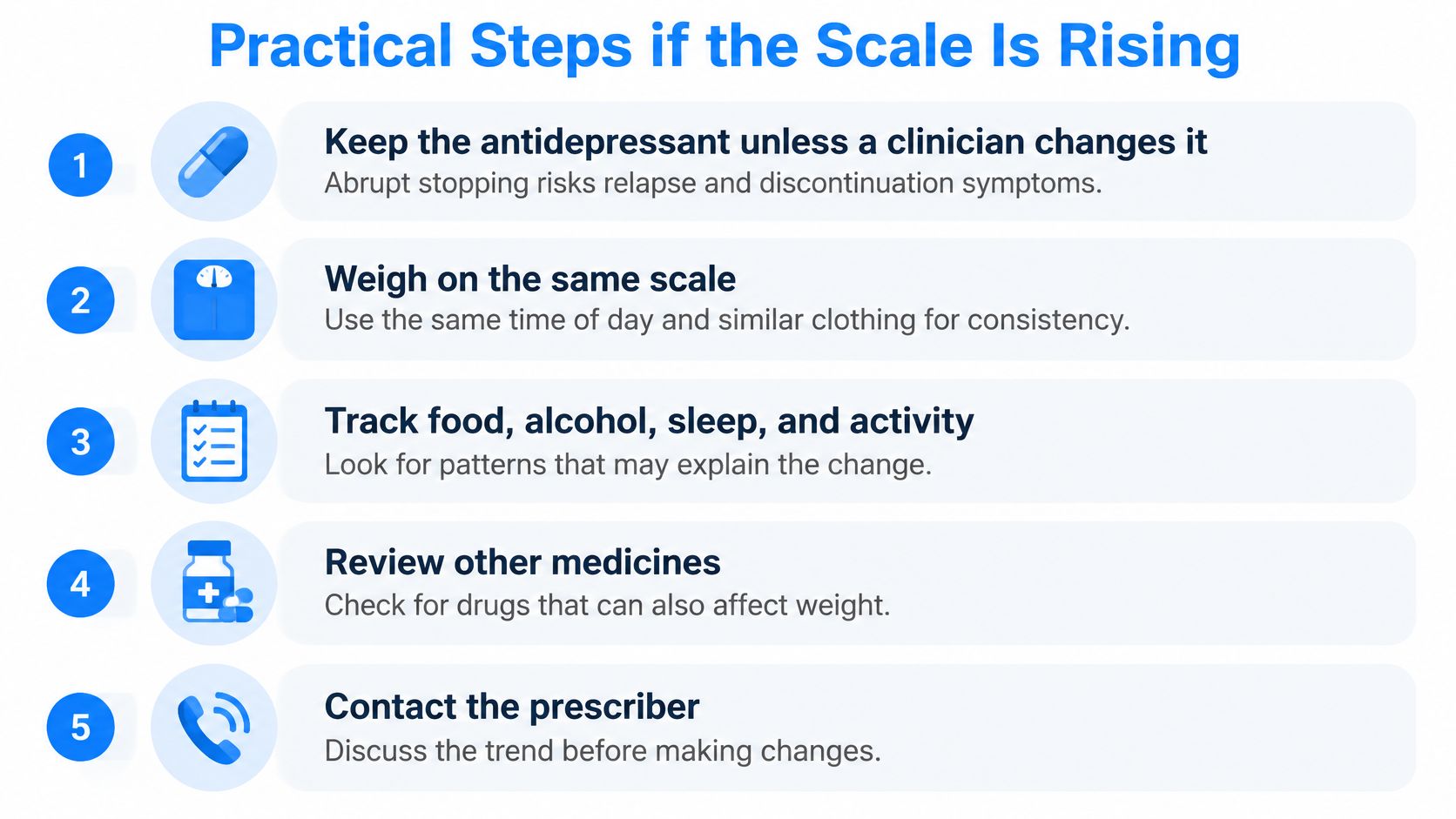
A practical monitoring protocol
Keep the antidepressant unless the clinician changes it. Skipping doses or stopping abruptly isn't a weight-management strategy. A concern about side effects should trigger a conversation while treatment continues as prescribed.
Use consistent weighing conditions. The same scale, similar clothing, and a similar time of day make comparisons more useful. About-weekly measurements are generally more informative than repeatedly reacting to daily fluctuations; patients with eating-disorder risk may need a different monitoring approach.
Pair nutrition with regular activity. A sustainable eating pattern can emphasize protein-containing foods, fiber-rich foods, and planned meals rather than severe restriction. A reduced-calorie approach is appropriate only when weight loss is clinically indicated, not when poor intake or underweight is the concern.
Review the context of the change. A brief record of food, alcohol, sleep, activity, and medication changes can reveal a pattern. A practical guide to improving metabolic health can support that broader assessment without replacing individualized care.
Consider a separate metabolic evaluation when appropriate. Adults with obesity, or overweight plus a weight-related condition, may be candidates for additional treatment. Eligibility requires assessment of medical history, risks, current medicines, and the ability to maintain follow-up.
Where incretin treatment fits
Tirzepatide activates GIP and GLP-1 receptors, pathways involved in appetite and glucose regulation. Semaglutide acts at the GLP-1 receptor. Neither should be treated as an automatic counterweight to an antidepressant.
In the FDA's approval announcement for tirzepatide weight management, participants without diabetes receiving 15 mg weekly in 72-week trials had an average 18% reduction in baseline weight compared with placebo, while the corresponding reduction in participants with type 2 diabetes was 12%.
Those are controlled-trial population averages, not promises for a particular patient or formulation. Treatment was combined with a reduced-calorie diet and increased physical activity.
Treatment boundary: Incretin medicines shouldn't be stacked, substituted, or dose-adjusted without the prescribing clinician's review.
The aim isn't an undefined “metabolic reset.” It's a monitored plan with measurable goals, tolerable treatment, adequate nutrition, and continued psychiatric stability.
When to Talk With Your Prescriber
Chest pain, shortness of breath, fainting, or rapidly developing swelling require urgent medical assessment. Suicidal thoughts or being unable to stay safe also call for immediate crisis or emergency support, not a routine appointment.
Severe appetite loss, persistent vomiting, or worsening mood warrant prompt contact with a clinician. These symptoms should not automatically be attributed to Prozac.
Preparing for a routine review
Steady weight gain over months is worth discussing if it affects blood glucose, joint pain, self-image, or your willingness to continue treatment. A modest average change in a study does not make your individual concern less important.
Bring a brief record of:
- Starting and follow-up weights: The overall trend matters more than one unusually high reading.
- Medicines: List prescriptions, nonprescription products, supplements, and recent changes.
- Appetite and sleep: Note meaningful changes in hunger, nausea, meal timing, rest, and activity.
- Treatment priorities: Describe both Prozac's psychiatric benefits and the practical effects of weight change.
Your mental-health prescriber should guide decisions about psychiatric medication. They may continue fluoxetine, assess possible metabolic contributors, or discuss another treatment, while weight care can be evaluated separately and in coordination.
Vials + Vitals offers telehealth assessment for weight care. Its GLP-1 area compares semaglutide, tirzepatide, and a needle-free tablet option. Semaglutide costs from $199 per month for a 1-month supply. Results from injectable trials should not be assumed to apply to compounded or needle-free formulations.
U.S.-licensed providers determine eligibility and treatment after an individualized assessment. Completing an assessment does not guarantee a prescription. Compounded medications are evaluated for individual suitability by a licensed provider and fulfilled by state-licensed partner compounding pharmacies.
For ongoing weight concerns during Prozac treatment, you can begin an assessment with Vials + Vitals. Bring your weight trend and complete medication list to the consultation.