Why Do I Wake Up at 3am? Causes, Red Flags and Fixes
Why do I wake up at 3am? Learn the common causes, red flags that need a doctor, and practical fixes that protect your sleep in 2026.

If the search is why do I wake up at 3am, most answers treat the clock as the diagnosis. That is the gap. Three in the morning is a clue to a pattern, not a disease name. The useful questions are how long you stay awake, whether sleep comes back, whether the day feels rested, and whether snoring, sweating, pain, alcohol, or a racing mind shows up with it.
A brief surfacing in the second half of the night is ordinary. It becomes a problem when you cannot settle or you wake unrested. The Vials + Vitals Medical Board uses that distinction as triage. Match the pattern, then change one variable or book an evaluation. Generic sleep tips alone can hide insomnia, a breathing disorder, a medicine effect, or menopausal sleep disruption.
Likely Causes of a 3am Waking at a Glance
A 3 a.m. waking is most often a sleep-maintenance problem, not a uniquely timed disorder. You surface, and the question is why sleep doesn't return. Sleep pressure falls overnight while circadian wake signals rise, so late arousals stand out with an early bedtime, stress, alcohol, or a noisy, bright room. A CDC occupational-health review reports that adults over 65 typically go to bed about 1.07 hours earlier and awaken about 1.33 hours earlier than younger adults. The pattern is a circadian rhythm disorder when it persists, causes insomnia or daytime sleepiness, and interferes with daily function.
Match time awake, return to sleep, next-day rest, and snoring or evening drinking to the first column. Causes can stack. The table starts a two-week log. It isn't a diagnosis.
| Likely cause | Typical clue | First check |
|---|---|---|
| Normal sleep-cycle arousal | Wakes briefly and falls back asleep within minutes | No action beyond stable sleep habits |
| Early circadian phase | Sleepy by 8 to 9 p.m., wakes around 3 to 5 a.m. and feels rested | Review light exposure and bedtime timing |
| Stress and cortisol arousal | Racing thoughts and inability to return to sleep for 30 minutes or more | Two-week sleep diary and stress review |
| Evening alcohol | Falls asleep quickly, then wakes after three to four hours and feels alert | Compare two weeks without evening alcohol |
| Medication timing | Wakes after a dose, or after a new prescription or dose change | Review dose timing with the prescriber |
| Obstructive sleep apnea | Snoring, gasping, morning headaches and daytime sleepiness | Clinical evaluation and sleep study referral |
| Insomnia | Trouble returning to sleep at least three nights a week for three months | Clinical evaluation of insomnia |
| Perimenopause or menopause | Night sweats or hot flashes with fragmented sleep | Symptom tracking and clinician review |
How Sleep Pressure, Cortisol and Your Body Clock Interact
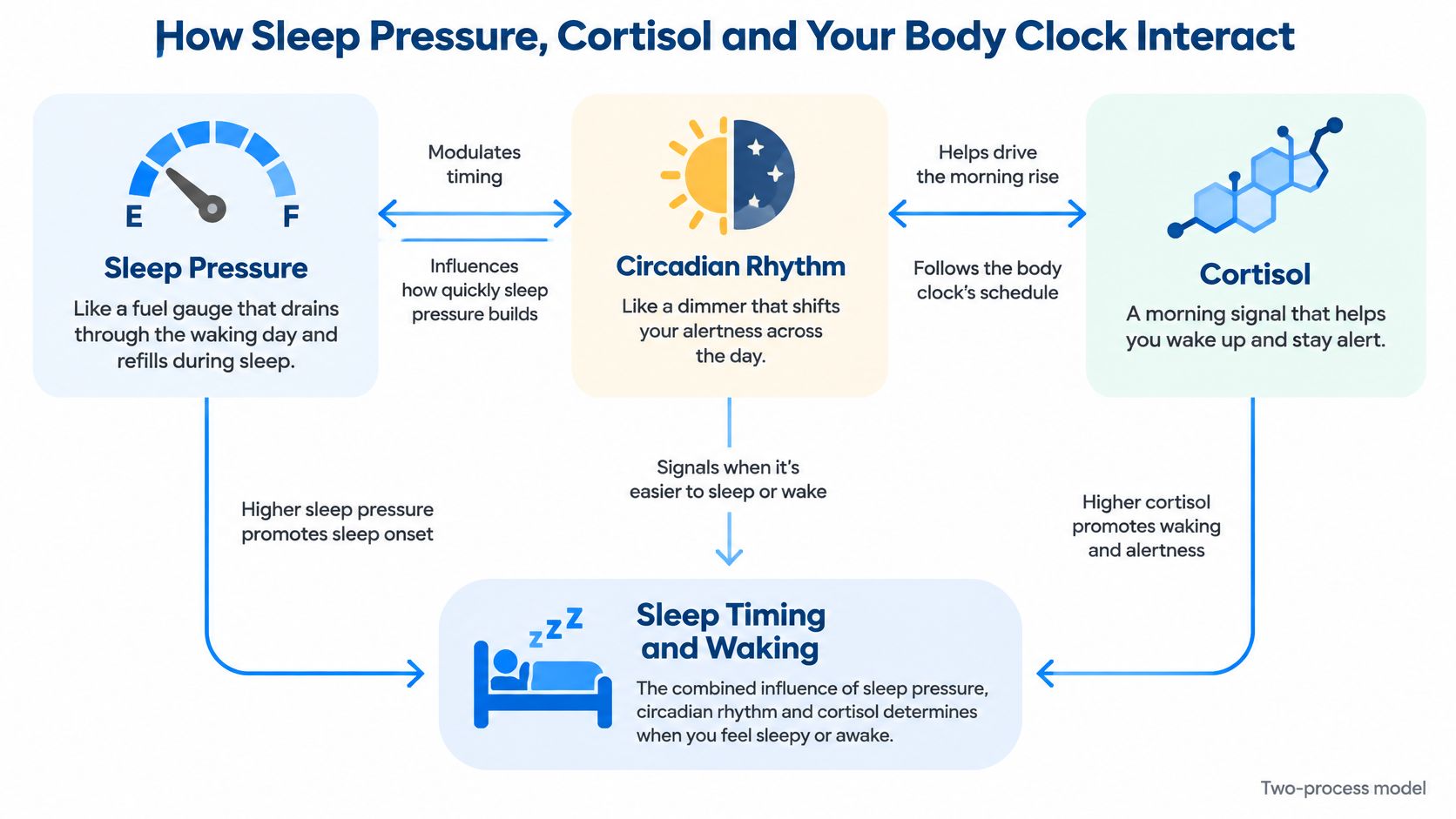
Think of sleep pressure as a fuel gauge. It drains through the waking day and refills during sleep. Think of the circadian rhythm as a dimmer that brightens alertness toward morning. By about 3 a.m., the gauge is lower and the dimmer is already turning up. That overlap, not a broken clock, is why a light arousal is easier to notice then.
Where cortisol fits
The suprachiasmatic nucleus coordinates a roughly 24-hour sleep-wake rhythm. The hypothalamic-pituitary-adrenal axis produces a cortisol rhythm that is lowest in early sleep and rises sharply before the habitual wake time, which StatPearls describes as normal circadian physiology rather than a single disease. Someone with an early internal schedule can feel that rise sooner. An early bedtime, sleep that is already long enough, or an advanced circadian phase makes a late-night wake more likely.
Chronic stress changes the landing. Higher cortisol and sympathetic activation increase arousal and suppress sleep-promoting pathways. A normal brief arousal then stretches into prolonged wakefulness. The clinical split is simple. Can the person return to sleep, and do they feel rested?
A brief awakening is normal. It becomes a problem when sleep doesn't return or the morning feels unrested.
Recurrent early waking with daytime impairment can fit an insomnia pattern. Sleeping well on a later, self-selected schedule points more toward a circadian rhythm disorder. A practical test is a two-week sleep diary. Record bedtime, estimated sleep onset, the awakening time, final wake time, light exposure, naps, caffeine, alcohol, and medication timing. Consistent early sleepiness plus early waking points to circadian timing. Variable awakenings with distress and long wakefulness point toward insomnia or another disruptor. A stable long-sleep schedule only helps after that reading is clear.
Alcohol, Medications and Dose Timing
A nightcap feels like it helps because the first half of the night looks better. National Institute on Alcohol Abuse and Alcoholism summaries of polysomnography indicate that alcohol may shorten sleep-onset latency, reduce wakefulness, suppress REM sleep, and increase slow-wave sleep early on. In the second half it tends to increase wake after sleep onset, reduce sleep efficiency, and produce REM rebound.
Say someone has two glasses of wine at 10 p.m., falls asleep quickly, and is wide awake near 3 a.m. That biphasic pattern fits. Alcohol can also worsen sleep-disordered breathing and periodic limb movements, so repeated arousals feel like one awakening. Early waking alone doesn't prove alcohol is the cause. Timing after evening drinking, plus improvement when drinking stops, is the useful evidence.
A two-week comparison
Keep bedtime and wake time fixed. Compare at least two weeks with no evening alcohol against the usual pattern. Record snoring, gasping, morning headaches, and daytime sleepiness. If awakenings persist despite abstinence, especially with witnessed breathing pauses, ask about sleep apnea.
Medications belong in the same log. Corticosteroids, some antidepressants, decongestants, and certain asthma or thyroid medicines can fragment sleep, and dose time matters. Don't stop or change a prescription on your own. List each medicine with its dose time and ask the prescriber whether a different hour is reasonable. Prescription and compounded treatments are written only at the clinical discretion of licensed U.S. providers after an individualized telehealth intake.
Real Patterns Behind a 3am Waking
These three profiles are composites, not real patients. Each shows how the same hour points to a different pattern.
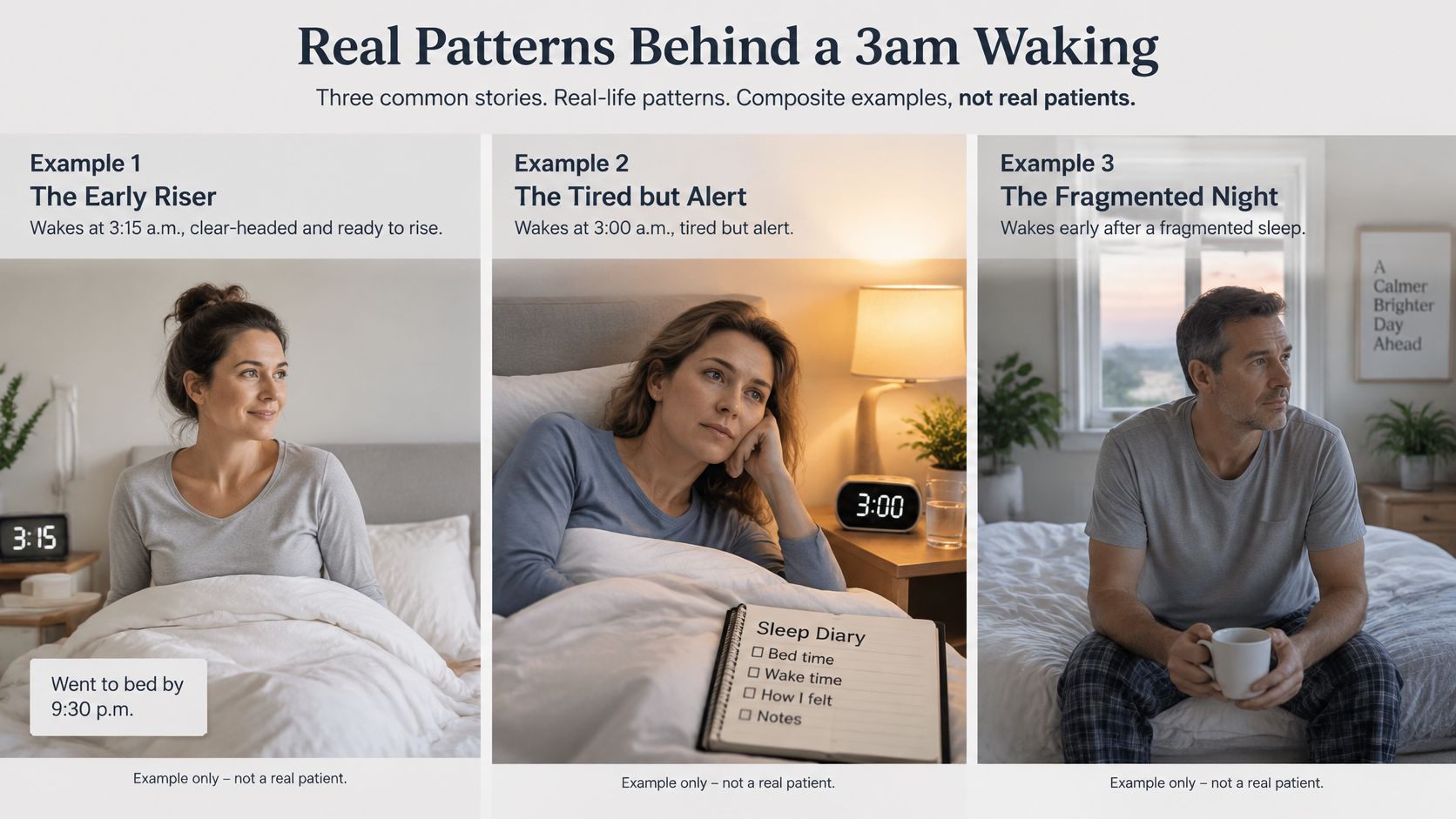
Profile one, early and rested. Bedtime is 9:30 p.m. Wake time is 3:15 a.m., the mind is clear, and rising at 5:30 a.m. feels easy. Sleep duration is already met. The pattern suggests an advanced circadian phase. A diary that shows steady early sleepiness and an early final wake, without distress, would confirm it.
Profile two, the planner. A manager under a deadline starts assigning tasks at 3 a.m. and stays up about 45 minutes. If that happens most nights for three months, stress arousal and a possible insomnia pattern fit better than a body-clock quirk. The confirming entry is variable wake-ups, a long return-to-sleep time, and a worse next day.
Profile three, the second-half rebound. Wine on most evenings, about four solid hours, then repeated waking. That fits alcohol-related rebound and calls for a snoring check. The diary should mark drink timing beside each awakening.
A recurring 3 a.m. wake isn't evidence of a special "organ clock" or one hormone abnormality, a point Cleveland Clinic guidance supports by focusing on symptoms instead. Apnea can cluster in later REM sleep, and some people only remember a bathroom trip. Ask whether a bed partner has heard snoring or breathing pauses. A diary can't capture that.
Red Flags That Warrant a Medical Visit
An occasional 3 a.m. wake is common. A persistent pattern is different. In 2024, 18.1% of U.S. adults reported trouble staying asleep, according to the National Center for Health Statistics. The same year, approximately 12% of U.S. adults said they had been diagnosed with chronic insomnia in an American Academy of Sleep Medicine survey of 2,005 adults.
| Warning sign | Why it matters | Next step |
|---|---|---|
| Awake most nights for three months or more | Meets an insomnia pattern | Clinical evaluation |
| Loud snoring, gasping or witnessed breathing pauses | Possible obstructive sleep apnea | Sleep study referral |
| Daytime sleepiness affecting work, concentration or driving | Circadian or breathing disorder | Prompt evaluation and no drowsy driving |
| Night sweats or hot flashes disrupting sleep | Menopausal transition, which can also coincide with other sleep disorders | Clinician review |
| Pain, reflux, low mood or anxiety | Co-occurring condition that fragments sleep | Primary care review |
| Frequent nighttime urination | Fluid, bladder or metabolic causes | Primary care evaluation |
What the numbers change
Among people meeting insomnia criteria, difficulty maintaining sleep accounted for 61% of symptoms and early-morning awakening for 52%, compared with 38% for difficulty initiating sleep, in CDC National Health Statistics reporting. Maintenance trouble is the larger slice, which is why a 3 a.m. pattern deserves a real look when days suffer. Repeated awakenings with breathing symptoms, impaired function, or a long return to sleep warrant assessment, including discussion of insomnia treatment when the diary shows a chronic pattern.
Menopause is a clue, not an automatic cause
Approximately 40%–60% of perimenopausal and postmenopausal women experience sleep disruption or insomnia symptoms, according to a review summarized by the Sleep Foundation. Hot flashes and night sweats can fragment sleep, and disruption can continue after the final menstrual period. The same years also raise the odds of insomnia, sleep apnea, restless legs, medication effects, and mood symptoms. Log timing, sweats, menstrual status, snoring, alcohol, caffeine, medicines, and time awake before assuming hormones are the only driver.
The North American Menopause Society notes that hormone therapy can help vasomotor and genitourinary symptoms, while any reduction in menopause-related abdominal fat is small, so it isn't a weight-loss treatment. Systemic estrogen is for whole-body symptoms such as hot flashes. Low-dose vaginal estrogen targets genitourinary symptoms with lower systemic exposure. Bio-identical or compounded formulations aren't automatically safer. Any hormone therapy is prescribed only at the clinical discretion of licensed U.S. providers after individualized intake, contraindication review, and a discussion of approved alternatives.
Thoughts of self-harm need immediate help through emergency services or the 988 Suicide and Crisis Lifeline. Dangerous drowsiness while driving also needs prompt care, and driving should stop until a clinician clears it.
Sleep Habits That Lower Your Odds of Waking
Anchor the day with a fixed wake time seven days a week, including after a short night. That hold makes the early-morning wake drive more predictable than chasing a perfect bedtime.
Light, temperature, and timing
Get outdoor light within an hour of waking, ideally for 10 to 30 minutes. The room should be dark, quiet, and cool, often around 60 to 67°F (16 to 19°C). Use blackout curtains or an eye mask if dawn light arrives early.
Stop caffeine about six hours before bed. Finish large meals two to three hours before sleep. Limit fluids in the last hour so a bladder signal is less likely to finish the job a light arousal started. Dim the lights for about 30 minutes and leave work email out of that window. A written sleep routine is easier to repeat than a mental list.
Practical rule: Change one variable at a time for 14 days so the diary shows which change mattered.
Don't lie in bed for hours trying to force sleep. Awake time in bed teaches the brain that the bed is a place for wakefulness. If a single habit isn't enough, prescription options exist only after clinician review. One example is a sleep-maintenance pairing of doxylamine 10 mg and trazodone 50 mg, considered only when a licensed U.S. provider finds it appropriate. It doesn't replace the diary, and it isn't a shortcut around apnea or mood symptoms.
Separate from that sleep decision, other protocols follow the same rule of individualized prescribing. Semaglutide activates the GLP-1 receptor in appetite-related brain regions. In the FDA-reviewed Wegovy program, 1.7 mg or 2.4 mg produced statistically significant weight reduction versus placebo at 68 weeks, with more participants reaching 5%, 10%, and 15% loss thresholds, per the Wegovy prescribing information. It doesn't replace nutrition, activity, or adverse-effect monitoring. For hair, finasteride lowers conversion of testosterone to dihydrotestosterone, minoxidil supports the anagen phase through a non-androgen path, and dutasteride inhibits both type 1 and type 2 5-alpha-reductase, with reviewed studies showing measurable growth in about three to six months at 0.5 mg daily, as summarized in the Annals of Dermatology. For erectile function, sildenafil and tadalafil preserve cGMP so cavernosal smooth muscle can relax when stimulation and blood flow are adequate. The American Urological Association treats oral PDE5 inhibitors as a first-line option unless contraindicated, and organic nitrates are contraindicated because blood pressure can fall sharply. Suggested emergency intervals are at least 24 hours after sildenafil and 48 hours after tadalafil before nitrate use under medical supervision. Patients must not self-manage that interaction. NAD+, sermorelin, glutathione, and MIC plus B12 are likewise individualized longevity tools, not sleep cures, and none of these therapies is guaranteed.
What to Do When You Wake and Cannot Fall Back Asleep
Use this sequence without hunting for the clock.
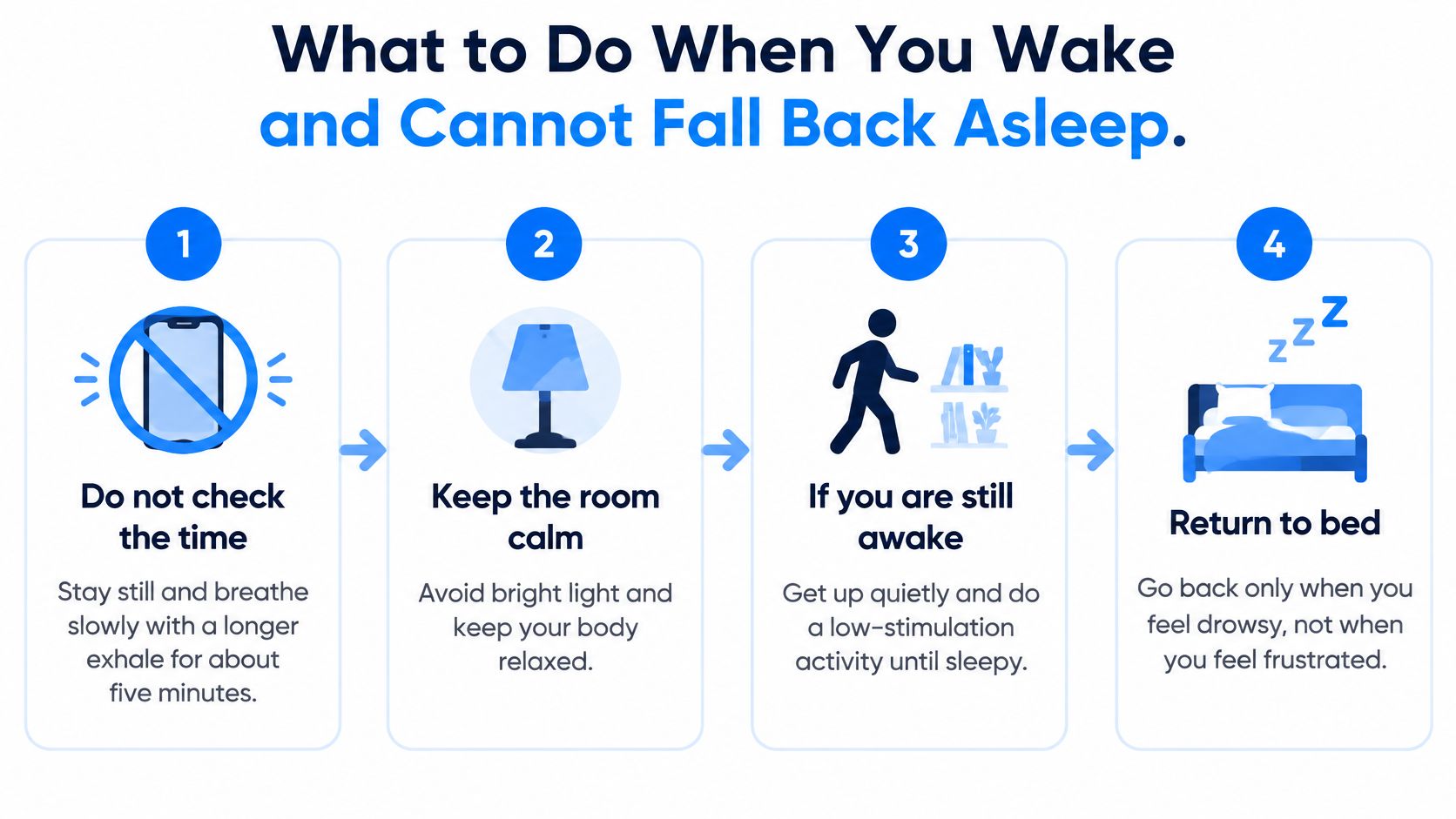
- Don't check the time. Stay still and breathe slowly, with a longer exhale, for about five minutes. Clock math turns a forgettable arousal into a worry loop.
- Leave the bed if you're still awake after roughly 20 minutes. Staying put pairs the mattress with frustration. The bed should predict sleep, not problem-solving.
- Move to a dim room. Use a warm lamp, not overhead lights. Bright light can make the return harder.
- Pick a low-stimulation task. Read a paper book or a familiar, unexciting page. Skip screens and unfinished work.
- Park circling worries. Write each one on a notepad with one morning action. The point is to stop rehearsing, not to solve the day at 3 a.m.
- Return only when sleepy. If wakefulness comes back, repeat the steps without treating it as a failure.
- Keep tomorrow's wake time. A broken night isn't a reason to sleep in. The anchor is what steadies the next evening.
- Log the episode. Note the approximate time, how long you were up, and any trigger such as alcohol, a hot flash, pain, or a bathroom trip.
These steps handle one night. A repeating pattern still needs the diary and, when red flags are present, a clinical review. Prescription treatment, if any, stays at the discretion of a licensed U.S. provider after that review.
Track Two Weeks Before You Book a Visit
Start the diary tonight. Use the fields already listed for timing, light, naps, caffeine, alcohol, and medicines, and add any snoring a bed partner reports.
After two weeks, read the page as a fork.
Branch one. Awakenings are infrequent, you fall back asleep, and days feel rested. Keep the habit changes and log another two weeks.
Branch two. Awakenings are frequent or long, breathing symptoms are present, daytime function is worse, or no clear cause appears. Book a primary care clinician or sleep specialist. Bring the diary and the medication list. A visit usually covers history, a sleep questionnaire, and, when breathing is a concern, a sleep study. Any prescription or compounded treatment is determined only at the clinical discretion of a licensed U.S. provider after individualized evaluation.
Informational purposes only. Compounded medications are evaluated by a licensed provider for individual suitability and are fulfilled by state-licensed partner compounding pharmacies.
Vials + Vitals offers physician-directed telehealth protocols for metabolic health, hormone care, hair, sexual wellness, and sleep-related concerns, with eligibility set by U.S.-licensed providers after an online clinical assessment. If a two-week log shows a pattern you want reviewed alongside weight, hormones, or recovery goals, start with a confidential intake. Visit Vials + Vitals to see whether a supervised protocol fits.