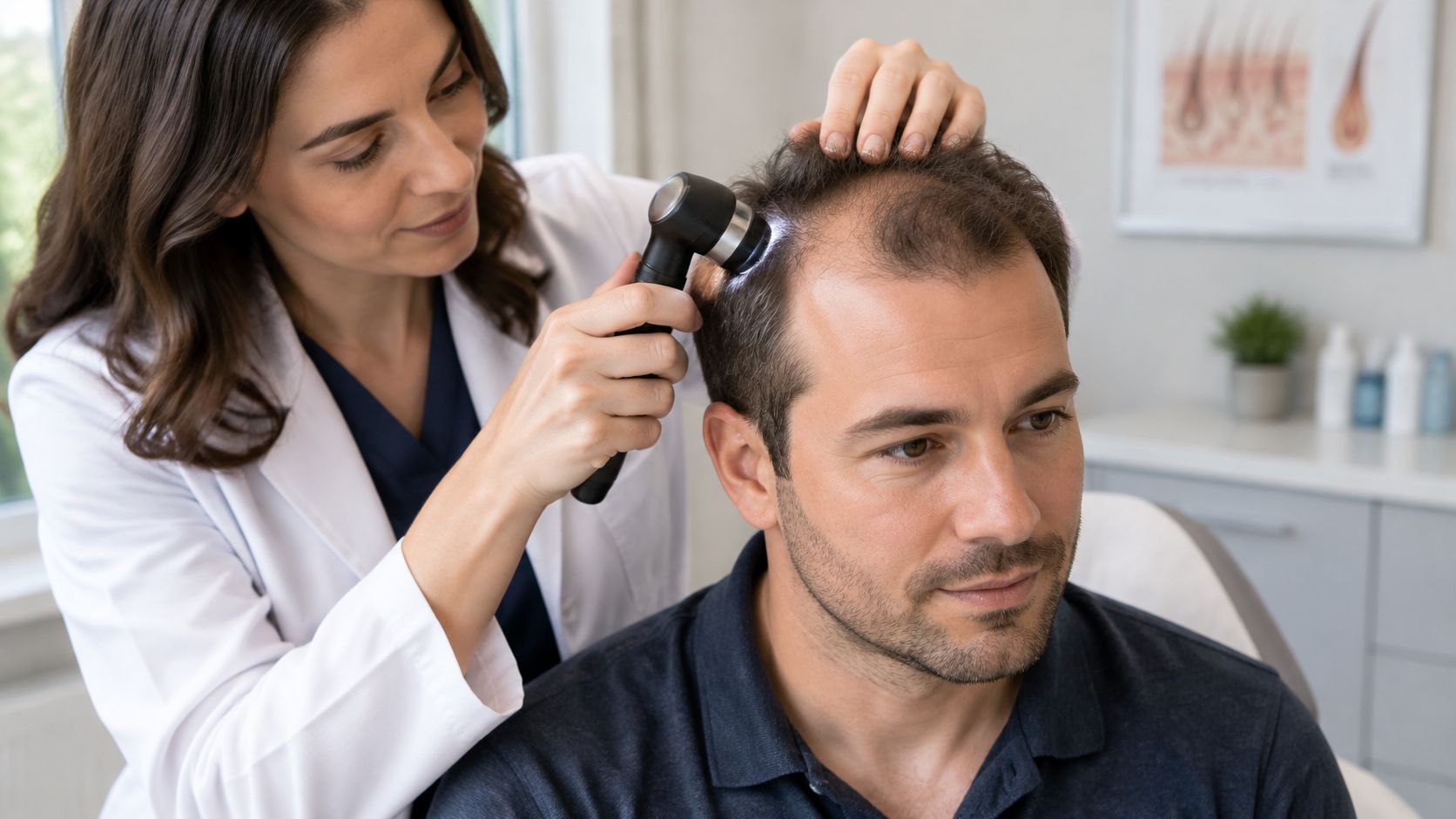
Hair Loss Treatment Clinic: What Good Care Looks Like
What a hair loss treatment clinic should offer, from diagnosis and DHT-targeted treatment to monitoring, plus how to check credentials before you commit.
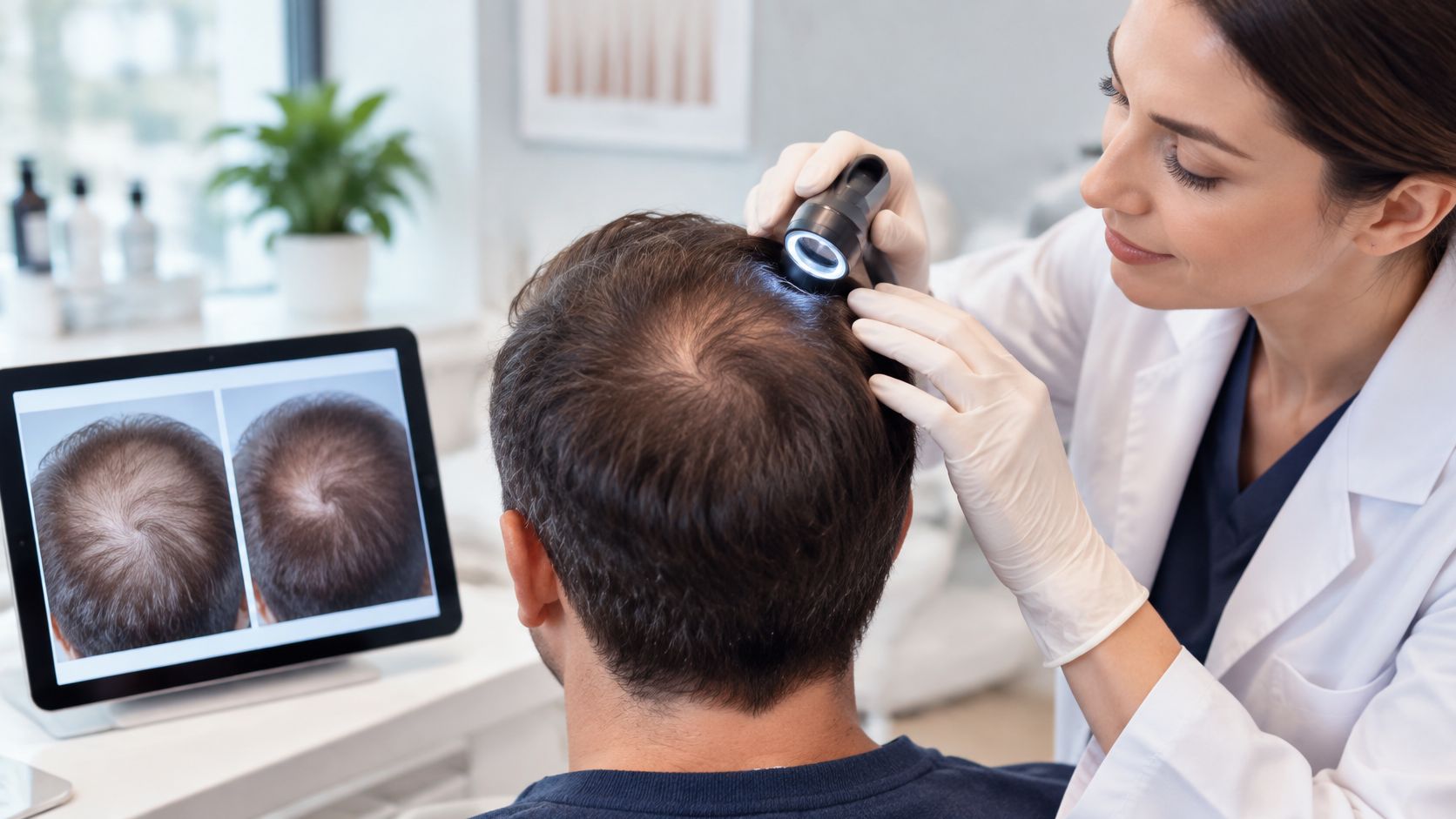
The part down the middle of the scalp has widened enough that a phone photo taken in daylight looks unfamiliar. The ponytail loops one extra time. The shower drain holds more hair than it did a year ago, and the search that follows returns a page of clinics promising a fuller head of hair by summer.
That search blends two very different businesses. One sells bottles, gummies and subscriptions and leaves the buyer to guess at the cause. The other is a hair loss treatment clinic, where a licensed clinician works out why hair is shedding, records what the scalp looks like today, prescribes only when the diagnosis supports it, and measures the result over months.
The distinction matters most in the cases that go sideways: the woman told to try a shampoo when her ferritin was never checked, the man who quit at week six because shedding briefly increased, the patient started on finasteride without anyone asking about pregnancy. Each of those is a diagnosis problem before it's a drug problem.
Why Hair Loss Deserves a Clinic, Not Just a Product
A thinning part can prompt a quick purchase: minoxidil, a biotin gummy, a shampoo labeled DHT-blocking, or a subscription. A clinical assessment starts with different questions. When did the shedding begin? Is the change at the crown, part line, or temples? Which medications are you taking, and does hair loss run in your family?
A hair loss treatment clinic evaluates the pattern before recommending a treatment. Follicles are like small production units: in pattern hair loss, they gradually shrink, producing finer, shorter hairs. A clinician needs to distinguish that process from shedding or scalp changes with other causes.
The core deliverable: a working diagnosis, a baseline for comparison, and a monitoring schedule. A prescription comes fourth in the visit.
Patterned thinning can follow genetic and hormonal influences, but a thinning scalp does not automatically mean androgenetic alopecia. Shedding after an illness, a crash diet, childbirth, or a medication change may have a different explanation. Smooth round patches, an itchy or scaly scalp, burning, or thinning eyebrows also warrant attention to causes beyond pattern loss.
That distinction shapes the goal. Treatment aims to retain follicles and assess changes in stabilization and density over time; it cannot promise a full return of lost hair. A baseline makes later comparisons more useful, while follow-up helps assess whether the plan remains appropriate.
What a Hair Loss Treatment Clinic Offers at Every Stage
Hair loss care follows a sequence, and each stage produces something a patient can hold: a diagnosis, a baseline image, a protocol, a follow-up date. Skipping a stage is what turns medical care into a transaction.
The care pathway, stage by stage
| Stage | What the clinic does | Typical tools and tests | What you leave with |
|---|---|---|---|
| Medical intake | Reviews onset, shedding pattern, family history, medications, systemic illness and pregnancy potential | Structured questionnaire reviewed by a licensed clinician | A working diagnosis and an eligibility check |
| Scalp examination | Maps distribution, miniaturization, inflammation and scarring | Standardized photographs, trichoscopy, hair-pull or wash test | A documented baseline for tracking change |
| Diagnosis and staging | Classifies the pattern and rules out competing causes | Differential diagnosis; biopsy only for uncertain or inflammatory cases | A named diagnosis with realistic goals |
| Treatment selection | Matches evidence-based options to the patient's profile and risks | Finasteride, dutasteride, minoxidil or a combination, with informed consent | An individualized protocol and monitoring plan |
| Monitoring and follow-up | Judges response, adherence and side effects over months | Follow-up photography at fixed intervals, symptom and lab review as indicated | A decision to continue, adjust, escalate or stop |
The two stages patients underestimate
Baseline documentation looks like busywork until month eight, when the only way to answer "is this working?" is a photograph taken under the same light, at the same distance, with the part in the same place. Without that reference image, a patient is left comparing a mirror to a memory, and memory is generous in both directions.
Scheduled follow-up is the stage that separates a prescription from a subscription. A clinician who reviews photographs at fixed intervals can distinguish expected early shedding from disease progression, catch scalp irritation before it ends adherence, and make an actual decision: continue, adjust, escalate or stop. A vendor who ships refills without asking has no mechanism for any of that.
Clinic types differ, and it's worth knowing which one is on the other side of the intake form. Surgical practices run procedure rooms; physicians in the International Society of Hair Restoration Surgery performed an average of 15 hair-restoration surgeries per month in 2024, according to the society's practice census, which tells you their workflow is built around operating-room throughput. Medical-management clinics, increasingly delivered by telehealth, diagnose, prescribe and monitor over months and refer out when surgery is the right answer. Neither model is wrong. Confusing one for the other is.
Judge any clinic against stages two and five. If nobody photographs the scalp and nobody books the review, the rest of the offer is a product with medical branding.
How a Clinic Triages Pattern Baldness From Other Causes
An emergency department doesn't treat every chest pain as a heart attack, and it doesn't send every patient home either. It sorts first. A hair loss treatment clinic works the same way, because one visible symptom, less hair, comes from conditions with completely different treatments.
The triage runs in a fixed order, and it finishes before a prescription is written.
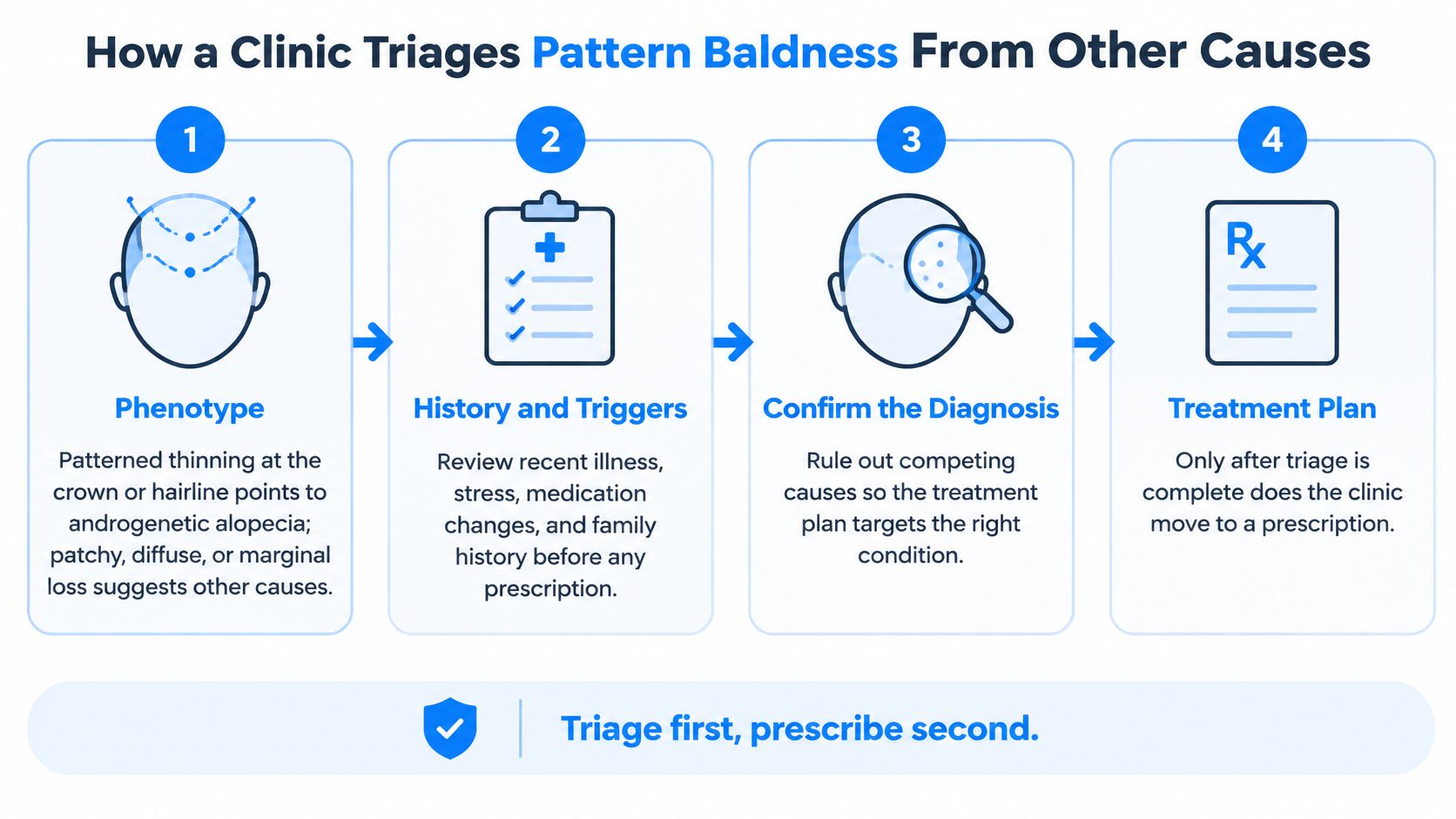
Step one, read the pattern
Patterned thinning that follows the crown, the temples or the part line is the signature of androgenetic alopecia, and it's what most clinics see. Everything else earns a second look. Patchy loss, diffuse thinning across the whole scalp, marginal loss along the hairline edge and any inflamed scalp suggest a different disease process with different management, as the American Academy of Family Physicians review of hair loss evaluation sets out. The distribution is the first diagnostic data point, and it costs nothing to observe.
Step two, take a structured history
A technically sound intake records distribution, onset, shedding rate, family history, medications, systemic illness, pregnancy potential and scalp symptoms. Each item earns its place. A blood pressure drug started two months before the shedding changes the differential. A pregnancy removes two of the most effective drugs from consideration entirely. Itching, pain, scaling or burning points away from pattern loss and toward an inflammatory or infectious process. This is the stage telemedicine handles well when the questionnaire is thorough, and handles badly when it's three checkboxes.
Step three, measure without cutting
Noninvasive assessment carries most of the diagnostic weight: standardized photographs under identical lighting, a hair-pull or wash test to estimate how many hairs are actively shedding, and trichoscopy, the dermoscopic examination of scalp and hair shafts, to quantify follicular miniaturization and caliber variation. Biopsy is reserved for cases that remain uncertain after those steps or that look inflammatory, and dermoscopic findings should guide where the sample is taken. A clinic that photographs nothing and measures nothing has no way to distinguish improvement from wishful thinking.
Visible density changes arrive slowly, and ordinary hair-cycle shifts can mask an early response. Compare images taken with the same lighting, the same camera distance, the same scalp part and the same interval between visits.
Why the distinction changes the drug
The stakes are pharmacological. Androgenetic alopecia is managed with follicle-preserving, growth-stimulating therapy, while alopecia areata, infection or a scarring process may need immunomodulatory, antimicrobial or anti-inflammatory care. Starting minoxidil on a scalp that's actively scarring delays the one intervention that preserves follicles, which is rapid inflammation control.
Red flags that should stop self-treatment
- Sudden diffuse shedding after an illness, a crash diet, high stress or a new medication, which points to a trigger rather than a follicle problem.
- Smooth round patches that appear over days, a pattern that suggests an autoimmune process.
- Scaling, pain, pustules or burning, which suggest inflammation or infection that minoxidil will irritate further.
- Rapid progression over weeks rather than years.
- Loss of eyebrows or body hair, which widens the differential beyond the scalp.
- A shiny, smooth scalp where follicles have been replaced by scar tissue, where regrowth is no longer the goal and preservation is.
Any of those belongs in front of a clinician who can examine the scalp in person and order labs or a biopsy. None of them belongs in a shopping cart.
Where women and scarring disease need a different conversation
Women need hormonal, thyroid and iron context before any prescription, and antiandrogen choices and safety considerations differ substantially between men and women. Minoxidil can also cause temporary early shedding, and its benefits require continued use; a 2025 consensus review of individualized hair loss care makes both points, and the same review cites patient-centered research on scarring alopecia in which only 37.5% of respondents reported well-controlled symptoms while 78.9% experienced depression or anxiety, with provider reluctance (46%), insurance denial (18%) and cost (16%) among the barriers. Thinning in women has its own workup, and the causes behind female pattern thinning are worth understanding before assuming a shared protocol. In scarring disease the goal is retention of remaining follicles under fast inflammation control, which is a different promise from the one pattern-loss patients receive.
A proper first visit ends with three things: a documented baseline, a provisional diagnosis and a monitoring plan. A prescription may be among them. It shouldn't be the only thing the visit produces.
Evidence-Based Treatments a Clinic May Prescribe
A thinning crown and a receding hairline can look similar in the mirror, yet treatment depends on what is happening inside the follicles. In pattern hair loss, genetically susceptible follicles gradually miniaturize: the growth phase shortens and each new hair shaft becomes finer. Finasteride and dutasteride inhibit 5-alpha-reductase, which converts testosterone to dihydrotestosterone (DHT). Minoxidil works through a different pathway to stimulate growth. A clinician may consider these mechanisms separately or together after assessing the likely cause of loss and the patient's health.
| Treatment | How it works | Time to judge results | Oversight and key cautions |
|---|---|---|---|
| Topical minoxidil | Growth stimulant that extends the hair growth phase | 6-12 months | Available over the counter in the US; scalp irritation and unwanted facial hair possible |
| Low-dose oral minoxidil | Growth stimulant taken daily | 6-12 months | Prescription only; not FDA-approved for hair loss; fluid retention, lower blood pressure and increased heart rate possible |
| Finasteride | 5-alpha-reductase inhibitor that lowers DHT in follicles | 6-12 months, better when started early | Prescription only; sexual side effects possible; must not be handled or taken during pregnancy |
| Dutasteride | Inhibits more of the 5-alpha-reductase pathway than finasteride | 6-12 months | Prescription only; individualized dosing and monitoring; compounded products are not automatically equivalent to approved drugs |
| Combination protocols | DHT reduction plus growth stimulation together | 12 months for a fair comparison | Prescription only; evidence supports use in selected patients; choice depends on individual risk |
What the combination data show
A meta-analysis of seven randomized controlled trials found that combined topical finasteride and minoxidil improved hair density by a mean difference of 9.22 and hair diameter by 2.26 compared with minoxidil alone. Photographic assessments also favored the combination, according to a review of combination therapy for pattern hair loss. The review also reports 12-month regrowth in 80.5% of men taking oral finasteride, 59.0% using topical minoxidil and 94.1% receiving both, based on a separate randomized comparison.
These results describe groups, not an individual's likely outcome. Baseline severity, age, reproductive plans, cardiovascular history, scalp tolerance and willingness to continue treatment all affect which option may be appropriate. Combination therapy can be considered when the potential benefit justifies the added treatment burden.
Where dutasteride fits
Dutasteride inhibits more of the 5-alpha-reductase pathway than finasteride. In a randomized study of 917 men aged 20 to 50 with androgenetic alopecia, participants received varying doses of dutasteride, finasteride 1 mg or placebo for 24 weeks. Hair counts and width improved with dutasteride. The strongest studied response was at 0.5 mg, which outperformed finasteride 1 mg on target-area hair count, hair width and blinded photographic assessment of frontal growth, according to the American Academy of Dermatology's session on FDA-approved and compounded hair loss treatments. The differences between dutasteride and finasteride for hair loss help explain why a stronger effect on this pathway does not automatically make dutasteride the right choice for every patient.
The guardrails that travel with every prescription
- Prescription status. Finasteride, dutasteride and oral minoxidil require a licensed prescriber in the United States. Topical minoxidil is available without a prescription, but oral use requires medical oversight.
- Pregnancy. Finasteride and dutasteride must not be handled or taken during pregnancy, including crushed or broken tablets.
- Cardiovascular and scalp history. Oral minoxidil can lower blood pressure, cause fluid retention and increase heart rate. Blood pressure history informs prescribing; scalp tolerance helps guide topical treatment choices.
- Compounded products. A compounded formulation is not automatically interchangeable with an FDA-approved product. Potency, vehicle and stability can vary by pharmacy.
Licensed U.S. healthcare providers prescribe only when an individualized assessment supports treatment. This keeps trial findings in context and helps match treatment to the diagnosis, risks and goals of the person seeking care.
Treatment Timelines and How Progress Is Measured
At week six, a patient may see more hairs in the shower and worry that treatment is making things worse. The timeline matters: early shedding can occur, while visible density changes often take months. A clinic helps distinguish a temporary change from ongoing loss and sets checkpoints before treatment begins.
| Period | Expected change | What the clinic checks |
|---|---|---|
| Weeks 2 to 8 | Shedding may increase as older hairs are pushed out | Adherence, and whether shedding is expected early loss or progression |
| Months 3 to 6 | Shedding may slow; stabilization may become clearer | Standardized photographs compared with the baseline |
| Months 6 to 12 | Density changes may become visible and measurable | Trichoscopy counts and photographic review |
| Beyond 12 months | Maintenance may be needed to retain benefits | Whether to continue, adjust, escalate or stop |
A single checkpoint cannot establish whether a treatment is working. The pattern across repeated measurements is more useful.
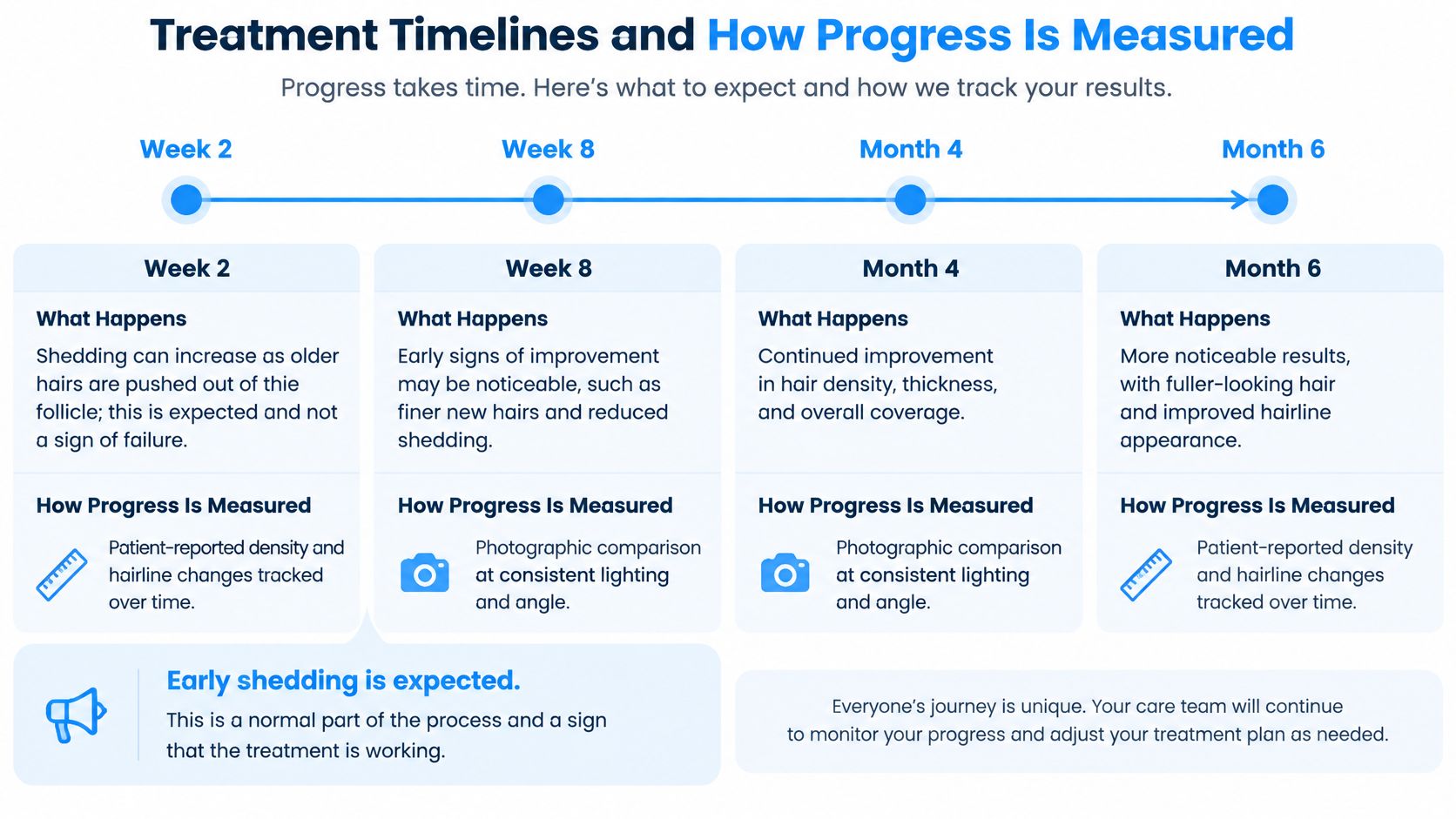
Early shedding is the part most patients aren't warned about
Between weeks two and eight, shedding can increase as older hairs leave the follicle. This can happen during treatment and does not, by itself, show whether the underlying condition is improving or progressing. A clinic can explain this possibility in advance and record the change, then compare it with the patient's baseline and later follow-ups.
Use month six as a meaningful review point, not week six. If treatment is stopped during an early shed, there may not have been enough time to assess its effect.
Benchmarks worth remembering
Topical minoxidil can reduce shedding, stimulate growth and strengthen existing hair. Patients typically need about 6 to 12 months before judging its effect, according to the American Academy of Dermatology's guidance on male pattern hair loss treatment. Finasteride slows additional hair loss in roughly 80% to 90% of men who take it, according to the American Academy of Dermatology. Complete regrowth is unlikely, and outcomes are generally better when treatment begins soon after loss is noticed.
Long-term results also show why retention matters. After five years of finasteride treatment, nearly 50% of men showed increased hair growth and 90% had at least maintained their hair, while 75% of untreated men were rated as having lost hair during the same period, according to coverage of the drugs' regulatory and long-term data. Practical steps in how to slow hair loss can support a plan focused on preserving follicles and monitoring change.
How progress gets measured, and what gets flagged
Use photographs taken at fixed intervals with consistent lighting, camera distance and scalp parting. Trichoscopy counts can add detail beneath what a mirror shows. Together, these measures help a clinician assess whether loss has stabilized and whether density has changed.
Safety review belongs at follow-up, too. Oral minoxidil can lower blood pressure, cause fluid retention and increase heart rate. Chest pain, shortness of breath, fainting or rapid unexplained weight gain require prompt medical attention. These risks make clinical monitoring part of treatment, not an optional extra.
The goal is to preserve follicles and assess density over time. Stabilization can be meaningful progress, even when treatment does not produce complete regrowth.
How to Assess a Clinic's Credentials and Protocols
A clinic's process matters most when the cause of hair loss is uncertain. In a 2025 patient survey reported in the British Journal of Dermatology, only 30% of respondents believed their first healthcare professional gave the correct diagnosis, 41% had difficulty obtaining a dermatology referral, and the median wait for a dermatologist was 12 months. Among respondents first seen by a dermatologist, 78% felt they received the correct diagnosis at that visit. These figures point to two separate questions: can you access care, and does the clinician have a process for distinguishing pattern loss from other causes?
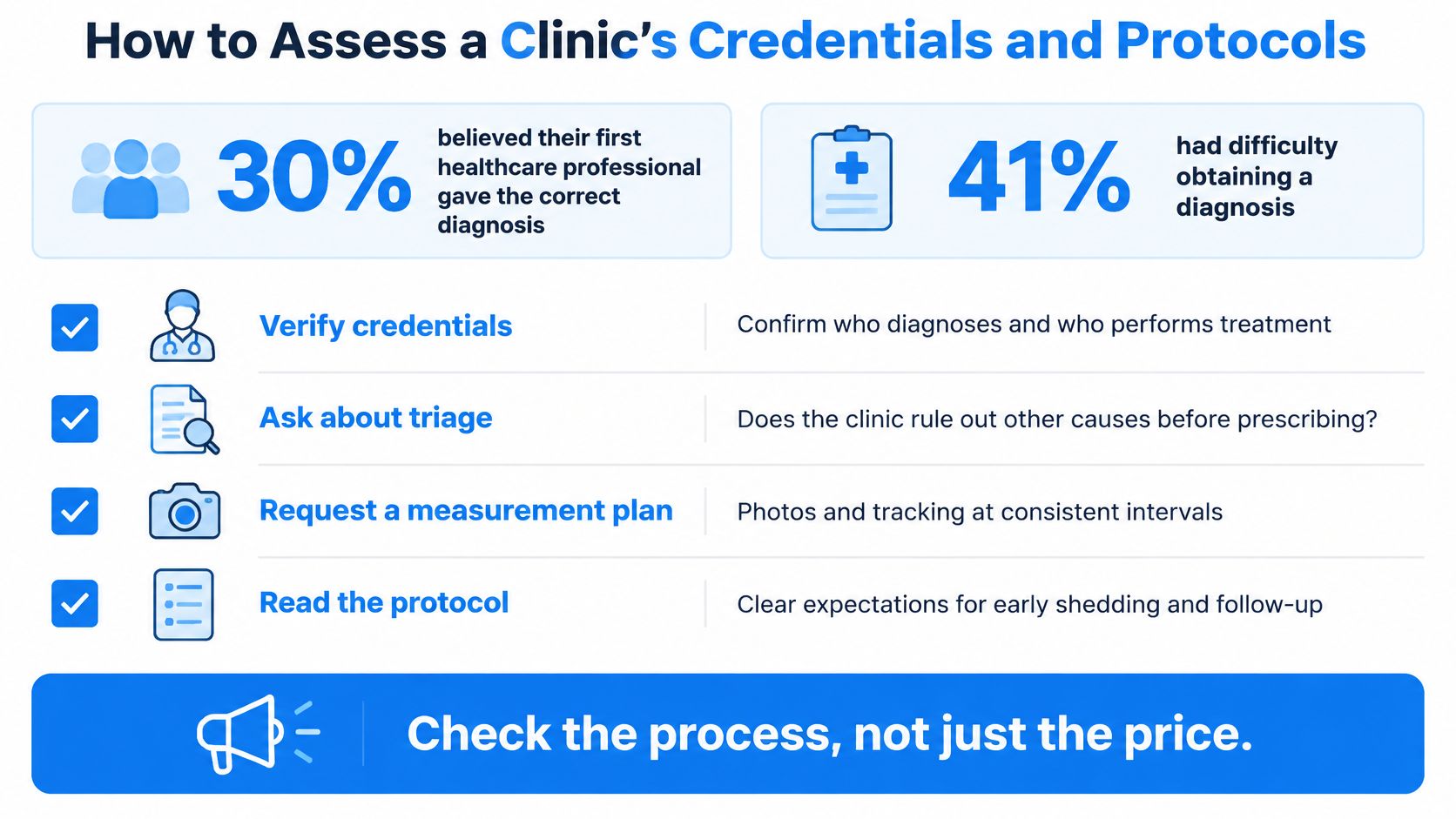
A clinic's credentials are only one part of the assessment. Ask how the clinician gathers information, decides whether treatment is appropriate, and responds when the pattern does not fit routine hair loss.
A checklist worth running before paying
- Confirm who is licensed and who decides. Vials + Vitals consultations are conducted by licensed U.S. healthcare providers. A prescription is issued only if a licensed provider determines treatment is clinically appropriate, and neither a prescription nor an outcome is promised.
- Ask whether diagnosis comes before prescribing. Find out what the intake covers and whether the clinician reviews scalp photographs or recommends an in-person assessment when the pattern is unclear. A short quiz alone may not capture enough context to distinguish causes.
- Check how treatment is adjusted to you. Ask whether the proposed medication, formulation and dose take your history into account, and who makes those decisions.
- Review the consent information. It should explain the treatment's known side effects, relevant pregnancy precautions, possible early shedding and whether continued use is needed to maintain benefit.
- Ask how progress will be reviewed. Find out when follow-up happens and how photographs or other measurements will be compared. Without a defined review, it is difficult to tell whether treatment is stabilizing loss.
- Understand the referral pathway. Ask what happens if the clinician suspects scarring or inflammation, or believes an examination, lab work or biopsy is needed.
- Ask which pharmacy dispenses the medication. For compounded treatments, ask what quality controls apply to preparation and dispensing.
- Read the outcome language carefully. A clinic should explain that response varies and avoid guaranteeing regrowth.
Before paying, ask: who reviews my progress, when will they do it, and what happens if the treatment is not helping?
Telehealth-specific checks
For telehealth, clarify whether the consultation is asynchronous or live, which states the clinician can serve, how to contact the care team and how prescribed medication is delivered. Vials + Vitals provides treatment only where it is clinically appropriate and permitted by applicable state and federal law. Discreet delivery is available when a treatment is prescribed.
Ask how consultation fees work and whether insurance is accepted. In the survey cited above, cost and insurance denial were among the most reported barriers for patients with scarring alopecia. A sound telehealth process should also explain when remote care is not enough and an in-person evaluation is needed.
Start With a Diagnosis and a 12-Month Plan
A wider part or a fuller drain can have more than one cause. Start by recording what has changed, then use a clinician's assessment to decide whether the pattern fits hair loss that can be managed remotely or needs an in-person examination.
- Document today. Photograph your scalp in consistent daylight, keeping the part in the same place. Note when shedding began and any changes around that time, such as a new medication, an illness, a diet change, childbirth or a menopause transition.
- Assemble your history. Include family patterns, current medications, major illnesses, diet, pregnancy or menopause timing, and scalp symptoms such as itching, pain, scaling or burning.
- Choose the right setting. Patches, pain, scaling, eyebrow loss or sudden diffuse shedding call for an in-person dermatologist. Confirmed pattern loss managed with prescription therapy can be appropriate for telehealth.
- Expect careful intake. A questionnaire and a clear account of your history help a clinician decide whether treatment is suitable. A provider may determine that prescribing is not appropriate.
- Set a realistic review point. Hair changes take time to assess. Discuss the follow-up schedule with your clinician and avoid judging a treatment by changes at week six alone.
Vials + Vitals begins care with a private online assessment reviewed by a doctor to determine whether treatment is appropriate. When a treatment is prescribed, discreet delivery is available. Follicle Fuel 2 costs from $159 per month for a 1-month supply.
Informational purposes only. Compounded medications are evaluated by a licensed provider for individual suitability and fulfilled by state-licensed partner compounding pharmacies.
A diagnosis helps distinguish pattern loss from other causes, while a baseline gives you a point of comparison. Vials + Vitals offers an online assessment reviewed by a licensed U.S. healthcare provider, with treatment provided only when clinically appropriate. If you are still guessing at the cause, start with the Vials + Vitals assessment before choosing another treatment.