How to Slow Hair Loss: Diagnosis, Treatment and Follow-Up
Learn how to slow hair loss with a clinical sequence: confirm the cause, compare evidence-based options, and track progress over 6-12 months.
At 12 months, 14% of men taking finasteride had a decrease in hair count, compared with 58% receiving placebo, according to FDA prescribing information. That finding reframes how to slow hair loss: preserving existing hair can be a meaningful treatment outcome, even without dramatic regrowth.
The Vials + Vitals Medical Board's educational approach starts with diagnosis, not a product. A licensed clinician identifies the cause, selects an appropriate treatment, and measures whether the patient retains hair or gains density over time.
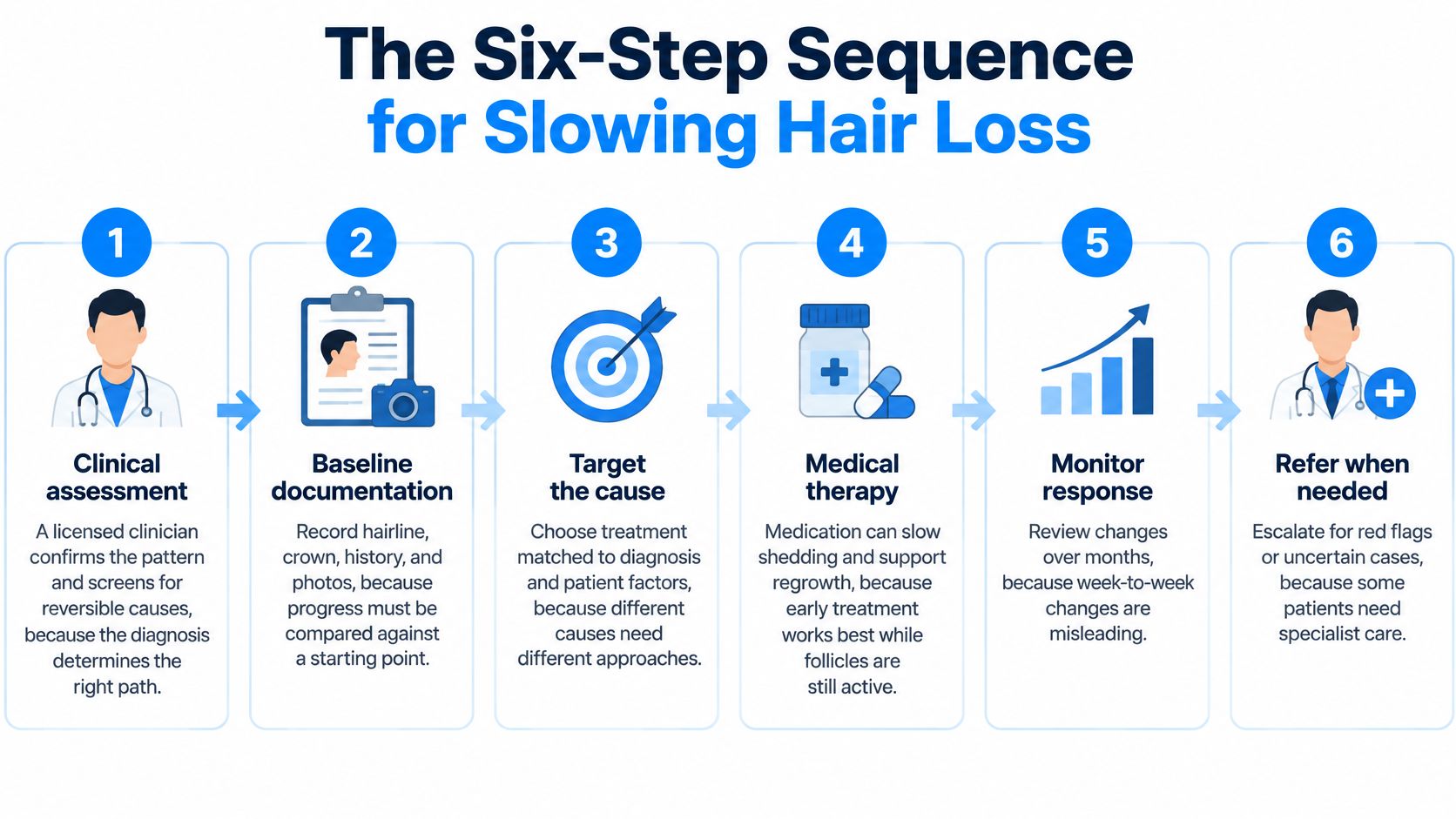
The Six-Step Sequence for Slowing Hair Loss
- Clinical assessment. At the first visit, a licensed clinician confirms the pattern and considers reversible contributors, including iron or ferritin status, vitamin D, thyroid disease, medication effects, and recent illness, because the cause determines treatment.
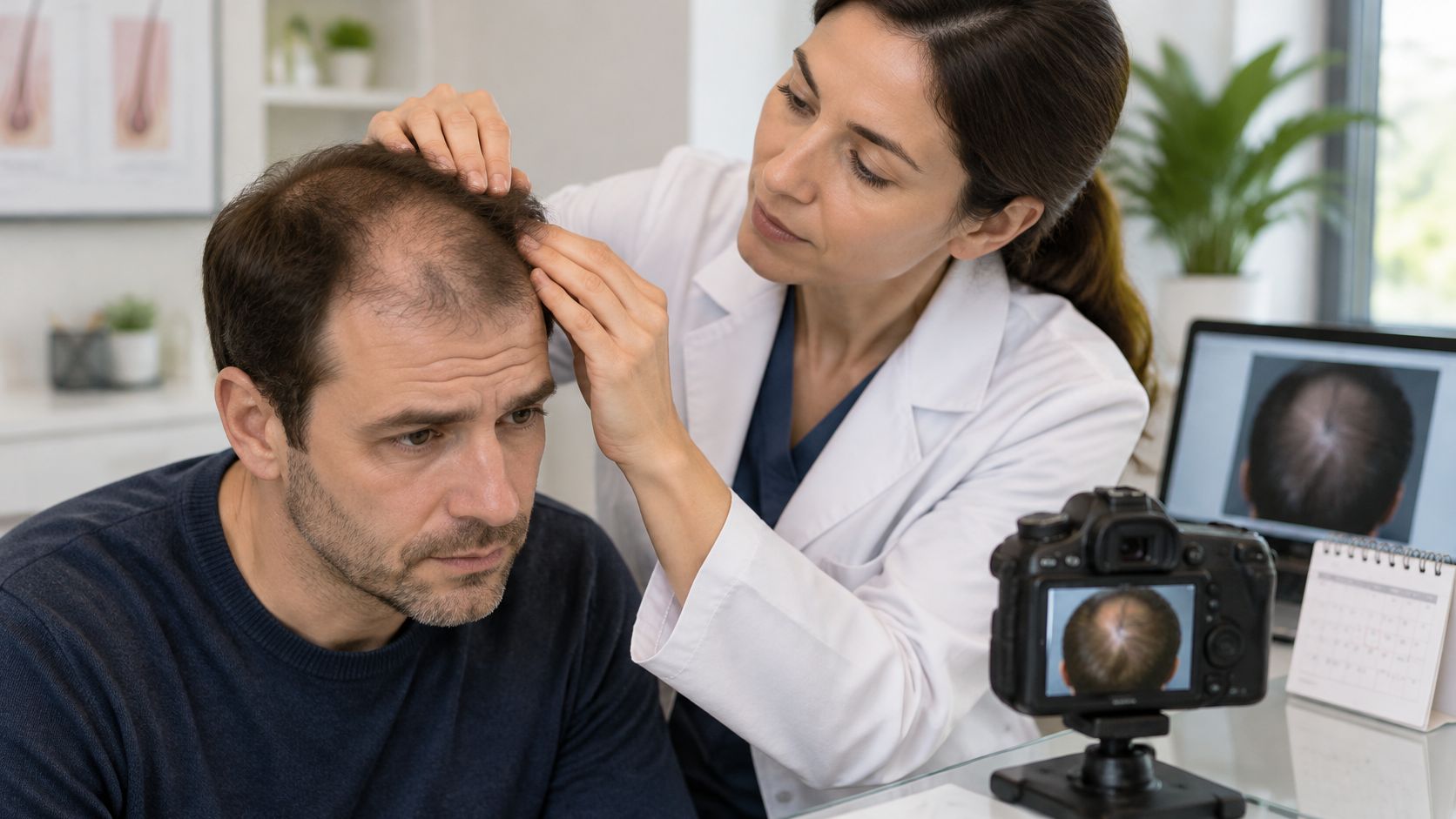
- Baseline photographs. On day one, the patient records the hairline and crown with clinician guidance, using repeatable lighting and camera distance so later comparisons have a reliable starting point.
- Therapy selection. At the first consultation, the clinician compares topical minoxidil, finasteride for eligible men, and combination protocols against the diagnosis, sex, pregnancy potential, and medical history.
- Consistent use. The patient follows the daily or prescribed schedule, with adherence planned before treatment starts because medication-dependent benefits require maintenance.
- Objective reassessment. The clinician plans an initial comparison at about six months and a fuller review within six to twelve months, rather than treating early cosmetic changes as definitive.
- Continue, adjust, or refer. At each review, the clinician weighs response, tolerability, and diagnostic certainty before deciding the next action.
Impatience during the first weeks is understandable. Early shedding or an unchanged hairline doesn't, by itself, establish treatment failure.
Six-step sequence with timing and responsibility
| Step | Action | Typical timing | Led by |
|---|---|---|---|
| 1 | Clinical assessment and cause check | First visit | Licensed clinician |
| 2 | Baseline standardized photographs | Day one | Patient, with clinician guidance |
| 3 | Therapy selection | First consultation | Licensed clinician |
| 4 | Consistent daily or prescribed use | Ongoing | Patient |
| 5 | Objective reassessment | About 6 months, fuller review at 6 to 12 months | Clinician, using patient photos |
| 6 | Continue, adjust or refer | At each review | Clinician |
Diagnose first, treat second, measure third.
Confirm the Cause Before Choosing Treatment
Gradual thinning suggests a different clinical problem than sudden shedding. With androgenetic alopecia, susceptible follicles progressively produce finer hairs, often creating temple recession, crown thinning, or a widening part. The clinician examines the distribution rather than diagnosing from the amount of hair in a shower drain.
Telogen effluvium typically causes more sudden, diffuse shedding after a trigger such as illness, surgery, major stress, rapid weight loss, or nutritional deficiency. The visible shedding may follow the trigger by months, so the clinical history must extend beyond the week the patient first noticed a change.
A clinical review of hair-loss management distinguishes these triggers from pattern loss and describes temporary increased shedding after minoxidil as follicles synchronize their growth cycles. It supports assessing the trend over roughly 3–6 months, rather than interpreting every wash-day change as worsening disease.
What the clinician checks
The clinician reviews prescription medications, supplements, dietary restriction, recent weight changes, and pregnancy or postpartum status. Depending on the history and examination, targeted testing may include ferritin and iron status, thyroid function, and vitamin D. These aren't automatic tests for every patient, and a suspected deficiency isn't a reason to start supplements without assessment.
Metabolic concerns also need appropriate context. A discussion of high cholesterol and hair loss can help frame questions, but cholesterol status alone doesn't establish the cause of thinning.
Red flags require prompt dermatologic evaluation: patchy loss, scalp redness or scaling, scarring, or loss involving eyebrows or body hair. A patient with these findings shouldn't add another pattern-loss medication.
More treatment isn't always the answer. Misclassifying shedding can delay care for an underlying condition; stopping an appropriate treatment prematurely can also obscure the response. Pregnancy changes treatment selection, and minoxidil isn't advised during pregnancy because fetal safety information is insufficient.
Hair loss presentation, likely cause and next step
| Presentation | Likely cause | Next step |
|---|---|---|
| Gradual thinning at the crown or temples | Androgenetic alopecia | Clinical evaluation, then pattern-based treatment |
| Sudden diffuse shedding after illness, stress or rapid weight loss | Telogen effluvium | Lab review and trigger assessment before escalating therapy |
| Patchy loss, scalp redness or scaling | Inflammatory or patchy alopecia | Prompt dermatology evaluation |
| Scarring, or loss of eyebrow or body hair | Scarring or systemic-associated alopecia | Prompt specialist referral |
| Shedding in the first weeks of minoxidil | Possible expected follicular synchronization | Continue if otherwise tolerated and reassess at 3 to 6 months, unless red flags develop |
A dated photo set and a list of recent health changes give the clinician a more useful starting point than a recollection of shedding alone.
Medical Options Compared by Mechanism and Evidence
The right option depends on diagnosis, sex, pregnancy potential, cardiovascular history, and clinical assessment. Treatments that support follicular growth aren't interchangeable with treatments that reduce androgen activity.
Different drugs target different pathways
Minoxidil is a potassium-channel opener and vasodilator that can support a longer active-growth phase and enlarge miniaturized follicles, as described in American Academy of Dermatology treatment guidance. Its effect isn't DHT inhibition.
Finasteride inhibits type II 5-alpha-reductase, reducing conversion of testosterone to dihydrotestosterone, or DHT. The American Academy of Dermatology's male-pattern hair-loss guidance reports that it slows further loss in approximately 80%–90% of men taking it. Evidence in women is much less favorable, so it isn't a universal treatment.
Dutasteride inhibits both type I and type II enzymes. A systematic review of DHT suppression reported approximately 51% scalp DHT reduction with dutasteride at one-tenth the compared finasteride dose, versus approximately 41% with finasteride. Those are biochemical findings, not equivalent predictions of visible regrowth; dutasteride isn't FDA-approved for hair loss.
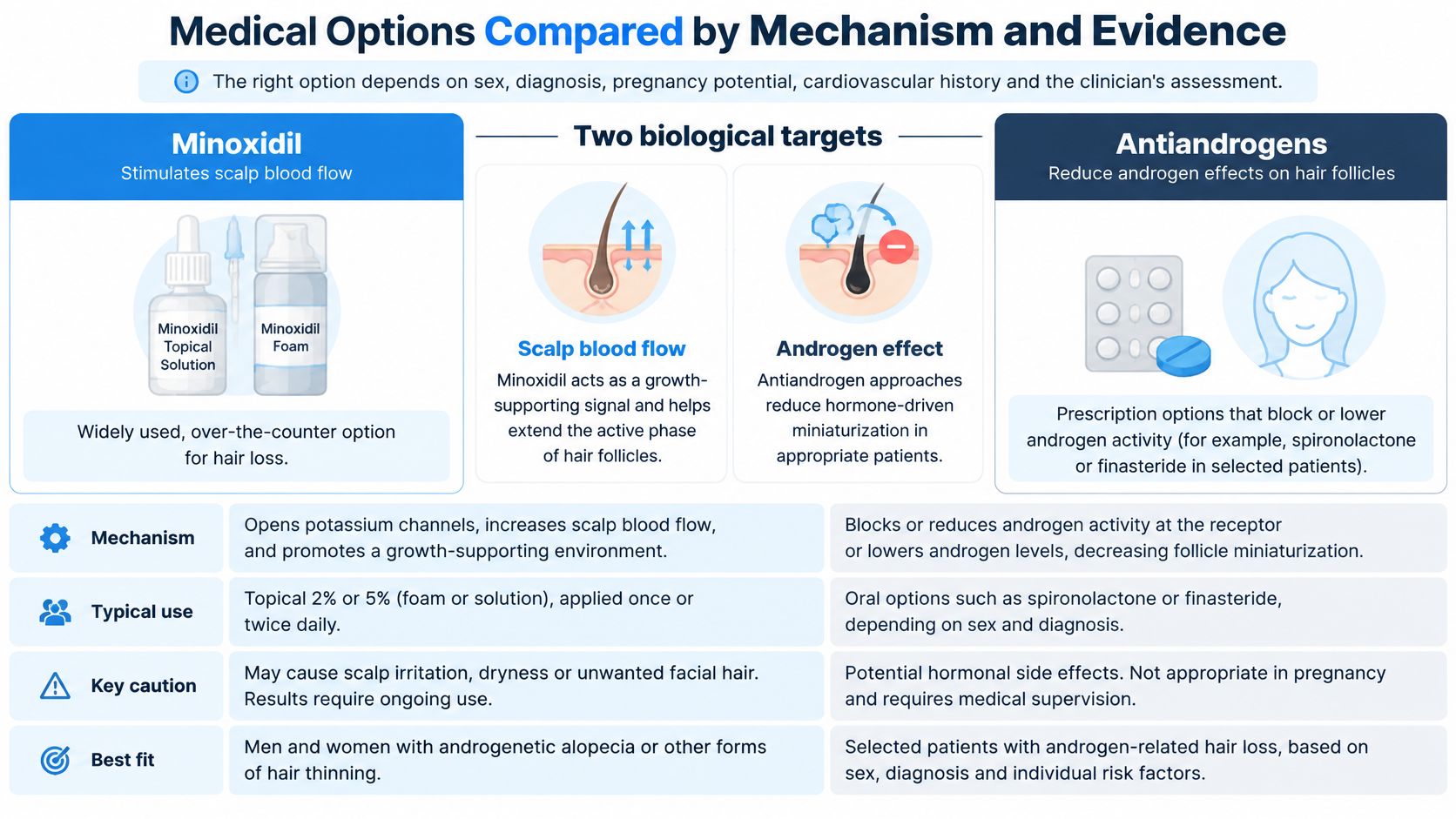
Medical options for thinning hair compared
| Option | Mechanism | Evidence snapshot | Key limit |
|---|---|---|---|
| Topical 2% minoxidil, twice daily | Potassium-channel opener supporting viable follicles | Effective and safe in women in a Cochrane review pooling six studies | Continuous use; scalp irritation |
| Topical 5% minoxidil, once daily | Same mechanism at higher concentration | May offer similar effectiveness to 2% twice daily in women | Irritation, dryness or itching; not advised in pregnancy |
| Oral finasteride 1 mg | Type II 5-alpha-reductase inhibition lowers DHT | Slows loss in roughly 80%–90% of men taking it | Prescription only; sexual and mood effects reported |
| Dutasteride | Type I and type II 5-alpha-reductase inhibition | Approximately 51% scalp DHT reduction in the comparison described above | Biochemical endpoint; not FDA-approved for hair loss |
| Finasteride plus topical minoxidil | Targets DHT and follicular growth | Generally better photographic outcomes in review data | Benefits aren't uniform; both components require risk review |
| Oral minoxidil | Systemic vasodilator | Not FDA-approved for hair loss | Can lower blood pressure, retain fluid and increase heart rate |
Evidence strength matters more than ingredient count
For topical minoxidil, a Cochrane systematic review pooling six studies found moderate-to-marked regrowth in 157 of 593 women, compared with 77 of 555 receiving placebo. The review concluded that the lower-concentration twice-daily regimen appears effective and safe, while the higher-concentration once-daily regimen may offer similar effectiveness with less application burden.
Combination therapy has a plausible mechanism, but superiority isn't automatic. A review of established and emerging treatments describes generally better photographic and clinical outcomes with finasteride plus topical minoxidil, while emphasizing that emerging approaches such as exosomes lack established long-term safety and standardized protocols.
A 2025 randomized trial found 0.1% topical finasteride plus 5% minoxidil had similar safety and effectiveness for density and shaft diameter as 5% minoxidil alone over 12 weeks. Short-term similarity doesn't settle long-term comparative benefit.
Oral minoxidil isn't FDA-approved for hair loss. Vials + Vitals's Re-Grow is prescription-only, with eligibility and availability varying; its ingredient list contains neither finasteride nor dutasteride, so it isn't a DHT-blocking formula.
Treatment limit: Growth support, DHT suppression, and a multi-ingredient formula aren't the same thing. Each option needs evidence for its intended use and a patient-specific risk review.
Applying Topical and Oral Regimens Correctly
Topical minoxidil belongs on the scalp, not just the hair. The patient parts the hair over the clinician-designated area and applies the labeled, measured amount to a dry scalp. Using a consistent time helps make application part of an existing routine.
Hands should be washed afterward, and the product should dry before styling. Extra product doesn't compensate for missed applications and can complicate tolerability.
Daily use and troubleshooting
- Application consistency. The patient follows the product-specific schedule rather than switching between formulations or frequencies without guidance.
- Irritation reporting. Mild dryness, itching, scaling, or redness should be reported to the prescribing clinician. If continued use remains tolerable and no concerning reaction develops, the patient follows the existing directions while awaiting advice; significant or worsening symptoms require prompt review.
- Oral finasteride. The standard prescribed regimen is a 1-mg tablet once daily, with or without food, as described in FDA prescribing information. A consistent daily time can support adherence.
- Combination protocols. Each component keeps its own instructions. The clinician specifies scheduling and, when relevant, the order of topical application.
- Missed doses. The patient follows written instructions and doesn't double a dose or improvise a catch-up schedule.
Practical rule: A regimen that cannot fit into daily life needs a clinician-led adjustment, not silent underuse.
The prescribing clinician and product labeling determine dosing and application details. General practice guidance doesn't replace those instructions, particularly for oral or compounded formulations.
Side Effects, Red Flags and When to Refer
Finasteride requires a baseline risk review before prescribing. The clinician documents sexual, psychiatric, fertility, hepatic, and medication history, together with hairline and crown photographs. This establishes both safety considerations and a reference for evaluating benefit.
The American Academy of Dermatology's diagnosis and treatment guidance describes reported risks including reduced libido, erectile difficulty, breast tenderness or enlargement, and depression. Sexual effects have also been reported to persist after discontinuation, so consent should address that possibility without implying that every patient will experience it.
Finasteride risks and the action they require
A patient who develops sexual symptoms, breast changes, or mood symptoms should contact the prescribing clinician promptly. The clinician evaluates timing, severity, other possible causes, and whether treatment should change. Suicidal thoughts or an immediate safety concern require emergency assistance.
Finasteride must not be taken by people who may become pregnant. Pregnant people shouldn't handle crushed or broken tablets because of potential fetal harm. Pregnancy potential must therefore be established before treatment, not discovered during a routine refill.

Minoxidil risks and earlier review
Oral minoxidil can lower blood pressure, cause fluid retention, and increase heart rate. The clinician considers cardiovascular history and other medications before prescribing; dizziness, swelling, or palpitations should be reported rather than accepted as the price of treatment.
Topical minoxidil can cause scalp irritation, dryness, scaling, itching, and redness. A patient who cannot tolerate application needs an assessment of the scalp and formulation, not an unsupervised switch to an oral product. Additional education about hair-loss treatment side effects can support symptom reporting but doesn't replace individualized advice.
Earlier-care thresholds
- Prompt medical attention: Chest pain, shortness of breath, fainting, or rapid unexplained weight gain while taking oral minoxidil.
- Prompt dermatology assessment: Sudden patchy loss, inflamed scalp, scarring, or eyebrow involvement.
- Prescriber contact: New sexual or mood symptoms, troublesome swelling or dizziness, or irritation that makes daily treatment unworkable.
Common mistakes include stopping after a few weeks because restoration isn't obvious, expecting complete recovery, and withholding adverse symptoms. A clinician can only judge the benefit–risk balance accurately when the patient reports both treatment use and tolerability truthfully.
Tracking Progress Across Six to Twelve Months
A brighter bathroom light or a shorter haircut can make the scalp look different without any biological change. Comparison against baseline, rather than week-to-week inspection, gives the clinician a more dependable basis for decisions.
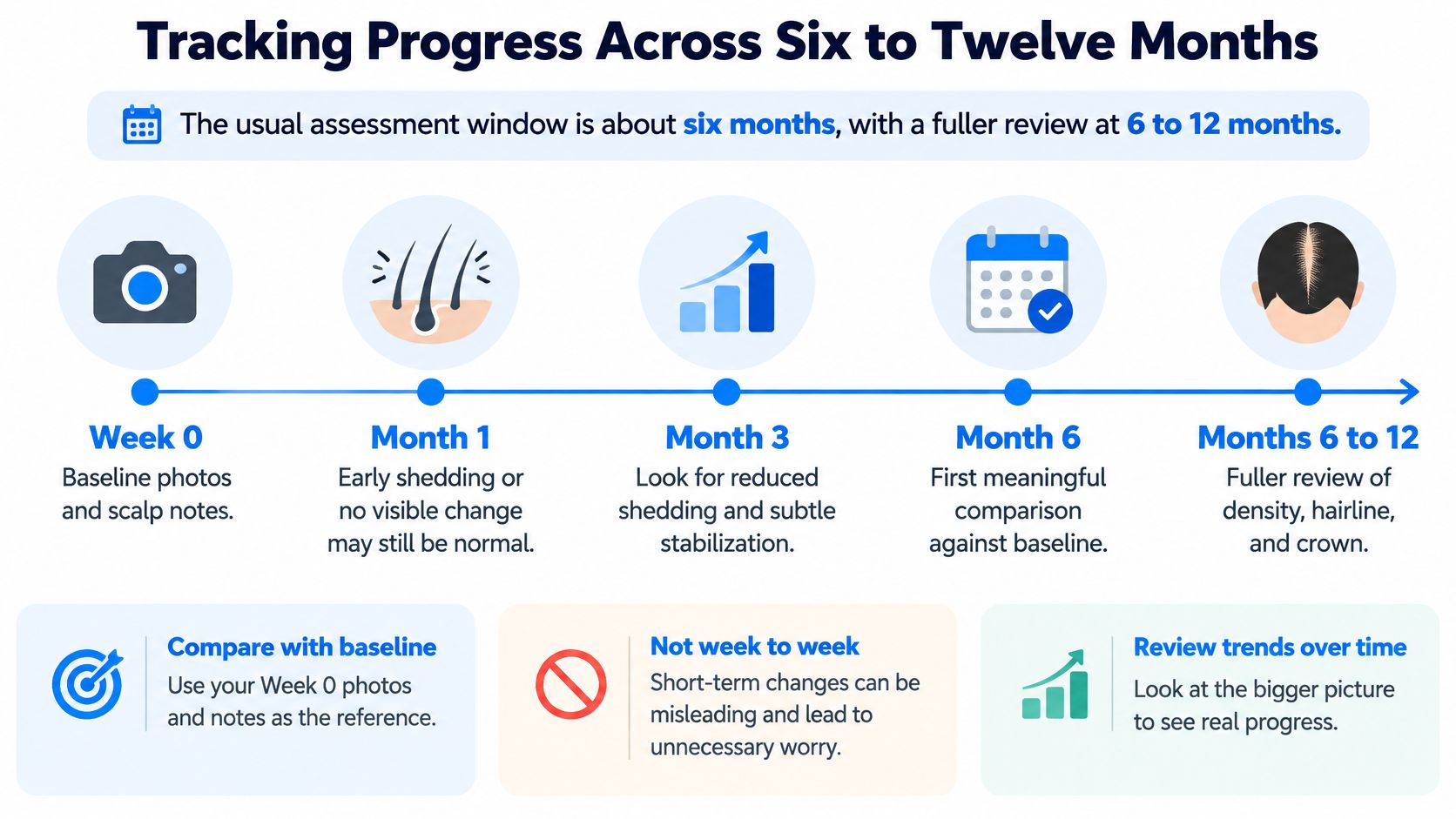
The American Academy of Dermatology advises allowing 6–12 months to assess regrowth, with improvement often requiring at least 4–6 months. An initial check around six months and a fuller review within that window provide a practical framework, although the clinician sets the actual schedule.
Follow the phases chronologically
During the opening phase, the patient records treatment use, irritation, and shedding while establishing a reproducible photo set. A change in shedding is useful information, but it shouldn't replace assessment of the scalp pattern and tolerability.
At the first objective check, the clinician compares photographs and, when available, density measurements. During the main assessment window, the clinician decides whether the observed benefit justifies continued treatment.
Tracking timeline by phase
| Phase | Focus | What to record |
|---|---|---|
| Months 0 to 3 | Baseline, adherence, and tolerability | Baseline photographs, dose log, early shedding and irritation |
| Months 3 to 6 | First objective check | Standardized photo comparison and clinician review of density |
| Months 6 to 12 | Main assessment window | Full photo set, decision to continue, adjust, or refer |
Make photographs comparable
- Scalp regions: Photograph the hairline, part, and crown consistently; understanding the crown of the head helps reproduce the same view.
- Lighting: Use the same light source and avoid comparing flash photography with ambient lighting.
- Hair presentation: Keep hair length and styling as similar as practical.
- Camera position: Maintain the same distance and angle, with assistance for overhead views when needed.
Minoxidil generally improves density or slows shedding rather than restoring a full head of hair. Finasteride is principally a long-term retention treatment, so stable density may represent benefit rather than failure.
Discontinuation allows the underlying process to resume, making maintenance part of treatment planning. At each review, the clinician chooses among continuing the current regimen, adjusting it, or referring for further assessment; new red flags override the routine schedule.
Book a Clinical Assessment as Your Next Step
The next action is a clinical assessment with a licensed provider before starting a prescription or topical regimen. The patient should bring enough information to distinguish gradual pattern loss from a new shedding trigger. A product preference can be discussed, but it shouldn't determine the diagnosis.
Useful preparation includes a dated photo set, current medications and supplements, recent laboratory results, and a timeline of illness, weight change, major stress, and pregnancy or postpartum status. Existing results can prevent unnecessary duplication, while a clear timeline helps the clinician decide whether additional testing is appropriate.
What the telehealth pathway involves
Vials + Vitals offers a hair health pathway beginning with an online clinical assessment. U.S.-licensed providers review individual intakes and determine eligibility and treatment at their clinical discretion. A provider may recommend in-person examination when photographs and history cannot adequately establish the cause or when specialist assessment is needed.
- Clinical review: The provider assesses the likely diagnosis, contraindications, and whether telehealth is appropriate.
- Treatment decision: Eligibility and availability vary by product and state; submitting an intake doesn't establish suitability.
- Written next steps: Prescribed treatments come with instructions for use and clear next steps.
Prescription treatments and compounded formulations are prescribed strictly at the clinical discretion of licensed U.S. healthcare providers following an individualized telehealth intake and consultation. The purpose is to select an appropriate pathway, which may involve treatment, further testing, or referral rather than a prescription.
A licensed clinician confirms the cause, selects an appropriate regimen, and uses documented follow-up to decide whether treatment should continue, change, or give way to specialist care.
Informational purposes only. Compounded medications are evaluated by a licensed provider for individual suitability and are fulfilled by state-licensed partner compounding pharmacies.
Vials + Vitals offers an online hair health assessment with licensed-provider review to evaluate thinning, treatment suitability, and next steps. Adults seeking medically supervised care can visit Vials + Vitals to begin an individualized intake and prepare a dated photo set and medication list for consultation.