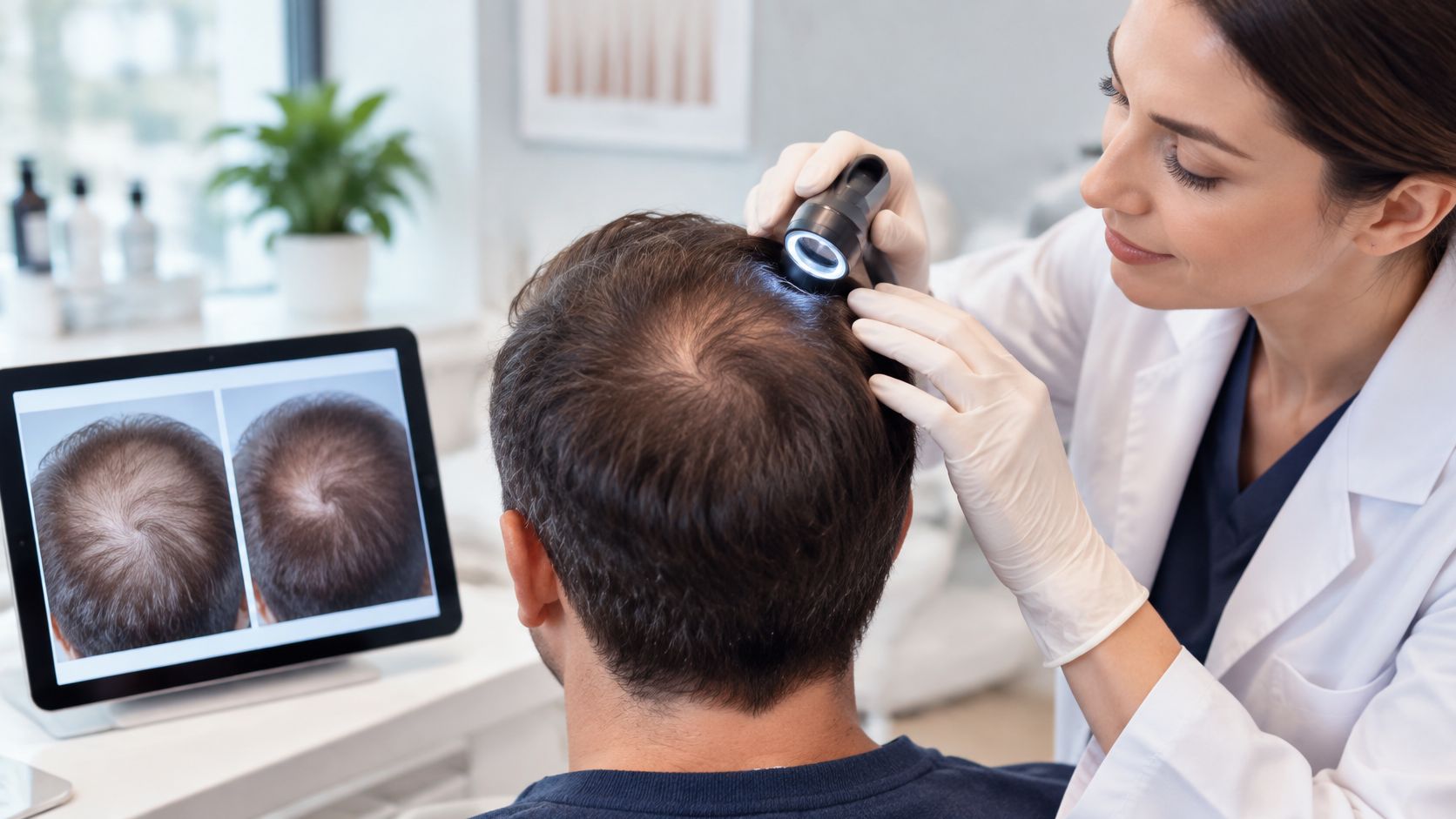
Alopecia in Men: Causes, Types and Treatment Options
Learn how alopecia in men develops, how clinicians confirm the cause, and which evidence-informed treatments act on each pathway. Physician-led overview.
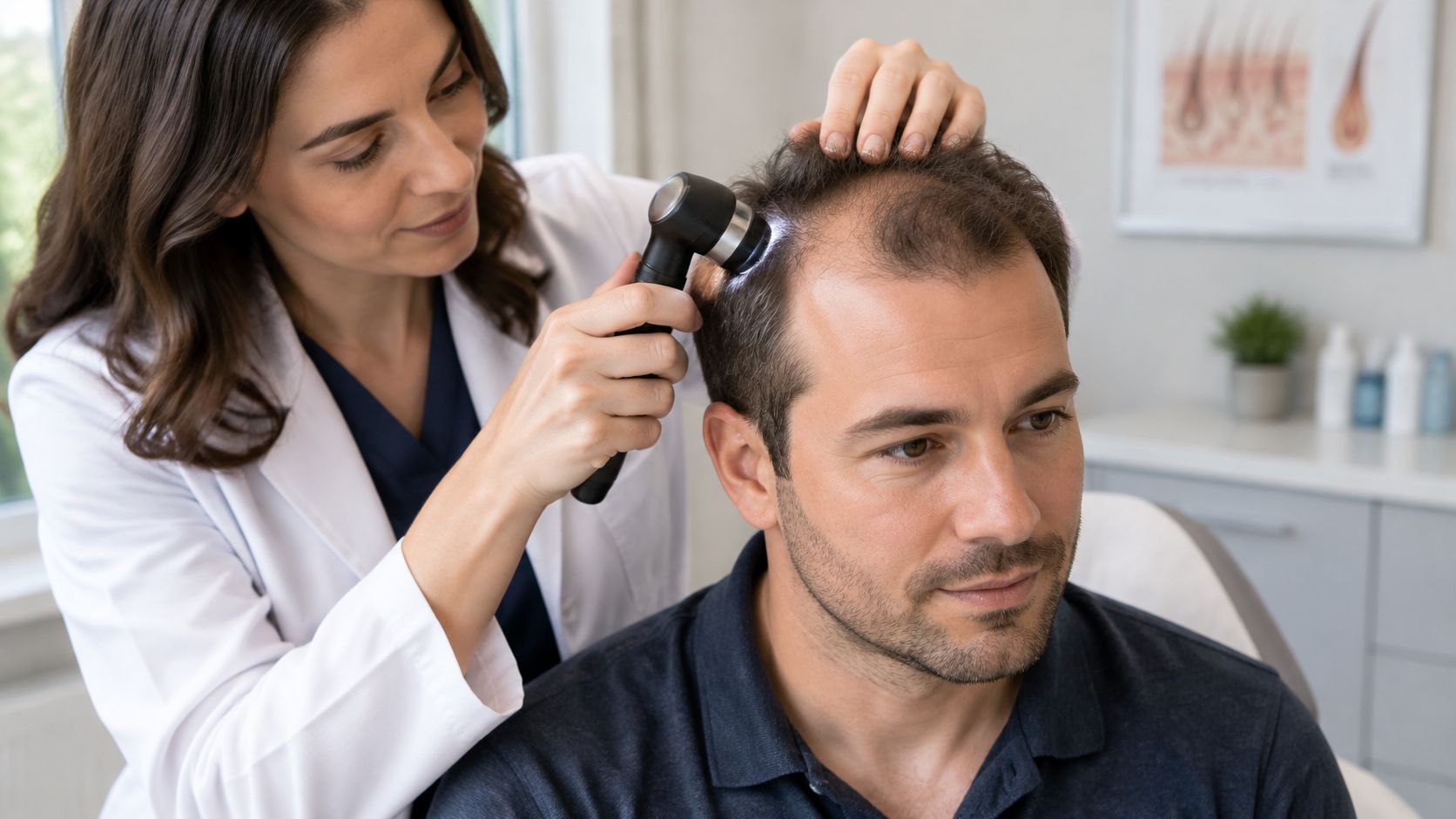
Which hair loss treatment works best?
As a question, it can't be answered, because it leaves out the part that decides everything else. Two men can sit down with the same receding temples and need plans that share nothing. One has androgenetic alopecia and benefits from turning down androgen signaling. The other is shedding from a medication started three months ago, and what he needs is a medication review, not a prescription for finasteride.
Hair loss in men isn't one condition. It's a group of conditions that share a symptom and differ in mechanism, tempo and treatment. Pattern recession is slow and genetically driven. Diffuse shedding arrives weeks after a trigger and often resolves on its own. Round patches belong to an immune process. Scaly patches with broken hairs can be fungal. Smooth patches with itching or pain may be scarring, and scarring is the one where a delay costs follicles permanently.
That's why the order matters. Name the pattern, confirm the cause, understand the mechanism, then choose a protocol. Most men do it backward, and months disappear before anyone notices the target was wrong.
Types of Hair Loss in Men at a Glance
Most readers arrive with a phone photograph of their own hairline and no vocabulary for what's happening to it. Five patterns account for the large majority of hair loss in men, and each one points somewhere different.
| Type | Typical pattern | Onset and clues | Usual next step |
|---|---|---|---|
| Androgenetic alopecia | Frontotemporal recession and vertex thinning | Gradual over years; family history common | Clinical diagnosis, then discuss prescription options |
| Telogen effluvium | Diffuse thinning over the whole scalp | Sudden shedding about two to three months after illness, surgery, crash dieting or a new medication | Identify and address the trigger; often self-limiting |
| Alopecia areata | Round or patchy bald spots | Abrupt onset; nail changes may occur | Dermatology evaluation; management differs from male pattern loss |
| Tinea capitis | Patchy loss with scaling or broken hairs | Scalp inflammation; more often seen in children | Fungal testing and antifungal treatment |
| Scarring alopecia | Smooth, permanent patches | Pain, itching, redness or scaling | Prompt in-person dermatology evaluation, sometimes with biopsy |
With androgenetic alopecia, notice the geography and the clock. It starts at the temples or the crown, rarely both at once, and moves over years rather than weeks. A father or uncle on the same trajectory is supporting evidence, not a diagnosis.
With telogen effluvium, notice the lag. Handfuls of hair come out in the shower and on the pillow, and the shedding typically begins about two to three months after the event that caused it. Men rarely connect the two, because by then the illness, the surgery or the crash diet feels like old news. Rapid weight loss is a common trigger, and it's the reason questions about semaglutide and hair loss come up so often in weight-management care. Shedding that follows a rapid change in intake and body weight is usually a telogen response to that change rather than a sign the follicle is failing.
Alopecia areata announces itself. Smooth round patches appear over days to weeks, and fine pitting of the nails sometimes comes with them. Tinea capitis brings scale and broken hairs rather than clean bald skin, and it's far more common in children, so an adult with a scaly patch deserves a second look. Scarring alopecia is judged by its symptoms as much as its appearance: itching, burning, redness or scale around a smooth patch means inflamed follicles are being destroyed.
A receding hairline on its own confirms nothing. It's also worth keeping scale in perspective: a global epidemiology study estimated that alopecia areata affects approximately 6.36 million men worldwide, a male prevalence of about 1.62% (global epidemiology study of alopecia areata). Abrupt round patches are far less common than gradual pattern loss, and they still call for a different next step.
How Clinicians Confirm the Cause
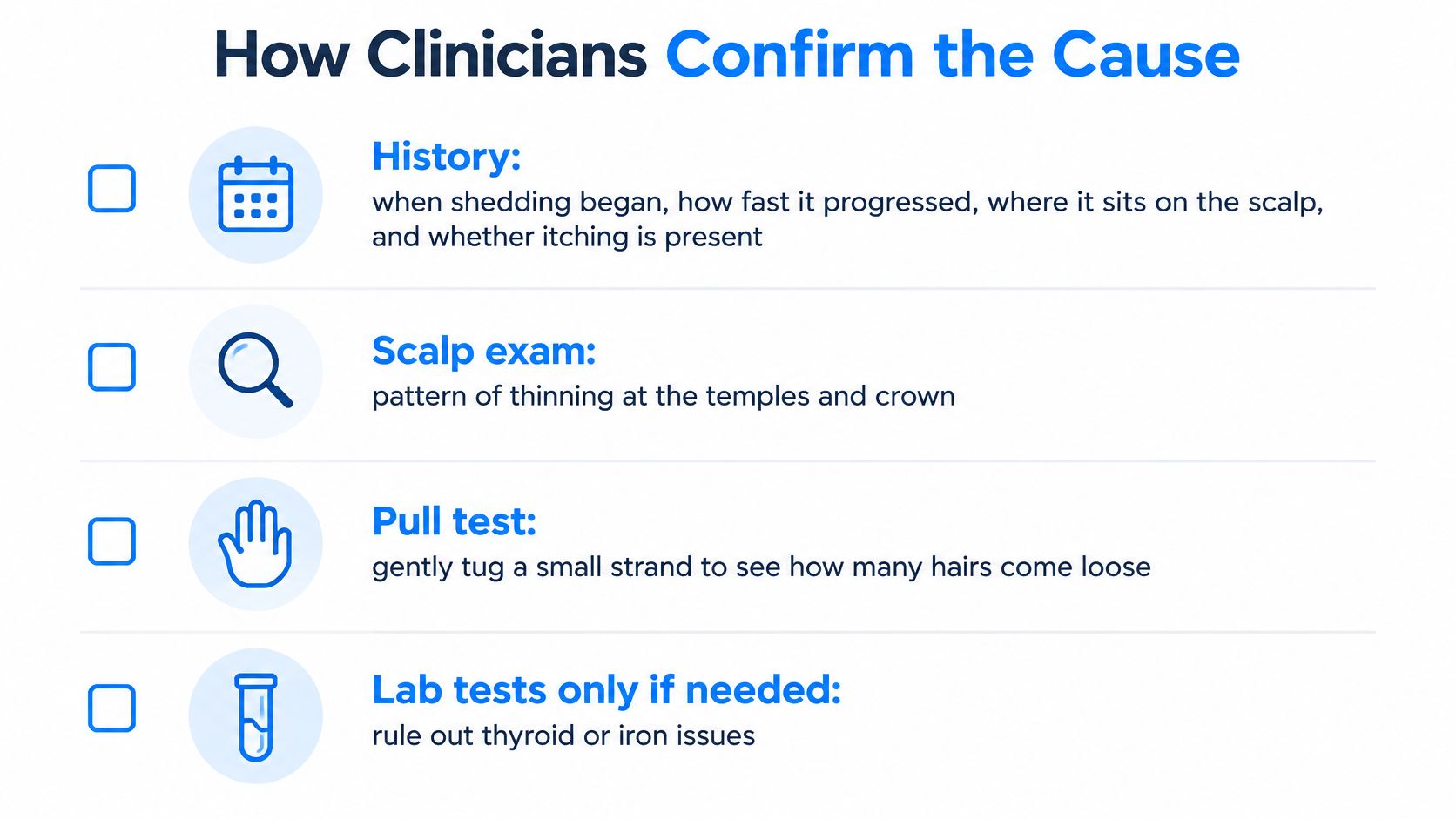
A diagnosis is the first treatment decision, not the paperwork that precedes it. The Merck Manual guidance on hair disorders makes the point that pattern alone can mislead: a young man with no family history of pattern loss should be asked directly about anabolic steroids and other medications, and an atypical pattern may justify scalp microscopy or biopsy. Treatment choice follows that answer. Minoxidil and finasteride are established options for male-pattern loss, while other alopecia types may need entirely different management.
The questions that change the work-up
Each of these moves the differential, which is why a clinician asks them before discussing a single prescription.
- Onset and tempo. Shedding that arrives over two weeks means something different from thinning watched for two years. Speed points to a trigger or an immune process; slowness points to genetics.
- Distribution. Temples and crown, whole scalp, or discrete round patches. The map narrows the list faster than any blood test.
- Scalp symptoms. Itching, burning, pain, redness or scale all argue against plain androgenetic alopecia and toward an inflammatory or infectious cause.
- Medications and supplements. Anabolic steroids, testosterone, some acne and mood medications, and high-dose vitamin A all carry shedding risk.
- Recent illness, surgery or crash dieting. Any of these can push a large share of follicles into telogen at once, with shedding following months later.
- Thyroid symptoms and family history. Thyroid disease produces diffuse thinning, and a strong family history of pattern loss supports a genetic cause.
What the examination adds
A scalp inspection in good light, a gentle pull test, and trichoscopy. For the pull test, grasp a small bundle of roughly 50 to 60 hairs near the scalp and tug steadily; more than a few hairs coming free supports active shedding rather than stable pattern loss. Trichoscopy separates the two pictures well: miniaturized hairs with wide variation in shaft diameter suggest androgenetic alopecia, while uniform shafts with empty follicles suggest a shedding disorder.
When the pattern doesn't fit
The triage rule: a typical male pattern with no warning features can move through a licensed telehealth intake. Sudden or patchy loss, scalp redness or scaling, pain, diffuse thinning with no clear trigger, visible scarring, or pattern loss in a young man with no family history belongs in a dermatology chair, where dermoscopy, laboratory testing or a biopsy can settle the question.
How Androgen Signaling Shortens the Growth Cycle
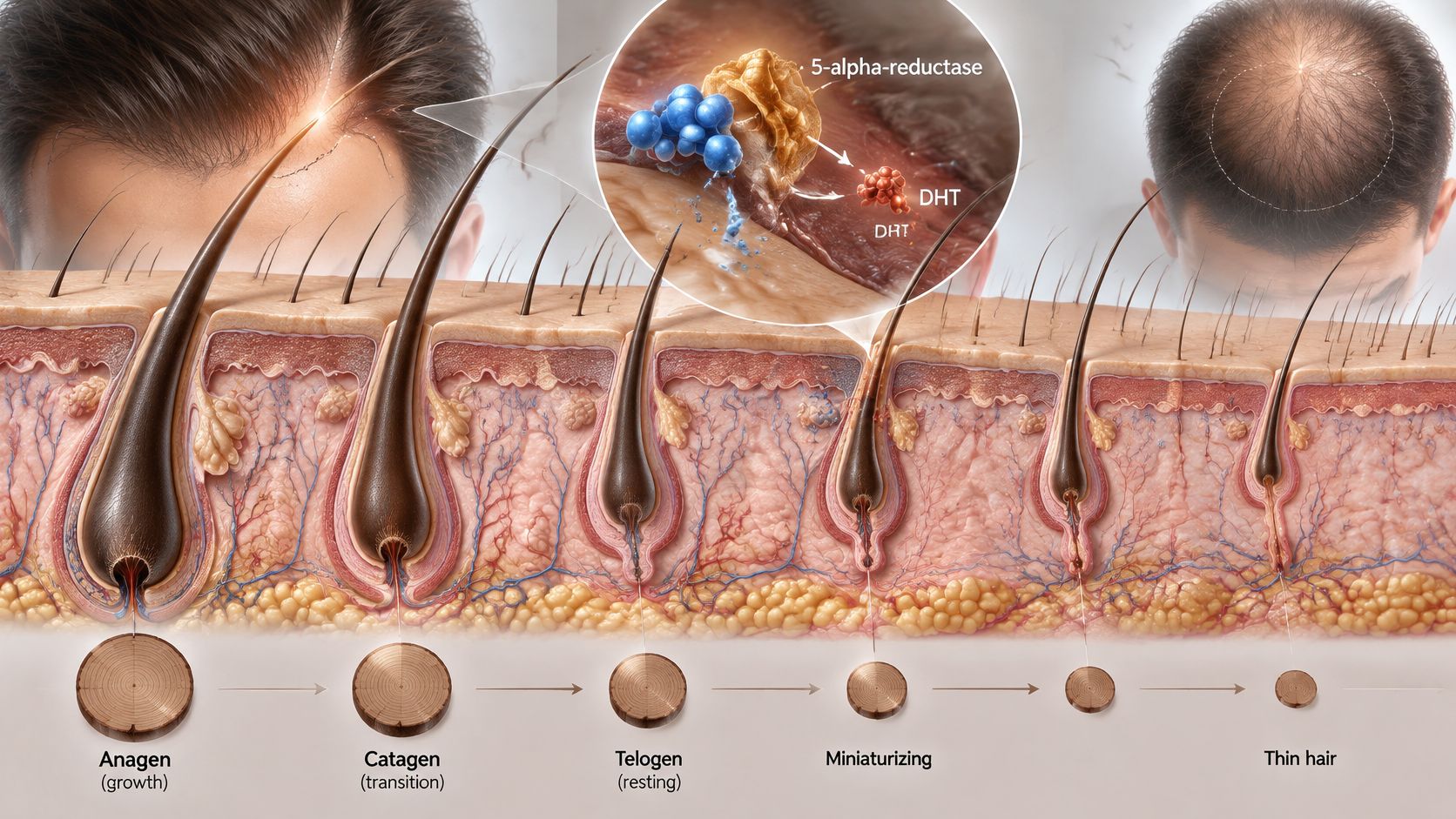
Each follicle runs its own growth season. Anagen is the long growing phase, catagen the brief transition, telogen the rest before the hair sheds and the cycle restarts. In a genetically susceptible follicle, every pass through that cycle comes back a little shorter than the last, and the hair it produces comes back a little finer.
The pathway, in order
The enzyme comes first. In susceptible scalp regions, higher 5-alpha-reductase activity converts testosterone into dihydrotestosterone, or DHT.
Then the receptor. DHT binds androgen receptors inside dermal papilla cells, the signaling hub at the base of each follicle.
Then the calendar shortens. That signaling progressively shortens anagen, the active-growth phase, so each follicle spends less time building hair and more time resting.
Then the hair itself shrinks. Terminal hairs become shorter and finer with every cycle, and some miniaturized follicles eventually fail to push a hair through the epidermis at all.
The clinical overview of androgenetic alopecia describes this as a genetically influenced androgen-signaling process.
The central idea: local follicle sensitivity to androgen signaling drives the pattern more than circulating testosterone does.
Why the pattern isn't uniform
The frontotemporal scalp and the vertex are sensitive to DHT. The occipital scalp is relatively resistant. That difference comes from local receptor density and enzyme activity in each region, and it holds stable over a lifetime. A transplant surgeon can move resistant follicles from the back of the head to the front and expect them to keep their original behavior, which is direct evidence that the sensitivity lives in the follicle itself.
Why hair thins with normal blood work
Many men get stuck here. A normal testosterone level does not rule out androgenetic alopecia, because what matters is the local conversion rate and each follicle's response to the DHT produced there. A man can have entirely ordinary serum androgens and still watch his hairline retreat, one shortened anagen at a time.
What it means for treatment
A follicle that has miniaturized over many cycles can be coaxed back toward a longer anagen, but only while the underlying signal stays suppressed. Stopping treatment lets miniaturization resume, which makes maintenance the realistic expectation, not a one-time fix. Treatments also differ in where they intervene: some reduce DHT production at the enzyme, while others push the follicle toward longer growth phases through separate routes. That distinction explains why two products can both be legitimate yet work through completely different mechanisms.
Treatment Options Compared by Mechanism and Evidence
Treatments for male-pattern hair loss act at two points in the pathway: they either turn down the androgen signal, or they push the follicle toward growth regardless of it. A third approach does both at once. The table maps each option to its mechanism, the direction of its evidence and the limit that matters clinically.
| Option | How it acts | Evidence summary | Key limits |
|---|---|---|---|
| Finasteride 1 mg daily | Inhibits type II 5-alpha-reductase, lowering DHT | Placebo-controlled data running up to five years show most treated men gaining hair or holding ground while placebo groups declined steadily | Prescription only; sexual and mood history reviewed before starting |
| Dutasteride | Inhibits type I and type II 5-alpha-reductase | A randomized head-to-head trial showed dose-dependent gains, with the highest dose tested outperforming finasteride on hair count, width and photographic assessment | Use for hair loss sits outside the FDA-approved indication |
| Topical minoxidil | Supports anagen and shaft caliber through pathways separate from DHT | Trials show reduced shedding, stimulated growth and stronger existing strands; complete regrowth is unlikely | Scalp irritation; response is assessed over months |
| Oral minoxidil | Systemic effects on vessels and follicles | Not FDA-approved for hair loss | Can lower blood pressure, cause fluid retention and raise heart rate |
| Finasteride plus topical minoxidil | Lowers DHT and supports growth at the same time | Pooled randomized-trial data favor the combination over either drug alone on photographic improvement | Most trials ran 3 to 6 months; durability is not established |
Reducing DHT at the enzyme
Finasteride inhibits type II 5-alpha-reductase, the enzyme that converts testosterone to DHT, so it turns down the signal that shortens anagen. The FDA prescribing information for finasteride reports that across studies lasting up to five years, 48% of men on 1 mg showed increased hair growth and 42% were rated as having no further visible change, with hair loss reported in 17% of treated men versus 72% on placebo at two years and 35% versus 100% at five years. Read the "no further visible change" group carefully: those men did not regrow hair, but they stopped losing it while the placebo curve kept falling. The benefit is divergence between two lines, not a universally restored hairline.
Dutasteride blocks both enzyme isoforms, reducing DHT through two routes. A 24-week randomized trial of dutasteride in men with androgenetic alopecia compared 0.02 mg, 0.1 mg and 0.5 mg daily against finasteride 1 mg and placebo in men aged 20 to 50, and hair count and width rose in a dose-dependent pattern, with the 0.5 mg dose producing significantly greater improvement than finasteride on count, width and photographic ratings. Potency isn't the same as suitability. The drug sits outside its FDA-approved indication when used for hair loss, which is why the tradeoffs are worth reading through in detail in this comparison of dutasteride versus finasteride for hair loss.
Supporting the follicle
Topical minoxidil works through pathways separate from DHT signaling. The American Academy of Dermatology guidance on male pattern hair loss treatment reports that trials show it can reduce hair loss, stimulate growth and strengthen existing strands, while noting that complete regrowth is unlikely. Oral minoxidil is a different proposition. It isn't FDA-approved for hair loss, and because it acts systemically it can lower blood pressure, cause fluid retention and raise heart rate. Re-Grow, a prescription-only oral minoxidil tablet, carries those same considerations, and eligibility and availability vary. A clinician's review of cardiovascular history comes before the first dose, not after the first symptom.
Prescription options are selected only after a licensed U.S. clinician confirms the diagnosis and weighs contraindications, adverse effects and the patient's reproductive and sexual-health context. That ordering matters: a DHT blocker prescribed for a man whose shedding is telogen effluvium treats the wrong problem at real cost. The table maps mechanisms. It doesn't rank men.
Combining Treatments and Tracking Results
Combination therapy means treating two stages of the same problem at once. The treatment table maps a drug that lowers the hormonal pressure on the follicle and a drug that helps the follicle produce a thicker hair; pairing them addresses cause and symptom in a single plan, which is why clinicians often prescribe both from the start.
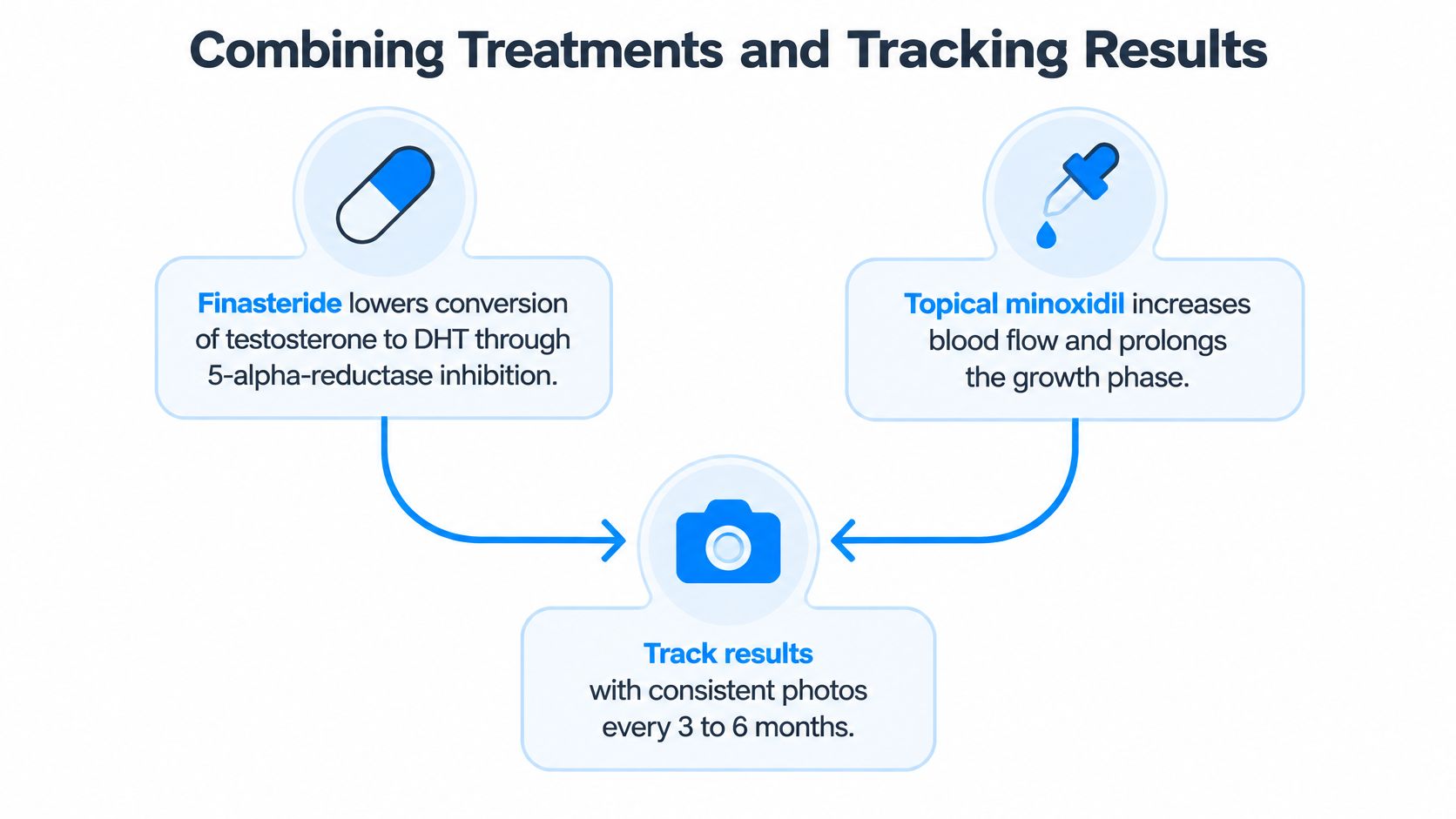
The evidence for pairing them is reasonably consistent for early response. A meta-analysis of combination therapy for male androgenetic alopecia pooled five randomized controlled trials and found higher global photographic improvement, more marked responses and fewer deterioration or no-change outcomes with finasteride plus topical minoxidil than with either drug alone, without a statistically significant increase in adverse events. A second meta-analysis of randomized trials reached a similar conclusion, reporting better hair counts, shaft diameter and photographic scores with combination therapy than with minoxidil alone.
Most of those trials followed patients for only three to six months. Read the numbers as evidence of early efficacy; durability beyond that window remains unproven.
A monitoring routine that produces usable data
- Standardized photographs at baseline. Same room, same light, same angle, hair dry and combed the same way. Photos taken under different lighting will convince a man he is losing ground when he isn't.
- Trichoscopic density and shaft diameter where available. These register change before it is visible across a room, which is the entire point of measuring.
- Dose and adherence recorded with the prescriber. A missed month explains a plateau more convincingly than a mechanism failure does.
- Expect gradual change, and expect a shedding phase. Growth stimulation can push resting hairs out first. That early shed is part of the schedule, a sign the cycle is turning over.
- Reassess at about six months. Most of the trial data were collected at that interval, so that is where the evidence applies.
- Plan for ongoing maintenance. Gains usually require continued therapy, so the plan needs a maintenance assumption built in from day one.
One product distinction matters here. Re-Grow (ReGrow Fuel) is an oral minoxidil tablet that also lists a copper peptide complex, apigenin and fisetin, and no hair-growth benefit is established for those added ingredients. Its ingredient list includes neither finasteride nor dutasteride, so it is not a DHT-blocking formula and cannot fill the antiandrogen role in a combination. It is also prescription-only, and eligibility and availability vary. Stacking growth support on top of an antiandrogen is one decision; substituting it for the antiandrogen is a different decision with a different expected outcome.
Before any of this starts, the intake review covers reproductive, sexual, psychiatric and medication history for finasteride, and scalp tolerance plus cardiovascular history for minoxidil. Those reviews set the follow-up checkpoints: which symptoms to watch for, when to recheck blood pressure and when to take the six-month photographs.
Side Effects, Warning Signs and When to Act
Two stories about finasteride circulate widely, and both are too tidy. One says the drug carries no meaningful risk. The other says its sexual effects are routinely permanent. The evidence sits between them, and the middle is more useful than either extreme.
What the layers of evidence actually say
A review of published reports on finasteride and persistent sexual dysfunction found that reports of persistent sexual side effects and severe depression raise legitimate safety concerns, while noting that the literature is affected by substantial methodological bias. A 2025 study reported no significant association between androgenetic alopecia or its severity and depression, anxiety or sexual symptoms. Both findings can be true at once. A population-level result describes groups; it doesn't clear an individual man's risk.
- Randomized-trial adverse-event data carries the most weight for frequency, because participants are counted whether or not they notice a symptom.
- Post-marketing reports catch rare events trials were never sized to detect, but they arrive without a denominator.
- Nocebo effects are real and measurable in this drug class, which is why blinding matters when reading symptom rates.
- Selected-patient risk factors, including pre-existing sexual or psychiatric concerns, shift the balance for a specific man rather than a population.
Documenting a baseline before the first dose
Record sexual function and mood before treatment, not after a symptom appears. Without a baseline, every later complaint becomes a debate about what was already there. Agree on follow-up checkpoints and on stop-and-contact instructions in writing, so a new symptom has a route that doesn't involve searching forums at midnight.
The concerns worth acting on
| Concern | Who needs closer review | Action |
|---|---|---|
| Sexual or mood changes on finasteride | Men with baseline sexual or psychiatric concerns | Report promptly; the clinician reviews whether to continue |
| Scalp itching or irritation on topical minoxidil | Men with a sensitive scalp or contact dermatitis | Pause and review the formulation with the prescriber |
| Dizziness, palpitations or swelling on oral minoxidil | Men with heart, blood pressure or fluid-retention history | Contact the prescriber for reassessment |
| Shedding in the first months of treatment | Men beginning growth-stimulating therapy | Often expected; review at the next checkpoint |
Some symptoms don't wait for a scheduled checkpoint. Chest pain, shortness of breath, fainting or rapid unexplained weight gain require prompt medical attention when taking oral minoxidil. Dizziness, palpitations or swelling belong in a message to the prescriber rather than a forum thread.
A fuller accounting of hair loss treatment side effects helps a man prepare, but the decision still belongs in a conversation. When sexual or mood concerns outweigh the expected benefit for an individual, topical options are a reasonable alternative to oral finasteride rather than a consolation prize.
Confirm the Diagnosis Before Choosing Your Next Step
Everything in this article converges on one sequence. The order matters more than any single step.
- Match the pattern first. Frontotemporal recession with vertex thinning and a family history points one way; diffuse shedding, round patches or scaling point another. The pattern decides what kind of evaluation comes next, which is why it leads the sequence.
- Triage before treating. Any atypical feature moves the workup to in-person dermatology before a prescription is discussed. A typical pattern can proceed through a licensed telehealth intake.
- Bring the intake what it needs. The history, medication list and baseline details covered earlier are what let a prescriber match treatment to cause rather than guess.
- Choose by mechanism. The options already compared each act on a different part of the growth cycle, and the right pick follows from the diagnosis, not the other way around.
- Agree on checkpoints before the first dose. A reassessment date, a stop-and-contact rule and a named point of contact belong in the plan from day one.
Skipping to step 4 is where men lose months. A product chosen before the cause is named treats a guess, and a shedding pattern misread as androgenetic loss can spend a year on the wrong mechanism.
Vials + Vitals runs a physician-directed telehealth intake in which U.S.-licensed providers determine eligibility after an individualized consultation. Prescription treatments and compounded formulations are prescribed strictly at the clinical discretion of licensed U.S. healthcare providers following that intake, and the follow-up structure exists so a plan can be adjusted rather than abandoned.
Informational purposes only. Compounded medications are evaluated by a licensed provider for individual suitability and are fulfilled by state-licensed partner compounding pharmacies.
If the hairline has changed and nobody has named the cause, the next step is an assessment rather than a product. Vials + Vitals offers a confidential, physician-led intake built around pattern recognition, red-flag triage and mechanism-matched options, with U.S.-licensed providers deciding what's appropriate for you. Visit Vials + Vitals to start the intake.