Weight Loss Plateau What to Do: A Clinical Review Guide
Weight loss plateau what to do: confirm the stall over about 12 weeks, review adherence, nutrition and dosing, and know when to call your clinician.

In the 68-week STEP 1 trial, adults treated with once-weekly semaglutide 2.4 mg averaged a body-weight change of -14.9% from baseline against -2.4% on placebo, an estimated treatment difference of 12.4 percentage points (STEP 1 trial report). That gap is the headline. The fine print is that a mean flattens hundreds of individual curves into a single number, and almost none of those curves ran in a straight line.
A week when the scale doesn't move is ordinary. A month is worth a look. Twelve weeks of a flat trend is a different event, and it deserves a structured review rather than a panic decision made on a Tuesday morning. The weight loss plateau what to do question has a clinical answer, and it starts with measurement, not with a bigger dose.
What follows is that review in order: how a plateau is defined and confirmed, which everyday causes get checked first, how escalation and switching are weighed, and how maintenance gets planned before treatment ever stops. Dose and medication decisions rest with a licensed prescriber. The work a patient can do is what makes those decisions informed.
Confirm the Plateau Is Real Before You Change Anything
A 2025 analysis of tirzepatide trials defined a plateau as less than 5% additional body-weight change across a 12-week interval (Clinical Obesity analysis of tirzepatide trial data). That definition does two useful things. It puts a clock on the decision, and it gives the word "plateau" a precise threshold, which is what separates a true stall from ordinary scale noise.
The same analysis found that most participants reached this stage by week 72, and that median time to plateau ranged from 24.3 to 36.1 weeks depending on starting BMI. Put those two numbers together and a practical rule falls out. A person at week 20 whose weight holds steady for ten days is early in the curve rather than stuck at the end of it. A person at week 60 has entered the range where slower change is expected, and a person at month 18 is somewhere the trials barely reach.
What a plateau measures
In the same analysis, one reported group had already lost about 12.1% of starting weight at the plateau point, and average reduction at week 72 reached 15.4% to 26.3% across the analyzed categories. A plateau marks where the additional change per 12 weeks falls below 5%. That is a very different statement from "the drug stopped working."
The analysis also reported a wide spread of outcomes, from losses of less than 5% to more than 30% of initial weight by the end of treatment. A plateau at 12% and a plateau at 26% are the same measurement event and completely different clinical situations, which is why the number on the chart reads as a trend rather than a verdict.
| Measure | How to track it | Plateau signal |
|---|---|---|
| Weight trend | Average of daily weigh-ins over 4 weeks | Less than 5% change across a 12-week interval |
| Timing in tirzepatide trials | Weeks since starting treatment | Most participants plateaued by week 72, with a median of 24.3 to 36.1 weeks depending on BMI category |
| Daily scale swings | Weigh at the same time under the same conditions | Normal fluctuation, so a single weigh-in is not a plateau |
| Waist circumference | Measure at the navel every 2 to 4 weeks | No reduction across consecutive checks |
How to measure a trend instead of a reading
Weigh every morning under identical conditions: after voiding, before eating or drinking, same scale, minimal clothing. Record the number and then ignore it for a month. The four-week average is what gets compared with the previous four weeks, and that comparison is the raw material for the 12-week rule.
For someone who started at 220 pounds, the 5% threshold works out to 11 pounds across the full 12 weeks. Losses smaller than that can hide inside ordinary water shifts for weeks at a time, which is why the rolling average carries more weight than any single morning.
Waist circumference at the navel every two to four weeks adds a second, slower signal that doesn't swing with dinner. So does the fit of one specific garment, which is harder to argue with than a bathroom scale.
Day-to-day swings of a few pounds come from fluid, sodium, bowel contents and the menstrual cycle. They can mask real fat loss for a week or two at a time, which is exactly why a single disappointing morning shouldn't trigger a dose change or a new prescription. A realistic timeline for how long to notice weight loss runs in months rather than days.
Working rule: one weigh-in is a data point, four weeks of them are evidence.
Why the curve flattens even when the drug still works
A smaller body runs on fewer calories, and physiological adaptations during negative energy balance can pull energy expenditure down further, so the deficit that produced early loss shrinks on its own (MedPage Today review of GLP-1 plateau evidence). In the semaglutide STEP trials, loss generally tapered around week 60, after participants had lost roughly 10% to 15% of starting weight. In the two-year STEP 5 study, participants plateaued at about week 60 and held that weight for the rest of the trial while treatment continued.
Tirzepatide follows the same shape with dose-dependent detail. In the 72-week SURMOUNT-1 trial, the 5 mg group reached a plateau within roughly weeks 60 to 72, while higher-dose groups had not clearly plateaued at the same point. A 2024 American Society for Metabolic and Bariatric Surgery report put continued tirzepatide at a 22.5% plateau reached at 17 to 18 months, with semaglutide at 14.9% over the same period (ASMBS summary of long-term durability data). That longer horizon matters, because week 72 isn't the end of the story and a person whose loss continues past it isn't doing anything wrong either.
Calculate the four-week average, compare it with the previous four weeks, and check the result against the 12-week interval. Below 5%, the stall is confirmed and the review has a concrete starting point. Above it, the curve is still moving and the dose question stays closed.
Check Causes Then Follow the Clinician Dosing Sequence
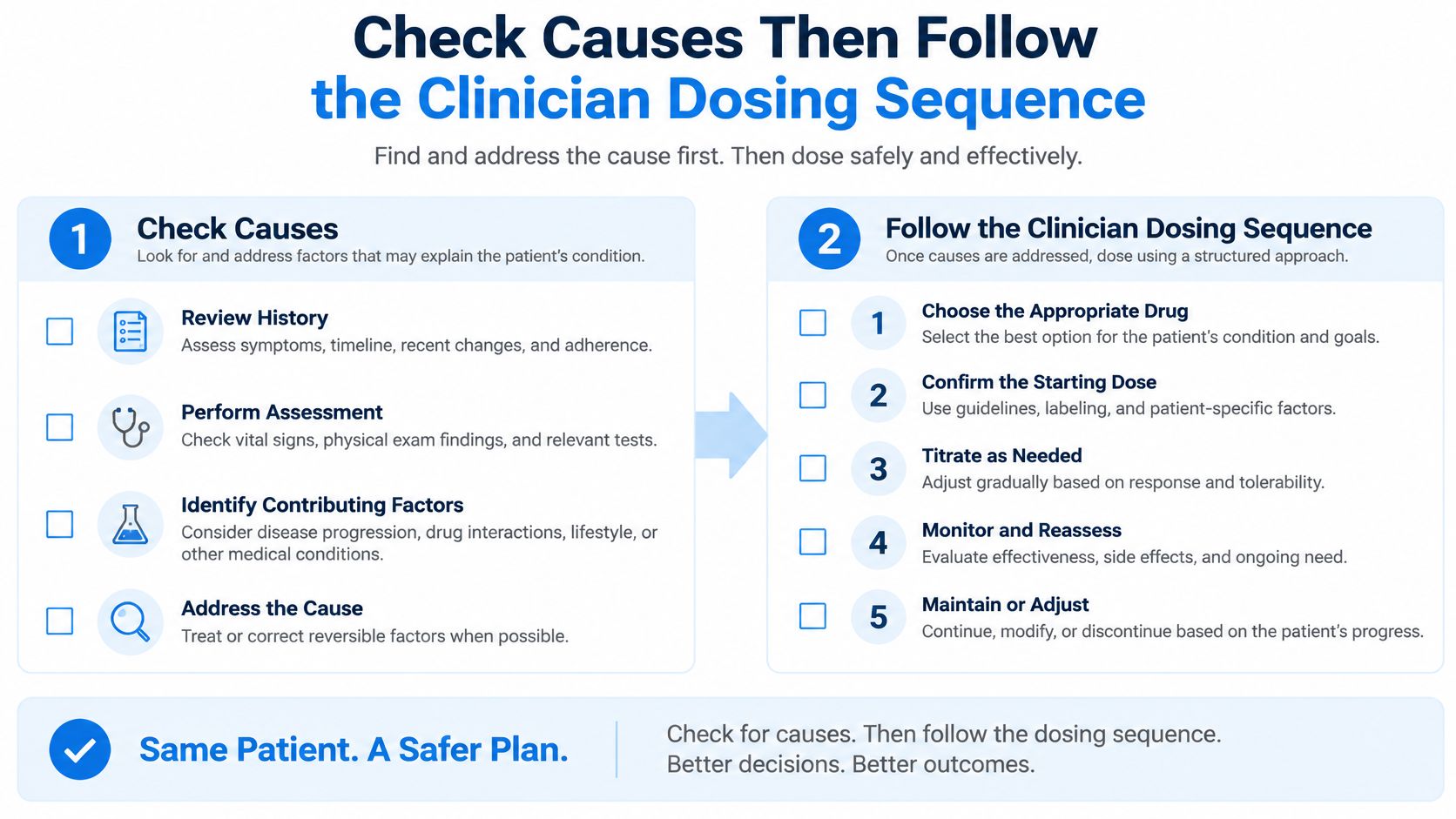
A confirmed stall starts a fixed sequence: causes first, dose second. The same order governs the start of treatment. The American Association of Clinical Endocrinology ties the intensification decision to early response, setting weight loss below 2.5% during the first month as the signal that a plan needs adjusting, because early reduction predicts longer-term success (AACE obesity clinical practice appendix). A plateau further into treatment calls for the same discipline: a structured reassessment of what changed before any change to what is prescribed.
The map below keeps those checks in order, with causes first and prescribing second.
The two-week cause check
Run these for roughly two weeks before drawing any conclusion about the medication itself. Most apparent plateaus resolve inside this list.
- Food and protein. Log intake against the target for 14 days, weighing portions rather than eyeballing them. Under-estimated energy intake is one of the most common reasons a deficit disappears.
- Dosing calendar. Line up every logged dose against pharmacy fill records and the prescribed schedule. A missed or late dose looks identical to a tolerance problem on a weight chart.
- Movement. Compare step counts across two weeks. Non-exercise activity tends to drift down without anyone noticing, and the drop is often larger than an extra workout would fix.
- Sleep. Record hours for two weeks. Short sleep changes appetite signaling and food choices in ways that show up on the scale weeks later.
- Symptoms. Keep a diary of nausea, constipation, reflux and fluid retention. Gastrointestinal effects that limit eating are information for the prescriber, not a reason to push the dose higher.
- Cycle and fluid timing. If periods or salty meals swing the scale, compare averages across a full cycle instead of week to week.
- The full medication list. New prescriptions, over-the-counter products, supplements and alcohol all belong on the list that goes to the visit.
For the diary: symptoms that limit eating are a reason to call the prescriber, never a reason to escalate the dose alone.
The recurring interpretation error is reading a plateau as pharmacologic failure while overlooking missed doses, under-counted intake, reduced daily movement, disrupted sleep, or side effects that make eating difficult. Each of those is correctable with tracking and timing, which is why the list runs before the prescription does.
What improves while the scale does not
Scale weight is one measure among several, and it is the least stable of them across a single week. Waist circumference, blood pressure, glycemic markers, mobility and body composition can all improve while weight holds steady, which means a flat month may still be a month of progress.
Behavioral support works the same way. It gets repeated and monitored rather than delivered once as a consultation. The components that carry weight are goal setting, self-monitoring, social support, problem solving, stimulus control, stress reduction and ongoing education, run as a program with follow-up built in.
| Likely cause | How to check | Next step to discuss |
|---|---|---|
| Under-counted intake | Log food for 2 weeks and compare with the target | Review intake and protein with a clinician or dietitian |
| Missed or late doses | Check the dosing calendar against pharmacy records | Correct timing with the prescriber and never double a dose |
| Lower daily movement | Compare step counts across 2 weeks | Add resistance training and daily walking |
| Poor sleep | Track hours of sleep over 2 weeks | Address sleep before changing medication |
| Constipation or nausea | Keep a symptom diary | Report it to the clinician and do not accelerate titration |
| Fluid or cycle-related swings | Compare averages across a full cycle | Use a longer averaging window and raise it at the visit |
| New medications or alcohol | Review the full medication list | Review with the prescriber |
The dosing sequence and why each step waits
For anyone already on GLP-1 or dual-incretin therapy, the clinician confirms the current indication, the tolerated dose, how long the patient has been at that dose, persistence, and whether a clinically appropriate maintenance phase has been reached. Unsupervised stacking of products or rapid self-titration sits outside that sequence entirely.
Head-to-head data explain why switching sometimes enters the conversation, and why a plateau alone doesn't settle it. In the 72-week SURMOUNT-5 trial, adults without diabetes on maximum-dose tirzepatide lost an average of 20.2% of baseline weight against 13.7% on maximum-dose semaglutide, a 6.5-percentage-point difference between groups (SURMOUNT-5 trial in the New England Journal of Medicine). Results outside trials tend to run below the head-to-head figures, and persistence drops across the first year of treatment, with gastrointestinal effects and cost among the reasons people stop. A plateau in a person who stopped filling prescriptions three months ago is an adherence problem until the records say otherwise.
The order of action is fixed, and each step waits for the one before it. Document adherence and tolerability. Correct administration, nutrition, hydration, constipation and activity. Optimize only inside the prescribed titration schedule. Reassess response and complications at defined intervals. Consider another approved strategy only if benefits remain inadequate after all of that.
The pitfall worth naming is treating a tolerability problem as permission to speed up titration. It reliably worsens nausea, vomiting, dehydration and the odds of stopping treatment altogether, which is the opposite of the intended result.
Titration timing is where most confusion lives. The prescribed schedule is easier to follow with a tirzepatide dosage chart that matches the standard escalation steps than with advice pulled from a forum. Vials + Vitals treats visible change from treatment as something assessed over months rather than days, and a response is not guaranteed.
This week, write down each dose, each symptom and the four-week average. A licensed U.S. provider makes the medication decision after a consultation, with that record in hand.
Escalation, Switching and Lifestyle Options Compared
A plateau review ends in one of four directions. None of them is ranked in advance, because the right fit depends on what the documented record shows rather than on the reading that brought you in.
| Response | Best fit | Main trade-off |
|---|---|---|
| Intensified lifestyle support | A plateau with intake, activity or sleep gaps not yet reviewed | Requires sustained effort, and results vary between people |
| Clinician-supervised dose adjustment | A tolerated dose and time at dose that are documented | Faster titration can worsen nausea, vomiting and dehydration |
| Switch to another incretin therapy | Inadequate response after a clinical review | Trial averages describe populations, and individual results vary |
| Monitored maintenance or planned tapering | Goals met and regain risk discussed | Regain can be substantial, so follow-up must be planned |
What decides between the options
Five inputs do the sorting: documented adherence, the maximum tolerated dose, time spent at that dose, side effects, and the patient's own goals. A plateau by itself is a measurement. The record turns it into a decision.
Lifestyle intensification belongs first when intake, activity or sleep have not been reviewed yet, because it costs the least and answers the most questions. Renewed calorie and protein tracking, dietitian or behavioral support, and resistance training can restart a stalled trend without any prescription change at all.
Switching belongs later in the sequence, after tolerability, adherence and dose timing have already been checked. The incretin trial comparisons covered in the dosing discussion describe what happened across large groups on average. What matters at a review is narrower: how this one person responded, at which dose, for how long, and at what cost in side effects.
Trial results supply context for the prescriber's judgment. The individual record supplies the evidence.
Medication-free observation counts as a legitimate option only as a planned, monitored choice with a defined review date. A stop with no follow-up scheduled leaves the regain risk unmanaged and the next decision unmade.
Questions that belong at a review visit
Arrive with the record and leave with a plan. Four questions do most of the work.
- Is this the maximum tolerated dose? The answer depends on side effects and duration at dose, not on the calendar.
- Would a lower dose or slower titration fit better? A dose taken consistently can outperform a higher one taken in irregular doses.
- What counts as an inadequate response, and at which review point? Agree on the threshold before the next interval starts.
- Have adherence, intake and activity been reviewed first? If they have not, a medication change is premature.
Changing doses between visits or adding medications without supervision converts a measurement question into a safety problem. Whichever row the record supports, the dose, switch or taper decision itself belongs to the licensed prescriber.
Plan Maintenance Before Stopping Treatment
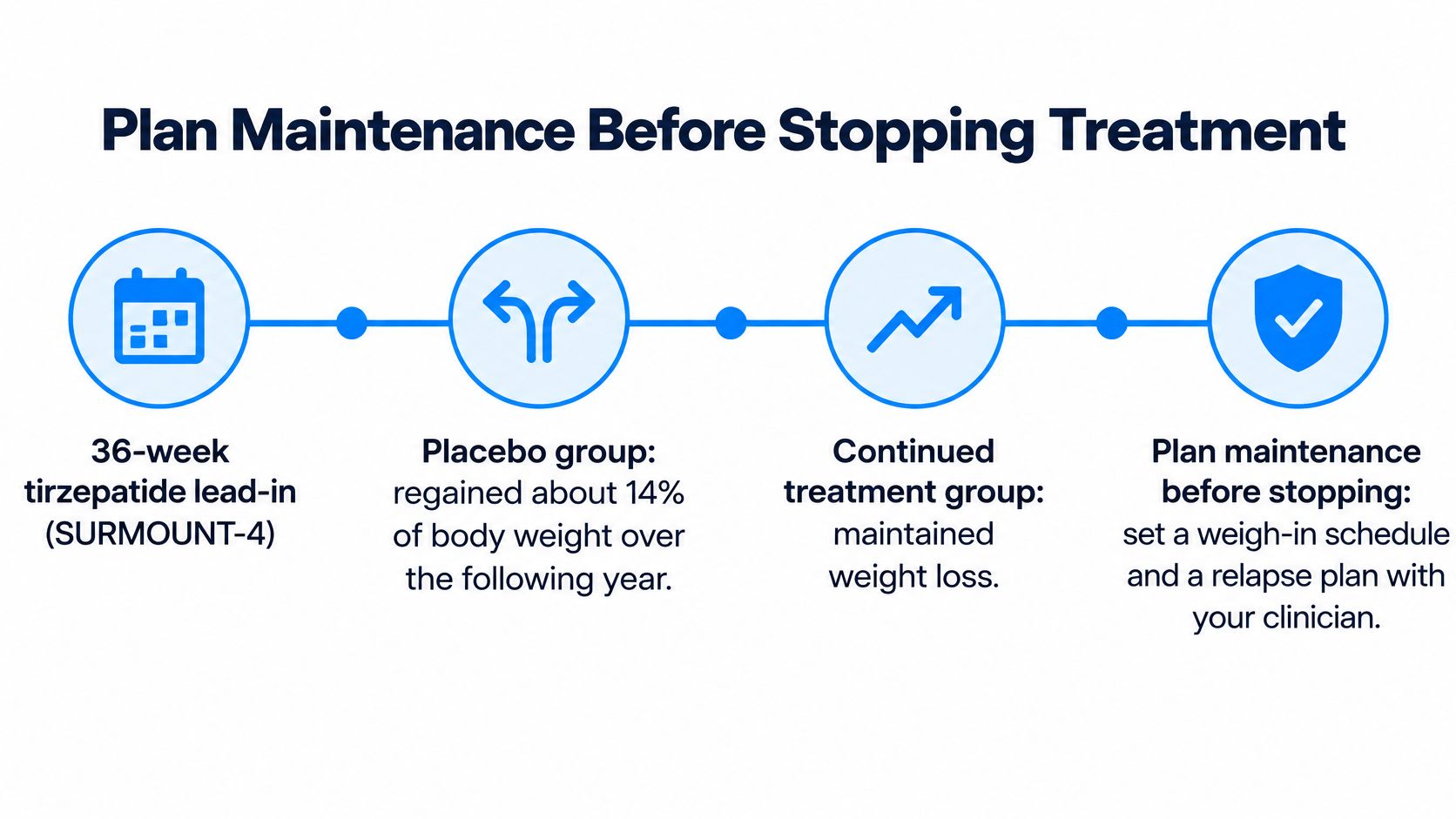
Regain is the part of the plateau conversation that usually arrives late. In SURMOUNT-4, participants received tirzepatide for 36 weeks before randomization, and those switched to placebo regained approximately 14% of body weight over the following 52 weeks while those who continued tirzepatide lost an additional 5.5%; a separate analysis of the withdrawal group found that 82% regained more than 25% of the weight they had lost within one year (American College of Cardiology scan of SURMOUNT-4 withdrawal data).
That pattern is why maintenance planning belongs before the last dose, while there is still time to choose calmly.
Phase one, decide the goal
Four destinations are worth naming out loud: indefinite treatment, a lower maintenance dose, a gradual transition, or a monitored medication-free trial. Each carries different monitoring and a different threshold for action.
The withdrawal data argues for writing the plan down in advance instead of improvising after the scale moves. A chosen destination also makes the next review legible: the prescriber can see which path was agreed and whether the monitoring matches it.
Phase two, monitor at defined intervals
Pick the measures and the interval before anything changes. Scale weight averages, waist circumference, blood pressure, glucose measures, appetite and side effects cover the ground that matters, and a planned metabolic reset review is where those measurements get read together instead of one at a time.
A useful rhythm is a four-week weight and waist average, a monthly blood pressure log, and glucose measures on the schedule the prescriber sets. Appetite and side effects get recorded at the same visits, because returning hunger and returning weight usually travel together.
Phase three, act on predefined triggers
Triggers should cover more than the scale. When weight returns after withdrawal, gains in waist circumference, blood pressure and glycemic control can unwind alongside it, so those measures belong in the trigger list too.
Maintenance is a medical plan with dates, measures and thresholds written in advance.
Write the triggers down: a set rise in the four-week average, a set increase in waist measurement, a change in blood pressure or glycemic readings. Each one carries a defined response, which is a call to the prescriber before any change is made alone at home.
Prepare the Next Clinician Visit
A plateau review works like a handoff: the measurements collected at home move into the hands of someone licensed to act on them. Book that visit before any dose change, before stopping, and before any attempt to escalate personally. Evidence beats memory in that room.
The record already built in the earlier steps does most of the work here, so gather it in one place: the four-week weight average, waist measurements, the dosing log, the symptom diary, and notes on sleep and alcohol. Add a complete list of every prescription, over-the-counter product and supplement currently in use, any prior reaction to a medication, and any condition that affects safety. Withholding a medication, condition or prior reaction can make a protocol unsafe and is grounds for declining or terminating care.
At Vials + Vitals, that review runs through a defined process: an online clinical assessment, evaluation by a U.S.-licensed provider, and prescription treatment, including compounded formulations, issued only at that provider's discretion after an individualized telehealth consultation. The GLP-1 weight care area compares semaglutide, tirzepatide and a needle-free tablet option, so the visit can weigh staying the course, adjusting the titration schedule or changing the medication itself.
Arrive with the questions written down. The visit can settle whether the current dose is the maximum tolerated, whether slower titration fits better, what counts as an inadequate response, and whether maintenance or a monitored change is appropriate. A defined agenda keeps the appointment focused on decisions rather than recall.
Informational purposes only. Compounded medications are evaluated by a licensed provider for individual suitability and are fulfilled by state-licensed partner compounding pharmacies.
Vials + Vitals pairs a confidential online assessment with review by a U.S.-licensed provider, so the four-week average, the dosing record and the symptom diary get read by someone who can act on them. GLP-1 care is individualized from intake through titration, with tirzepatide from $299 per month for a 1-month supply and every protocol set at the provider's discretion. Visit Vials + Vitals to start the assessment and bring the plateau, and the record behind it, to a licensed prescriber.