Tirzepatide Dosage Chart: Weekly Doses Explained
Tirzepatide dosage chart covering weekly initiation, escalation and maintenance doses, missed-dose timing and label checks, for provider-supervised use.

Tirzepatide for weight reduction starts at 2.5 mg injected under the skin once weekly for 4 weeks, then 5 mg once weekly, and the maximum recommended dose is 15 mg once weekly.
Why do so many dosage charts still get read as conversion charts? A milligram is the amount of drug. A milliliter, or a mark on a syringe, is a volume. Those are not the same measurement, and they do not travel together from one pen, vial, or compounded presentation to the next. The Vials + Vitals Medical Board treats the labeled stages as a sequence with minimum times and clinician checkpoints, not a calendar that every adult is expected to climb. Prescription treatment, including any compounded formulation, is set at the clinical discretion of a licensed U.S. healthcare provider after an individualized telehealth intake and consultation.
Tirzepatide Dosage Chart at a Glance
For weight reduction, the adult framework on FDA labeling starts at 2.5 mg given subcutaneously once weekly for 4 weeks, then moves to 5 mg once weekly. The FDA drug label for tirzepatide allows a further 2.5 mg increase only after at least 4 weeks on the current dose, and only when more effect is needed. That four-week floor is an assessment interval. It exists so gastrointestinal tolerance and early response can be reviewed before the dose changes, rather than so a calendar can advance on its own.
15 mg once weekly is the maximum recommended dose for adults. For weight reduction and longer-term maintenance, labeling identifies 5 mg, 10 mg, and 15 mg once weekly as maintenance options. 2.5 mg is an initiation dose and is not an approved maintenance dose. The 7.5 mg and 12.5 mg rows are titration steps used only when a clinician judges them appropriate. Nobody is required to reach 15 mg.
| Stage | Dose (subcutaneous, once weekly) | Minimum Time at Dose | Role in the Schedule |
|---|---|---|---|
| Initiation | 2.5 mg | 4 weeks | Starting dose only; not an approved maintenance dose |
| First step-up | 5 mg | At least 4 weeks before any increase | Approved maintenance option |
| Escalation step | 7.5 mg | At least 4 weeks at 5 mg | Titration step only, if clinically appropriate |
| Escalation step | 10 mg | At least 4 weeks at 7.5 mg | Approved maintenance option |
| Escalation step | 12.5 mg | At least 4 weeks at 10 mg | Titration step only, if clinically appropriate |
| Maximum | 15 mg | At least 4 weeks at 12.5 mg | Maximum recommended dose and approved maintenance option |
How to use the rows today
These specifications describe FDA-approved products. They should not be copied onto a compounded formulation, a different route, or a combination protocol without individualized clinician review.
Three checks are enough before the next injection:
- Name the stage. Match the current prescription to initiation, a maintenance option, or an optional titration step.
- Match the milligrams. Confirm that the prescribed weekly dose is the same number printed for that stage.
- Hold the increase. Bring nausea, poor intake, or any other tolerability question to the prescriber before a dose change.
Practical rule: The tirzepatide dosage chart is a reference for labeled stages. It is not a self-directed schedule, and it is not permission to convert milligrams into syringe units.
Dosing Differences Across Labeled Uses
One product name does not mean one maintenance target. Tirzepatide is labeled differently for chronic weight management, obstructive sleep apnea, and type 2 diabetes, so a single stage list cannot cover every prescription.
| Indication (Product) | Starting Dose | Maintenance or Target Doses | Maximum Dose |
|---|---|---|---|
| Chronic weight management (Zepbound) | 2.5 mg for 4 weeks, then 5 mg once weekly | 5 mg, 10 mg, or 15 mg once weekly | 15 mg once weekly |
| Obstructive sleep apnea (Zepbound) | 2.5 mg for 4 weeks, then 5 mg once weekly | 10 mg or 15 mg once weekly | 15 mg once weekly |
| Type 2 diabetes (Mounjaro) | 2.5 mg once weekly, increased by 2.5 mg no sooner than every 4 weeks | Titrated to glycemic response | 15 mg once weekly or maximum tolerated dose |
The Mounjaro prescribing information and related Zepbound labeling set those boundaries. Escalation still moves in 2.5 mg steps no more often than every 4 weeks, up to 15 mg once weekly or, for diabetes, the maximum tolerated dose.
What the prescriber decides on each row
Chronic weight management (Zepbound). The label lists 5 mg, 10 mg, or 15 mg weekly as maintenance choices. The prescriber selects among those options using weight response and how the current dose is tolerated. A person who is doing well on 5 mg does not have a labeling reason to keep climbing.
Obstructive sleep apnea (Zepbound). Labeled maintenance doses are 10 mg or 15 mg weekly. The prescriber is choosing between those two, not treating 5 mg as a long-term target for that indication. The opening stage chart for weight reduction therefore does not describe this row.
Type 2 diabetes (Mounjaro). The 2.5 mg start is for initiation. Later increases are considered when more glycemic control is needed, up to 15 mg once weekly or the maximum tolerated dose. The decision is glucose response, concurrent diabetes medicines, and tolerance, not a weight-management milestone.
Why the rows do not mix
A dose written for someone else's indication is not interchangeable with yours. Say a neighbor stays at 5 mg for weight management while your prescription is for sleep apnea. Copying that 5 mg stay would skip the maintenance doses that labeling lists for apnea. The same mistake runs the other way if a diabetes titration aimed at glucose is treated as a weight chart.
Read the indication printed on the prescription, then ask the prescriber which labeling applies to this course of care.
Week-by-Week Titration and Dose Checkpoints
The fastest labeled pace still has fixed stops. Weeks 1 through 4 are 2.5 mg once weekly, the initiation dose. Weeks 5 through 8 are 5 mg once weekly, the first step-up. Week 9 is the earliest point at which a review for another 2.5 mg increase can occur, and only if the prescriber judges it clinically appropriate.
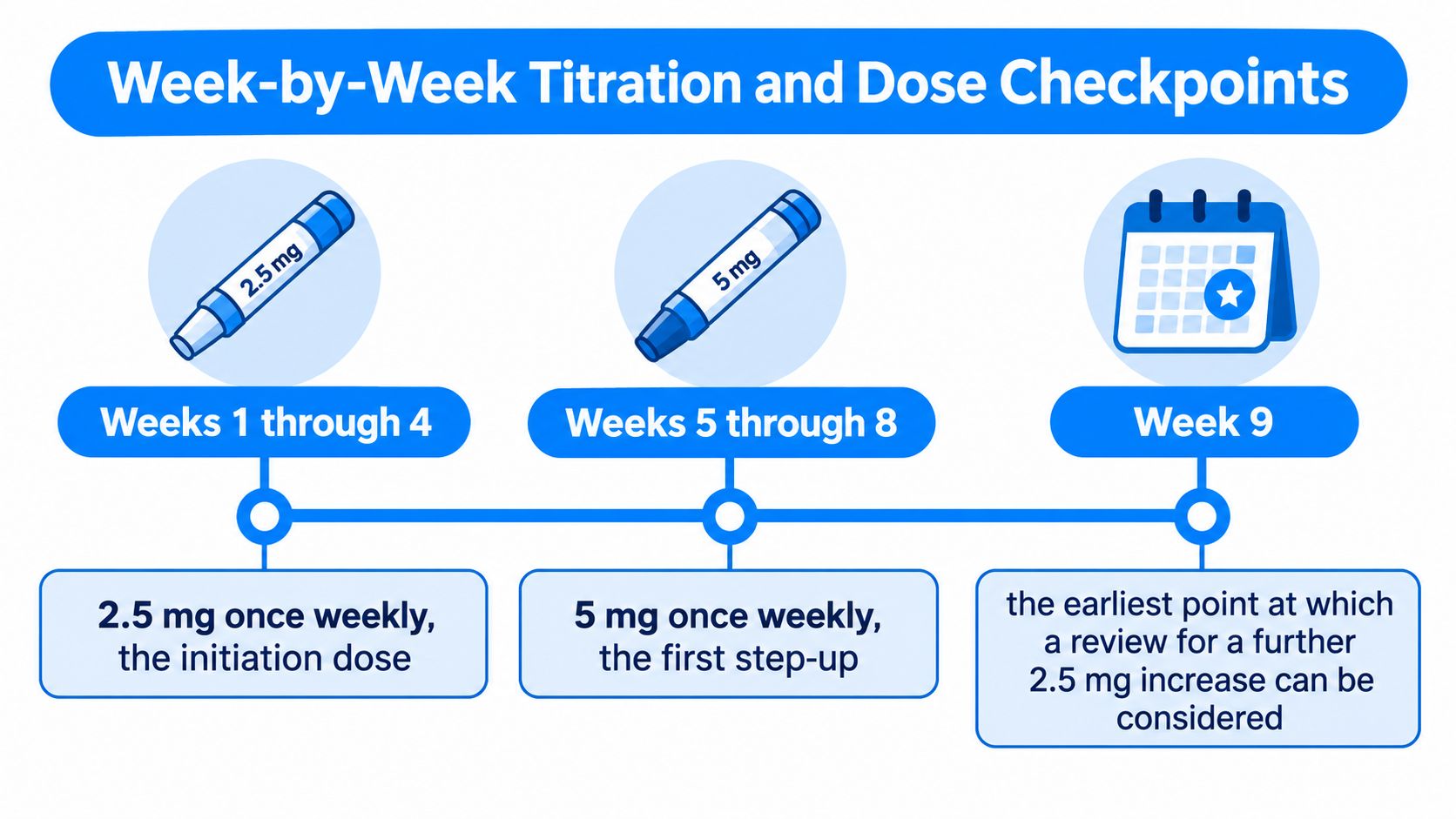
Per the FDA structured product labeling for Zepbound, maintenance options for weight reduction are 5 mg, 10 mg, or 15 mg injected subcutaneously once weekly, with 15 mg as the maximum recommended dosage. When escalation continues, later 2.5 mg steps such as 7.5 mg, 10 mg, 12.5 mg, and 15 mg each require at least 4 weeks on the current dose. Intermediate doses function as titration steps. Tolerability and therapeutic response decide whether the next step happens at all.
People changing from another weekly incretin medicine still need this same pause-and-review pattern, which is covered in more detail in this guide to switching weekly incretin treatment.
Five checks before any increase
A dose never changes because a week number arrived. Before an increase, the prescriber reviews:
- Gastrointestinal symptoms. Nausea, vomiting, diarrhea, and constipation, including how often they occur and whether food or fluids are being kept down.
- Hydration and intake. Whether drinking and eating are adequate for the current week, not just whether the scale moved.
- Response versus the goal. Weight trend for a weight indication, or glucose pattern when diabetes medicines are also in use.
- Interacting diabetes medicines. Insulin or a sulfonylurea may need a dose adjustment because low blood glucose becomes more likely when those agents are combined with an incretin medicine.
- Contraindications and new history. Any new diagnosis, procedure, or symptom that would make the next step unsafe.
Remaining at a lower tolerated dose is an accepted result of the staged approach. It is not a failed treatment. Keep a dose log with the date, the milligram dose, symptoms, and questions, and bring that log to each visit so the review reflects what happened.
How to Read Your Label Before Each Dose
Patients move among branded pens, single-dose vials, and compounded presentations. A tirzepatide dosage chart that lists only milligrams and weeks hides the risky part. Milligrams, milliliters, and syringe units are not interchangeable. The FDA label record for Zepbound (NDA 217806) expresses the approved schedule in milligrams once weekly, not in a universal units table. Injectable concentrations and devices also differ by market and formulation. A more detailed chart can increase risk if it invites self-conversion or assumes every vial has the same strength.
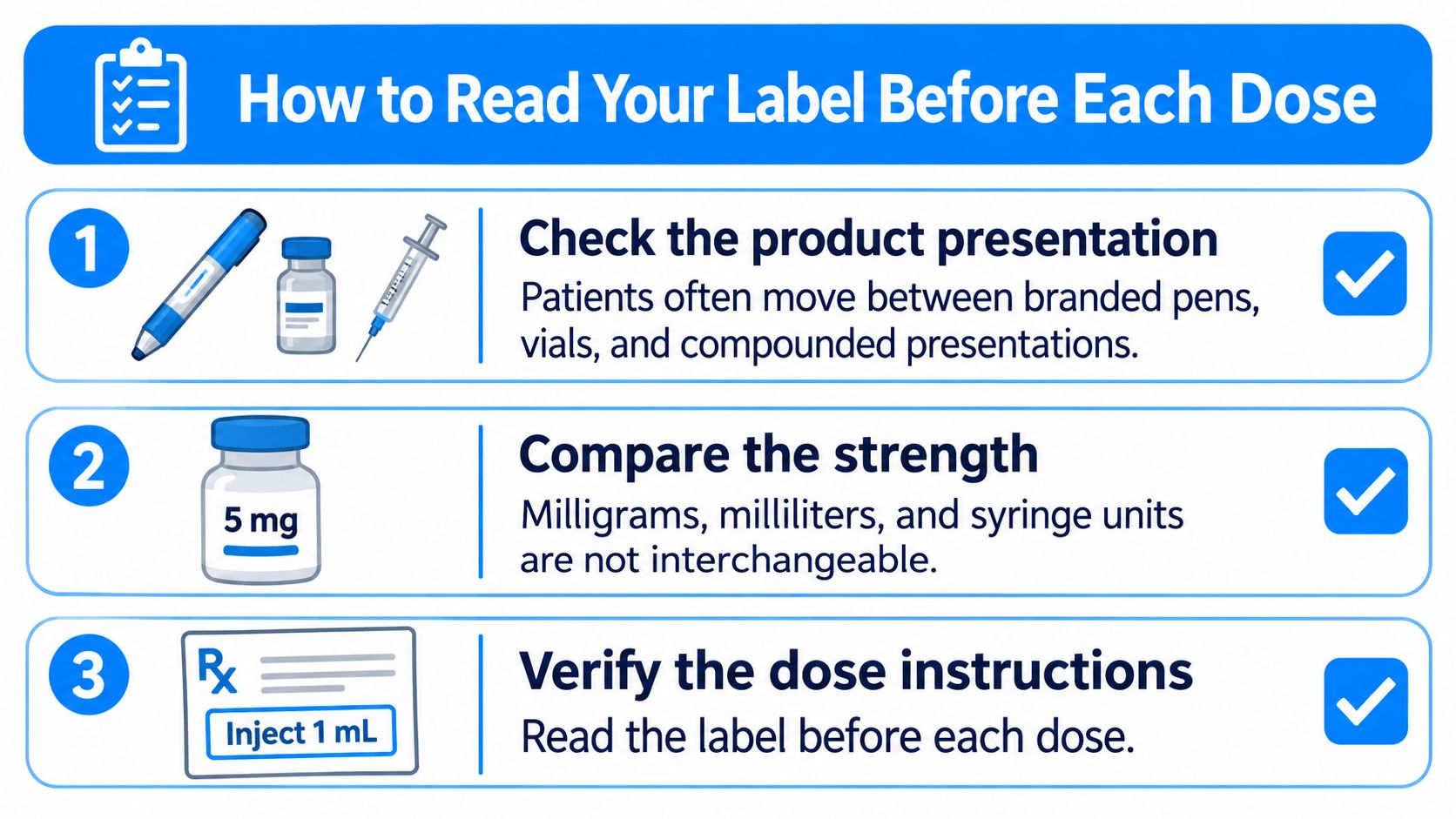
Compounded drugs are not FDA-approved or evaluated by FDA for safety, effectiveness, or quality. A compounded label still needs the same verification. It does not get a shortcut because the milligram number looks familiar. Device differences between Zepbound vials and pens are a separate question from the weekly milligram stage.
Six checks, each for a reason
- Confirm the milligram dose. It should match the stage the prescriber set, because the prescription, not a screenshot, is the order.
- Read the concentration in mg/mL. That figure belongs to this container. Another pharmacy's concentration does not apply.
- Note the exact volume in mL. Use only the volume the prescriber wrote. Do not borrow a volume from a different vial.
- Match the syringe type. Units on an insulin syringe measure volume for that syringe. They are not milligrams of tirzepatide.
- Compare with the expected step. The weekly milligram dose should still be the stage already prescribed, not the next row on a public chart.
- Stop if the container changed. Contact the prescriber or the dispensing pharmacy before using a different concentration or device. Do not substitute a friend's presentation or an online conversion.
If any value on the label does not match the written directions, do not inject. Call before the next dose.
Weight Loss Results by Maintenance Dose
The 72-week SURMOUNT-1 randomized trial, summarized by the New England Journal of Medicine, assigned adults with obesity to maintenance doses after a stepwise start. Participants began at 2.5 mg once weekly and increased at 4-week intervals to the assigned maintenance dose. The share who reached at least 20% weight reduction was 32% with 5 mg, 55% with 10 mg, and 63% with 15 mg, compared with 1.3% with placebo.
| Group | Reaching At Least 20% Weight Reduction | Context |
|---|---|---|
| 5 mg once weekly | 32% | Approved maintenance option, population-level result |
| 10 mg once weekly | 55% | Approved maintenance option, population-level result |
| 15 mg once weekly | 63% | Maximum recommended dose, population-level result |
| Placebo | 1.3% | Comparison group |
Adults receiving the 15 mg dose lost, on average, more than 20% of total body weight, with a 0.51-percentage-point reduction in glycated hemoglobin. Those figures describe a controlled trial population. They are not a prediction for one person, and they do not establish that a higher dose is appropriate for every patient.
What the percentages cannot decide
Nutrition, physical activity, sleep, and ongoing medical monitoring sat alongside the medicine in that care model. A higher maintenance dose showed a higher proportion reaching the 20% threshold in the trial. The dose that fits is still the one a person can tolerate, chosen by the prescriber. Photos and anecdotes, including injection outcome examples, are not a substitute for that judgment.
Tirzepatide is a dual GIP and GLP-1 receptor agonist. Binding those incretin receptors slows gastric emptying, reduces appetite signaling, and supports insulin release when glucose levels are high. That mechanism explains why glucose and weight can both change. It does not make a trial average into a personal target.
Missed Dose Rules and Timing Limits
Tirzepatide is taken once weekly, so the clock starts on the scheduled day, not on the day someone happens to notice the pen.
| Situation | What to Do | Next Scheduled Dose |
|---|---|---|
| Missed dose, 4 days (96 hours) or less since the scheduled day | Take it as soon as remembered | Resume the usual weekly day |
| Missed dose, more than 4 days (96 hours) since the scheduled day | Skip the missed dose | Take the next dose on the regular weekly day |
| Timing would place two doses within 3 days of each other | Do not take two doses within 3 days | Contact the prescriber for timing |
The 96-hour split in plain terms
Four days or less. Take the missed dose when it is remembered, then return to the usual weekday. A Wednesday dose remembered on Saturday still belongs to that week.
More than four days. Skip it. Taking it late would stack too close to the next scheduled injection. The following dose stays on the regular day.
Two doses inside three days. Do not take both. Someone who already shifted the injection day, then remembers a missed dose, can land inside that window without meaning to. That is a timing question for the prescriber, not a reason to "catch up."
A missed dose is not a reason to take an extra dose, and it does not change the stage the prescriber set. A gap during a titration step does not bump the prescription to the next milligram strength. Medication must be used only as directed on the label. Patients should not change the amount or the schedule themselves.
Write the injection day on a calendar and set one reminder. If doses are missed repeatedly, or if travel has made the weekday unclear, call the prescriber before the next injection rather than rebuilding the week alone.
Safety Signals That Pause Dose Increases
The boxed warning describes a risk of thyroid C-cell tumors seen in rodent studies. Tirzepatide is contraindicated in patients with a personal or family history of medullary thyroid carcinoma or Multiple Endocrine Neoplasia syndrome type 2. Disclose the full thyroid history, including relatives, before treatment starts. Report a neck lump, persistent hoarseness, trouble swallowing, or shortness of breath.

Withholding a medication, a condition, or a prior reaction can make a protocol unsafe and is grounds for declining or terminating care. The intake is only as accurate as the history that is offered.
Signals by body system
Pancreas and gallbladder. Severe abdominal pain that persists or radiates to the back can indicate pancreatitis. Stop escalation and seek care the same day. Right-upper abdominal pain, especially with nausea after fatty meals, can point to gallbladder disease and also warrants prompt contact.
Gut and kidneys. Nausea, vomiting, and diarrhea can dehydrate a person enough to strain kidney function. Dark urine, dizziness, or an inability to keep fluids down is a reason to pause any planned increase and call. Sip fluids on schedule during the first days after a step-up, and say so if that plan fails.
Glucose. Low blood glucose is more likely when tirzepatide is combined with insulin or a sulfonylurea. Those doses may need review. Shakiness, sweating, or confusion is a glucose event to report, not a side effect to push through until the next titration visit.
Pregnancy. Discuss pregnancy plans and contraception before treatment. Delayed gastric emptying can reduce the effectiveness of oral hormonal contraceptives. Labeling advises a non-oral method, or an added barrier method, for 4 weeks after the start and for 4 weeks after each dose increase.
Pause the next increase and contact a provider whenever one of these signs appears. Do not wait for the four-week mark to see whether it passes.
Confirm Your Dose With a Licensed Provider
A chart can show the labeled boundaries. It cannot choose the row. Prescription tirzepatide, and any compounded formulation, is determined by a licensed U.S. healthcare provider after an individualized telehealth intake and consultation. Eligibility and product availability vary, and provider approval is required. Vials + Vitals is a physician-directed telehealth service in which U.S.-licensed providers decide eligibility, formulation, and the titration schedule. When a treatment is prescribed, discreet delivery is available. Tirzepatide costs from $299 per month for a 1-month supply.
Bring these items to the consultation:
- Current dose and stage, in milligrams, not in syringe units.
- The pharmacy label, including mg/mL concentration and the volume in mL.
- The dose log, with dates, symptoms, and any missed doses.
- Current medicines, including insulin or a sulfonylurea.
- Thyroid, pancreatic, and pregnancy history.
Ask which stage fits this history, and what symptom would prompt a change rather than another increase.
Informational purposes only. Compounded medications are evaluated by a licensed provider for individual suitability and are fulfilled by state-licensed partner compounding pharmacies.
Vials + Vitals offers physician-directed telehealth for metabolic care, including tirzepatide protocols with an individualized titration schedule rather than a self-built chart. A licensed U.S. provider reviews the intake, sets eligibility and dose, and coordinates fulfillment when treatment is appropriate. Visit Vials + Vitals to start a confidential assessment and confirm the weekly dose that matches your prescription.