Semaglutide Hair Loss: Causes, Timing and What to Do
Semaglutide hair loss is linked mostly to rapid weight loss and telogen effluvium. Learn timing, management steps and when to see a provider.

Hair loss is a reported side effect of semaglutide, seen in 3.3% of adults on the 2.4 mg Wegovy dose versus 1.0% on placebo, and it's most consistent with weight-loss-related telogen effluvium rather than direct follicle damage. The gap is real but modest, and it says more about how fast the body is changing than about the molecule itself.
Reporting systems tell a louder story than trials do. A 2026 pharmacovigilance analysis counted 697 alopecia reports involving semaglutide and detected a reporting signal in 2024 with a reporting odds ratio of 1.55 (Journal of Cosmetic Dermatology). A disproportionality signal measures how often a drug appears in reports relative to other drugs, not how many users shed hair, and the distance between those two ideas is where most online advice goes wrong.
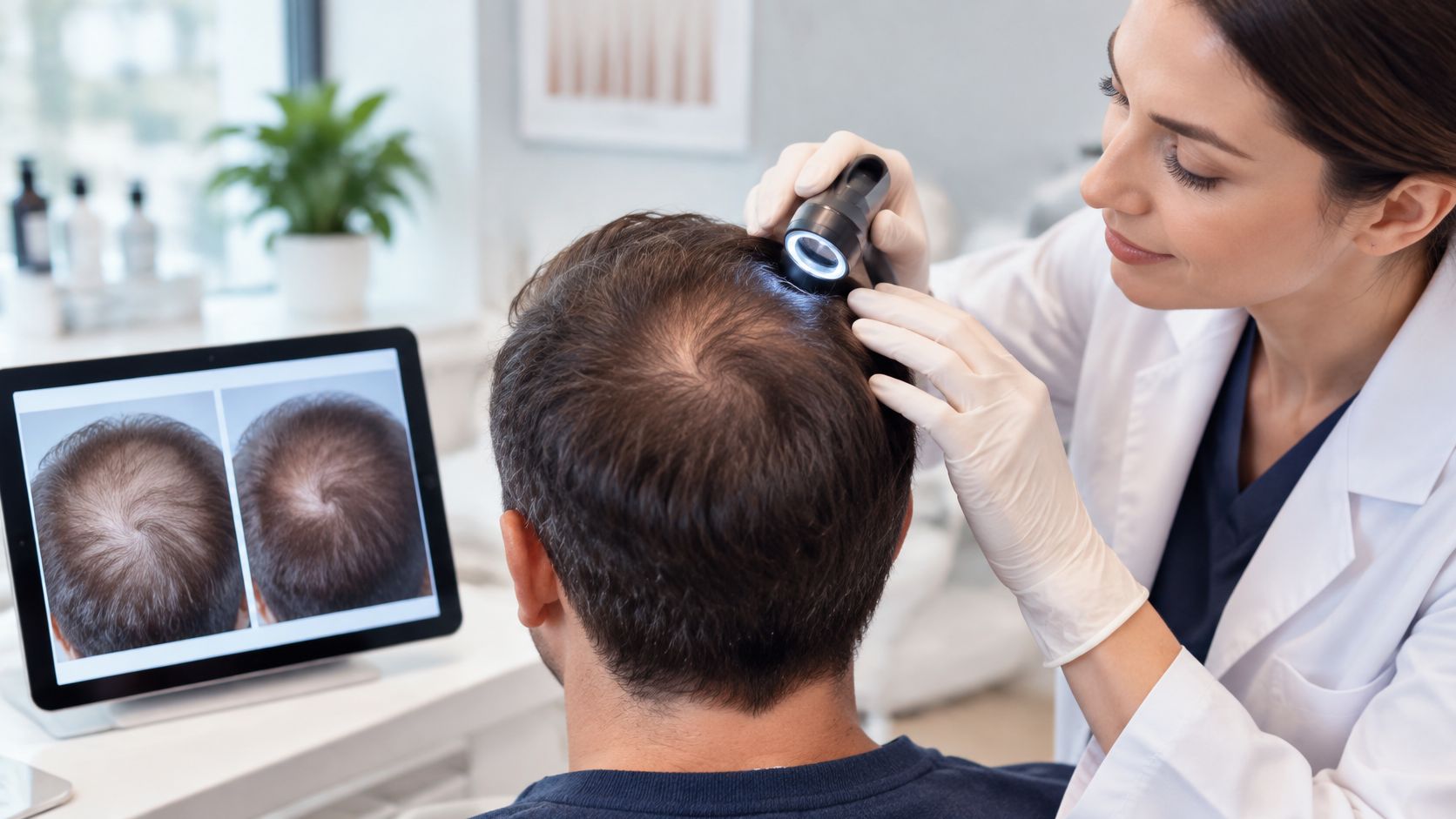
Two clinically different problems get folded into one label. One is a temporary, diffuse shed tied to rapid weight change. The other is patterned hair loss that was already developing and becomes visible under the brighter light of a shrinking body. Telling them apart changes everything about what to do next.
Does Semaglutide Cause Hair Loss? The Short Answer
Semaglutide is associated with increased reporting of hair shedding, not with proven destruction of hair follicles. The FDA prescribing information for Wegovy reports hair loss in 3.3% of adults receiving the 2.4 mg dose against 1.0% of adults receiving placebo in pooled studies. Split by sex, the rates were 4.0% in women versus 2.0% on placebo, and 0.9% in men versus 0%.
That single percentage is a starting point, not a verdict. The same label states the hair loss was associated with weight reduction, which frames rapid or substantial weight loss as the likely intermediary rather than semaglutide acting as a follicle toxin. The female preponderance fits the same picture: women notice and report hair shedding more readily than men, so part of that gap is reporting behavior rather than biology alone.
Reported rates move by an order of magnitude depending on how the question is asked. The table below puts the main estimates side by side so the design differences are visible.
Reported hair loss rates in semaglutide research
| Source | Semaglutide group | Comparator | Key note |
|---|---|---|---|
| FDA Wegovy label, pooled adults | 3.3% | 1.0% placebo | Associated with weight reduction |
| FDA Wegovy label, women | 4.0% | 2.0% placebo | Higher reported rate in women |
| FDA Wegovy label, men | 0.9% | 0% placebo | Small number of events |
| OASIS 1 trial, oral semaglutide 50 mg | 6.9% | 2.7% placebo | Randomized trial |
| 2026 meta-analysis of randomized trials | 1.65% | 0.37% placebo | Pooled odds ratio 2.92; low certainty |
| 2026 observational cohort (152 users) | 64% | Not reported | Self-reported shedding; not comparable to trials |
Randomized trials count events under a defined protocol, usually an adverse-event box ticked during a study visit. Self-reported cohorts count what people say happened, often after they've read that shedding is possible, and they fold in temporary shedding, restricted eating, rapid weight loss and pre-existing hair disorders. That's how a figure in the sixties and a figure near two can describe the same drug.
The practical reading is narrow and useful. Shedding shows up more often than placebo, it's commonly linked to weight loss, and it deserves clinical assessment when it's severe, persistent, patchy or accompanied by scalp symptoms. Population rates describe groups. They don't predict what happens to one person starting a prescription.
Why Rapid Weight Loss Triggers Shedding
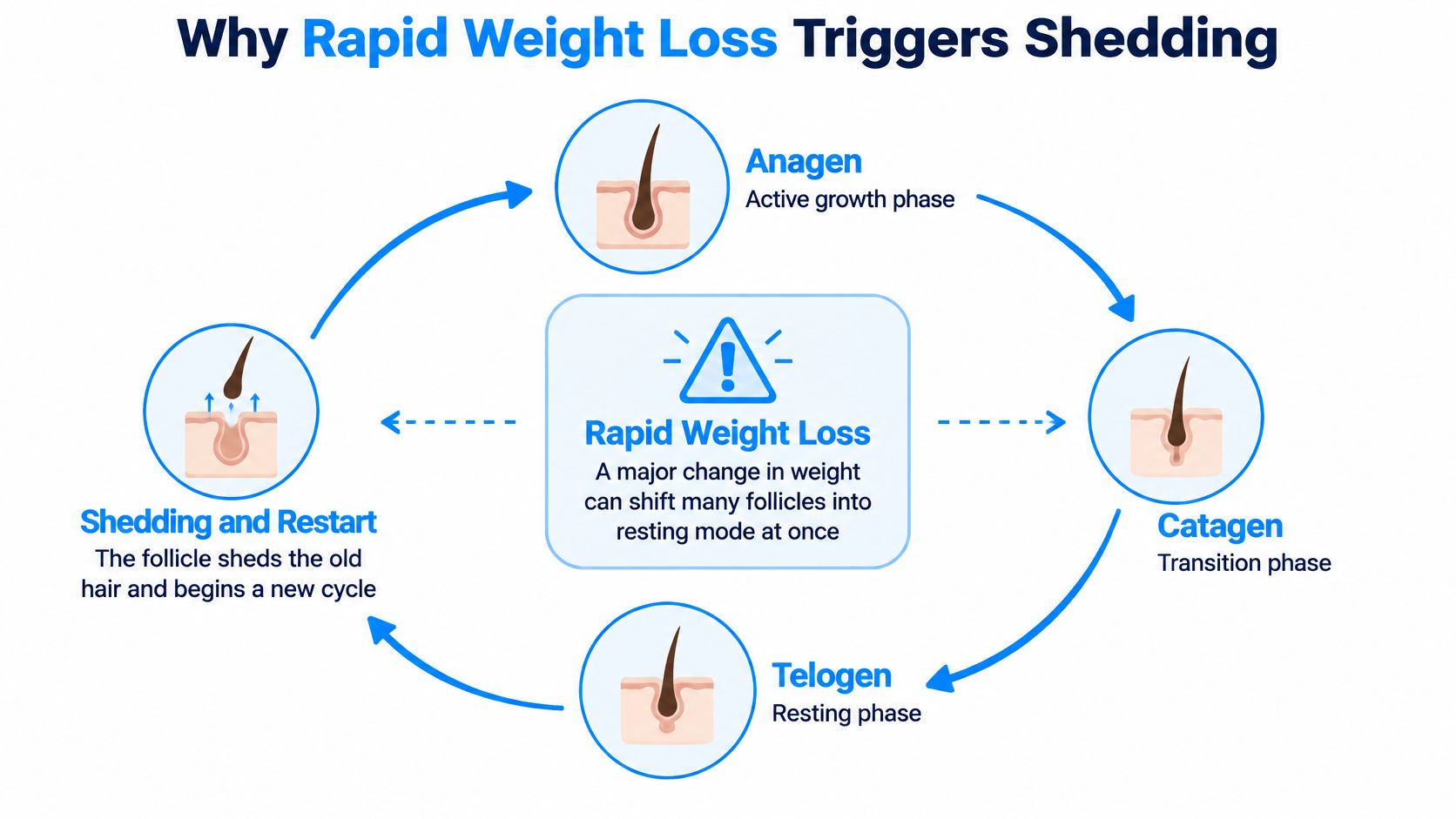
Every hair follicle runs a cycle. Anagen is active growth, catagen is the short transition, and telogen is a resting phase that ends with the old hair released and a new one starting. A minority of scalp follicles sits in telogen at any moment, which is why normal daily shedding never empties a scalp.
A systemic stressor can push an abnormally large share of follicles into telogen at once. Because the follicle holds its hair for weeks before letting go, the shed arrives roughly two to three months after the trigger. Think of a construction crew pulled off a site all at once: nothing collapses, but the structure looks thinner weeks later because no one is building.
The cycle shift is the whole mechanism, and it helps to see it drawn out.
The evidence points at weight loss rather than a direct drug effect. In randomized obesity trials of semaglutide and related GLP-1 medicines, alopecia appears in roughly 3% to 7% of treated participants, while a 2026 observational cohort of 152 GLP-1 receptor agonist users reported shedding in 70.4%, including 64% of semaglutide users (Acta Diabetologica review of the evidence). That same review traces the signal to the pace and size of the loss, with risk rising markedly once weight reduction passes roughly 10% to 15% of baseline body weight.
Run the arithmetic on a 100 kg patient who loses 12 kg over six months. Twelve percent of baseline weight puts that patient past the threshold, so the pace itself becomes the thing to discuss at the next visit, whichever molecule produced it. The stressors travel together: low calorie intake, low protein intake, and the metabolic reorganization that accompanies fast fat loss.
The variable worth watching: weekly loss velocity. Two patients on identical doses who lose weight at different speeds will not have the same hair story.
None of this has been confirmed in a prospective trial built to test the mechanism, so it remains the best-supported explanation rather than a settled one. What follows from it is practical: monitor the pace of weight loss, not only the name on the vial. A structured plan for losing 30 pounds at a supervised pace keeps weekly loss inside a range the hair cycle tolerates better than a crash trajectory.
Telogen Effluvium and Pattern Hair Loss Compared
The two conditions can look similar in a bathroom mirror and behave very differently over a year. One is a reactive episode that resolves when its trigger resolves. The other is a genetically driven process that keeps progressing without treatment.
Telogen effluvium compared with androgenetic alopecia
| Feature | Telogen effluvium | Androgenetic alopecia |
|---|---|---|
| Pattern | Diffuse shedding across the scalp | Gradual thinning at the temples and crown |
| Typical trigger | Rapid weight loss, illness, surgery or major stress | Genetic susceptibility and androgen sensitivity |
| Onset | Often about 2 to 3 months after the trigger | Gradual, over months to years |
| Reversibility | Usually recovers once the trigger settles | Progressive without treatment |
| Scalp findings | Normal scalp, no scarring | Miniaturized follicles, no scarring |
| Typical management | Address the trigger and monitor | Minoxidil, finasteride or dutasteride under provider direction |
Reading the scalp
Telogen effluvium is defined by diffuse, often acute shedding that reflects a shift in the hair-cycle distribution, with a larger proportion of follicles entering the resting and shedding phase instead of staying in active anagen growth (clinical review of telogen effluvium_ra4.pdf)). In practice, that means more hair on the brush, on the pillow and in the shower drain, spread evenly rather than concentrated at the part or the crown. The scalp itself usually looks normal, without redness, scaling or scarring.
Androgenetic alopecia looks different. The part widens, the temples recede, the crown thins, and the change is measured over years rather than weeks. Miniaturized follicles produce finer, shorter hairs before they stop producing pigment and length. Findings that fall outside an uncomplicated reactive shed, such as sudden patchy loss, scalp inflammation, scarring or steady progression, are the ones that justify dermatologic evaluation rather than watchful waiting.
Why the distinction changes management
A trigger-driven episode is managed by addressing the trigger and monitoring. Pattern loss needs direct treatment, and the same clinical review cautions that telogen effluvium shouldn't be diagnosed until other causes of long-standing diffuse shedding, including androgenetic alopecia, have been considered or excluded. The two can also coexist: diffuse shedding makes underlying follicular miniaturization more obvious, so a patient can present with both at once.
A 2026 review makes the same point from the safety side, reporting 199 hair-loss reports and a significant pharmacovigilance signal for semaglutide, with androgenetic alopecia and telogen effluvium among the predominant reported subtypes, while stressing that causality has not been established (review of alopecia subtypes linked to semaglutide). Treating every shed as a single, uniform side effect misses that split.
The classification comes from a clinician taking a history, examining the scalp and ordering targeted testing when it's indicated. It doesn't come from a search engine or a self-assessment quiz.
Timeline From the First Dose to Regrowth
Shedding follows the treatment calendar with a lag. Knowing where that lag lands stops people from abandoning a working medication in a panic at week five, or from ignoring a pattern that deserves attention at month eight.
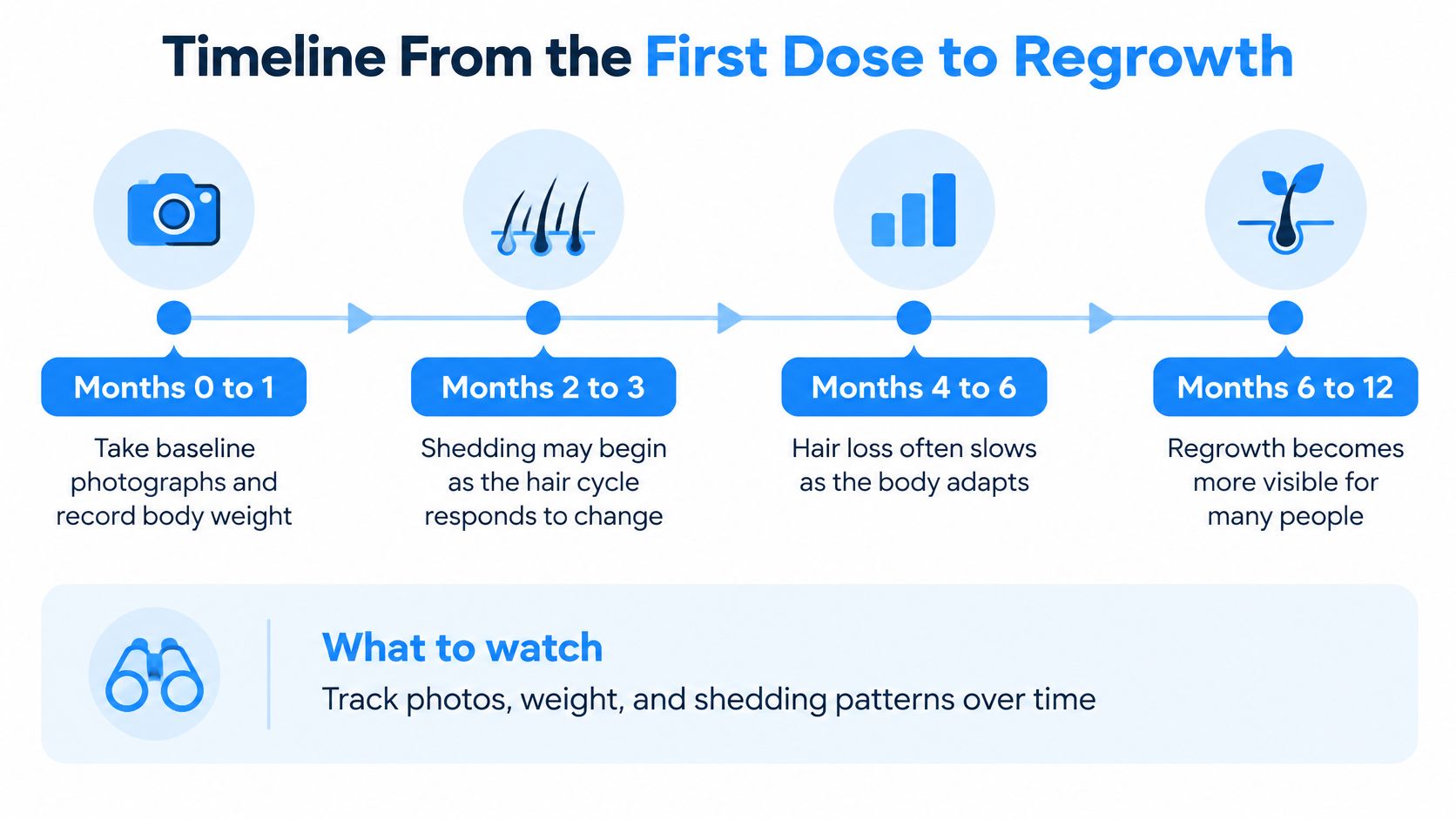
Months 0 to 1. Photograph the hairline and crown in consistent lighting and record body weight before the first dose. Shedding is unlikely in the opening weeks because the mechanism is delayed, which is exactly why a baseline image is worth more than a memory of how the hair looked.
Months 2 to 3. This is the typical window for telogen shedding to become noticeable, since the follicle has been holding hair it committed to release weeks earlier. A patient who starts treatment in January often notices the change in March or April, not in February.
Months 3 to 6. Shedding risk runs highest while weight is coming off fastest, and that pace usually peaks in this stretch. Consider a patient who finds clumps on the brush at month four, sees weight loss slow by month six, and reports tapering shedding by month nine. The sequence is unremarkable and expected, which is precisely why it reassures when someone explains it in advance.
Month 6 onward. Shedding generally eases as weight stabilizes, though visible regrowth takes longer because follicles need to cycle back into anagen and grow hair to a noticeable length. Density returns gradually, and the first change many notice is less shedding rather than new growth.
Set expectations honestly: visible change from any hair-directed step is assessed over months rather than days, and a response isn't guaranteed.
These are typical windows, not promises. Shedding that continues well past the point where weight has stabilized is a reason to bring the timeline back to the provider, along with the photographs and the weight log. Any plan to stop treatment or change the dose belongs in that same conversation, because regrowth is gradual and its timing depends on what triggered the shed in the first place.
Other Causes to Rule Out Before Blaming the Drug
Semaglutide is one input among several, and a careful clinician works the list before pinning a shed on the prescription. The Wegovy prescribing information is explicit that the labeling doesn't establish direct follicular damage and directs assessment toward other explanations, including rapid weight reduction, inadequate protein or micronutrient intake, thyroid disease and androgenetic alopecia.
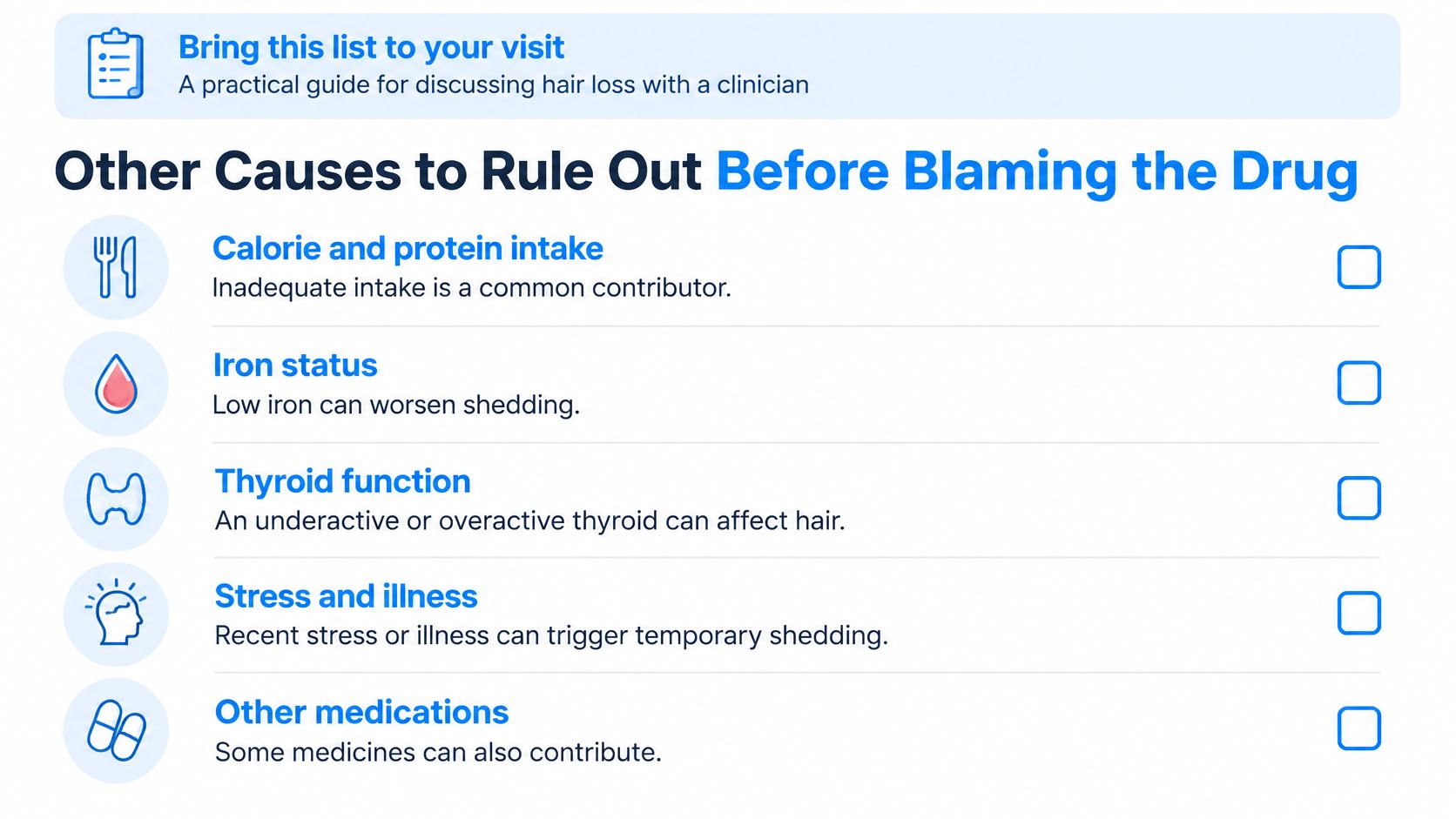
- Calorie and protein intake. Hair is a protein structure built from a metabolically expensive matrix, and undereating is a common contributor. Compare actual intake with the target the provider set rather than an approximation.
- Iron status. Ferritin is the number to ask about, because low iron stores can worsen diffuse shedding even when hemoglobin looks acceptable.
- Vitamin D and zinc. Both sit in the nutrient cluster tied to follicle cycling, and both are easy to miss on a reduced appetite.
- Thyroid function. An underactive or overactive thyroid produces diffuse shedding that looks identical to a reactive episode, so thyroid testing belongs in the workup.
- Recent illness, surgery, childbirth or high fever. Each is an established telogen trigger with its own two-to-three-month delay, and two triggers can land on the same follicle cycle.
- Other medications and supplements. Some drugs contribute to shedding, and high-dose biotin taken for hair can interfere with certain laboratory assays, which is one more reason to list everything on the intake form.
- Family history of pattern thinning. A parent or sibling with early thinning shifts the probability toward androgenetic alopecia, which needs different management.
- Scalp conditions. Seborrheic dermatitis and other inflammatory disorders cause shedding with itching, scaling or redness, and they respond to targeted treatment.
A practical guide to slowing hair loss without stopping treatment covers the day-to-day habits that support this list, from washing routine to styling tension.
A checklist doesn't replace clinical review. Blood tests and examinations are ordered at the provider's discretion, based on the history, the examination findings and what the timeline suggests. Two patients with the same complaint can leave with completely different test panels.
How to Protect Your Hair During Treatment
A 2025 Saudi Arabian cross-sectional study of 254 GLP-1 receptor agonist users found that hair-loss severity varied by medication and suggested the 3-to-6-month period may be particularly susceptible, coinciding with the stretch of greatest weight loss (Journal of Cosmetic Dermatology study). A systematic review in the same literature likewise identified rapid weight loss as a potential contributor and reported that higher obesity-treatment doses were more often associated with hair-loss reports, while acknowledging the absence of large prospective trials establishing causality.
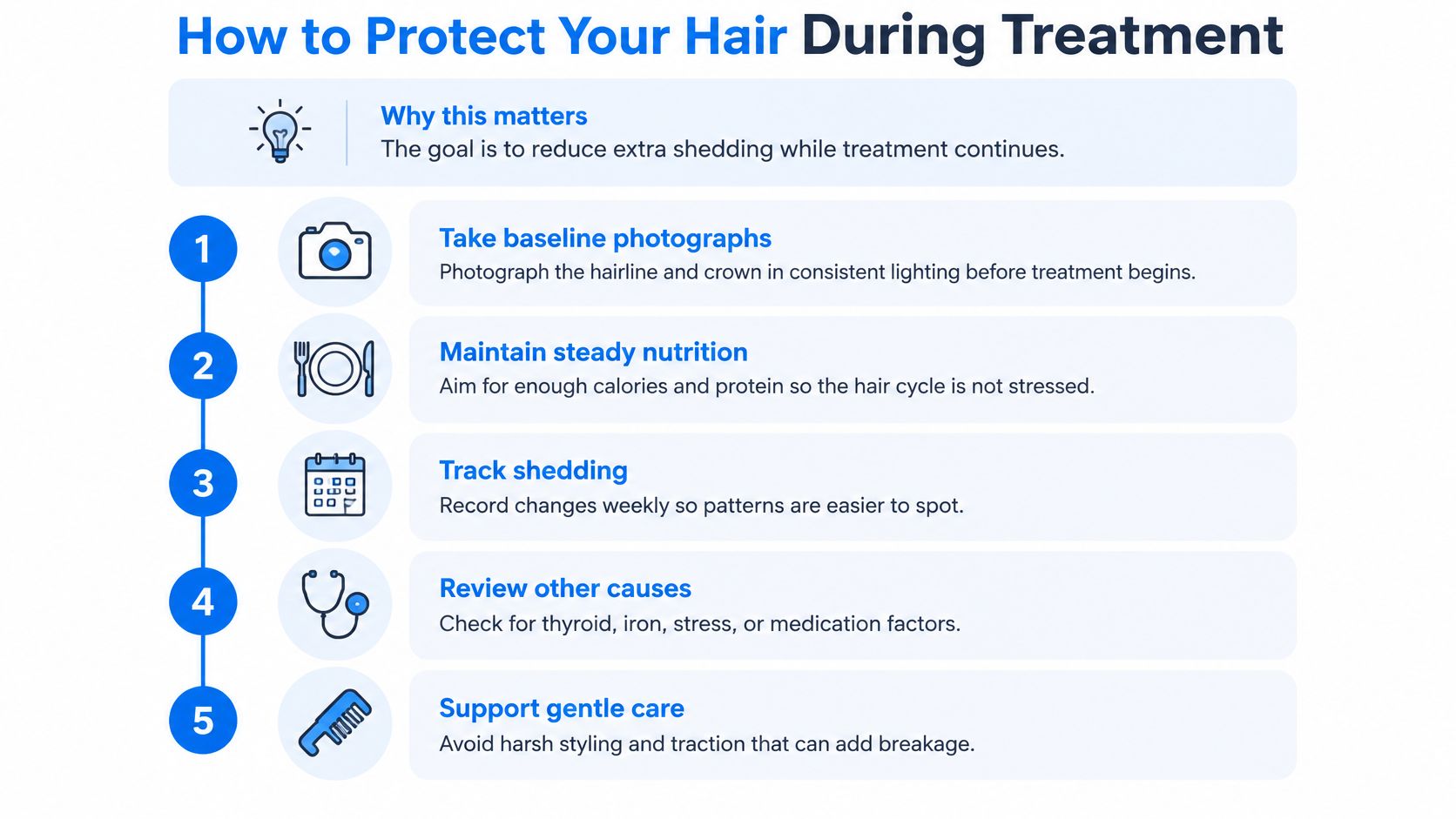
- Take baseline photographs before the first dose. Use the same lighting, the same angle and the same damp or dry state each time. Skipping this is the most common slip, because six months later there's no honest comparison to make.
- Record body weight weekly and calculate percent change monthly. A pace climbing toward the 10% to 15% of baseline range is worth raising with the provider. Weekly numbers also separate a real acceleration from ordinary fluid fluctuation.
- Track shedding on the same day each week. A weekly photograph or a count of hairs on the pillow catches a trend. Daily estimates are misleading because shedding varies with washing frequency and styling.
- Hold the protein and calorie targets set with the provider. Crash dieting in pursuit of a faster result is the other common slip, and it stacks a nutritional stressor on top of a weight-loss stressor.
- Discuss dose changes, titration steps and any plan to stop with the provider first. Abrupt discontinuation can undermine weight-management goals without resolving the shed, since the trigger is the weight trajectory rather than the molecule.
- Use the red flags in the next section to decide when to request a review instead of waiting out another month.
The contrarian point is worth stating plainly: a slower, medically supervised weight-loss trajectory may matter more than switching products. Current evidence points toward weight-loss magnitude and metabolic stress as key contributors rather than a proven direct toxic effect of semaglutide, so changing the molecule while keeping the same rate of loss may change very little. Supplements are not a substitute for that conversation, and indiscriminate biotin adds cost and laboratory interference without an established protective benefit.
Prescription Options When Pattern Loss Is Confirmed
Treatment follows diagnosis. These options are matched to androgenetic alopecia, not to a reactive shed, and each is chosen only by a licensed U.S. provider after an individualized review.
Common hair-loss treatment options and their key limits
| Option | Mechanism | Typical use | Key limit |
|---|---|---|---|
| Topical minoxidil | Vasodilator that prolongs the growth phase | Androgenetic alopecia in men and women | Requires consistent daily use; early shedding possible |
| Oral minoxidil | Systemic vasodilation | Off-label for hair loss; not FDA-approved for hair loss | Can lower blood pressure, cause fluid retention and raise heart rate |
| Finasteride | Inhibits type II 5-alpha reductase, lowering scalp DHT | Androgenetic alopecia in men | Not used in women who are or may become pregnant |
| Dutasteride | Inhibits types I and II 5-alpha reductase | Off-label for hair loss in men | Provider discretion; individualized safety review |
Topical minoxidil rewards consistency and punishes gaps. It can also produce an early shed in the first weeks as follicles shift cycles, which is a normal phase rather than a failure, and the patients who quit at that point are the ones who never reach the payoff.
Oral minoxidil is not FDA-approved for hair loss, and it works systemically. Blood pressure can fall, fluid can accumulate and heart rate can rise, which is why it needs medical oversight rather than an online order (Vials + Vitals notes the same limits for its Re-Grow oral minoxidil tablet, which lists a copper peptide complex, apigenin and fisetin alongside minoxidil).
Finasteride is not used in women who are or may become pregnant, a restriction that reflects the drug's hormonal mechanism rather than convenience. Dutasteride is prescribed at provider discretion after an individualized safety review.
Both 5-alpha reductase inhibitors act on the androgen pathway that drives follicular miniaturization, which is why they aren't the first response to trigger-driven telogen shedding. Blocking DHT in a patient whose hair is shedding because of fast weight loss addresses the wrong mechanism. For a side-by-side look at the two drugs, this comparison of dutasteride versus finasteride for hair loss sets out the potency and safety differences.
Note what the Re-Grow ingredient list doesn't contain: no finasteride and no dutasteride, so it isn't a DHT-blocking formula, and the product is prescription-only with eligibility and availability that vary.
Before prescribing any of these, a provider reviews contraindications, sex-specific safety issues, blood pressure and current medications. Judging whether a treatment is working takes months of consistent use, and no prescription carries a guarantee.
When to Contact Your Provider and Next Steps
Some findings mean a shed has moved past the expected pattern and needs a clinician rather than another month of observation.
Red flags and the recommended response
| Finding | What it may indicate | Suggested next step |
|---|---|---|
| Patchy loss that appears suddenly | Alopecia areata or another inflammatory cause | Dermatology referral |
| Scalp redness, scaling, pain or pustules | Inflammatory or infectious scalp disorder | Prompt clinical review |
| Scarring or a smooth, shiny scalp | Scarring alopecia | Urgent dermatology evaluation |
| Shedding persisting more than six months | Chronic telogen effluvium or pattern loss | Provider review with laboratory testing |
| Shedding with fatigue, cold or heat intolerance | Possible thyroid disorder | Thyroid testing |
| Chest pain, shortness of breath, fainting or rapid unexplained weight gain on oral minoxidil | Possible cardiovascular or fluid effect | Seek medical attention promptly |
The Wegovy prescribing information draws a similar line, noting that sudden patchy loss, scalp inflammation, scarring or persistent progression are less typical of uncomplicated telogen effluvium and warrant dermatologic evaluation. Those are the findings that turn a waiting game into a diagnostic question.
Bring three things to the visit: baseline photographs, a weight log and the date shedding started. Those three data points make the conversation concrete.
A physician-directed telehealth service such as Vials + Vitals can begin with an online clinical assessment reviewed by a U.S.-licensed provider, who then determines eligibility, formulation and titration. Completing that assessment doesn't guarantee a prescription, and nothing guarantees a specific clinical outcome. Any prescription, compounded formulation or titration plan is determined at the clinical discretion of a licensed U.S. provider following an individualized telehealth intake and consultation, and fulfillment runs through state-licensed partner compounding pharmacies.
Oral minoxidil carries its own safety rule worth repeating in plain terms: chest pain, shortness of breath, fainting or rapid unexplained weight gain require prompt medical attention rather than a message through a patient portal.
Informational purposes only. Compounded medications are evaluated by a licensed provider for individual suitability and are fulfilled by state-licensed partner compounding pharmacies.
Vials + Vitals builds its hair and metabolic protocols around exactly the sequence this article describes: baseline records first, a clinician review of timing, weight-loss velocity and nutrition, then a decision about whether treatment is appropriate. The platform's hair health area and GLP-1 weight care area sit inside one clinical workflow, so a shed that starts mid-protocol gets assessed rather than guessed at. Start with the online assessment at Vials + Vitals and let a U.S.-licensed provider determine the next step.