Weight Loss Plateau Breaker: What Works and When to Act
Weight loss plateau breaker steps: confirm a true plateau, adjust diet and training, and review GLP-1 options with a licensed provider.

The scale has sat inside the same narrow band for weeks. Breakfast is still smaller, the weekly dose still lands on the same morning, and clothes still fit differently than they did at the start. That stall is when most adults start looking for a weight loss plateau breaker, and it is also when a single weigh-in is most likely to send the plan in the wrong direction.
A physician-directed program treats that flat stretch as a finding to verify, not as proof that the medicine has failed. Body weight moves with fluid, sodium, bowel contents, menstrual timing, and a hard training week. Fat loss can continue while the scale does not. The useful sequence is simple. Confirm that the average is flat, audit what is happening, change one lever, and only then ask a licensed prescriber whether the dose, the drug, or a maintenance plan should change.
Confirm a True Plateau Before You Change Anything
A weight-loss plateau is the point at which body weight stabilizes after intentional loss. It is an expected biological phase. It is not, by itself, evidence that treatment has stopped working.
Two drivers tend to arrive together. Hunger signaling rises, including higher ghrelin and weaker satiety signals, so the same plate feels less filling. At the same time, energy expenditure falls because a smaller body costs less to move and to maintain. A 2025 analysis of the SURMOUNT-1 obesity trial defined time to plateau as that stabilization point, and it found that timing tracks starting body size. Median time was 24.3 weeks for participants with overweight, 26.0 weeks for class I obesity, and 36.1 weeks for both class II and class III obesity. By week 72, about 90.2%, 88.9%, 87.6%, and 87.8% of those four groups had reached a plateau, according to the 2025 SURMOUNT-1 plateau analysis. Those on effective pharmacotherapy eventually enter a maintenance phase. A larger starting BMI tends to take longer to get there.
A plateau should be judged from several weeks of averages, not from one disappointing morning.
Verify the stall before you change the plan:
- Same conditions each morning. Weigh after urinating and before eating, on the same scale.
- Use a 7-day rolling average. Compare weekly averages. Ignore a single high or low reading.
- Apply a 12-week rule. Call it a plateau only when that average changes by less than 5% across roughly 12 weeks.
- Measure the waist every two weeks. Circumference can keep moving while the scale stalls.
- Log the confounders. Note fluid shifts, constipation, sodium intake, menstrual timing, and training-related water retention before you conclude that fat loss has stopped.
| BMI category | Median weeks to plateau | Reached plateau by week 72 |
|---|---|---|
| Overweight | 24.3 | 90.2% |
| Class I obesity | 26.0 | 88.9% |
| Class II obesity | 36.1 | 87.6% |
| Class III obesity | 36.1 | 87.8% |
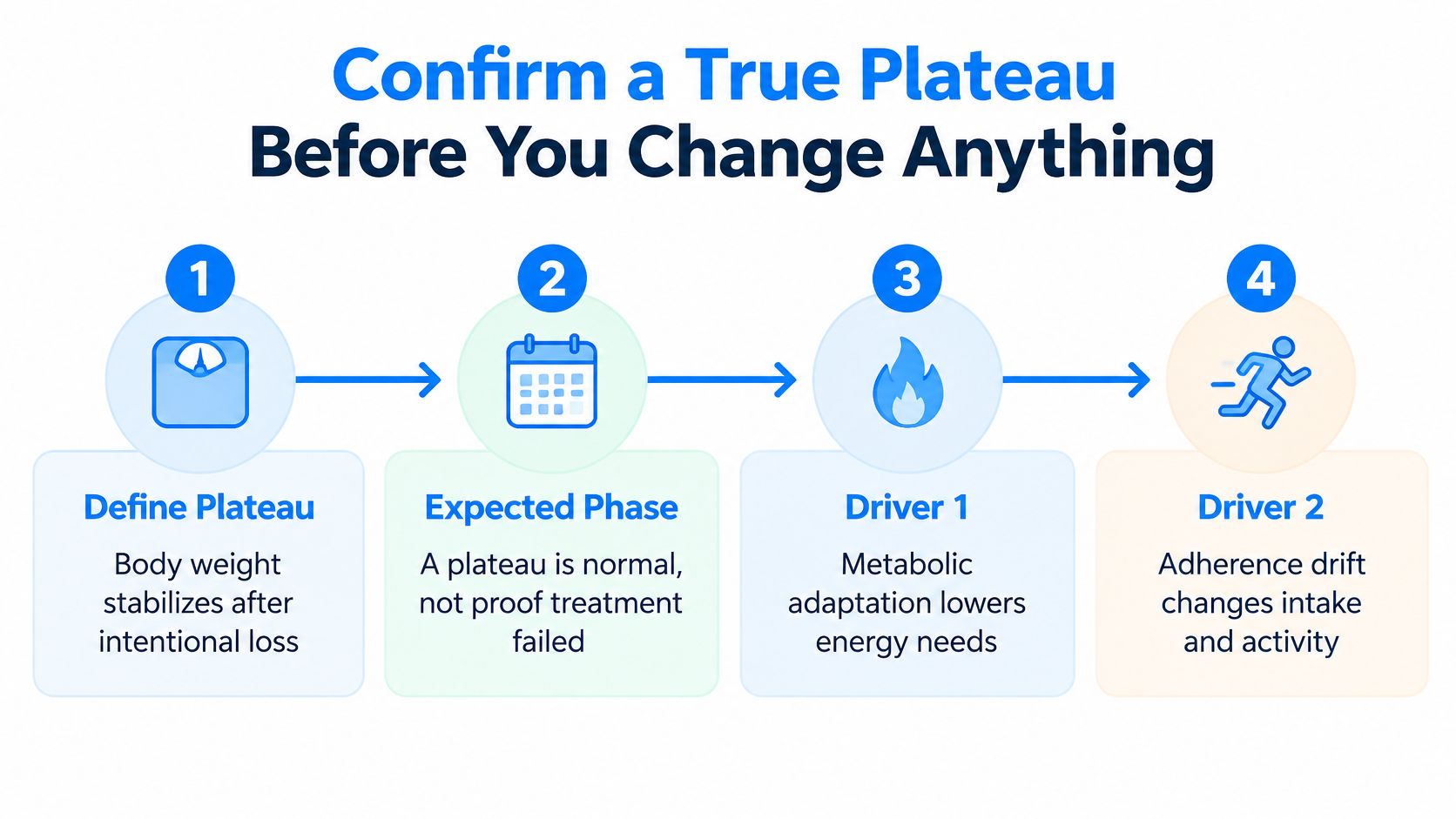
If the verified average is flat, move to a structured adherence audit. If the average is still falling, stay with the current plan and reassess in four weeks. Dose progression, food intake, activity, sleep, other medicines, and waist or body-composition change all belong in that review before a clinician considers a protocol adjustment.
What Benchmark Loss Looks Like on Treatment
A scale can pause while a treatment is still following its expected course. Weight loss with medication unfolds over months, so compare a sustained trend with the dose and time on treatment. Trial results provide context, not a promised result for any individual.
In adults with obesity or overweight plus at least one weight-related condition, the 2022 SURMOUNT-1 publication reported outcomes after 72 weeks of once-weekly tirzepatide. Mean reductions were 16.0% at 5 mg, 21.4% at 10 mg, and 22.5% at 15 mg, compared with 2.4% on placebo. In average absolute terms, the reductions were about 35 pounds, 49 pounds, and 52 pounds, compared with about 5 pounds on placebo. At least 5% weight loss occurred in 89% of participants taking 5 mg and 96% taking either 10 mg or 15 mg, compared with 28% on placebo.
| Arm | Mean loss at 72 weeks | Approx. absolute loss | At least 5% loss | ACC treatment-regimen estimate |
|---|---|---|---|---|
| Placebo | 2.4% | About 5 lb | 28% | Not reported |
| Tirzepatide 5 mg | 16.0% | About 35 lb | 89% | 15.0% |
| Tirzepatide 10 mg | 21.4% | About 49 lb | 96% | 19.5% |
| Tirzepatide 15 mg | 22.5% | About 52 lb | 96% | 20.9% |
Why two sets of percentages can both be right
The American College of Cardiology's summary of the trial lists treatment-regimen estimates of 15.0%, 19.5%, and 20.9% for the 5 mg, 10 mg, and 15 mg doses. These estimates use different statistical estimands and analysis populations, so they describe the same trial differently. Dose response also develops gradually. Dose escalation does not restart weight loss overnight.
The timing of change matters alongside the final percentage. In an adolescent trial of weekly semaglutide 2.4 mg, the mean placebo-subtracted difference was 17.4 percentage points, with weight loss reaching a low point at about 60 weeks, according to the New England Journal of Medicine report. The report also describes a similar time frame in adult STEP 1, where the placebo-subtracted difference was 12.4 percentage points. A pause around six to nine months, for example, may occur before the full treatment timeline has played out. The guide to how long visible change can take offers further context. Visible change is assessed over months rather than days, and a response is not guaranteed.
Use the trial results as reference points, then compare them with the person's verified trend, dose, and time at that dose. A result well below these benchmarks after a full dose interval is a reason to review the plan with a provider, not to increase the dose independently.
How to Audit Adherence and Adjust One Variable
Start with a record, not a stack of new rules. Run a 14-day adherence audit with weighed portions, medication timing and any missed doses, weekend intake, liquid calories, sleep hours, and daily steps. A plateau often sits on a gap the log makes obvious, such as two looser weekends or a dose taken late every other week.

Energy expenditure falls as body mass falls, so an unchanged meal plan can slowly meet the new, lower need. Intake and expenditure meet in the middle even when the original menu never changed. That is adaptation, not automatic noncompliance. Clinical guidance commonly uses a 500 to 750 kcal per day deficit, a range that has historically produced about 0.5 to 1 kg (1 to 2 lb) of weekly loss. A pace near 0.7% of body weight per week may help limit muscle loss and excessive metabolic adaptation, as summarized in this NCBI Bookshelf overview of obesity management.
One lever, then a pause
- Recalculate energy needs at the current weight before you cut anything further.
- Set the daily deficit at 500 to 750 kcal, and skip crash-level restriction.
- Check the weekly pace against about 0.7% of body weight, and slow down if energy or strength is falling.
- Add progressive resistance training at least twice a week, and build moderate activity toward at least 200 minutes weekly.
- Keep protein adequate across the day so the deficit is less likely to come from lean tissue.
- Change one variable, hold it for two to four weeks, and reassess. Several changes at once hide which one helped, and they can worsen fatigue, lean-mass loss, or dropout.
| Lever | Reference value | Check after 14 days |
|---|---|---|
| Daily energy deficit | 500 to 750 kcal per day | Weekly loss near 0.5 to 1 kg (1 to 2 lb) |
| Weekly loss pace | About 0.7% of body weight per week | Energy level and lean-mass signs stable |
| Protein intake | Adequate at each meal | Target met on most audit days |
| Resistance training | Two or more sessions per week | Progressive load logged each week |
| Moderate activity | At least 200 minutes per week | Weekly minutes logged |
| Sleep | 7 or more hours per night | Hours logged on most nights |
Say the audit shows the deficit and the training are already in range, but liquid calories on Saturday erase most of the week. Fix that one item and leave the dose alone until the next review. Any medication dose change is a clinical decision for the prescriber, and it should follow this audit rather than replace it.
Medication Options and How Each Changes the Plan
The drugs are not interchangeable switches. Semaglutide is a GLP-1 receptor agonist. It lowers intake by reducing appetite through central satiety signaling and by slowing gastric emptying. Tirzepatide activates both the GIP receptor and the GLP-1 receptor, so it is a dual incretin therapy rather than a higher dose of the same single pathway.
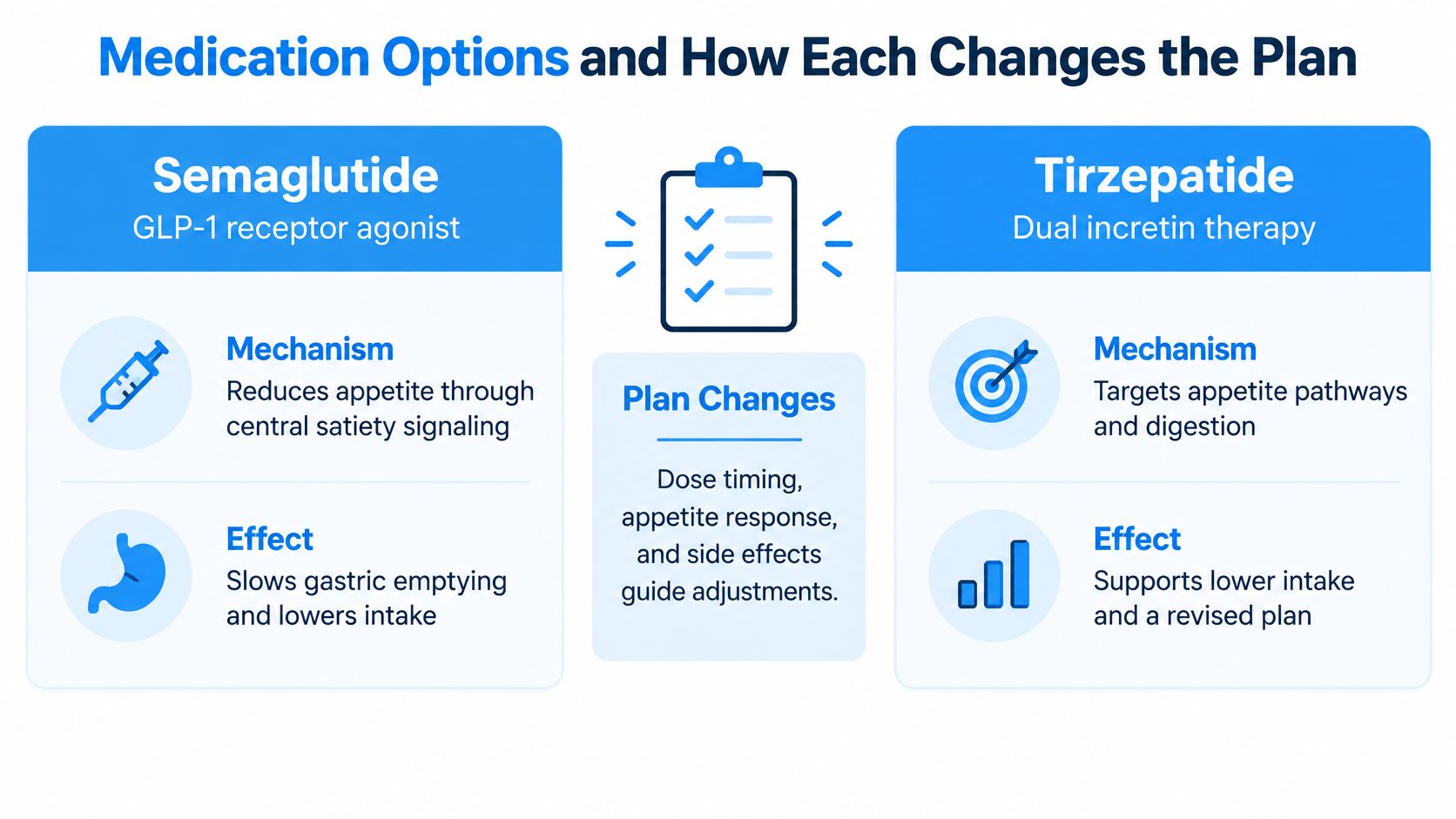
Labeling matters when a stall shows up early. FDA labeling for semaglutide describes escalation over about 12 to 16 weeks before a 1.7 mg or 2.4 mg weekly maintenance dose. Time spent still climbing that ladder is not treatment failure. In the 68-week study, both maintenance doses produced statistically significant weight reduction compared with placebo, and more participants reached at least 5%, 10%, and 15% loss. The label also frames the medicine as an adjunct to reduced-calorie eating and more physical activity.
Tirzepatide's reviewed evidence is dose-related and tied to diet and exercise. In the FDA review of tirzepatide for adults with obesity or overweight without type 2 diabetes, 5 mg, 10 mg, or 15 mg produced an estimated placebo-adjusted reduction of about 12% to 18%. About 85% of participants on 5 mg reached at least 5% loss and about 69% reached at least 10%. At 15 mg, about 91% reached at least 5% and about 84% reached at least 10%.
| Option | Receptor target | Reference result from trials | Titration note |
|---|---|---|---|
| Semaglutide (weekly) | GLP-1 receptor | Significant placebo-subtracted loss at 1.7 mg and 2.4 mg in the 68-week study | Escalates over about 12 to 16 weeks to 1.7 mg or 2.4 mg maintenance |
| Tirzepatide | GIP and GLP-1 receptors | About 12% to 18% placebo-adjusted loss across 5 mg to 15 mg | Dose set by a licensed prescriber after intake |
| Sublingual orally disintegrating tablet | Agent-specific | No trial percentage listed | Availability and titration set by a licensed prescriber |
A 72-week head-to-head comparison found greater average loss with tirzepatide than with semaglutide, 20.2% versus 13.7%, in the published head-to-head trial. Group averages do not establish that a switch is right for a given person. Tolerability, comorbidities, time already spent at the current dose, and the adherence log come first. Readers comparing weight loss injection options still need that individual review. Compounded formulations are handled the same way. Prescription treatment is determined by a licensed U.S. healthcare provider after individualized telehealth intake and consultation, not by a self-directed increase.
Safety Signals and Errors That Need Provider Review
Four patterns call for a prescriber conversation before any self-directed change. None of them is solved by a stronger push in the same week.
Patterns that should pause the plan
Stopping, reducing, or re-spacing doses without a prescriber can bring appetite back and undo a stable weight. Review the current dose and the calendar with the clinician before you skip, stretch, or cut a dose. Improvised spacing is not a maintenance strategy.
Red-flag symptoms need a person, not a new meal plan. Report persistent vomiting, severe abdominal pain, dehydration, dizziness, or loss that runs well beyond the weekly pace set in the audit. Severe abdominal pain or signs of an allergic reaction warrant urgent care, not a wait until the next routine visit.
An incomplete history can make an otherwise reasonable protocol unsafe. Disclose a prior reaction, pancreatitis or gallbladder disease, pregnancy plans, thyroid cancer history, diabetes medicines, and supplements at intake. Withholding a medication, condition, or prior reaction can make a protocol unsafe and is grounds for declining or terminating care.
Changing dose, meal timing, and training volume in the same week makes it impossible to see which change mattered. Keep the one-variable rule. If the audit shows a clear error, such as missed doses or unlogged liquid calories, correct that error and restart the 14-day window before anything else moves.
If an error explains the stall, fix the error first. A new dose on top of a broken log only hides the cause.
Side effects, contraindications, and other conditions belong in that same conversation. A licensed U.S. clinician weighs them against the treatment goal. A single scale reading does not.
Maintenance Planning After the Plateau
The question becomes which weight the current treatment is holding, and what the safest next aim is. A stable average may reflect a new weight maintained during therapy, rather than a signal that treatment has stopped working. The next step could be continued loss, steady maintenance, a lower maintenance dose, or a monitored transition, depending on the person's response and clinical circumstances.
Withdrawal trials help show why these options are not interchangeable. In a semaglutide withdrawal trial, participants who continued treatment after a 20-week run-in lost an additional 7.9% over 48 weeks, while those switched to placebo regained 6.9%. In a tirzepatide withdrawal trial, continued treatment produced another 5.5% reduction over 52 weeks, while participants switched to placebo regained 14.0%, as summarized in this review of treatment withdrawal. These findings show what happened in the trials; they do not predict exactly what will happen to an individual.
| Withdrawal trial | Continued treatment | Switched to placebo |
|---|---|---|
| Semaglutide, after 20-week run-in | Additional 7.9% loss over 48 weeks | Regained 6.9% |
| Tirzepatide | Additional 5.5% loss over 52 weeks | Regained 14.0% |
Four questions, in order
- Does the stall still meet the verified definition, based on morning averages rather than a few noisy days?
- Has the current dose been held long enough, through titration and several further weeks?
- Are waist, blood pressure, glucose, and lipid trends stable, or is another measure changing while weight holds?
- Which path best fits the person's situation, continued maintenance, a lower maintenance dose, or a planned transition, considering appetite, tolerability, and other conditions?
Research on withdrawal does not establish that spacing doses on an improvised schedule preserves weight loss or prevents regain. Dose or schedule changes therefore call for a prescriber's individualized risk-benefit review, including discussion of possible appetite changes. Maintenance remains an active treatment decision: continue the habits that support the chosen plan, including resistance training, adequate protein, consistent sleep, and regular weigh-ins. Those records help show whether the current aim remains appropriate over time.
Bring Your Plateau Data to a Licensed Provider
A useful plateau review starts with a clear record, not a general impression that “nothing is working.” Bring your morning weight log and 7-day averages, biweekly waist measurements, adherence audit, current dose and administration dates, missed doses, sleep and activity totals, medication and supplement list, and notes on side effects. Together, these details help distinguish a sustained stall from ordinary fluctuations or changes in routine.
What the visit is for
Ask the provider to document the plateau definition used, what the adherence review found, and when the next review should happen. The record should also capture the treatment question being considered, such as whether to continue the current plan, adjust the dose, or discuss a planned transition. That gives the next decision a specific starting point rather than relying on memory.
Vials + Vitals' GLP-1 weight care area compares semaglutide, tirzepatide, and a needle-free tablet option, which may help frame a discussion when injections are a barrier. Tirzepatide costs from $299 per month for a 1-month supply. No prescription or outcome is promised, and a program page cannot replace an individual clinical assessment. Arranging a review with a telehealth weight loss doctor connects the plateau record to a clinical discussion.
Compounded medications require a provider's assessment of individual suitability and are dispensed by state-licensed partner compounding pharmacies. Information on the website is educational and does not guarantee a specific clinical outcome.
Vials + Vitals offers physician-directed telehealth for GLP-1 and dual incretin weight care. If the scale has stalled, bring the record to the assessment and discuss the next step before changing a dose on your own. Visit Vials + Vitals to start the assessment.