Semaglutide Dose Calculator: How to Read Results Safely
Learn how a semaglutide dose calculator works, which inputs it needs, how to check mg-to-mL conversions, and when to confirm doses with your prescriber.

Type a dose into a calculator, read the units, draw them up. That's the advice that circulates on nearly every forum thread about semaglutide dosing, and it's the step where most measuring errors begin.
A semaglutide dose calculator is useful for exactly what its name describes: arithmetic. It converts a prescribed milligram dose into a measurable volume using the concentration printed on one specific vial. It can't tell anyone whether that milligram dose is the right next step this week, whether a two-week gap changes the answer, or whether the number typed into the concentration field matches the label on the vial in hand.
Read the results with that division in mind. Part of what comes back is checked math. The rest is a decision that belongs to a licensed prescriber who has seen the full history, the symptoms, and the product.
Semaglutide Schedule and How It Differs From Tirzepatide
The FDA-approved Wegovy (semaglutide) labeling sets a fixed calendar, and a well-built calculator follows it rather than inventing an interpolation between steps. For adults, treatment begins at 0.25 mg once weekly during weeks 1 through 4. It then moves to 0.5 mg during weeks 5 through 8, 1 mg during weeks 9 through 12, and 1.7 mg during weeks 13 through 16, as set out in the FDA prescribing information for Wegovy. From week 17 onward, the recommended maintenance dose is 2.4 mg once weekly, though 1.7 mg may be used depending on treatment response and tolerability.
| Treatment week | Weekly dose | Calculator note |
|---|---|---|
| Weeks 1 to 4 | 0.25 mg | Starting dose, so confirm the prescribed product before entering any concentration |
| Weeks 5 to 8 | 0.5 mg | First labeled escalation step |
| Weeks 9 to 12 | 1 mg | Second labeled escalation step |
| Weeks 13 to 16 | 1.7 mg | Third labeled escalation step |
| Week 17 onward | 2.4 mg | Maintenance dose, though 1.7 mg may be used depending on response and tolerability |
Two details in that labeling matter more than the numbers themselves. The first is that escalation is permitted but never obligatory. The label allows a step to be delayed by four weeks when a patient doesn't tolerate a dose, which is why a responsible calculator shows a clinician-directed hold instead of nudging the next step forward. The second is scale. The schedule spans 0.25 mg to 2.4 mg, a 9.6-fold increase across at least 16 weeks. At that spread, a concentration or unit error doesn't produce a near miss.
Why the Week Number Drives the Output
The Wegovy prescribing information on titration pacing states the reasoning plainly. Dose increases follow a structured schedule, generally at four-week intervals, rather than being calculated from current body weight or raised in response to a short run of appetite changes. The gradual pace is intended to improve tolerability while the body adapts to gastrointestinal and metabolic effects.
That design choice explains why the calculator asks for a treatment week rather than a weight, a BMI, or a target dose. A patient at week 10 taking 1 mg is in a different position from a patient at week 10 who has been held at 0.5 mg since week 6, even when both weigh the same. The week number places the patient on the labeled path. The dose history shows whether they're still walking it.
A step is scheduled, not earned. Four weeks is the fastest labeled pace, not a deadline. Noticeable nausea at week 8 is a reason to hold, and holding is already authorized in the labeling.
Semaglutide's elimination half-life of approximately one week adds another layer. The medication may remain in circulation for roughly five to seven weeks after the last 2.4 mg dose. A calculator shouldn't suggest that one missed injection clears the system, and it shouldn't offer an unsupervised catch-up dose to compensate for one.
Where Tirzepatide Diverges
Tirzepatide runs on a separate framework, and the two don't substitute for each other. The Zepbound prescribing information recommends an initial 2.5 mg once weekly for four weeks, followed by increases in 2.5 mg increments only after at least four weeks at the current dose. That 2.5 mg starting dose is for initiation and isn't a maintenance dose; maintenance options depend on the indication and on how the patient responds. Its elimination half-life is approximately five to six days, shorter than semaglutide's but still long enough that exposure persists well past injection day.
No calculator should translate a semaglutide schedule into an equivalent tirzepatide schedule, and none should suggest running both without explicit medical direction. Switching from Wegovy to Mounjaro carries its own timing and tolerability rules, and those belong to a prescriber.
Three actions close the loop before the next injection. Find the current treatment week. Compare the dose in hand with the prescription label. Route any mismatch to the prescriber before the needle comes out. The figures above describe the FDA-approved injectable regimen and shouldn't be treated as interchangeable with unapproved formulations, alternative routes, or individualized prescriptions.
How to Run the Calculator Step by Step
A safe calculator behaves like a checklist. It collects inputs in a fixed order and withholds a volume until each one has been matched against something physical: the vial, the prescription, the syringe in the box.
The infographic compresses the workflow into four checkpoints, from product confirmation through reading the result. The numbered steps below unpack the inputs behind them.
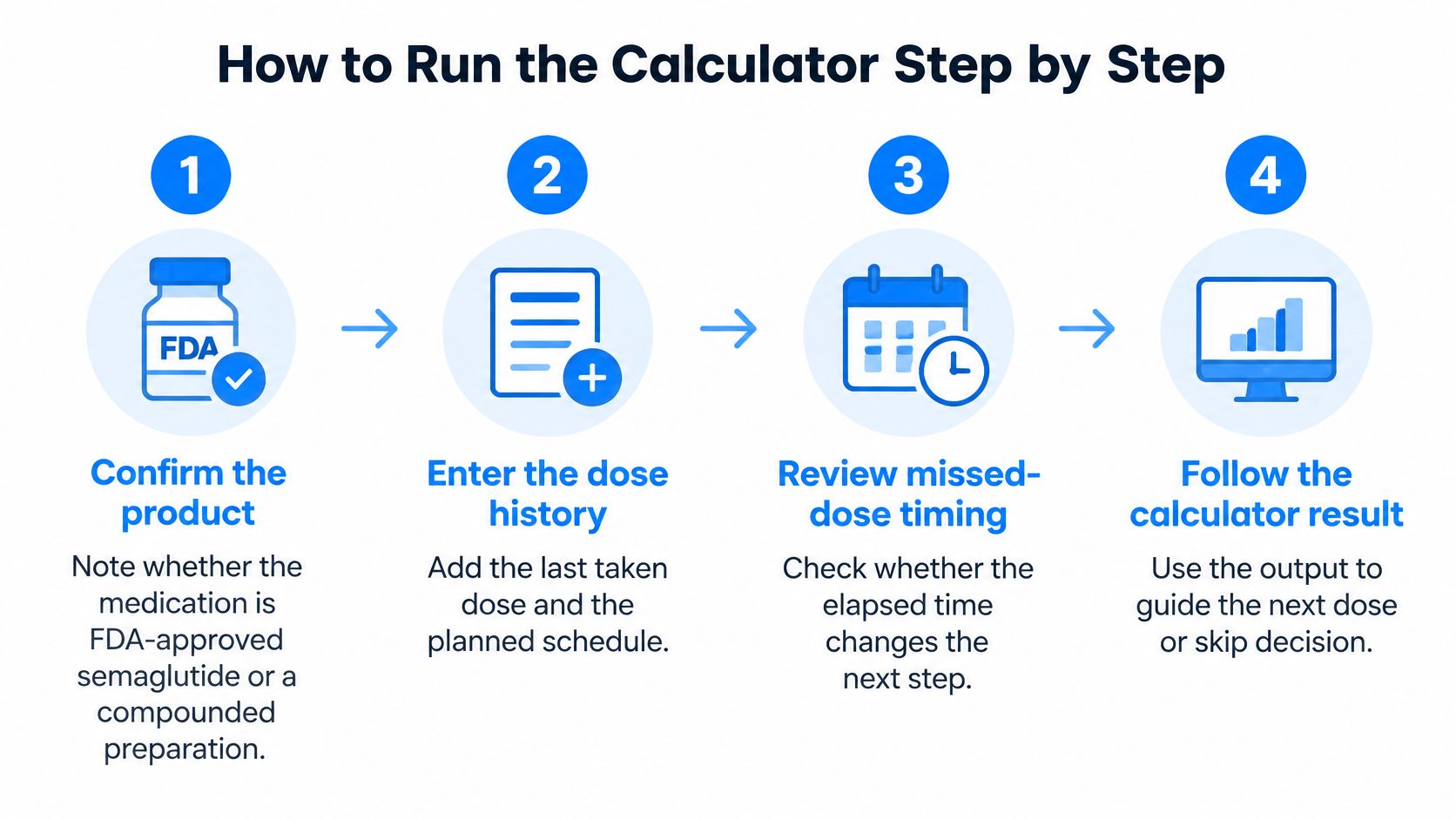
The Seven Inputs, in Order
- Confirm the product. An FDA-approved prefilled pen and a compounded vial are read differently, and compounded drugs are not FDA-approved or evaluated by the FDA for safety, effectiveness or quality. The concentration on a compounded product can also change between shipments while the carton looks identical.
- Enter the current treatment week. Not the date of the first injection, and not the number of weeks since the last dose change. The week places the patient on the labeled schedule; a start date can't reveal whether a step was deliberately held.
- Type the prescribed dose in milligrams, exactly as written on the prescription. Not rounded up, not copied from another person's plan, not carried over from last month. This is the one value the calculator has no way to verify on its own.
- Enter the concentration in mg/mL as printed on the vial label, read off the vial in hand rather than from memory. A vial that holds several milligrams in total isn't the same thing as a concentration of those milligrams per milliliter.
- Select the syringe size and confirm its markings. U-100 means 100 units per milliliter, so 0.5 mL is 50 units and a full barrel is 100 units. A syringe marked only in milliliters needs the mL figure used instead.
- Read both outputs and compare them with the labeled maximum volume. Milliliters and the matching syringe units belong on the same screen. If either exceeds the maximum intended volume on the label, that's a stop signal, not a rounding problem.
- Check the next-step date. It should land seven days out and preserve the once-weekly interval. A dose change isn't due because the calendar advanced; it's due when the prescriber authorizes it.
Order matters here. When a concentration is entered after a volume has already appeared on screen, it tends to be treated as confirmation rather than as a new input, which is why a well-built tool hides the result until every field is filled.
Where the Sequence Breaks
The three failures behind most bad results. Entering total milligrams in the vial instead of the per-milliliter concentration. Using a syringe whose markings don't match the units on the prescription. Assuming a dose change is overdue because a month has passed.
Two of those share a root cause. The calculator compares what's typed with what's prescribed, and neither field reveals what is physically in the vial. When a new shipment arrives at a different strength, every input can look correct and the answer can still be wrong.
A passing check has a specific signature. The milligram dose matches the prescription, the milliliter value matches the concentration, the syringe units match the volume, and no conflicting input has been flagged.
Converting Milligrams to Milliliters and Syringe Units
Every conversion rests on one relationship. Volume in milliliters equals the prescribed dose in milligrams divided by the concentration in milligrams per milliliter. On a U-100 syringe, where 100 units equal 1 mL, units equal the volume in milliliters multiplied by 100.
Run it on an illustrative vial labeled 1 mg/mL. A 0.25 mg dose becomes 0.25 mL, which is 25 units on the barrel. A 2.4 mg dose from that same vial works out to 2.4 mL, a volume larger than a 1 mL syringe holds, so the tool has to flag it rather than let it be split across two draws.
| Volume (mL) | U-100 syringe units | Illustrative dose at 1 mg/mL |
|---|---|---|
| 0.10 | 10 | 0.1 mg |
| 0.25 | 25 | 0.25 mg |
| 0.50 | 50 | 0.5 mg |
| 1.00 | 100 | 1 mg |
Nothing about the number 0.25 mg changes when a vial is filled at a different strength. Only the volume drawn changes, and the volume is the part a patient physically performs. That asymmetry is why a calculator that accepts a dose and returns a syringe mark, without ever asking for the concentration, is describing a measurement it cannot know.
The FDA safety communication on dosing errors with compounded semaglutide, published July 26, 2024, records what happens when that gap goes unclosed. The agency described adverse events, some requiring hospitalization, tied to patients measuring or administering incorrect doses and to clinicians miscalculating them. In reported measurement incidents, patients administered 5 to 20 times more semaglutide than intended. In separate conversion errors, providers mistranslated milligram amounts into syringe units or milliliters, and patients received 5 to 10 times the intended dose. The FDA noted that compounded products may have different concentrations and recommended an appropriate syringe size with explicit measurement counseling.
The rules that follow are narrow.
- Concentration before conversion. No volume should appear until the mg/mL field is filled and matched to the vial.
- Three units on one screen. Milligrams, milliliters and syringe units shown together, so a mismatch is visible rather than buried.
- A hard stop at the maximum volume. Exceeding the labeled maximum ends the calculation.
Checking the printed scale against the calculated units takes ten seconds and catches the error the arithmetic can't.
One boundary worth stating. FDA-approved prefilled pens deliver fixed labeled doses without any volume conversion, so this math applies to vials and other multi-dose or compounded formats. Confirm the product type in the first step, and never apply vial math to a pen.
Missed Doses, Delays and Escalation Questions
Most dose calculators treat the next injection as a date problem. Count seven days from the last one, read off the next step, done. That model holds for an uninterrupted schedule. After a gap it stops answering the question that matters, which is whether escalation should be delayed, restarted, or held where it was.
The simple case is covered in the Ozempic prescribing information. A missed dose may be taken within five days; after more than five days, it should be skipped and the next dose taken on schedule. That rule doesn't decide what happens after several missed doses, a prolonged interruption, intolerance, or a switch in product and indication. A tool that folds all four into a single seven-day count is guessing with a straight face.
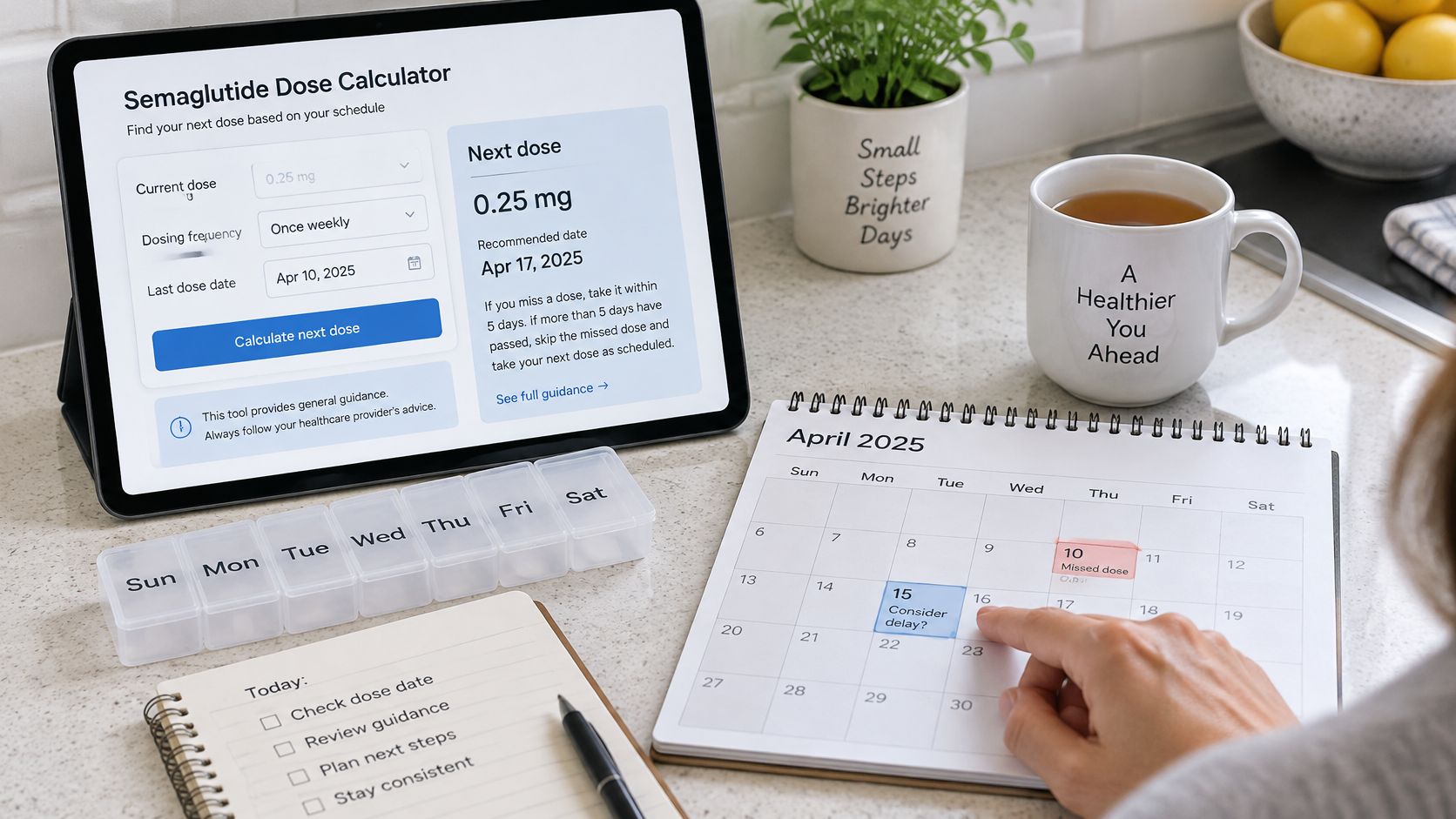
Elapsed time is only one of the variables that changes the answer, and the FDA has documented the direction the pressure runs. The agency has received adverse-event reports involving compounded semaglutide prescribed above labeled doses, administered more frequently than prescribed, or escalated more rapidly than the approved schedule. The drift is consistently toward more drug, not less.
A calculator that takes missed-dose questions seriously collects the following before it returns anything.
- The date of the last dose, not the date of the next one.
- How many doses were missed, since one gap and three gaps are different clinical situations.
- Current symptoms, particularly nausea, vomiting, or abdominal pain that hasn't resolved.
- The last dose that was tolerated, which is usually the safest place to resume from.
- The indication and the product, because labeling differs between them.
- The concentration on the current vial, which may not be the concentration from before the break.
- Whether another GLP-1 therapy is in the background, including one recently stopped.
The correct output for most gaps isn't a number. It's a prompt to contact the prescriber, with no automatic catch-up dose and no accelerated escalation. Someone who skipped two weeks because of nausea has a tolerability question dressed up as a scheduling question, and taking a larger dose to make up for lost time moves in exactly the wrong direction. The tool should flag the gap and stop.
The review that follows is the same one a telehealth weight loss doctor performs at any scheduled check-in: last dose, symptoms, tolerability, and the product in hand. Safe dosing depends on labeling, treatment interruption, tolerability, and clinical judgment, not on elapsed time alone.
Limits, Warning Signs and Prescriber Confirmation
Before the next injection, confirm four things with the prescriber or the dispensing pharmacist: the dose, the concentration, the syringe, and the date of the next step. If any of the four doesn't match the prescription label, don't inject and don't adjust the amount.
A calculator performs arithmetic on whatever it's handed. Enter the wrong concentration and it returns a wrong volume with the same confidence as a right one. That's the central limitation, and it's why the alerts and statements on unapproved GLP-1 drugs used for weight loss exist in the first place. Compounded formulations are not FDA-approved and are not evaluated by the FDA for safety, effectiveness or quality.
What the Tool Cannot See
Tolerability doesn't fit in a text field. Neither do pregnancy plans, diabetes therapies, gastrointestinal symptoms, a history of pancreatitis, or any other factor that shifts a protocol. A patient who is losing steadily at 1 mg with mild side effects and a patient who is losing at the same rate with daily reflux need different decisions from the same set of numbers, and the calculator sees identical inputs.
The tool also can't distinguish a deliberate hold from a forgotten week. Both look like a mismatch between the calendar and the schedule, which is why the prescriber, not the software, resolves them.
When the Result Should Stop the Injection
Five conditions trigger a do-not-inject checkpoint, and each one routes to the prescriber or the dispensing pharmacist rather than to a second calculation.
- Mismatched units, where the prescription is written in milligrams and the syringe is marked in something else.
- A volume above the labeled maximum, which usually means the concentration was entered incorrectly.
- A dose that doesn't match the prescription, even by a small margin.
- A missed-dose situation the tool can't classify, including multiple gaps or a recent product switch.
- Any concerning symptom, particularly the serious warning signs of semaglutide such as persistent vomiting or severe abdominal pain.
The checkpoint isn't a warning label. It's the point where the arithmetic ends and a licensed clinician takes over.
What a Prescriber Review Covers
Vials + Vitals is a physician-directed telehealth service in which licensed U.S. providers review every intake and set the formulation and titration schedule, with fulfillment by state-licensed partner pharmacies. Submitting an intake requests a clinical evaluation and doesn't purchase a specific medication, and completing an assessment doesn't guarantee a prescription. The intake may request state of residence, date of birth, sex assigned at birth, measurements, medical and medication history, and treatment-specific screening answers. When a clinician does prescribe, a dispensing pharmacy supplies the medication with directions, and prescribed treatments arrive with instructions for use and clear next steps. Vials + Vitals offers a GLP-1 titration calculator inside those physician-directed protocols, and the prescribing decision still belongs to the provider.
Six items make a complete pre-injection check. Current week, product type, concentration on the vial, calculated volume, matching syringe units, and the date of the next step. Call the prescriber on any mismatch, and don't change the amount or the timing alone.
Informational purposes only. Compounded medications are evaluated by a licensed provider for individual suitability and are fulfilled by state-licensed partner compounding pharmacies.
Reading a calculator's output safely comes down to knowing which part is arithmetic and which part is a clinical decision, and Vials + Vitals structures its GLP-1 weight care around that split so a licensed U.S. provider sets the dose, the concentration, and the pace of titration for each patient rather than leaving it to a chart. Care begins with a confidential online assessment, and no prescription is issued until a provider has reviewed the full history. Visit Vials + Vitals to start the assessment.