Peptides for Sleep: What the Evidence Shows in 2026
Peptides for sleep are studied in small trials, and orexin medicines have the strongest support. Compare evidence, mechanisms and safety before you decide.

The advice that circulates most widely about peptides for sleep is to start with DSIP, add a growth-hormone secretagogue before bed, and wait for deeper slow-wave sleep. It sounds mechanistic and confident. Ranked by study design instead of by marketing, it falls apart.
The treatments with randomized trials and objective sleep endpoints are prescription orexin-receptor antagonists, not supplements. The best-controlled human trial of a sleep-branded peptide product moved exactly one measured parameter while leaving sleep duration, sleep onset and sleep efficiency unchanged. Everything else marketed for sleep sits somewhere between a pilot study and a laboratory dish.
This analysis grades each compound by sample size, control group, endpoint quality and route of administration. That ordering matters more than any single mechanism claim, because it tells you which products have been tested in people and which have only been tested in cells.
Which Peptides Have Sleep Evidence and How Strong It Is
Only one class of peptide-related sleep treatment has randomized trial evidence behind it, and it isn't sold as a supplement. Dual orexin receptor antagonists are prescription medicines that have been tested against placebo with polysomnography and validated self-report scales. Every other compound marketed for sleep occupies a weaker tier, from preliminary to investigational.
| Compound or class | Proposed sleep role | Strongest human evidence | Evidence level |
|---|---|---|---|
| Orexin receptor antagonists (suvorexant, lemborexant, daridorexant) | Block orexin wake signaling | Randomized trials with objective and self-reported sleep endpoints | Established, prescription only |
| Collagen peptides, 15 g | Possibly fewer nighttime awakenings | One randomized crossover study in 13 men | Preliminary |
| Proprietary peptide matrix | Orexin-cortisol pathway | Eight-week single-blind pilot plus in vitro cell data | Investigational |
| DSIP (emideltide) | Sleep-promoting neuropeptide | Small, decades-old human studies with inconsistent results | Weak, no validated regimen |
| Epitalon | Sleep and longevity claims | Laboratory, animal and small human studies measuring biological markers | Very limited |
The most-cited human trial on a sleep-related peptide is a 2023 randomized crossover study of 13 physically active men averaging 24 ± 4 years old who reported sleep complaints. Participants took 15 g of collagen peptides or placebo one hour before bed for seven nights in each condition, with overnight polysomnography recording the outcomes in the published crossover trial.
Awakenings fell to 21.3 ± 9.7 with collagen peptides versus 29.3 ± 13.8 with placebo, an absolute difference of 8.0 awakenings at P = 0.028. Total sleep quantity, sleep-onset latency and sleep efficiency did not change significantly.
That split result is the most useful thing in the literature. A peptide product can shift a single nighttime measure, here the number of times sleep breaks, without producing longer or more efficient sleep. Fragmented sleep and short sleep are different problems, and a supplement that touches one hasn't demonstrated it touches the other.
Practical rule: when a sleep peptide claim cites a real study, find out which endpoint moved. Fewer awakenings is not the same outcome as more sleep.
The limits are as important as the result. The sample was small and homogeneous, treatment lasted seven nights per condition, and the design says nothing about older adults, women, people with diagnosed insomnia, or patients taking sedatives or other medications. That makes the finding a preliminary signal, not proof of a clinically meaningful insomnia treatment.
How Peptides Are Thought to Influence Sleep
The orexin system behaves less like a sedative and more like a switch that holds wakefulness in the on position. In 1998, two independent research groups identified the neuropeptides now called orexins, also known as hypocretins, one through hypothalamic peptide discovery and the other through work on orphaned G-protein-coupled receptors, as reviews of orexin biology describe.
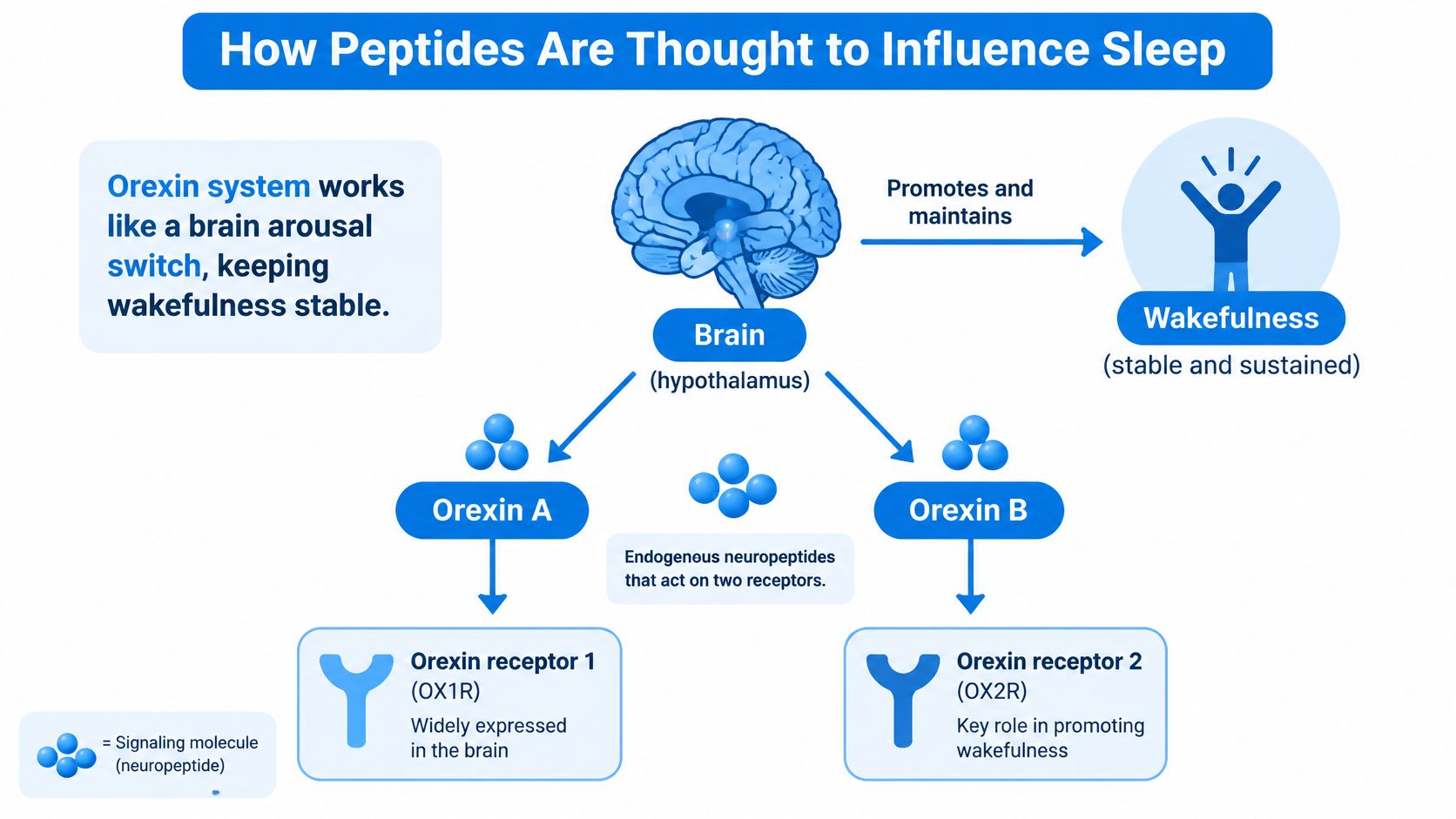
Two peptides, two receptors
Orexin A and orexin B signal through orexin receptor 1 (OX1R) and orexin receptor 2 (OX2R) inside hypothalamic arousal networks. The neurons that produce them are a strikingly small population, only a few thousand cells in the lateral hypothalamus, yet their influence over sleep-wake regulation is broad. Loss of orexin-producing neurons is strongly associated with type 1 narcolepsy, which is the clearest human demonstration that this pathway controls stable wakefulness.
Intervention can run in either direction. Blocking the receptors lowers wake drive and can promote sleep. Activating OX2R has been investigated to counter the excessive daytime sleepiness of narcolepsy.
Why an endogenous peptide is not a supplement claim
An endogenous neuropeptide can be a foundational regulator of arousal without any administered peptide reaching the same receptors in the same way. Route, dose, digestive stability and blood-brain-barrier penetration all sit between a marketed vial and the hypothalamic circuit. The orexin system also shares territory with stress-hormone signaling, which is why cortisol language appears so often in sleep product marketing, but shared anatomy is not an outcome.
Before accepting a claim, establish what the compound is supposed to bind. That question, and the difference between an intact peptide and a mixture, is where what peptide therapy actually involves becomes practical rather than academic.
What Orexin-Targeting Medicines Show in Trials
Dual orexin receptor antagonists, or DORAs, competitively inhibit OX1R and OX2R. They reduce wake drive rather than producing the nonspecific central-nervous-system sedation of GABAergic drugs, which is why their trial programs use sleep latency and wake-after-sleep-onset as endpoints instead of subjective drowsiness. The published outcomes for the approved agents are summarized in trial data on orexin receptor antagonists.
| Drug | Dose studied | Reported trial outcomes | US regulatory status |
|---|---|---|---|
| Suvorexant | 15 to 40 mg | Improved objectively measured latency to persistent sleep, self-reported total sleep time, sleep quality and insomnia severity over about three months | Prescription; controlled substance |
| Daridorexant | 50 mg | Reduced wake after sleep onset and sleep-onset latency; improved total sleep time and daytime function at Months 1 and 3 | Prescription; controlled substance |
| Lemborexant | Not specified in the reviewed trial material | Outcomes not detailed in the reviewed material | Prescription; controlled substance |
Read objective and self-reported endpoints separately
Latency to persistent sleep is measured by polysomnography or a defined objective method. Sleep quality and insomnia severity are reported by the patient. A drug can improve one and not the other, and a program that reports only the favorable half is telling you something about its reporting choices.
Suvorexant at 15 to 40 mg improved objectively measured latency to persistent sleep and, across roughly three months, improved self-reported total sleep time, sleep quality and insomnia severity. Daridorexant at 50 mg reduced both wake after sleep onset and sleep-onset latency, with gains in total sleep time and daytime function at Months 1 and 3. Those are complementary endpoints, not interchangeable ones.
Clinically relevant precautions belong to this class: next-day impairment and controlled-substance status in the United States. Neither makes a DORA interchangeable with a compounded or orally marketed peptide product.
The trial base belongs to the approved molecules. A compounded vial sold under a similar name inherits none of it, and neither does an oral peptide marketed with cortisol language but no polysomnography data. Product development in this space has to state its molecular target, receptor pharmacology, pharmacokinetics and validated sleep endpoints before claiming anything about sleep.
Lemborexant is approved and prescribed, yet the reviewed material doesn't detail its studied dose or trial results. Leaving those cells blank is the honest move. Readers should treat an unconfirmed detail as unconfirmed rather than filling the gap with an assumption.
Judging Sleep Peptide Studies Before You Trust Them
Start with a case that looks stronger than it is. A proprietary peptide matrix was tested in an eight-week, single-blind, placebo-controlled pilot in adults with mild-to-moderate sleep impairment. In parallel, an in vitro experiment found the matrix changed orexin-induced cortisol release by 23% in H295R adrenal cells, as the pilot report on the peptide matrix describes.
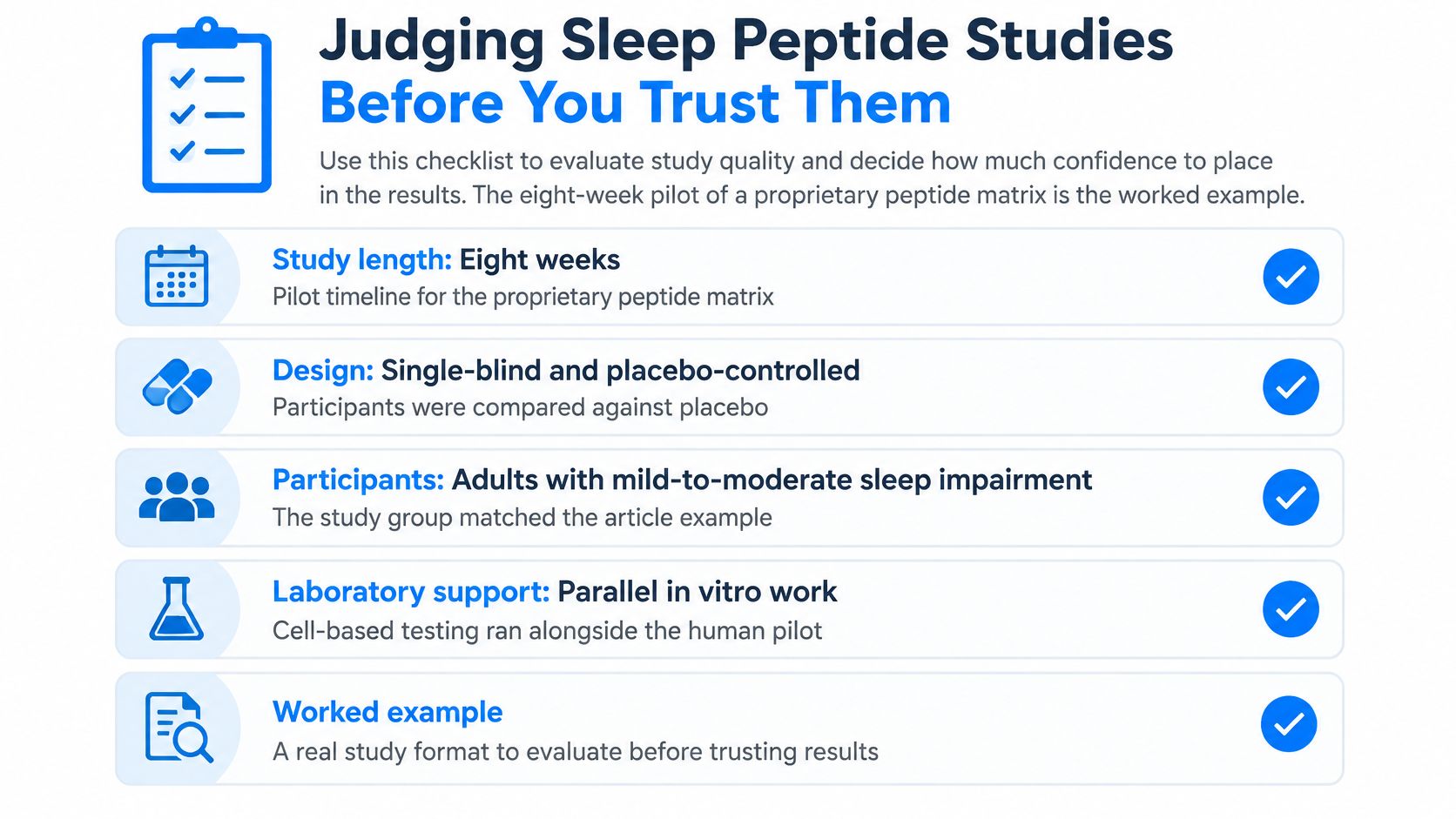
Why the 23% figure doesn't travel
A percentage change in cortisol release from an adrenal cell line is a laboratory observation. It is not a measure of human sleep architecture, and it cannot stand in for sleep-onset latency, wake after sleep onset or total sleep time. The biological rationale, that orexin signaling participates in both sleep-wake regulation and hypothalamic-pituitary-adrenal activity with bidirectional orexin-cortisol relationships, explains why researchers looked. It doesn't tell you what happened in the participants' beds.
A single-blind pilot of eight weeks also can't establish dose-response, durability of effect, a clinically meaningful effect size, or safety across populations. Single-blind means participants knew what they were taking, which matters in a condition as suggestible as sleep.
Product-level questions to ask
Identity questions come next, and they're where most marketing stops.
- Intact peptide, hydrolysate or blend? Each behaves differently in the gut and in the bloodstream, and a blend hides which component was tested.
- Gastrointestinal stability and absorption? A peptide that degrades before absorption can't reach a hypothalamic receptor.
- Blood-brain-barrier penetration? A sleep target sits behind that barrier, so the burden of proof is higher than for a peripheral endpoint.
- Batch potency testing? Without it, the dose on the label is a hope.
| Criterion | Stronger signal | Weak signal |
|---|---|---|
| Sample size and control | Randomized, placebo-controlled, adequately powered | Small pilot, single-blind or uncontrolled |
| Sleep measurement | Polysomnography or validated actigraphy | Self-report only |
| Sleep endpoints | Sleep-onset latency, wake after sleep onset and total sleep time reported | A single vague outcome such as better rest |
| Daytime impairment | Measured and reported | Not assessed |
| Adverse events | Systematically monitored and reported | Not reported |
| Replication | Independent peer-reviewed randomized trials | Only in vitro or single-sponsor data |
| Product identity | Named intact peptide with potency and batch testing | Undisclosed blend or hydrolysate |
Until larger peer-reviewed randomized trials establish those parameters, products in this category are investigational. They are not equivalents of FDA-approved orexin-receptor medicines, and they are not a substitute for evidence-based insomnia care.
Administration Routes, Safety and Interactions
The question isn't whether a peptide can influence sleep. It's whether the evidence applies to the route, dose and product a person is offered. DSIP (emideltide) is the peptide most directly associated with sleep, and its human studies are small and decades old, with inconsistent reported effects. No validated subcutaneous regimen or clinically meaningful long-term benefit has been established, as reporting on the FDA advisory panel review of six peptides reflects in the broader regulatory discussion.
That gap is easy to miss. Many write-ups present mechanistic or animal findings without separating intravenous research from the injectable, oral and compounded products sold today. A result from a small controlled study cannot be transplanted onto a different formulation, route, dose or patient population.
| Route | Where the evidence stands | Key safety or practical consideration |
|---|---|---|
| Oral supplement, collagen or peptide mixture | One small randomized human trial for collagen; mixtures vary widely | Gut stability, absorption and batch potency differ between intact peptides, hydrolysates and blends |
| Subcutaneous injection (DSIP) | No validated subcutaneous regimen established | Dose, frequency and long-term adverse effects are unknown |
| Prescription oral DORA tablet | Randomized trials for suvorexant and daridorexant | Next-day impairment; controlled-substance status |
| Compounded or unapproved injectable | No sleep-specific evidence base identified | Potency, sterility and individualized provider evaluation |
| Intravenous research formulation | Mostly laboratory and early human studies | Results not directly comparable to products sold today |
Interactions and warning signs
Most peptide products have no characterized interaction profile. That makes medication review essential: every current prescription, supplement, sedating substance, alcohol-containing product and other sleep aid should go to the prescriber, because combined sedation and overlapping receptor effects are unknown rather than proven safe.
Escalate promptly for excessive daytime sleepiness, confusion, or breathing pauses during sleep. Those signs point to a diagnosis, such as sleep apnea, that no peptide addresses.
Epitalon illustrates the same problem from another angle. Its sleep and longevity claims rest on laboratory, animal and small human studies that measured biological markers rather than well-designed insomnia outcomes. For a route-by-route view of what approved and unapproved products carry, peptide therapy safety is worth reading before any purchase.
The contrarian conclusion holds: peptides for sleep are not one treatment category. They're a set of compounds with wildly unequal evidence, and the most heavily branded one may have the thinnest support of all.
Confirm a Sleep Peptide Plan With a Licensed Provider
Sleep complaints need a diagnosis before any compound is considered. Sleep apnea, chronic insomnia, medication effects and mood conditions can produce identical symptoms, and treating the wrong one with a peptide delays effective care.
A physician-directed telehealth pathway starts with a confidential online assessment covering sleep history, current medications and contraindications. A U.S.-licensed provider reviews every intake and prescribes only when a treatment is clinically indicated, setting the formulation and titration schedule when one is written. Eligibility and availability vary by state and by treatment, and the consultation itself may be asynchronous or live depending on state rules. If the review finds no clinically appropriate option, the consultation fee is refunded. Fulfillment runs through licensed U.S. pharmacy partners, including EPIQ Scripts, Foothills Pharmacy and Emerald Compounding Pharmacy, with discreet delivery when a treatment is prescribed.
What to bring to the consultation
- A two-week sleep diary. Bedtime, wake time, estimated awakenings and daytime naps give the provider a baseline no questionnaire replaces.
- A complete medication and supplement list. Include sleep aids, alcohol frequency and anything bought online, since unlisted products are the ones that cause problems.
- Prior sleep study results if any exist, including home tests, because existing data can answer questions before new testing.
- Specific questions about the proposed compound. Ask whether the option under discussion is an approved orexin-receptor medicine with trial data on sleep onset and maintenance or a marketed peptide without sleep-specific endpoints, which measurable outcome will be tracked, and when the plan will be reassessed.
Sleep-specific peptide protocols are not a core care area at Vials + Vitals, whose offerings center on GLP-1 weight care, men's sexual wellness, women's hormone health, hair health and peptide and wellness therapy. That is a reason to ask directly whether any listed option fits the diagnosis rather than assuming a sleep product exists. For readers who want the diagnostic starting point first, insomnia treatment online outlines how an evaluation typically proceeds.
Vials + Vitals runs a physician-directed telehealth model in which a U.S.-licensed provider reviews a confidential online intake, decides whether any prescription is appropriate and sets the protocol, with dispensing through accredited U.S. pharmacies. For a sleep complaint, that means a clinical conversation about diagnosis, medication review and measurable endpoints instead of a marketing claim about delta sleep. Start the assessment at Vials + Vitals.