Peptides for Hair Growth: 6 Options Reviewed
A clinical guide to peptides for hair growth: mechanisms, evidence levels, safety, and how providers build them into supervised hair restoration plans.
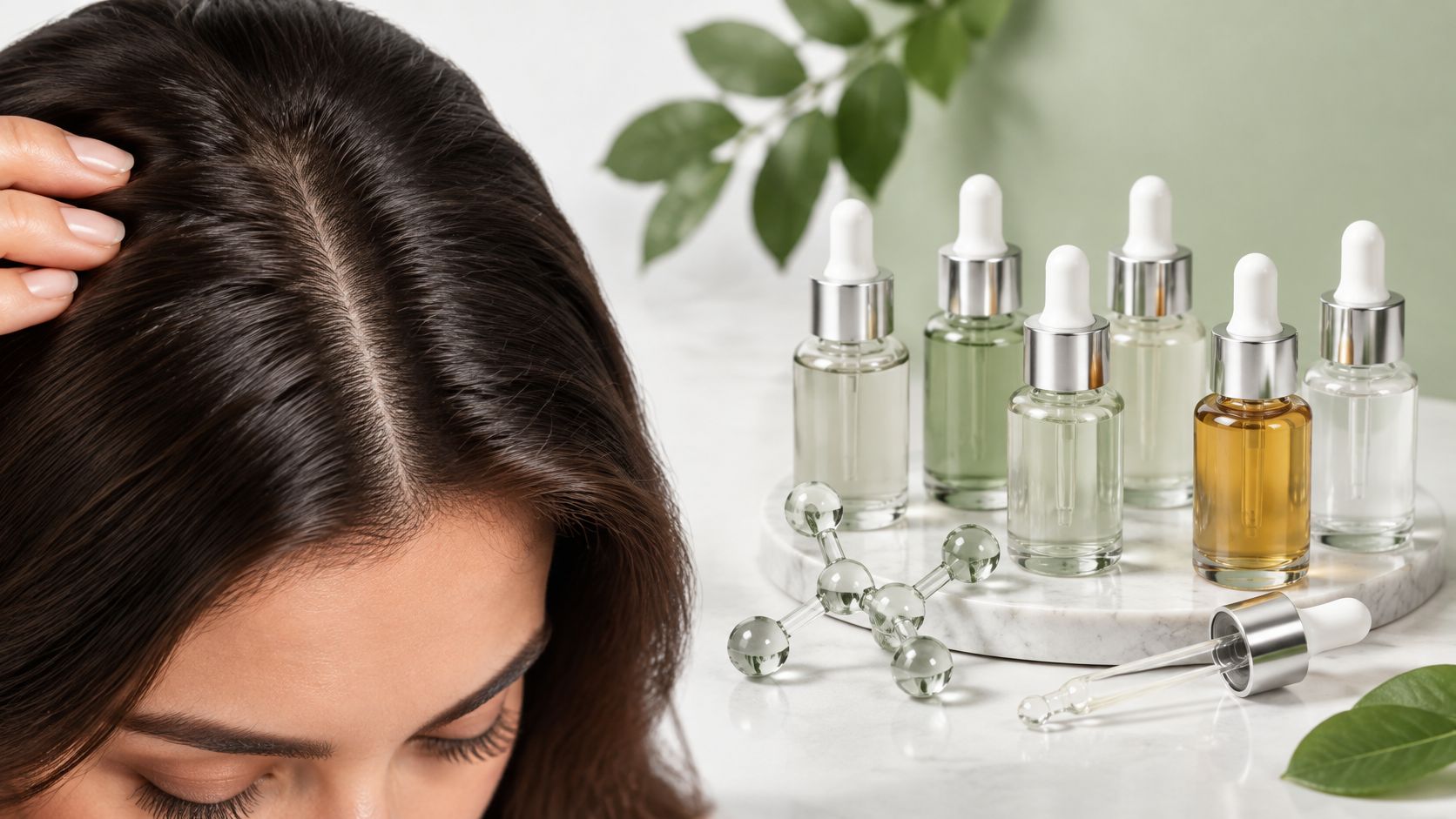
If a bottle labeled peptides for hair growth is treating the follicle, or only smoothing the shaft, most labels never say. Ask any clinician who works in hair restoration and the same line comes back. Peptides are promising, and they are not interchangeable.
This roundup covers six approaches, from copper tripeptide serums to microneedling-assisted delivery. Each is graded by evidence, preclinical or clinical, and set beside therapies that already have a regulatory record. Current clinical reviews identify topical minoxidil and oral finasteride as the FDA-approved pharmacologic treatments for androgenetic alopecia, while peptide and related regenerative approaches generally remain investigational or off-label, as summarized in a 2026 systematic review in PMC.
An early signal shows why that grade matters. A phase-2A study of the investigational peptide PP405 reported statistically significant regrowth after 8 weeks among 78 participants, and a review of that study reported that 31% achieved more than a 20% increase in hair density in that window, according to a 2026 review in Biomedicines. Phase 2A explores activity and preliminary safety. It doesn't validate every serum on a shelf.
What follows is mechanism, safety, and realistic timelines. Prescription treatments and compounded formulations are prescribed strictly at the clinical discretion of licensed US healthcare providers after an individualized telehealth intake and consultation.
1. Copper Tripeptide-1 (GHK-Cu) Topical Serum
Copper tripeptide-1 (GHK-Cu) carries the longest research trail of any peptide on a hair-serum label. It is the copper complex of glycyl-L-histidyl-L-lysine, a tripeptide that circulates in human plasma and declines with age. Scalp products deliver it as a low-concentration cosmetic serum, and it holds no drug approval for hair loss.
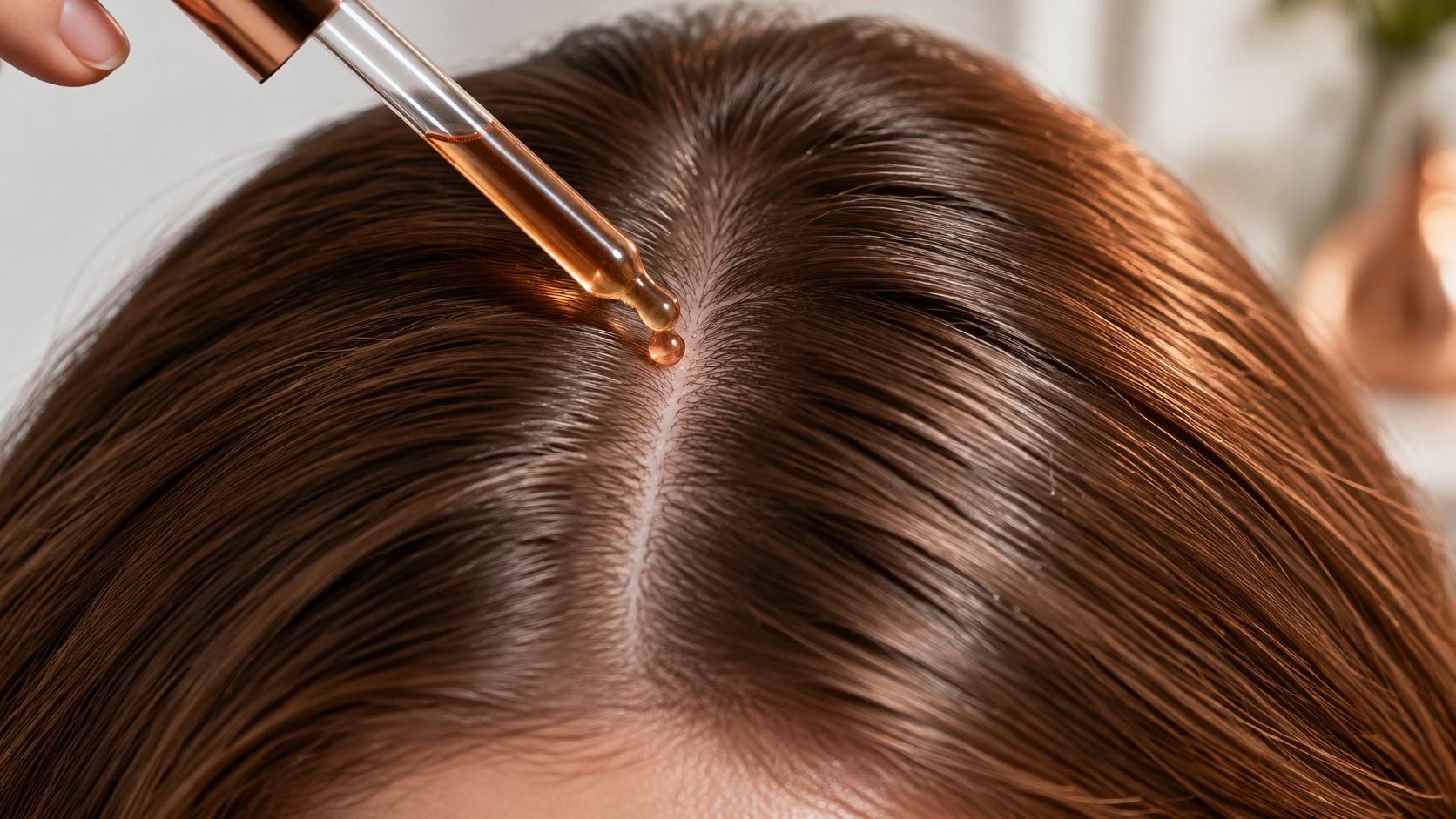
Three actions get proposed for it: signaling tied to vascular endothelial growth factor, extracellular-matrix remodeling through collagen and glycosaminoglycan synthesis, and antioxidant activity around the follicle. The human evidence behind those actions is thin, which is why the controlled work still sits in animal models. A PubMed-indexed study evaluated hair-follicle stimulation by peptide copper complexes in C3H mice and reported that copper-peptide-treated follicles entered the early growth phase in as few as 6 days, compared with about 9 days for minoxidil alone, per the study record on PubMed. That is a laboratory timing signal, and it does not translate into a clinic result you can book. Animal data also leave human dose, absorption, and safety unsettled.
Evidence grade: preclinical, with limited human hair trials. Role: adjunct alongside minoxidil inside a supervised regimen. A typical use is a dermatology-adjacent serum on a clean, dry scalp, sometimes after a supervised microneedling visit, with photographs at 16 to 24 weeks. For the wider category this serum sits in, see what peptide therapy involves.
- Apply on a dry scalp: Follow the provider's timing or the product label, and space actives apart instead of layering them in the same minute.
- Photograph the baseline: Same lighting and part line, so change is measured rather than guessed.
- Flag irritation early: Copper serums stacked with retinoids, acids, or fresh needling can compound redness.
Practical rule: If the label only says "copper peptide," it may not be the studied GHK-copper complex. Ask for the exact sequence before you commit months of use.
2. Acetyl Tetrapeptide-3 (Capixyl-Type Formulations)
Acetyl tetrapeptide-3 is a synthetic signal peptide sold mostly inside combination serums, often with a botanical such as Rhodiola extract. The pitch is follicular anchoring and less shed in androgen-driven thinning. The proposed path is dermal-papilla signaling that may shift the anagen-telogen balance. That is a hypothesis, not a mapped drug mechanism like 5-alpha-reductase inhibition.
A systematic review that screened human trials gave Grade B support to formulations containing acetyl tetrapeptide-3, biotinoyl tripeptide-1, glycyl-histidyl-lysine peptide, and the pentapeptide Gly-Pro-Ile-Gly-Ser, and it treated that support as formulation-specific rather than proof that every "hair peptide" is interchangeable, per the Journal of Drugs in Dermatology review. Many of the underlying studies were small or sponsor-linked. Read them as supportive, not definitive.
What a fair trial of this serum looks like
Say a woman with diffuse thinning already uses minoxidil. Her clinician adds a disclosed-concentration serum in the maintenance phase, not as the only therapy. She keeps the same part line, the same wash schedule, and a trichoscopy visit before anyone calls the peptide a success. Several months of consistent use come before that judgment. Stopping minoxidil to "see if the peptide is enough" confounds the result and can restart miniaturization.
- Demand a concentration: A trademark name without a percent isn't a protocol.
- Match the diagnosis: Pattern loss, telogen effluvium, and scarring alopecias don't share one serum.
- Track shed and caliber: A drop in loose hairs can be real even when density photos barely move.
Sponsor-run ingredient studies can be useful. They aren't a substitute for an independent comparison against minoxidil or finasteride.
3. Biotinoyl Tripeptide-1
The evidence file here is thin, so I place this ingredient at the preclinical end of the scale: a plausible mechanism plus manufacturer-run blend studies, with no stand-alone clinical trial of the peptide itself.
Biotinoyl tripeptide-1 links biotin (vitamin B7) to a short peptide so the conjugate is more lipophilic than biotin alone. The design aim is passage across the stratum corneum and delivery toward the follicular unit. Biotin is a cofactor for carboxylases in fatty-acid synthesis and cellular energy metabolism, and keratin assembly is central to the shaft, so topical use is framed as support for thickness and break resistance.
That rationale does not correct androgenetic miniaturization on its own. One 2024 study of 32 adults using a serum containing Procapil and three other branded ingredients reported a 31.62% increase in hair-growth rate after 60 days, a formulation result catalogued in the Journal of Drugs in Dermatology systematic review of peptides for hair loss. Procapil blends are not pure biotinoyl tripeptide-1, so that figure belongs to the whole serum, not to one peptide.
Where it earns a place
A patient with brittle lengths and a normal scalp exam can reasonably use a leave-in treatment as a shaft-quality adjunct while the clinician checks protein intake, iron, thyroid status, and pattern loss. Documented biotin deficiency calls for supervised repletion, which a cosmetic dropper cannot provide. Oral biotin can interfere with some lab assays, so flag it to the ordering clinician before bloodwork.
- Keep it adjunctive: Don't drop an evidence-based pattern-loss drug for a biotin conjugate.
- Protect the fiber: Loose styles, less heat, and adequate protein do more for breakage than another peptide layer.
- Measure: Count shaft gains and new terminal follicles separately. Added length on existing hairs is a cosmetic endpoint; regrowth is a follicular one.
4. Palmitoyl Peptide Complexes (Matrixyl-Family Ingredients)
Palmitoyl pentapeptide-4, and pairs such as palmitoyl tripeptide-1 with palmitoyl tetrapeptide-7, are lipid-tailed signal peptides. The palmitoyl chain raises lipophilicity, which helps the fragment sit in epidermis and dermis rather than staying on the surface oil. These sequences are built to resemble pieces of matrix proteins and to nudge fibroblasts toward collagen and glycosaminoglycan synthesis.
Hair products borrow that skin logic. A healthier dermal bed might support the follicle's connective-tissue sheath and improve fiber quality. Hair-growth evidence for this family is still preliminary. No large, diagnosis-specific trial establishes palmitoyl peptides as treatment for androgenetic alopecia.
The more common miss is treating shaft cosmetics as if they were follicular therapy. Peptide choice often matters less than naming the cause, whether that is genetic pattern loss, rapid weight loss, iron deficiency, thyroid disease, medication effects, postpartum shift, inflammation, or scarring. Hair-loss reports during GLP-1 treatment are described in emerging reviews, with inconsistent findings and confounding from calorie restriction and rapid weight loss, as discussed in the Journal of Drugs in Dermatology peptide review. A scalp serum won't sort that out.
A worked example: an aesthetic program adds a palmitoyl serum beside minoxidil for scalp comfort and fiber feel, with one product at a time so irritation isn't blamed on the wrong bottle. Baseline photos separate a good hair day from a real change. Stacking three peptide serums at once muddies both the skin barrier and the readout.
Improved scalp feel is a legitimate cosmetic goal. It isn't evidence that miniaturized follicles have reversed.
5. Peptide Serums Combined with Minoxidil (Multimodal Topical Regimens)
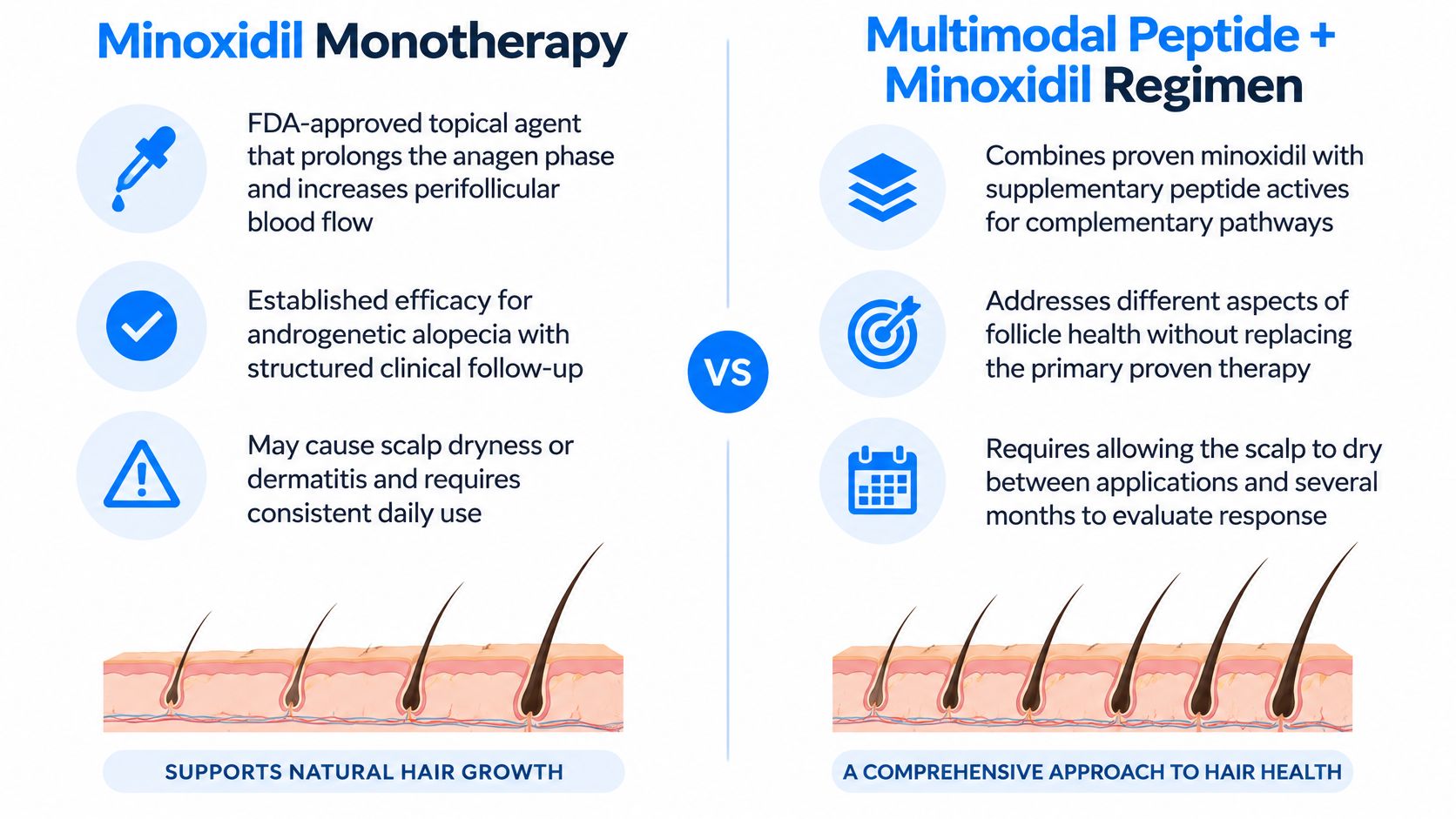
The strongest case for pairing a peptide serum with minoxidil is mechanistic: the two do not share a target. Minoxidil's effect is generally tied to potassium-channel opening, a longer anagen phase, and more blood flow around the follicle. Peptides, when they do anything measurable, sit on matrix signals, anchoring, or local growth-factor pathways. Complementary targets do not establish synergy; the combination data are mostly observational or drawn from small comparisons.
The American Academy of Dermatology notes that minoxidil can stimulate growth and slow further loss, with visible change commonly taking about 6 to 12 months of steady use, and that finasteride slows additional loss in about 80% to 90% of men in trial summaries, with regrowth more likely when treatment starts early, per the AAD diagnosis and treatment overview. Those figures describe trial populations under supervised use. Minoxidil is also not expected to rebuild a full head of hair, which is part of why clinicians layer a second agent rather than inflate expectations on the first.
How a supervised stack runs in practice
A provider-directed plan for diffuse thinning keeps minoxidil as the backbone and adds one peptide serum once the scalp tolerates the first drug. Sequence matters. Let the scalp dry between layers so the next product does not dilute the dose or trap irritants against the skin. Standardized photos every 8 to 12 weeks decide whether the peptide earns its place in the regimen or gets dropped. Stopping an effective minoxidil or finasteride course is typically followed by renewed loss, so a peptide serum cannot cover a drug holiday.
Side-effect literacy belongs in the same prescribing visit. Unwanted hair growth, scalp irritation, and systemic effects differ by route, which is why the full product list goes to the prescriber before anything is layered. A plain walk-through of hair-loss treatment side effects helps separate nuisance reactions from symptoms that need a clinician the same day.
6. Microneedling-Assisted Peptide Delivery
The practical question is whether extra absorption justifies extra injury. Needling creates temporary microchannels through epidermis into superficial dermis; for a short window the stratum corneum barrier is easier to cross, so a peptide serum or topical minoxidil can reach more of the follicular unit. The controlled injury also starts local repair signaling, including growth-factor release. Depth, needle density, pressure, and spacing decide both exposure and downtime, and published protocols vary enough that “microneedling plus peptides” remains a supervised adjunct rather than a single standard.
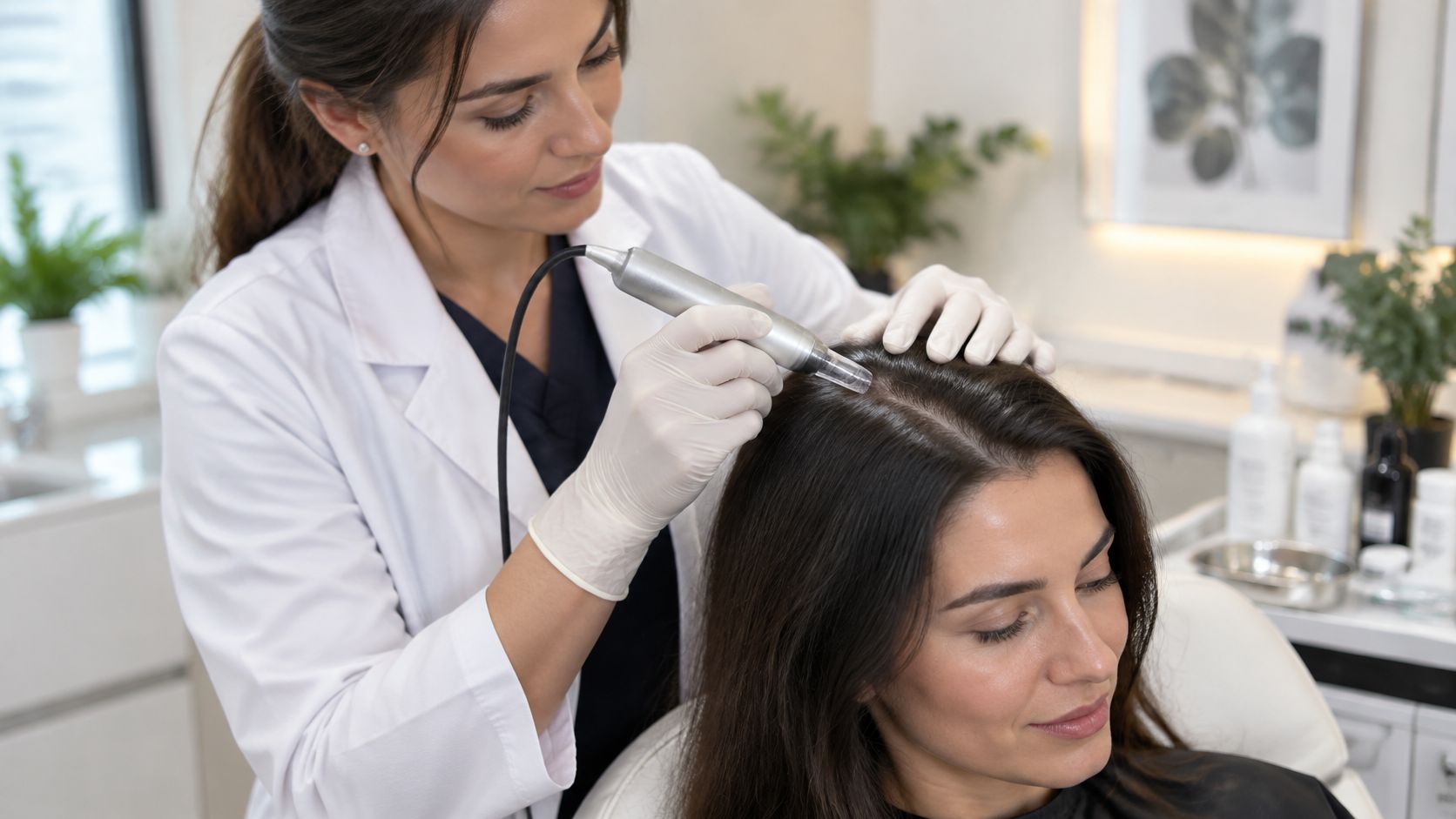
In-clinic series for women with androgenetic alopecia often pair needling with topical minoxidil, then reassess density before extending the series. Home rollers raise infection and depth-control problems that a sterile protocol is designed to reduce. Because needling increases the amount of formula absorbed, the same leave-on serum can behave like a higher-exposure treatment; that dosing choice belongs with the clinician.
Regenerative marketing blurs the line further. The FDA states that no exosome products are FDA-approved and has reported serious adverse events tied to unapproved products marketed as exosomes, as summarized in a PMC review of investigational hair approaches. A peptide serum applied after needling is a different category from an injected biologic. Patients weighing routes can review whether peptide therapy is safe before booking a device session.
- Verify the setup: needle length, sterility, single-use cartridges, and who is trained to run the device.
- Plan a series: one pass follows the hair cycle's timing; schedule reassessment before adding another agent.
- Respect the recovery window: use only the products your clinician clears for the several days they set, and defer repeat needling until the scalp has re-epithelialized.
Comparing Peptide Approaches for Hair Growth
The choice is practical: define the job before adding another ingredient. Peptide-only products support a regimen; minoxidil is the therapeutic backbone when included, and microneedling changes delivery rather than contributing another active.
| Approach | Use It When | Judge It By |
|---|---|---|
| Copper Tripeptide-1 (GHK-Cu) Topical Serum | A diagnosed plan needs a scalp adjunct while established treatment does the therapeutic work | Whether standardized assessment shows added benefit |
| Acetyl Tetrapeptide-3 (Capixyl-Type Formulations) | Early or mild thinning calls for non-invasive support | Shedding, density appearance and tolerability |
| Biotinoyl Tripeptide-1 | The problem is shaft quality, breakage or cosmetic fullness | Changes in hair quality, not new-growth claims |
| Palmitoyl Peptide Complexes (Matrixyl-Family Ingredients) | A broader plan needs scalp conditioning | A distinct scalp benefit, rather than duplication of another leave-on |
| Peptide Serums Combined with Minoxidil (Multimodal Topical Regimens) | A clinician chooses minoxidil and wants one peptide adjunct | An interpretable response without changing several variables |
| Microneedling-Assisted Peptide Delivery | Supervised delivery may help a committed topical regimen | Enough added response to justify repeat procedures |
I would keep one peptide variable at a time. If the result cannot be interpreted, simplify the routine and preserve the treatment with the clearest job.
Building Peptides Into a Supervised Hair Plan: Next Steps
The first 30 days decide whether a peptide earns a place in the plan. Get the hair-loss type confirmed by a clinician, take baseline photos in fixed lighting, and start the anchor treatment before anything cosmetic; for topical regimens that anchor is minoxidil. Add a peptide serum only after the backbone is running, so early shedding or regrowth can be attributed to a specific change instead of a shelf of products started the same week.
For readers who want a prescription protocol rather than a bathroom-cabinet experiment, Vials + Vitals runs physician-directed telehealth for hair health that begins with a confidential online assessment. U.S.-licensed providers decide eligibility and formulation, and dispensing runs through accredited partner pharmacies: EPIQ Scripts, Foothills Pharmacy, and Emerald Compounding. One oral option is Re-Grow, a prescription-only minoxidil tablet that also lists a copper peptide complex, apigenin, and fisetin. Oral minoxidil is not FDA-approved for hair loss, no hair-growth benefit is established for those added ingredients, and the formula contains no finasteride or dutasteride, so it does not block DHT. Re-Grow runs from $189 per month for a one-month supply, with the initial review and standard shipping included. Eligibility and availability vary.
Once a plan is running, treat the follow-up as part of the prescription. Repeat photos on the same schedule and lighting, and review progress with the provider near the end of the roughly 12-week titration window rather than week to week. If a peptide serum causes scalp irritation, stop it instead of layering a second one over it. If oral minoxidil is involved, report swelling, palpitations, dizziness, or unwanted body hair to the prescriber, and treat chest pain, shortness of breath, fainting, or rapid unexplained weight gain as reasons to seek prompt care. Compounded formulations are evaluated by a licensed provider for individual suitability and fulfilled by state-licensed partner compounding pharmacies.
Vials + Vitals offers physician-directed telehealth for hair health, including prescription oral options reviewed by U.S.-licensed providers and dispensed through accredited partner pharmacies. If you're weighing peptides for hair growth inside a supervised plan rather than as a standalone serum, start with a confidential assessment and let a clinician decide what fits your diagnosis. Visit Vials + Vitals to see how the intake and pharmacy fulfillment work.