Do Men Like Women Who Squirt? What Studies Show
Do men like women who squirt? Studies show mixed reactions, not a universal preference. Learn the physiology, stigma, and consent-first talk.

Do men like women who squirt? A 2026 qualitative study in Archives of Sexual Behavior interviewed 16 cisgender women and found that partners' responses were not all the same. The accounts describe different ways the same bodily response can be interpreted, rather than a percentage of men who like it.
Squirting may be read as arousal, validation of a partner's skill, or a mess to manage. It can also become a performance demand. Those interpretations do not reliably show whether someone had an orgasm or whether the encounter felt good. A partner's reaction is only one part of the experience.
Do Men Like Women Who Squirt
There's no universal male preference. The same event can be welcomed, ignored, disliked, or turned into a demand.
Four partner reactions reported by women
| Pattern | How it showed up | What it often meant | Risk if treated as the rule |
|---|---|---|---|
| Neutral bodily response | Fluid noticed and the encounter continued | Acceptance without a score | Low; still worth a brief check-in |
| Undesirable event | Avoidance, discomfort, or stopping because of mess | Personal dislike, not a medical verdict | Shame if dislike is stated as her failure |
| Evidence of his skill | He treated fluid as proof he performed well | Validation for the partner | He may ignore whether she felt pleasure |
| Expected performance | He wanted it repeated or read absence as failure | A demand rather than a preference | Coercive pressure and faked responses |
A 2026 qualitative study in Archives of Sexual Behavior, based on interviews with 16 cisgender women aged 34–60, identified these four recurring patterns in heterosexual encounters. Positive reactions were frequently reported, but women also described dismissive responses and coercive pressure.
The study was small and non-random, and the accounts came from women rather than a direct survey of men. It therefore can't establish how many men prefer squirting, dislike it, or feel neutral. Its contribution is more specific: it helps distinguish reactions that can look superficially similar but carry different consequences.
Enjoyment and validation aren't the same
An enthusiastic response can support a comfortable encounter when the woman also welcomes what happened. A partner might find the release arousing while remaining attentive to her experience and willing to pause.
Enthusiasm becomes less helpful when he treats the fluid as his achievement. If she describes discomfort or says she didn't orgasm, his interpretation shouldn't override hers. A visible bodily response doesn't give a partner authority to define someone else's pleasure.
The neutral pattern deserves attention, too. Acceptance doesn't require a dramatic compliment. Noticing the fluid, checking comfort, and continuing without turning the moment into an evaluation can leave room for the woman's own reaction.
Practical rule: A positive reaction supports the person experiencing it. It doesn't assign that person a task.
Dislike doesn't justify humiliation
A partner may dislike wet bedding or feel uncomfortable with a particular bodily fluid. That preference can be expressed without describing a woman as dirty, defective, or unsuccessful.
The emotional distinction matters. Someone who feels accepted may remain comfortable discussing practical needs; someone whose partner reacts dismissively may feel embarrassed or reluctant to speak. Those feelings shouldn't be inferred from the fluid itself. They need to be heard from the person involved.
Likewise, feeling pleased about a partner's response isn't automatically harmful. The problem begins when personal validation matters more than her feedback, or when enthusiasm becomes an obligation to reproduce the event.
The working rule is straightforward: liking may mean arousal, feeling skilled, tolerating towels, or applying pressure. The first three can fit within a consensual encounter when both people remain comfortable. Pressure doesn't become acceptable because it's presented as admiration.
Squirting, Ejaculation, and Leakage Explained
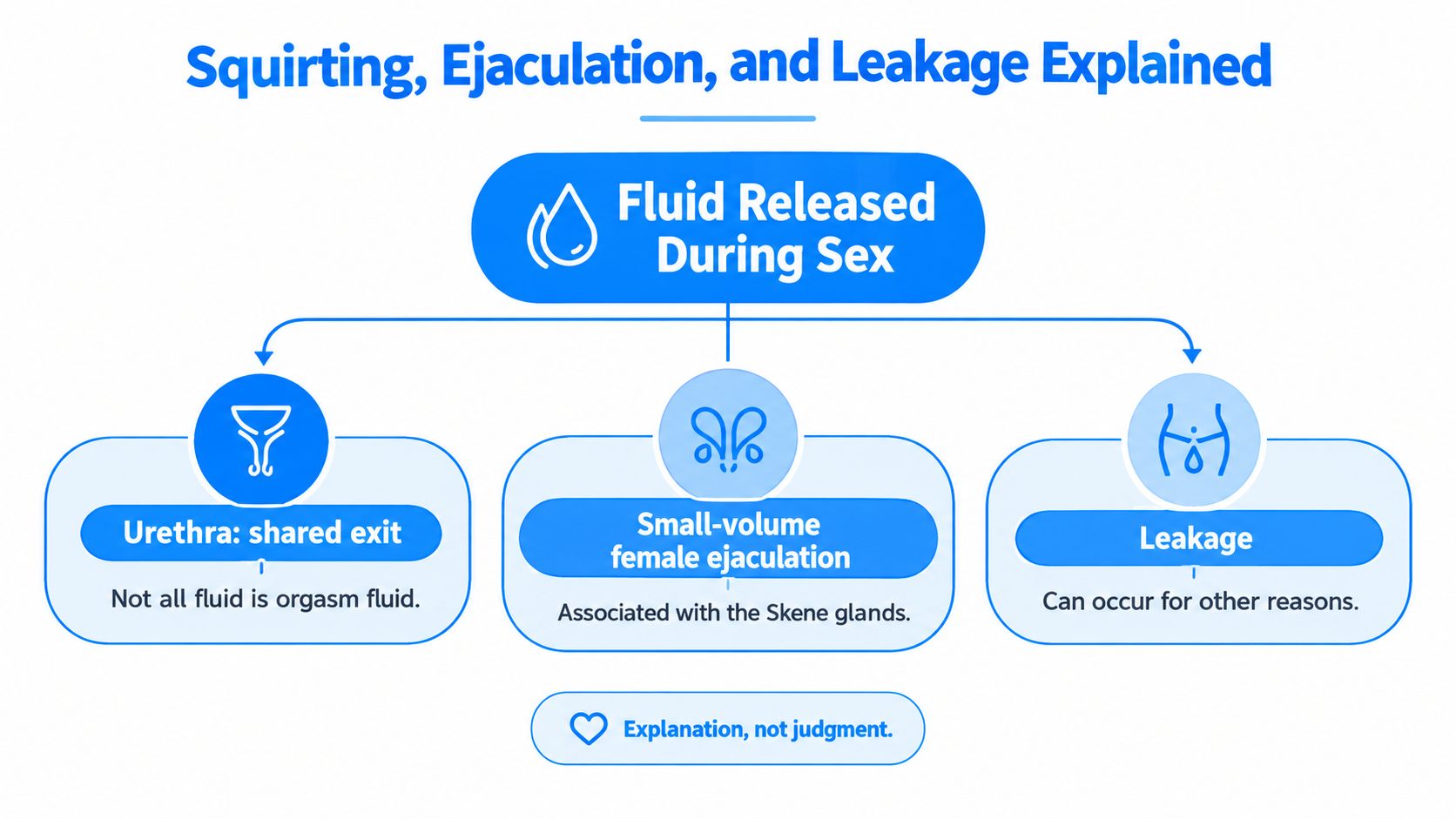
Fluid release during sex can have different anatomical sources, and the amount alone cannot identify which response occurred. The urethra carries urine out of the bladder and can also release fluid during sexual activity. Its presence does not establish whether orgasm occurred.
Small-volume female ejaculation is associated with the Skene's glands, sometimes called the female prostate. Larger-volume squirting is generally associated with bladder-derived fluid, rather than a larger amount of the same glandular secretion.
The physiological discussion of squirting and female ejaculation distinguishes dilute, urine-like fluid associated with squirting from smaller secretions containing prostate-specific antigen (PSA), which are associated with the Skene's glands. Appearance alone cannot reliably distinguish the fluids.
Bladder-derived fluid is a physiological response
The fluid's anatomical source describes how the body produces it. The Journal of Sexual Medicine clinical summary describes squirting and small-volume ejaculation as physiological responses and reports that 7% of surveyed women experienced ejaculation or squirting consistently during sexual activity, while about half experienced it only occasionally.
That variation means the response may happen in one encounter and not another. It also helps explain why fluid release should not be treated as an expected ending.
Fluid release and orgasm are distinct experiences that can occur separately or together:
- Squirting without orgasm: Fluid release can happen without the person experiencing it as climax.
- Orgasm without squirting: An orgasm can occur without visible fluid.
- Both together: Orgasm and fluid release may happen during the same encounter, without either becoming a requirement later.
The fluid can be interpreted in different ways: as a sign of arousal, as validation of a partner's skill, as a practical mess to manage, or as pressure to repeat the response. None of these interpretations reliably indicates orgasm or sexual success. The person experiencing it is the best source on whether it felt pleasurable, neutral, uncomfortable, or unfamiliar.
When leakage needs a different explanation
Leakage during arousal can have a different context from leaking during a cough, feeling urgency before reaching a bathroom, or losing urine during ordinary daily activities. The timing and symptoms help distinguish these experiences. For details on what to track and when to seek care, see the clinician section.
Clinical distinction: A response can be physiologically understandable and still deserve evaluation when it causes distress.
Trying to force a particular response can distract from the person's comfort. No technique, supplement, or prescription should be presented as a dependable way to produce squirting. Body literacy is the right frame: understand the anatomy, recognize personal variation, and identify symptoms that merit care.
How Common the Experience Is
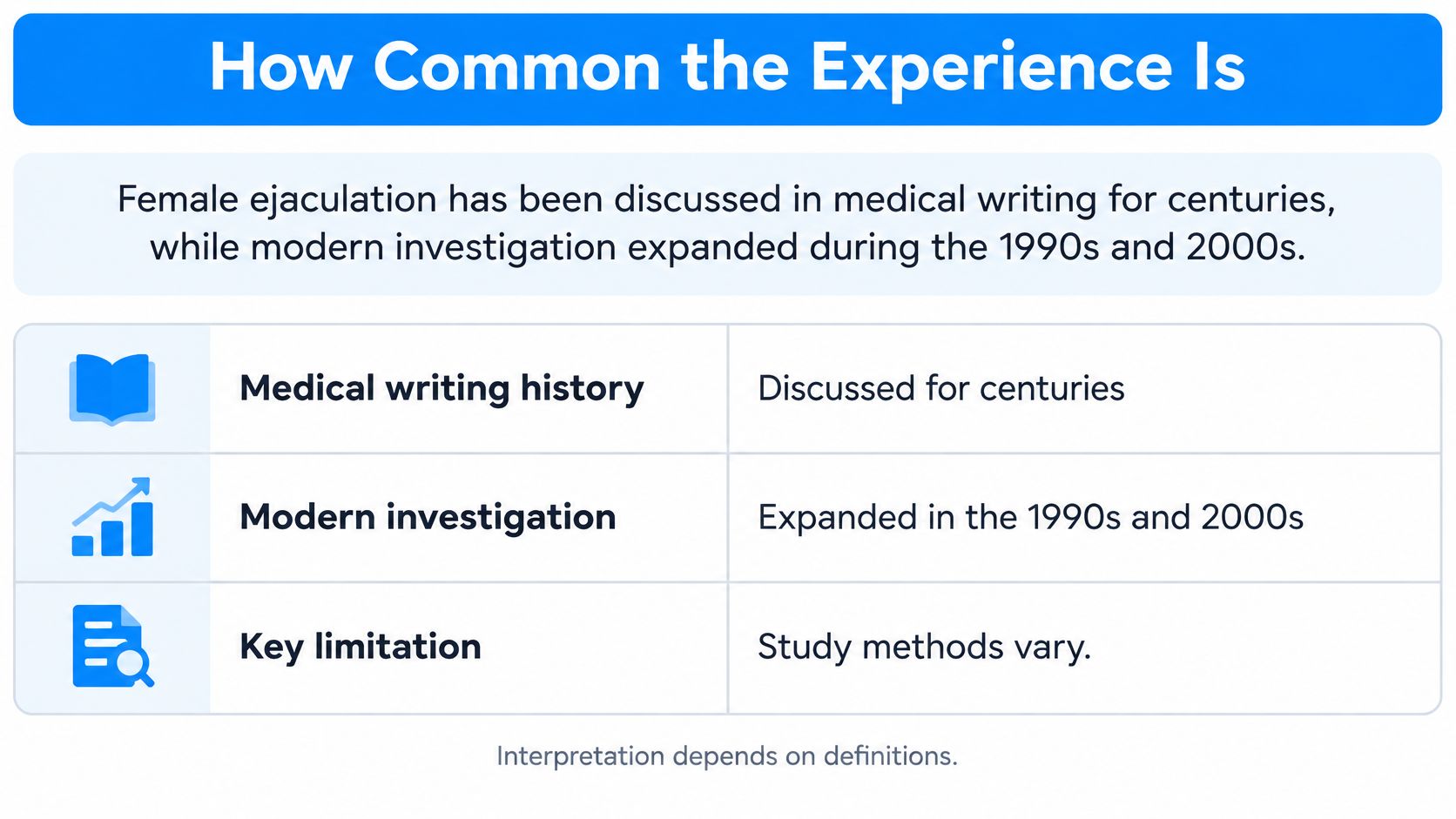
Studies describe how often women report fluid release, but their estimates depend on what researchers ask and who responds.
Reported prevalence of fluid release among women
| Source | Figure | What was counted | What it does not show |
|---|---|---|---|
| 2023 U.S. nationally representative study in the Journal of Sex Research | 40% of adult women, with a median lifetime frequency of three to five times | Ever having squirted | Whether partners liked the event |
| 2024 Sexual Medicine publication discussing a Swedish online survey | 58% of respondents in the survey conducted in 2019 | Having experienced ejaculation or squirting | A fixed frequency |
A publication year and a survey year are not necessarily the same. The Swedish survey was conducted in 2019, even though the publication appeared in 2024.
Why estimates don't line up neatly
Researchers have not always used squirting, female ejaculation, and fluid expulsion at orgasm to mean the same thing. A questionnaire that groups ejaculation and squirting may count experiences differently from one asking specifically about a noticeable release of fluid.
Recruitment shapes the result, too. A nationally representative sample and an online survey may reflect different groups of people, even when their questions sound similar. And a lifetime question records whether something ever happened, not how often it happens now.
These distinctions help clarify what a prevalence figure can show:
- Experience isn't frequency: Having experienced fluid release does not mean it happens regularly.
- Frequency isn't a recommendation: A reported pattern does not establish how often anyone should experience it.
Common enough for education, not an expectation
Different definitions can blur public understanding of fluid release. Neutral language helps keep the topic within ordinary sexual-health education, without casting the experience as either an achievement or an embarrassment.
Not experiencing squirting is a normal variant, not evidence of low arousal or sexual dysfunction. No one needs to develop the response to have a typical sexual experience.
Encounters That Feel Welcoming or Pressured
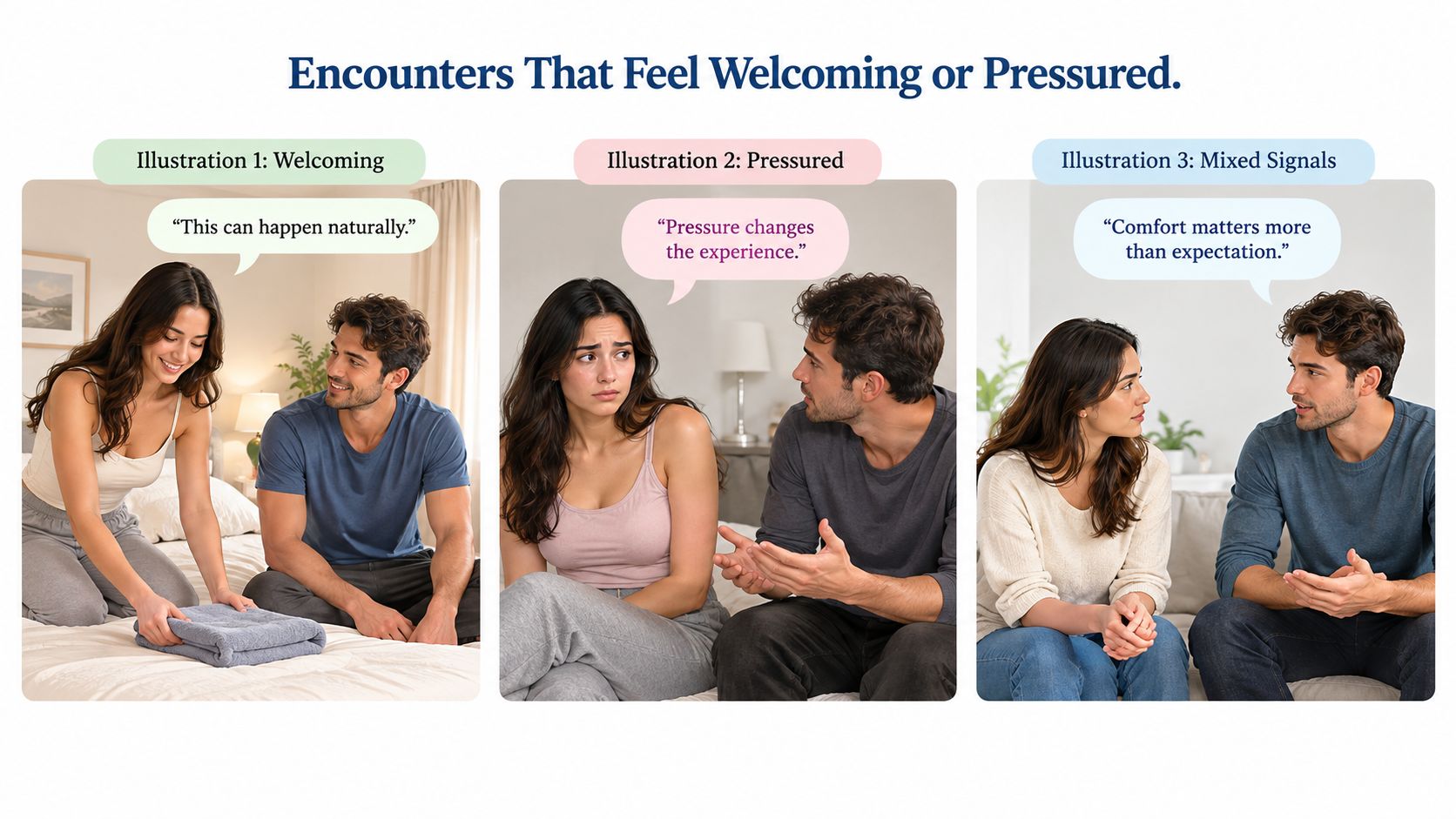
The following scenes are illustrations of partner-response patterns, not patient stories or case reports. They show why the interpersonal meaning of an encounter can matter more than the visible fluid.
A welcoming response
A woman explains that fluid sometimes releases without warning. Her partner puts down a towel and asks whether she wants to continue, pause, or change position.
Neither person treats the preparation as a promise that anything will happen. If she becomes uncomfortable, the plan changes without disappointment becoming her responsibility.
The welcoming feature isn't the towel itself. It's the partner's willingness to follow her feedback rather than treating preparation as consent to pursue a particular outcome.
Discomfort without a verdict
During another encounter, a man pulls away because he dislikes the wetness. An abrupt joke about urine could leave his partner feeling judged, while a plain statement about discomfort would make the practical issue easier to understand.
He doesn't have to enjoy the experience. She doesn't have to accept ridicule as the cost of expressing a bodily response.
A workable conversation separates the preference from the person: dislike of mess can lead to a different setup or a decision not to continue. It shouldn't become an argument that her body is wrong or that his boundary must be overridden.
Pressure presented as enthusiasm
In a third illustration, a partner insists that a real orgasm should involve squirting. He asks her to force it and keeps pursuing that outcome after she wants to stop.
That scene reflects the coercive pattern in which a partner assigns meaning to fluid release despite the woman's own account. The concern isn't whether he finds squirting exciting. It's that he treats excitement as permission to disregard her wishes.
Pornography or social-media clips can encourage misleading comparisons when a dramatic release is presented as the finish line. An edited or staged scene isn't a physiological schedule, and recreating it isn't an obligation.
A preference is information; a demand is a consent problem.
The same distinction applies to other sexual exploration. Educational material about male masturbation and individual preferences should be approached as information about personal experience, not as a script someone else must follow.
Before discussing another encounter, each person can consider whether the previous one felt welcoming, uncomfortable, or pressured. That description provides a clearer starting point than debating whether squirting is universally attractive.
How to Talk Before the Next Encounter
A conversation about bodily fluids is easier when both people are clothed, unhurried, and free to decline sex. The purpose is an agreement about comfort, not persuasion.
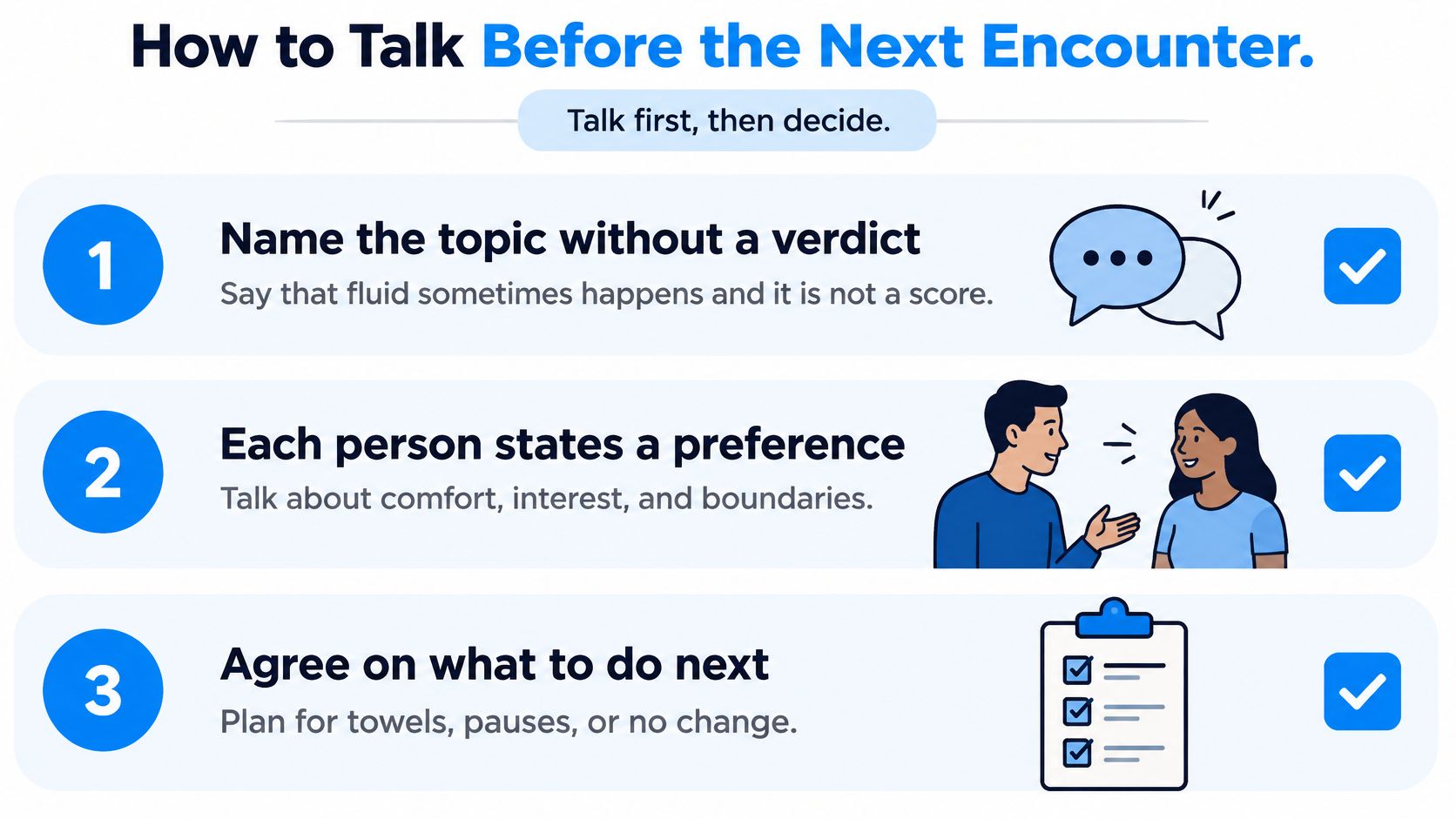
A conversation without a performance target
Name the topic without a verdict. A neutral opening keeps the discussion from sounding like praise that creates an obligation or criticism that assigns blame. A sample sentence is: Fluid sometimes happens during sex, and it isn't a score.
Let each person state a preference. Enjoyment, neutrality, and dislike of mess are all legitimate starting points. A partner's statement might be: The experience can be enjoyable when it happens, but there's no need for it to happen.
Separate preference from orgasm. Partners should agree to rely on the person's description of pleasure rather than interpreting a bodily sign. A sample sentence is: Pleasure and orgasm need to be described, not assumed from fluid.
Choose a practical setup. If both people want to continue exploring, a towel, washable waterproof layer, accessible bathroom, and agreed pause word can reduce uncertainty. A sample agreement is: A towel can stay nearby, and pause means stopping to check comfort.
Make stopping independent of the ending. Neither person owes an orgasm, a release of fluid, or continued contact because an encounter has started. A sample sentence is: Either person can stop without completing anything.
Decline a forced-response goal. If one partner wants to pursue squirting as a trick, the other can refuse that expectation without defending the refusal. A clear boundary is: Being asked to force fluid release isn't comfortable, so that won't be part of the encounter.
What a usable agreement includes
A preference statement shouldn't need a long defense. Someone who dislikes cleanup can say so, and someone who feels vulnerable about fluid release can ask for discretion.
The agreement also needs to survive a change of mind. Preparing a waterproof layer doesn't commit anyone to continue, and expressing curiosity doesn't waive a later boundary.
Pressure, mocking, and continuing after a stop aren't acceptable compromises. If either person feels unable to speak freely, resolving that safety concern matters more than refining the setup.
A reusable checklist can remain brief:
- Preference stated: Both people have described their comfort.
- No orgasm equation: Neither person will infer climax from fluid.
- Setup chosen: Practical arrangements suit both people.
- Stop word confirmed: Either person can pause or end contact.
Decide Whether This Needs a Clinician
A preference about squirting does not, by itself, call for medical treatment. The reason for seeking help matters: discomfort, frequent leakage outside sex, and distress are different from a partner's expectation or a practical concern about cleanup.
When a conversation is enough
If both people feel comfortable and the only issue is wet bedding, a towel and an honest conversation may be all that's needed. Squirting is not a measure of sexual success, and not squirting does not mean sex was unsatisfying.
If a partner treats fluid release as a performance test, address that expectation directly. Changing someone's body to meet a partner's benchmark would leave the pressure unresolved.
When to see a clinician
See a clinician if leakage is painful, happens often outside sex, or causes distress. An evaluation is also warranted when leakage comes with urinary urgency, pain or burning, skin irritation, or difficulty controlling urine.
For the appointment, note when the leakage occurs, what symptoms accompany it, and how it affects daily life or intimacy. These details help focus the discussion without requiring you to diagnose the cause.
Sexual pain, low desire, orgasm concerns, and erectile difficulties are separate concerns that deserve their own assessment. Concerns about changes in penile sensitivity also need their own history and evaluation. A partner's squirting response cannot establish whether someone else has a sensory or erectile problem.
What treatment should not promise
No prescription, compounded formulation, or sexual-wellness protocol should be presented as a way to produce squirting. Treatment should address a defined health concern, with a clinician weighing potential benefits and risks for the individual.
When symptoms interfere with daily life or intimacy, arrange an evaluation. When the concern is only whether a body meets a partner's expectation, a clearer boundary is more useful than medication.
Informational purposes only. A licensed provider evaluates compounded medications for individual suitability, and state-licensed partner compounding pharmacies fulfill them.
Vials + Vitals offers physician-directed telehealth assessment and individualized care for sexual-wellness and other health concerns. Adults seeking help with a distinct symptom, rather than a treatment to produce squirting, can visit Vials + Vitals to complete a confidential intake and discuss next steps with a licensed provider.