Do Condoms Make You Last Longer? What the Evidence Shows
Do condoms make you last longer? Review the evidence on thicker and numbing condoms, safety limits and when rapid ejaculation needs clinical care.
Ordinary condoms don't reliably make sex last longer for most men. A thicker or benzocaine condom can add a measurable delay for some men, and the size of that effect depends on the product: one randomized trial measured an 11.5% increase in intravaginal ejaculation latency with a 5% benzocaine condom versus a standard condom, while a 3% version added just 3.4%, a difference that was not statistically significant.
The most clarifying number in this literature is a negative one. A five-country population survey published in the Journal of Sexual Medicine measured intravaginal ejaculation latency time, the interval from vaginal penetration to ejaculation, across men in five countries and found the median was independent of condom use. In ordinary use, across whole populations, a standard condom did not buy measurable time.
That finding reframes the question. "Do condoms make you last longer" has a population-level answer (no, not dependably) and a conditional answer (sometimes, for particular products and particular men). The two answers coexist because the mechanism is sensory rather than mechanical endurance. A condom changes how much stimulation reaches the glans, and stimulation is only one of several inputs that determine when ejaculation happens. Sorting the products by measured effect is the fastest way to see where the meaningful differences sit.
What the Evidence Says About Condoms and Timing
The honest answer has two halves. Typical condom use doesn't reliably extend intercourse, yet the benefit is real in a specific group: a controlled comparison found a significant increase in ejaculation latency among men with premature ejaculation and no significant change in the control group (comparison of condom use and ejaculation latency). That pattern locates the effect precisely. A condom is a sensitivity tool for men whose ejaculation is driven by intense stimulation, not a universal endurance aid. The same comparison found that thickened condoms reduced glans sensitivity but drew poorer comfort ratings, which is the central trade-off in one line.
The product matters as much as the wearer. The table below places the barrier effect of plain latex beside benzocaine condoms and the stronger topical anesthetics, using measured values from trials that compared them head to head.
| Product | How it works | Reported change in latency | Main trade-off |
|---|---|---|---|
| Standard latex condom | Physical barrier that lowers direct glans contact | Increase also seen in the plain latex control; exact minutes not reported | Some reduction in sensation |
| Thickened condom | Thicker latex lowers sensory input | Longer latency and lower vibration sensitivity; exact minutes not reported | Lower comfort ratings |
| 3% benzocaine condom | Barrier plus topical anesthetic | +3.4% vs. standard condom (P = .4432, not significant) | Possible reduced pleasure and partner transfer |
| 5% benzocaine condom | Barrier plus topical anesthetic | +11.5% vs. standard condom (P = .0173, significant) | Possible reduced pleasure and partner transfer |
| Lidocaine spray or lidocaine-prilocaine cream | Topical anesthetic applied to the skin | Larger increase than benzocaine condoms in a 2025 study of 273 men with lifelong premature ejaculation | Numbness and possible loss of erection with prolonged application |
Read it from the top. In the crossover trial behind the benzocaine figures, every condom tested raised latency from baseline, including the plain latex control, so part of any gain comes from wearing a condom at all rather than from an active ingredient (crossover trial of standard and benzocaine condoms).
Anesthetic concentration then decides how much more you get. The 5% benzocaine condom increased intravaginal ejaculation latency by 11.5% relative to the standard condom, a statistically significant difference at P = .0173. The 3% formulation produced a 3.4% increase that was not statistically significant (P = .4432), as summarized in a clinical review of condom and topical evidence. The same review notes that thickened condoms can lengthen the time between vaginal penetration and ejaculation and may help men with premature ejaculation.
Topicals still outpace condoms. In a 2025 randomized comparison of 273 men with lifelong premature ejaculation, benzocaine condoms prolonged latency but produced a smaller increase than lidocaine spray or lidocaine-prilocaine cream (2025 randomized comparison of anesthetic options).
Reading the Table Row by Row
Three patterns matter more than any single figure. First, the dose-response is steep: quadrupling the anesthetic from 3% to 5% moved a non-significant result to a significant one. Second, the barrier alone does something, which is why the plain latex control improved. Third, comfort falls as attenuation rises, so the product that delays most is rarely the one that feels best.
Use the table as a ladder, not a menu. Identify your own pattern first: does ejaculation arrive early during any intercourse, or only during vigorous or highly stimulating sessions? Start at the lowest rung that plausibly addresses your pattern, meaning a well-fitting standard condom, and track results across several encounters before stepping up. Moving straight to a numbing product skips the step most likely to succeed with the fewest drawbacks.
How Condoms Change Sensation and Timing
Penile sensation behaves like a volume control. A standard condom turns the dial down a notch by placing a barrier between the glans and shaft and the partner's tissue. A numbing agent turns it down further, because it changes how strongly the nerve endings themselves report what they're feeling.
The pathway is uncomplicated. Stimulation of the glans and shaft travels along sensory nerves into spinal and cortical circuits that govern ejaculation, and reducing that input raises the threshold at which the reflex fires. The Sexual Medicine Society of North America describes the mechanism as primarily sensory and notes that a single condom may reduce sensitivity enough to improve ejaculatory control for some men, while multiple condoms reduce sensation excessively and are not an appropriate strategy.
The distinction worth remembering: a barrier changes how much stimulation arrives. An anesthetic condom adds a chemical step that changes how strongly the skin reports it. The first is reversible in seconds and carries no dosing question. The second has a concentration, a duration, and a transfer risk.
Barrier Effect Versus Anesthetic Effect
Nothing in either mechanism increases erectile capacity or alters semen production. That matters because men often expect a delay product to also improve firmness or stamina in a general sense, and it doesn't. A condom modulates incoming signal. If erection quality is already marginal, adding numbness can push it in the wrong direction, which is why the same product that helps one man can make intercourse harder for another.
Response also varies with baseline timing, arousal level, erection quality, and simple comfort. A man who ejaculates within a minute of penetration has more room to gain from reduced input than a man at the population median. Men who want to understand their own sensitivity baseline before choosing a product can review what influences penis sensitivity and compare it against their own pattern.
The practical question to answer before shopping is whether sensation is the trigger. If arousal spikes fast and ejaculation follows within a few thrusts, a barrier has something to work with. If timing is inconsistent, tied to anxiety, or paired with weak erections, the condom is addressing the wrong variable.
Behavioral Techniques That Work With a Condom
Pauses train control. A condom lowers incoming stimulation. Put them together and you get two mechanisms working on the same reflex from different directions, which is why clinicians pair behavioral methods with a barrier rather than treating them as alternatives.
- Start-stop. Thrust until arousal is high but ejaculation isn't imminent, then stop all movement and wait for the urge to fall before resuming. Run two or three of these cycles before allowing ejaculation.
- Squeeze. At that same high point, the man or his partner gently squeezes the glans for several seconds until the urge fades, then restarts intercourse. Pressure, not pinching.
- Pair the method with one well-fitted condom. When high penile sensitivity is the trigger, the barrier lowers glans input while the pauses teach the nervous system to tolerate a higher level of arousal.
- Change one variable at a time. A new thicker condom, a new technique, and a new lubricant introduced in the same week tell you nothing about which one helped.
Rule of one variable: hold everything constant except the thing you're testing, and give it several encounters before judging it.
These steps are most relevant for men with premature ejaculation and do less when latency is already typical. They don't increase erectile capacity or change semen production, so they won't fix an erection problem disguised as a timing problem. Men who want to understand how solo practice shapes the reflex can review masturbation habits that affect ejaculatory control, since the same start-stop logic applies there with less pressure.
If pauses fail, cause pain, or the pattern has been lifelong and distressing, the next step is clinical evaluation rather than a second condom or an extra layer of anesthetic.
Safety Limits Including Double Condoms and Partner Transfer
Never wear two condoms to imitate a thicker one. Friction between the layers can increase breakage risk, so layering compromises the product instead of providing a calibrated reduction in sensation, and clinical guidance on condom use for reducing penile sensitivity treats a single properly fitted condom as the unit (urology guidance on condoms and penile sensitivity). The same guidance is explicit that a condom goes on before any genital contact, because pregnancy and sexually transmitted infection protection depend on it being there from the start.
That protection isn't negotiable against a timing goal. A condom that delays ejaculation but gets applied late has traded a reliable benefit for an unreliable one.
Partner Transfer, Allergies, and Lubricant
Numbing ingredients don't stay put. Anesthetic can pass to a partner and cause genital numbness or irritation, so follow the product directions, keep the condom in place during intercourse, and stop if either partner notices unfamiliar numbness.
- Burning or stinging: stop, remove the condom, and wash with warm water. Persistence beyond a few minutes warrants a call to a clinician.
- Rash or itching: treat it as a possible sensitivity reaction and avoid that ingredient class afterward.
- Marked numbness or loss of erection: the dose or the product is wrong for you. Complete desensitization is not the goal.
- Partner discomfort: remove the condom, wash, and reassess the product rather than pushing through.
Latex allergy calls for a non-latex condom, and a known benzocaine sensitivity rules out anesthetic products entirely. Lubricant choice follows the same logic: use a water-based or silicone-based product compatible with the condom material, and keep oil-based lubricants away from latex, where they weaken the material and increase the chance of a break.
Topical Options and When to See a Clinician
Topical anesthetics are the stronger reference point in this comparison, and their timing rules are the clearest illustration of why more is not better.
| Option | Typical timing before sex | Key caution |
|---|---|---|
| Lidocaine, benzocaine, or prilocaine cream, gel, or spray | About 10 to 15 minutes (Mayo Clinic) | Wash before penetration to limit partner transfer |
| Lidocaine-prilocaine cream | About 20 to 30 minutes (older AUA guidance) | About 30 to 45 minutes can cause substantial numbness and loss of erection |
| Anesthetic condom | Before any genital contact | Stop for numbness, burning, irritation, or loss of enjoyment |
| Clinician-directed therapy | Set after evaluation | For persistent or distressing rapid ejaculation or associated symptoms |
Mayo Clinic reports that lidocaine-, benzocaine-, or prilocaine-containing creams, gels, and sprays are commonly applied about 10 to 15 minutes before sex to reduce penile sensation and delay ejaculation. Older American Urological Association guidance describes lidocaine/prilocaine cream applied roughly 20 to 30 minutes before intercourse as increasing ejaculatory latency, while warning that leaving it on for about 30 to 45 minutes can produce substantial numbness and loss of erection in a significant percentage of men (AUA guidance on topical anesthetics for premature ejaculation).
Two operational lessons follow. Applying more product or waiting longer is not a dependable way to add minutes, it's a way to add numbness. And residual anesthetic can transfer to a partner, so washing the penis thoroughly before penetration, or keeping the condom in place, limits that exposure.
In the 2025 study of 273 men with lifelong premature ejaculation, benzocaine condoms increased latency by less than lidocaine spray or lidocaine-prilocaine cream, and adverse effects were minimal and lowest in the condom group, which is a meaningful point in favor of the milder option (2025 prospective randomized comparison in lifelong premature ejaculation).
When a Clinician Should Take Over
Schedule an evaluation when rapid ejaculation is persistent or distressing, or when it shows up alongside erection difficulty, pain, urinary symptoms, or relationship strain. Those combinations point to something a condom can't classify.
A licensed clinician can separate lifelong from acquired premature ejaculation and discuss behavioral therapy or prescription care. Prescription treatments and compounded formulations are provided only at the clinical discretion of licensed U.S. healthcare providers, following an individualized telehealth intake and consultation. Anyone using prescription erectile medication should also know the red flags Vials + Vitals lists for urgent care: an erection lasting more than four hours, sudden loss of vision or hearing, fainting, or chest pain.
Condoms and topicals manage sensation. They are not definitive treatment for a persistent condition, and they shouldn't be stretched into that role by escalating dose.
Choose a Condom and Set a Trial Plan
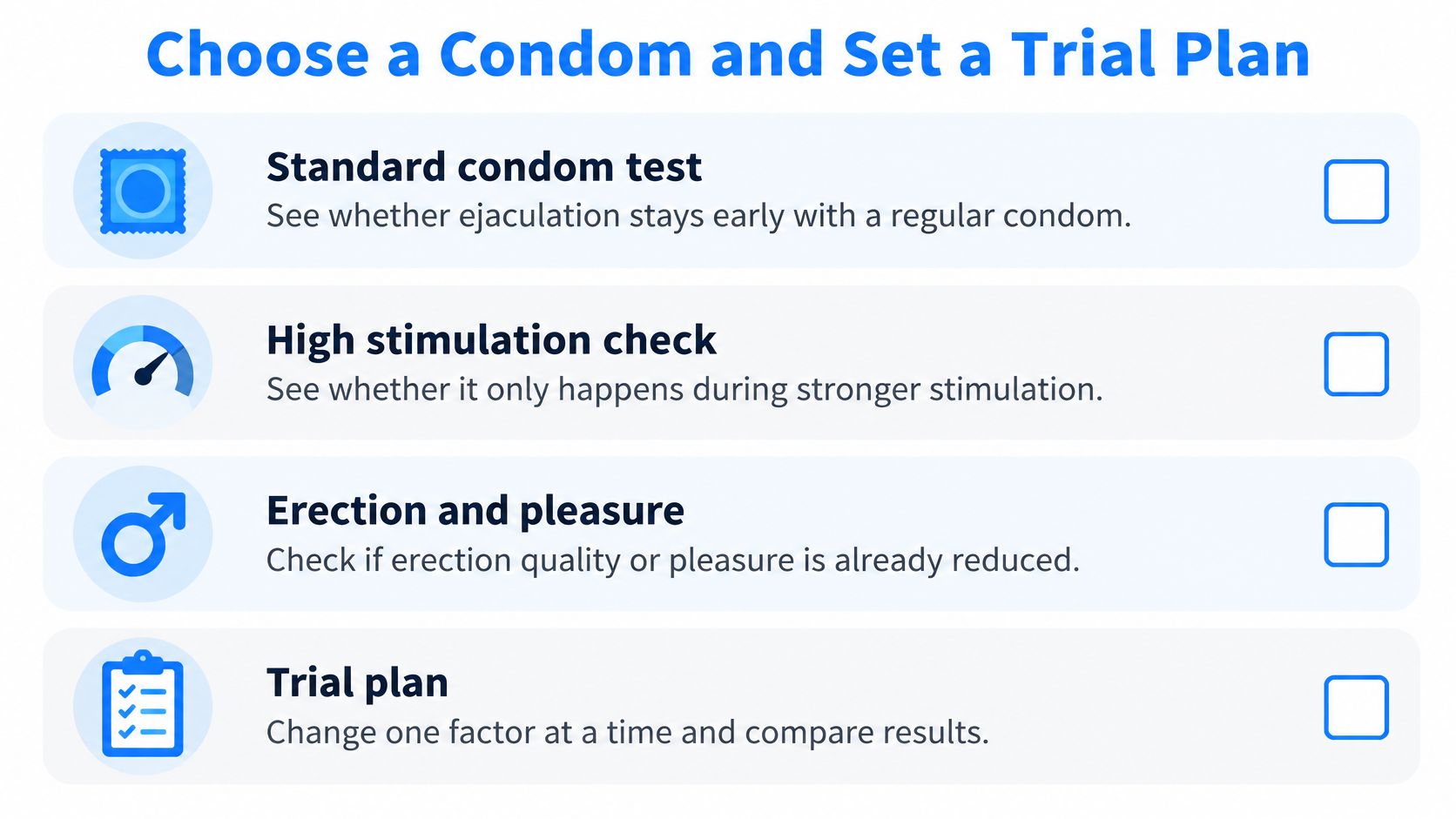
Four checks narrow the choice faster than any product description.
Four Checks Before the First Trial
- Standard condom test. Does ejaculation stay early with a regular condom, or only during particularly strong stimulation? The second pattern responds better to a barrier.
- High stimulation check. If timing is fine during slower intercourse and short during vigorous sex, sensitivity is doing the work.
- Erection and pleasure. If firmness or enjoyment is already reduced, desensitizing products will make intercourse worse, not longer.
- Comfort and irritation. Any history of numbness, burning, or partner irritation rules out anesthetic options.
Mayo Clinic identifies benzocaine and lidocaine as the numbing agents used in certain climax-control condoms, and notes that because the active ingredient can decrease sensation for both partners, users should follow product directions and stop for excessive numbness, burning, irritation, or loss of enjoyment (Mayo Clinic on premature ejaculation treatment).
Two worked examples show how the checks resolve. A man whose timing is short only during vigorous sex, whose erections are strong, and whose partner finds standard condoms comfortable keeps plain latex, logs several encounters, and stops there. A man who tries a thicker condom and notices his erection fading mid-session stops all desensitizing products and books an evaluation, because the barrier is now working against him.
The Trial Plan
- Define the problem. Note whether timing is consistently early and whether it bothers either partner. A pattern that bothers nobody isn't a condition to treat.
- Test one condom. Use a single well-fitting condom with water-based or silicone-based lubricant across several encounters and record what changes.
- Step up once. Only then try one thicker or desensitizing condom, and stop immediately if comfort or erection quality falls.
- Never combine. Don't stack condoms or add a separate anesthetic to a numbing condom. Two products don't produce a predictable sum.
- Escalate clinically. If distress persists, a U.S.-licensed provider decides on care after an individualized telehealth intake, including whether behavioral therapy or prescription treatment fits.
Informational purposes only. Compounded medications are evaluated by a licensed provider for individual suitability and are fulfilled by state-licensed partner compounding pharmacies.
Most men who ask whether condoms help them last longer are really asking whether anything simple can close the gap between their timing and their confidence, and the answer is that a single well-fitted condom is a reasonable, low-risk first experiment while a numbing product is a targeted second step for a specific pattern. Vials + Vitals handles the part that comes after self-experimentation, with men's sexual wellness care that starts from a confidential online assessment and a review by a U.S.-licensed provider who determines whether prescription treatment is appropriate. Visit Vials + Vitals to begin that intake and get an individualized answer instead of another generic fix.