Why No Cure for Herpes Still Holds in 2026
Why no cure for herpes comes down to latent virus in nerve cells. Learn what treatment, vaccines, and editing can and cannot change.

There's no established sterilizing cure for herpes because HSV DNA can persist for life in sensory ganglia, while acyclovir, valacyclovir, and famciclovir suppress viral replication rather than remove that hidden DNA. Treatment can improve symptoms and lower transmission risk without eliminating the infection.
The scale makes that distinction important: WHO estimated that approximately 846 million people aged 15–49, more than 1 in 5 worldwide in that age range, were living with genital herpes in 2020. The central problem isn't a shortage of medicines that affect active virus. It's the difficulty of safely reaching and disabling viral genetic material inside long-lived human nerve cells.
For someone evaluating treatment or a promising headline, the useful question is more specific than whether something works. Does it improve outbreaks, reduce contagiousness, or remove the infection's biological reservoir?
Why No Cure for Herpes Is a Reservoir Problem
Herpes remains treatable, but current treatment doesn't empty its nerve-cell reservoir. After an initial infection, herpes simplex virus establishes a protected, inactive state in sensory neurons. A medicine can interrupt active infection at the surface while viral genetic material remains deeper in the nervous system.
That explains an otherwise confusing experience: a person takes medication, lesions heal, and symptoms disappear, yet another outbreak occurs later. The treatment may have done exactly what it was intended to do. Healing skin and eliminating latent viral DNA are different biological outcomes.
The CDC's herpes overview explains that medicines can shorten outbreaks and that daily treatment can reduce the likelihood of transmitting genital herpes. Those benefits matter clinically, but neither means that treatment has removed the underlying infection.
Three outcomes people confuse with a herpes cure
| Outcome | What can change | What remains | After medicine stops |
|---|---|---|---|
| Symptom control | Shorter, milder outbreaks when treatment is timed well | Latent genomes in sensory neurons | Outbreaks can return |
| Reduced contagiousness | Daily suppression can lower shedding and transmission risk | Subclinical shedding is still possible | The treatment-associated reduction ends |
| Viral eradication | Not achieved by approved drugs | Lifetime neuronal reservoir | Not applicable with present care |
The table separates outcomes that headlines often combine. A study showing fewer painful lesions measures a meaningful patient benefit. It doesn't establish that treated participants can no longer transmit HSV, and it doesn't establish eradication.
Likewise, reduced contagiousness is a probability change, not a declaration that sexual contact carries no risk. A person may benefit from daily suppression while still needing a risk-reduction plan with a partner.
Why the reservoir changes the standard of proof
A reservoir is a location where infection persists despite treatment directed at its active phase. For HSV, that location includes neurons that must continue performing normal sensory functions. Removing the reservoir therefore requires more precision than treating damaged skin.
Claims about clearance need evidence that reaches beyond appearance or comfort. An outbreak diary can document symptom improvement. Measurements of shedding can evaluate viral activity at a sampled surface. Neither, by itself, proves that every relevant neuron is free of latent HSV DNA.
Practical rule: A headline about fewer outbreaks should be interpreted as evidence about outbreaks, not automatically as evidence of viral eradication.
This distinction explains why no cure for herpes is established despite useful antiviral treatment. It also prevents the opposite misunderstanding: the absence of eradication does not make symptom control or transmission reduction unimportant.
How Herpes Settles Inside Sensory Neurons
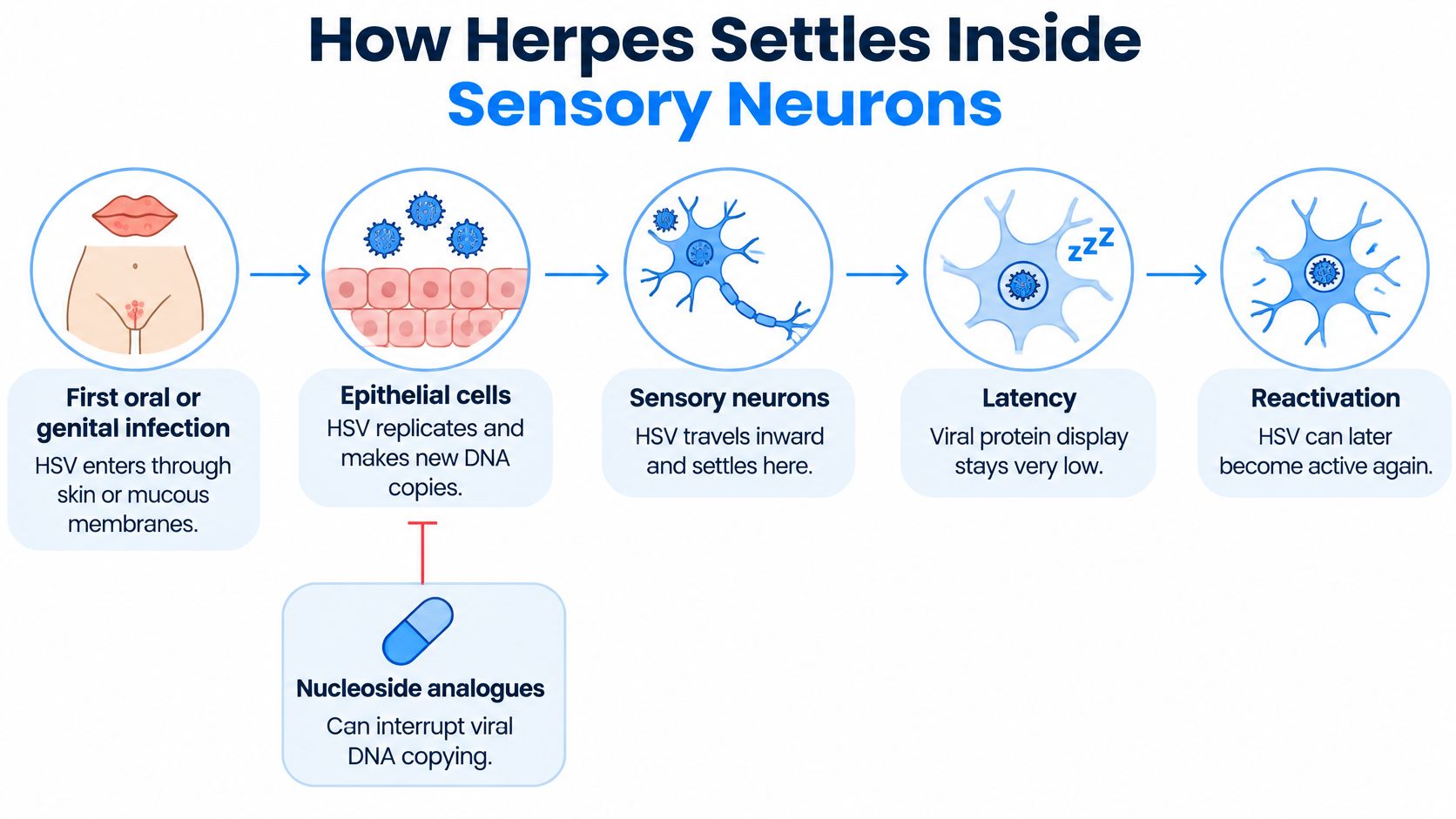
Consider a typical initial oral infection. HSV enters susceptible epithelial cells at the surface, where it copies its DNA and produces components needed to assemble new virus. During this active phase, antiviral medicines have a biochemical process to interrupt.
Nearby sensory nerve endings provide a route inward. The virus travels toward the nerve-cell body, a direction called retrograde transport. Rather than remaining only in the lip or surrounding skin, the infection can establish itself in a sensory ganglion, a cluster of nerve-cell bodies.
From surface infection to a latent episome
For many oral infections, the relevant location is the trigeminal ganglion. For many genital infections, HSV settles in sacral dorsal-root ganglia. The NIH herpes simplex strategic plan describes latent viral genomes as remaining in most infected sensory neurons throughout the individual's life.
Inside the neuron's nucleus, HSV DNA can persist as a circular episome. An episome is genetic material maintained separately from the cell's chromosomes. During latency, most genes responsible for productive viral replication are switched off.
A loading-dock analogy helps distinguish these states. Active infection resembles a loading dock dispatching shipments, where medicine can interrupt production. Latency resembles inventory stored in a locked room that the loading equipment never enters.
The limitation isn't that medicine cannot get near a nerve. The more fundamental problem is that a drug designed to block viral DNA copying doesn't remove DNA that is already present and largely inactive.
Reactivation reverses the journey
Latency isn't necessarily permanent silence. When HSV reactivates, viral genes involved in replication become active again, and newly produced virus can move outward along the nerve toward the surface.
- Surface lesions: Reactivation can produce recognizable blisters or ulcers.
- Subclinical activity: Virus can reach the surface without an obvious lesion.
- Variable symptoms: The visible episode reflects activity at that moment, not a complete inventory of infected neurons.
Illness, fever, sun exposure, menstruation, injury, and emotional stress can accompany reactivation. These associations don't mean every outbreak has an identifiable trigger or that preventing stress reliably prevents viral activity.
The clinical consequence is straightforward: a comfortable week documents a comfortable week. It isn't a clearance test, because the skin cannot reveal whether latent episomes remain inside sensory ganglia.
Why the Immune System Cannot Finish the Job
A healthy immune system can restrain HSV without eliminating every infected neuron. During latency, the virus produces relatively little of the protein material that immune cells use to recognize infected cells. Less viral protein display means fewer recognizable targets.
HSV also uses noncoding RNAs and epigenetic regulation to help maintain this quiet state. Noncoding RNAs influence cellular processes without becoming proteins. Epigenetic regulation changes how accessible genes are to the machinery that reads them, helping keep replication-associated genes switched off.
Clearance must preserve the neuron
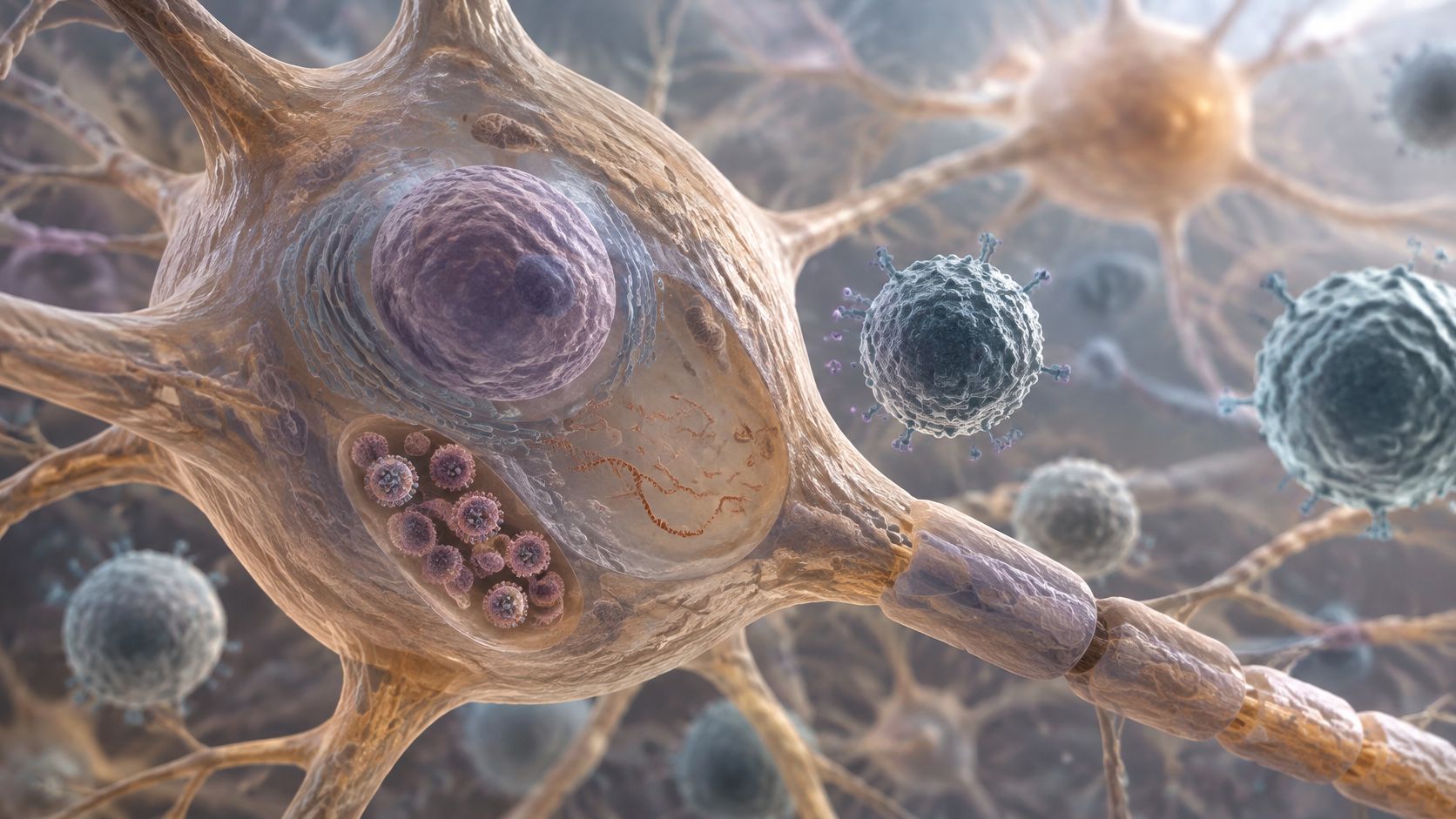
The location creates a second obstacle. Sensory neurons are long-lived cells with essential functions, not disposable containers. An intervention that destroys infected nerve cells indiscriminately could cause sensory loss or other neurological injury.
A sterilizing strategy would therefore need to accomplish several tasks together:
- Reach the relevant ganglia: Delivery must include the neurons harboring infection, not just accessible skin.
- Disable HSV selectively: The intervention must distinguish viral genetic material from essential human genetic material.
- Protect nervous tissue: Off-target editing, inflammation, and neuronal injury must remain acceptably controlled.
- Prevent residual reactivation: Remaining infected cells must not retain the ability to restart productive infection.
Achieving one task doesn't establish success at the others. Efficient delivery, for example, would be insufficient if the intervention damaged neurons or left a clinically important reservoir behind.
What animal reductions can and cannot establish
The supplied preclinical gene-editing evidence describes engineered-nuclease reductions of approximately 90% or more of latent HSV DNA in mouse models of orofacial infection and up to 97% in genital-infection mouse models. These are animal findings, not validated human treatment outcomes.
A large reduction demonstrates biological activity. It doesn't establish complete clearance, safe delivery throughout human ganglia, or durable prevention of transmission. Residual viral genomes remain important because an incomplete reduction could still leave material capable of reactivation.
Researchers therefore distinguish a sterilizing cure, meaning elimination of the infection, from a possible functional cure, meaning durable control of shedding and reactivation without continuous treatment. The latter could be valuable without proving that all viral DNA has disappeared.
Human evaluation must address safety, lasting clinical benefit, and meaningful effects on transmission. A molecular result measured in animal tissue cannot substitute for those endpoints.
Partial deletion in a mouse is not clearance in a person.
What Acyclovir Valacyclovir and Famciclovir Actually Do
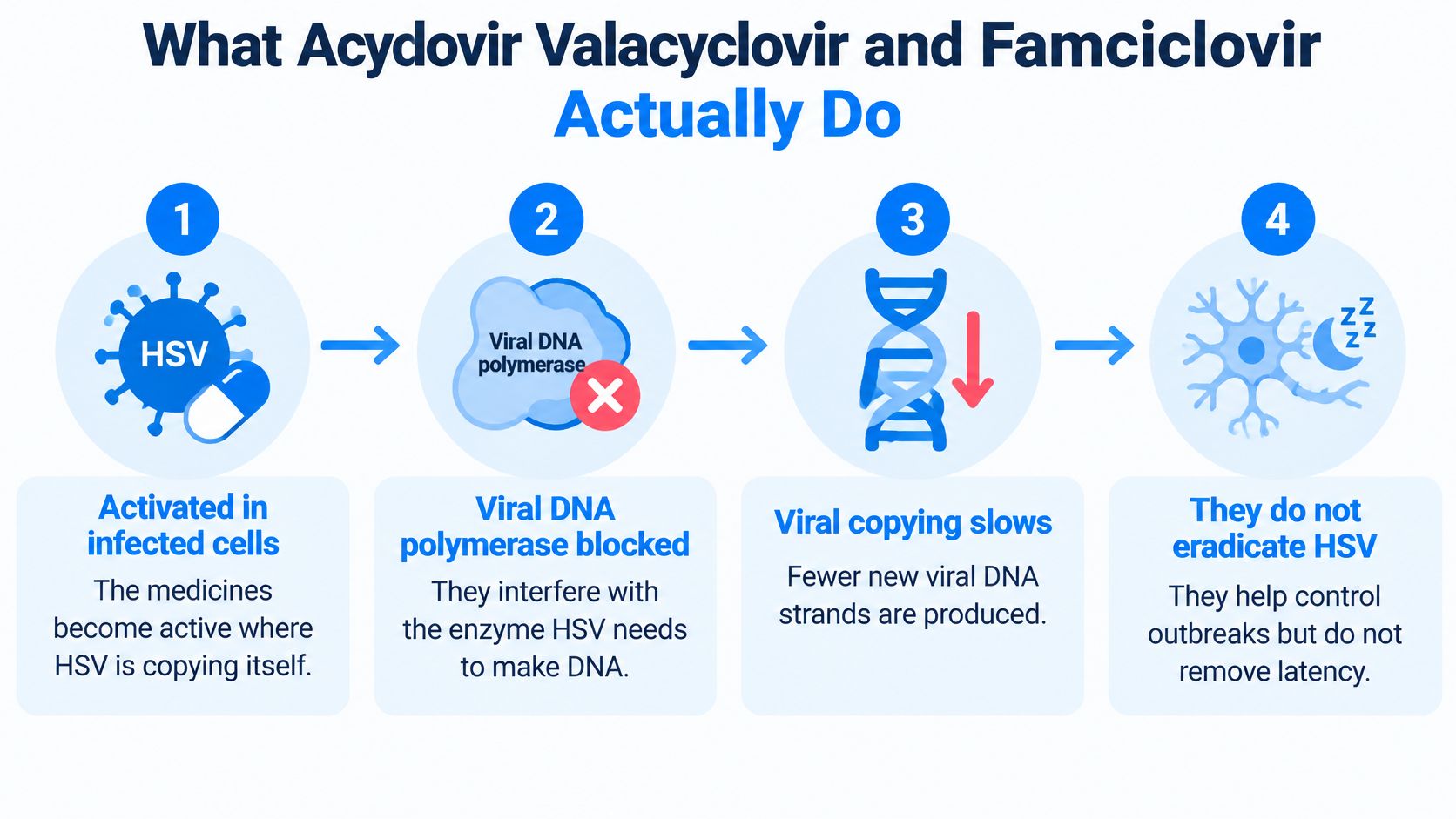
Acyclovir, valacyclovir, and famciclovir interfere with HSV DNA replication. Valacyclovir is converted to acyclovir, while famciclovir is converted to penciclovir. After further activation, their antiviral forms interfere with viral DNA polymerase, the enzyme HSV uses to copy its genetic material.
That mechanism makes these medicines useful during viral replication. It doesn't provide a way to extract a silent episome from a neuron's nucleus. Choosing the appropriate medication and schedule is therefore a decision about controlling activity, not removing the reservoir.
Match treatment to its purpose
Episodic therapy treats an individual recurrence. According to the WHO herpes simplex fact sheet, treatment for recurrent episodes is most effective when started within 48 hours of symptom onset.
A person with an established clinician-directed plan may be instructed to act during familiar prodromal symptoms, such as tingling or burning, rather than wait for a fully developed lesion. The medication, dose, and course should follow that person's prescription rather than an improvised schedule.
Daily suppressive therapy serves a different purpose. It aims to reduce recurrences and, in appropriate circumstances, lower the likelihood of transmission while treatment continues. A clinician weighs that benefit against the person's medical history, preferences, and treatment burden.
The CDC treatment guidelines explicitly state that antiviral therapy neither eradicates latent virus nor prevents recurrences after treatment is discontinued. Recurrence after stopping treatment therefore doesn't necessarily indicate drug resistance or an incorrect prescription.
Use medication within a broader care plan
Medication doesn't replace communication or exposure precautions. For genital herpes, risk reduction can include:
- Avoiding sexual contact during prodrome or lesions: New tingling, burning, or visible sores should trigger the agreed precautions.
- Using condoms consistently: Barrier protection can reduce risk but doesn't cover every potentially infectious skin surface.
- Discussing HSV with partners: Treatment should be described as risk reduction, not proof that transmission is impossible.
Some situations need more than a routine recurrence plan. A first severe episode, pregnancy or pregnancy planning, and frequent troublesome outbreaks warrant individualized clinical direction. Leftover medication from an unrelated prescription isn't an adequate substitute.
Immunocompromised patients may have more prolonged or severe HSV activity and require specialized management. Kidney function also matters when a clinician selects antiviral dosing, because drug handling and accumulation affect safety.
A clinician may revise treatment as circumstances change. That review should assess symptoms, tolerability, adherence, and partner-related goals without interpreting the absence of sores as proof of clearance. No telehealth brand should promise that an antiviral prescription will eliminate HSV.
Where Vaccines and Gene Editing Stand in 2026
Care and research options against a sterilizing cure
| Approach | Main target | Status in 2026 | Removes latent DNA |
|---|---|---|---|
| Episodic antiviral | Virus copying itself during an outbreak | Standard clinician-directed care | No |
| Daily suppressive antiviral | Ongoing replication and shedding | Standard care while taken | No |
| Preventive HSV vaccine | Infection in someone not yet infected | Investigational | No for established infection |
| Therapeutic HSV vaccine | Immune control of recurrence and shedding | Early trials, not an approved cure | No established removal |
| HSV-2 mRNA vaccine | Immune response to HSV-2 | First-in-human research with projected continuation into the following year | No established removal |
| Gene editing of episomes | Latent DNA in neurons | Preclinical mouse reductions, not established human clearance | Not shown safely in people |
| Shingles vaccine | Varicella-zoster virus | Approved for shingles prevention, not HSV | No |
A preventive vaccine and a therapeutic vaccine answer different questions. The former aims to prevent infection in someone who hasn't acquired the target virus. The latter aims to improve immune control in someone already infected, potentially reducing recurrences or shedding.
Neither purpose automatically requires removal of established latent DNA. Even a vaccine that produces strong immune responses must demonstrate whether those responses translate into the clinical benefit being claimed.
Early trials are not clinical availability
The HSV vaccine trial information describes investigational development, including a first-in-human HSV-2 mRNA study that began in 2025 and is expected to continue through 2027. That projected schedule is not an approval date or a prediction that the vaccine will eliminate infection.
Therapeutic-vaccine research in adults with recurrent HSV-2 has also evaluated safety, immune responses, and preliminary clinical benefit. Participants in the described study were required to pause suppressive antivirals so investigators could evaluate the investigational intervention.
That is a research procedure under a study protocol. It isn't advice for patients to stop prescribed medication independently, and trial enrollment doesn't establish that an experimental product can replace existing care.
Gene editing addresses a different target: the latent viral genome itself. Its appeal is mechanistic precision, but human delivery, off-target effects, neuronal safety, and transmission outcomes remain essential unresolved questions. A promising platform name doesn't answer those questions.
Why shingles vaccination is different
Shingles is caused by varicella-zoster virus, not herpes simplex virus. Genital herpes is usually caused by HSV-1 or HSV-2. Although these viruses belong to the broader herpesvirus family, their vaccines aren't interchangeable.
A shingles vaccine is therefore not a treatment for genital herpes and doesn't remove HSV from sensory neurons. Shared family membership isn't enough to make immune protection transferable between distinct viruses.
Meaningful human evidence can take years to accumulate. No responsible interpretation of an early trial can convert a projected completion date into a promised treatment timeline. If a future intervention reduces outbreaks without demonstrating removal of latent genomes, its benefit should be described according to that measured outcome.
Three Myths That Make Suppression Look Like Clearance
Quiet skin means the infection has disappeared
A person may interpret months without lesions as proof that the body has eliminated HSV. Clinically, symptom history records what the person noticed, not every episode of viral activity. It cannot establish whether the neuronal reservoir remains.
The useful distinction is between feeling well and documenting eradication. Feeling well is a legitimate treatment goal, but it isn't a laboratory demonstration that infection has ended.
A symptom-free partner cannot carry HSV
A partner who has never recognized an outbreak may still have HSV. Mild symptoms can be overlooked or mistaken for irritation, and some infections don't produce recognizable symptoms.
That uncertainty also means symptom timing alone cannot reliably establish when infection occurred or identify who transmitted it. Partner conversations should avoid treating a new diagnosis as proof of recent exposure or dishonesty.
An outbreak product can replace antiviral care
Supplements, creams, and unapproved peptides marketed for outbreaks have no established role as a sterilizing strategy. A product that soothes irritation, changes skin appearance, or supports general wellness hasn't thereby shown removal of neuronal HSV DNA.
Control of symptoms is real progress, and it is not the same as an empty ganglion.
A useful headline check asks:
- Which outcome was measured? Lesion healing, recurrence frequency, shedding, and latent DNA are different endpoints.
- Who or what was studied? Cell cultures, animals, and human participants provide different levels of clinical evidence.
- What disappeared? Reduced detectable viral material is not necessarily complete reservoir removal.
- How was safety assessed? A biologically active intervention must also preserve normal tissue function.
These questions allow readers to recognize meaningful progress without accepting a claim broader than the evidence supports.
Plan Care Around Suppression Not Eradication
Adults with recurrent oral or genital symptoms should seek diagnostic evaluation rather than purchase a product advertised to clear herpes. When a lesion is present, a clinician can determine whether sampling is appropriate and distinguish HSV from other causes of sores or irritation.
The practical treatment discussion usually concerns episodic therapy versus daily suppression. Pregnancy plans, immune status, outbreak burden, kidney function, partner considerations, and applicable law can affect that decision. No general article can supply an individualized dosing protocol.
Keep other wellness therapies separate
Treatments for unrelated concerns aren't HSV treatments. Semaglutide and tirzepatide act through GLP-1 or combined GIP/GLP-1 receptor pathways for metabolic care alongside lifestyle measures; a “metabolic reset” isn't evidence of viral clearance. Hair therapies such as finasteride and dutasteride reduce DHT formation, while minoxidil supports hair growth through a different pathway.
Tadalafil and sildenafil inhibit PDE5 in erectile-dysfunction care and require individualized dosing assessment. NAD+, sermorelin, glutathione, and MIC + B12 approaches address separate wellness discussions, not established HSV eradication. Menopause-related bio-identical hormone care likewise requires evaluation of symptoms and systemic versus topical exposure, not assumptions about antiviral effects.
Make prescribing decisions individually
At Vials + Vitals, prescription treatments and compounded formulations are prescribed strictly at the clinical discretion of licensed U.S. healthcare providers following an individualized telehealth intake and consultation. Completing an assessment does not ensure a prescription or a clinical outcome. Compounded medications are not FDA-approved or evaluated by the FDA for safety, effectiveness, or quality.
This page does not offer an HSV protocol. Patients should not stop prescribed antivirals to pursue an experimental headline or substitute unrelated sexual-wellness or longevity therapies for infection care.
Informational purposes only. Compounded medications are evaluated by a licensed provider for individual suitability and are fulfilled by state-licensed partner compounding pharmacies.
Vials + Vitals offers provider-directed telehealth assessment for metabolic health, hair health, sexual wellness, longevity, and menopause-related hormone concerns, not a promised means of clearing HSV. Adults exploring those separate care needs can visit Vials + Vitals to review available services and begin an individualized clinical assessment, while arranging HSV-specific evaluation with an appropriate licensed clinician.