When to Take Metformin with Meals for Best Results
Learn when to take metformin with meals, how immediate and extended-release dosing differ, and what to do for missed doses or GI side effects.

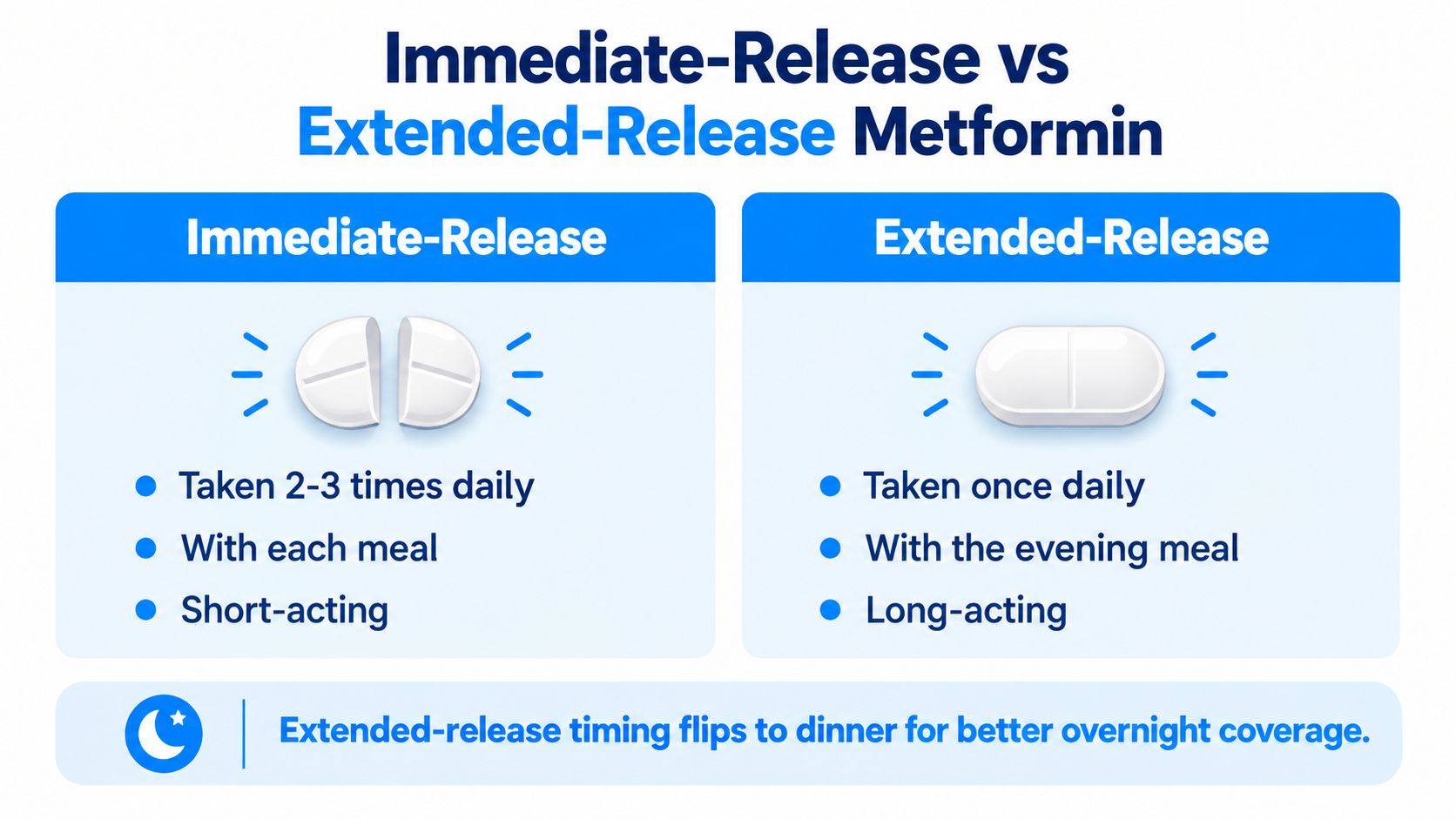
Metformin should be taken with or immediately after a meal. Immediate-release tablets are commonly divided across meals, while extended-release metformin is usually taken once daily with the evening meal, with the exact schedule determined by the prescribed formulation and the clinician's instructions.
A new prescription can create a surprisingly practical problem. The label may say “with meals,” but the patient may skip breakfast, work overnight, eat dinner at an unpredictable time, or wonder whether “with” means before, during, or after the first bite. The right answer depends less on a perfect clock time than on matching the prescribed formulation to a real meal and protecting gastrointestinal tolerability.
The Core Rule for Taking Metformin With Meals
The simplest counseling rule is also the most useful: take metformin with food or immediately after eating, not on an empty stomach. Nausea, diarrhea, and abdominal discomfort are particularly common when treatment begins, and meal pairing can make the medicine easier to tolerate. The National Health Service guidance on metformin advises taking conventional metformin with food, commonly one to three times daily, while the exact schedule varies by product and prescription.
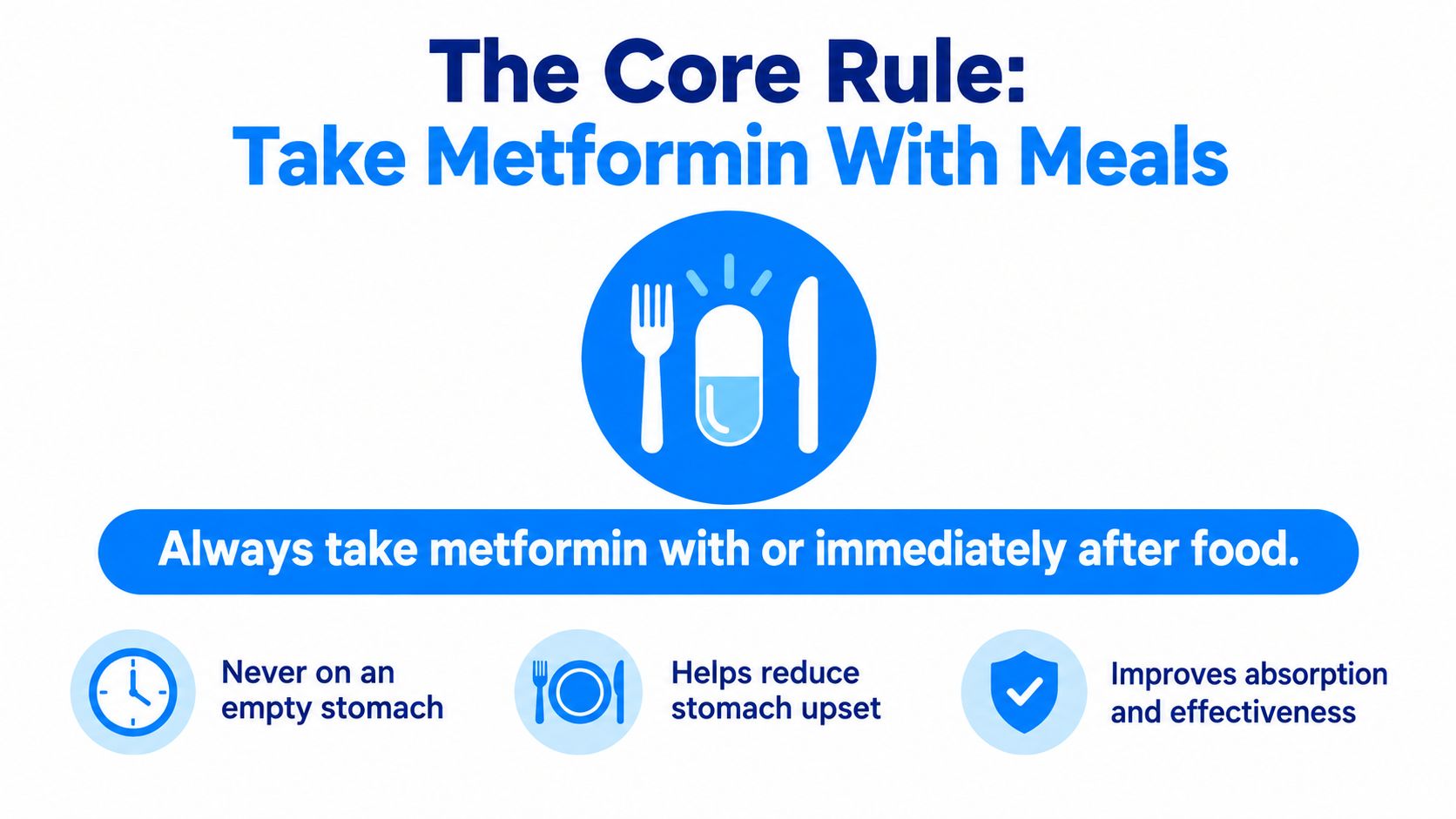
Food does more than make the dose easier to remember. It can reduce the intensity of stomach-related symptoms, and the timing creates a repeatable routine that patients can maintain. The important distinction is that tolerability often determines whether a patient continues metformin, not whether the medicine can lower glucose under ideal conditions.
Start with the bottle, not the clock
Look for the formulation on the label:
- Immediate-release metformin is commonly taken in divided doses with meals. A prescription may call for breakfast and dinner, or for three meal-associated doses.
- Extended-release or modified-release metformin is often taken once daily, commonly with the evening meal.
- The prescribed directions take priority over a general schedule. Kidney function, glucose response, and other medicines can change the appropriate dose and timing.
Patients should swallow tablets whole with water. Extended-release tablets, in particular, shouldn't be crushed or chewed because altering the tablet can interfere with the intended release pattern.
A meal doesn't need to be elaborate. The practical goal is to avoid taking the tablet into an empty stomach, then to use a meal that occurs reliably enough to support adherence. Patients who are also coordinating timing probiotics with meals should keep each product's instructions separate rather than assuming that all meal-associated medicines follow the same schedule.
Practical rule: The correct answer to “when to take metformin” starts with the formulation and ends with a meal the patient can reliably eat.
Immediate-Release Metformin and Why It Makes Sense
Immediate-release metformin is generally prescribed in divided doses with meals, rather than as one large bedtime dose. The reason is practical and pharmacokinetic. Meal-associated dosing helps distribute exposure through the day and may make gastrointestinal effects more manageable.
For an immediate-release product, food changes how metformin enters the bloodstream. A single 850-mg dose taken with food produced an approximately 40% lower peak plasma concentration, 25% lower overall exposure, and a 35-minute delay in time to peak concentration compared with fasting administration, according to FDA prescribing information for immediate-release metformin. Those differences support the familiar instruction to take the medicine with meals, while the meal itself can reduce the chance of nausea, diarrhea, or abdominal discomfort. (https://www.accessdata.fda.gov/spl/data/0b7a97b7-9be1-26c2-e063-6394a90ae0c6/0b7a97b7-9be1-26c2-e063-6394a90ae0c6.xml)

How to use a divided schedule
A patient prescribed two daily doses will often pair them with two reliable meals. A patient prescribed three daily doses will generally pair them with breakfast, lunch, and dinner, according to the label. The prescription shouldn't be compressed into one bedtime dose because bedtime is convenient.
Moving all immediate-release doses to bedtime can place multiple tablets against one meal, or against no meal at all. That approach may worsen gastrointestinal symptoms and leaves the daytime schedule different from the regimen selected by the prescriber. A pill organizer, a meal-based reminder, or keeping the bottle in a safe location associated with a regular meal can reduce uncertainty without changing the prescription.
Expect gradual adjustment
Clinicians may begin with a lower amount and increase it gradually over several weeks. This approach gives the gastrointestinal tract time to adapt and allows the prescriber to assess tolerability before further escalation. Patients shouldn't speed up that process because the glucose effect seems insufficient early on.
For patients using metformin for polycystic ovary syndrome, meal-associated dosing remains important even though the treatment goal may differ from glucose management alone. A patient looking for broader context on how metformin helps PCOS should still follow the formulation-specific prescription rather than applying a diabetes schedule or changing doses independently.
Extended-Release Metformin and the Evening Meal
Extended-release metformin usually follows a different daily pattern: one dose with the evening meal. Evening isn't especially special, and patients shouldn't assume that every metformin product belongs at dinner. The evening meal is the anchor recommended for several extended-release labels, making the once-daily dose easier to associate with food and the product's intended release profile.
For one extended-release product, prescribing information specifies an initial dose of 500 mg with the evening meal, with increases of 500 mg at weekly intervals according to glucose control and tolerability, up to 2,000 mg once daily with the evening meal. The same labeling explains that administration with food helps decrease stomach upset. (https://dailymed.nlm.nih.gov/dailymed/fda/fdaDrugXsl.cfm?setid=2a84c550-aed8-4058-961f-351a5e4cf7a1)
Food can also alter exposure differently across formulations. In that extended-release label, total exposure, measured by area under the concentration-time curve, increased by approximately 60% when the product was taken with food. This is the opposite direction from the exposure changes described for the evaluated immediate-release conditions, which is why patients shouldn't transfer instructions from one formulation to another.
The formulation determines the meal
| Formulation | Usual pattern | Meal pairing |
|---|---|---|
| Immediate-release | Divided daily doses | With the prescribed meals |
| Extended-release | Usually once daily | Commonly with the evening meal |
A 2023 systematic review and meta-analysis of 14 clinical trials involving 408 participants found that food reduced metformin exposure by approximately 28% to 30% and peak concentration by about 40% in the evaluated immediate-release studies. High-fat, high-calorie meals also slowed absorption. In contrast, extended-release labeling for the evaluated product reported an exposure increase of approximately 50% with food. (https://pmc.ncbi.nlm.nih.gov/articles/PMC10344758/)
The apparent conflict is the clinical lesson. “Take metformin with food” is a safety and administration rule, but the precise food effect depends on the formulation. If the bottle says extended-release and the patient wants to move the dose to breakfast, the safest response is to ask the prescriber or pharmacist first, not to experiment.
Matching Your Dose to Your Real Meals
A workable schedule fits the patient's actual day. The best anchor is usually a meal that occurs reliably, not an idealized breakfast or a fixed clock time that disappears on weekends.
A patient who routinely skips breakfast shouldn't automatically take immediate-release metformin before leaving home. The patient should follow the prescribed meal pattern, use an appropriate meal-based routine, and contact the prescriber if the written schedule doesn't match daily eating habits. The goal is a repeatable pairing rule, not a forced meal that creates a new adherence problem.
Build the routine around predictable eating
- Breakfast skipper: If the prescription calls for divided doses and breakfast rarely happens, the patient should ask the prescriber whether lunch and dinner can serve as the appropriate anchors. The schedule shouldn't be changed independently.
- Night-shift worker: “Morning” means the beginning of the waking period, not necessarily sunrise. The patient should pair doses with the first and last reliable meals of the waking day, while confirming the plan with the clinical team.
- One-large-meal pattern: A once-daily extended-release prescription may be easier to associate with the evening meal, but immediate-release doses shouldn't be consolidated into that meal without prescriber direction.
- Travel across time zones: Patients should preserve the prescribed relationship between the dose and food, then ask the pharmacist how to handle a substantial schedule change. A short trip doesn't justify doubling or compressing doses.
A meal-based reminder is more useful than a clock reminder when the medicine must be taken with food.
Every tablet should be swallowed whole with water. Never crush or chew extended-release metformin, because doing so can release the medicine differently from the way the product was designed to work. Patients who see an intact tablet shell in the stool should discuss the specific product with a pharmacist rather than altering it themselves.
Meal timing also matters when patients are coordinating several therapies. A patient reviewing weight-management treatment and asking why they aren't losing weight on semaglutide should avoid assuming that metformin and a separate therapy can be moved to the same meal without checking each prescription.
Common Timing Mistakes Worth Avoiding
Most timing errors come from a reasonable but incorrect assumption: faster absorption must mean better treatment, a missed meal must mean a missed tablet, or one metformin product must behave like another. Those shortcuts can increase stomach upset or create an uneven dosing pattern.
The following mistakes deserve attention:
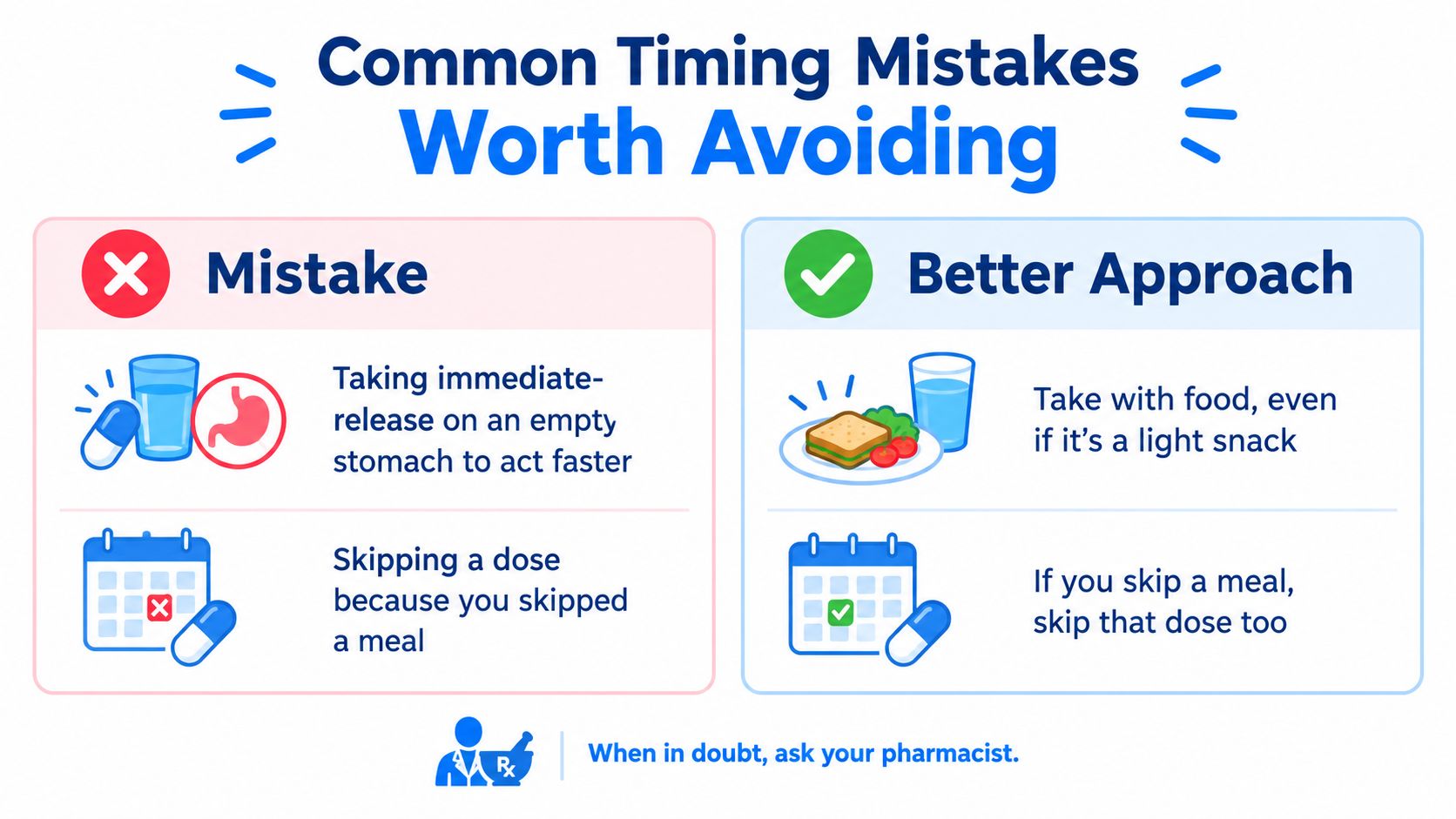
- Taking immediate-release metformin on an empty stomach: This can increase gastrointestinal discomfort and changes absorption compared with taking the same dose with food. The medicine doesn't need an empty stomach to work.
- Moving every dose to bedtime: Immediate-release regimens are commonly divided across meals. Consolidating them can conflict with the prescription and place the total amount against one meal.
- Treating all formulations alike: Immediate-release and extended-release products have different administration patterns and different food-related pharmacokinetic behavior.
- Crushing or chewing a modified-release tablet: This can interfere with controlled release. Tablets should be swallowed whole unless the product instructions specifically say otherwise.
- Doubling after a missed extended-release dose: One FDA-listed extended-release label advises skipping the missed dose and resuming the normal schedule, rather than taking two doses together. (https://dailymed.nlm.nih.gov/dailymed/fda/fdaDrugXsl.cfm?setid=2a84c550-aed8-4058-961f-351a5e4cf7a1)
What to do after a missed meal
A missed meal creates a formulation-specific question. If a patient has immediate-release metformin prescribed with that meal, the patient shouldn't invent a replacement schedule or double the next dose. The label and the pharmacist's instructions should determine whether the missed dose is skipped or taken later with food.
Patients who miss doses repeatedly should treat that pattern as useful clinical information. The solution may involve a different formulation, a revised meal anchor, a reminder strategy, or a prescription adjustment, but it shouldn't be improvised at the kitchen counter.
Missed-dose rule: Don't compensate with an extra tablet unless the prescriber explicitly directs it.
When the Standard Schedule Needs Prescriber Input
The ordinary rule, take metformin with food, isn't enough for every clinical situation. Patients should contact the prescriber before changing the schedule when kidney function is reduced, when a procedure involves iodinated contrast, or when another medicine changes the glucose-lowering plan.
Situations that warrant a call
Kidney impairment matters because the appropriate metformin plan depends partly on renal function. A patient with new kidney concerns, a change in kidney laboratory results, or a clinician's warning about renal impairment shouldn't adjust the dose or timing alone.
Upcoming imaging with iodinated contrast requires advance communication. The care team may provide product-specific instructions based on kidney function, the imaging procedure, and the patient's broader condition. Waiting until the appointment can create avoidable confusion.
Vomiting, dehydration, or severe acute illness also changes the risk assessment. A patient who can't keep fluids down, has substantial diarrhea, or is becoming dehydrated should seek prompt clinical advice about the next dose rather than trying to maintain the routine at all costs.
Persistent gastrointestinal symptoms deserve review when they don't settle with the prescribed titration approach. Ongoing diarrhea, vomiting, severe abdominal discomfort, or inability to eat can undermine adherence and hydration. The prescriber may need to reassess dose, formulation, kidney status, or another cause.
Changes to other glucose-lowering medicines can also require coordination. A patient starting or stopping another treatment shouldn't shift metformin to a different meal to make the overall schedule look cleaner.
For general education on metabolic habits, a science-backed blood sugar guide may provide useful background, but it doesn't replace a medication review. Patients should also keep the broader treatment plan in view, including any clinician-directed metabolic reset review, rather than treating meal timing as a standalone solution.
A Two-Question Check Before Every Dose
At the kitchen counter, the entire decision can be reduced to two questions:
- Which formulation is in the bottle? Is it immediate-release, extended-release, or another modified product?
- Which meal is on the plate? Is this the meal assigned to the prescribed dose, and is there enough food to avoid taking the tablet on an empty stomach?
For immediate-release metformin, the answer usually points to divided meal-associated doses. For extended-release metformin, it usually points to one dose with the evening meal. The patient should still follow the pharmacy label because the exact schedule can vary with kidney function, glucose response, and other medicines.
The one-minute safety check
- Read the label: Confirm the formulation, dose, and frequency before changing anything.
- Pair the dose with food: Take metformin with or immediately after the appropriate meal.
- Swallow it correctly: Use water, and don't crush or chew extended-release tablets.
- Handle missed doses cautiously: Don't double a dose unless the prescriber specifically instructs it.
- Escalate the right problems: Contact the clinical team for persistent gastrointestinal symptoms, dehydration, kidney concerns, contrast imaging, or medication changes.
The most reliable schedule is the one that respects both the pharmacology and the patient's real life. A patient who repeatedly skips a meal, works overnight, travels, or cannot tolerate the prescribed routine needs a clinician-guided adjustment, not a private experiment. For patients coordinating temperature-sensitive therapies alongside oral medicines, understanding cold-chain shipping is a separate practical issue, and it shouldn't be confused with metformin meal timing.
Vials + Vitals provides physician-directed telehealth care for individualized metabolic protocols, including clinician-supervised tirzepatide and semaglutide treatment when appropriate. Adults can complete an online clinical assessment and receive licensed provider review, personalized titration guidance, and pharmacy fulfillment when treatment is clinically indicated. Visit Vials + Vitals to begin the evaluation.