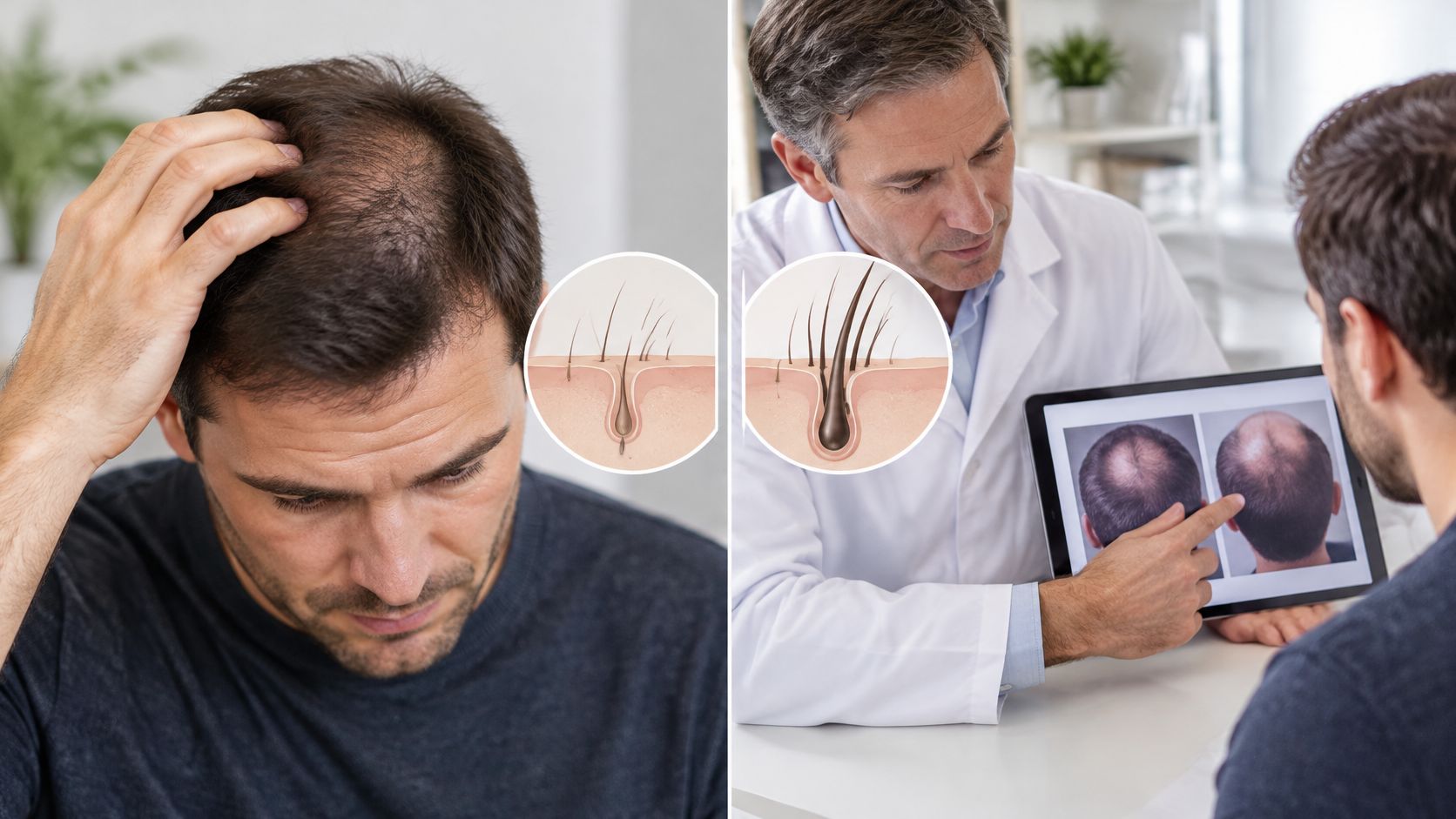
Hair Loss Treatment That Actually Works: 2026 Guide
Find a hair loss treatment that actually works in 2026. Compare proven options, real results and expert guidance to regrow hair with confidence.

Most start hair loss treatment by shopping for a product. That's backwards. The first question is whether the shedding is androgenetic alopecia, a temporary shed, a scarring disorder, or something systemic, because finasteride and minoxidil do not treat every type of hair loss.
That distinction matters because the wrong diagnosis wastes time, money, and hair. The honest version of hair loss treatment that works starts with pattern recognition, then moves to therapies with real evidence, realistic timelines, and physician supervision when the diagnosis is unclear or the risk is significant.
Why Most Hair Loss Advice Fails Before It Starts
The biggest mistake is treating hair loss like a shopping problem instead of a medical one. A scalp doesn't care how expensive the bottle is if the cause is telogen effluvium, alopecia areata, a scarring alopecia, thyroid disease, nutritional deficiency, or medication-related shedding. Those problems need different answers, and some need prompt medical care.
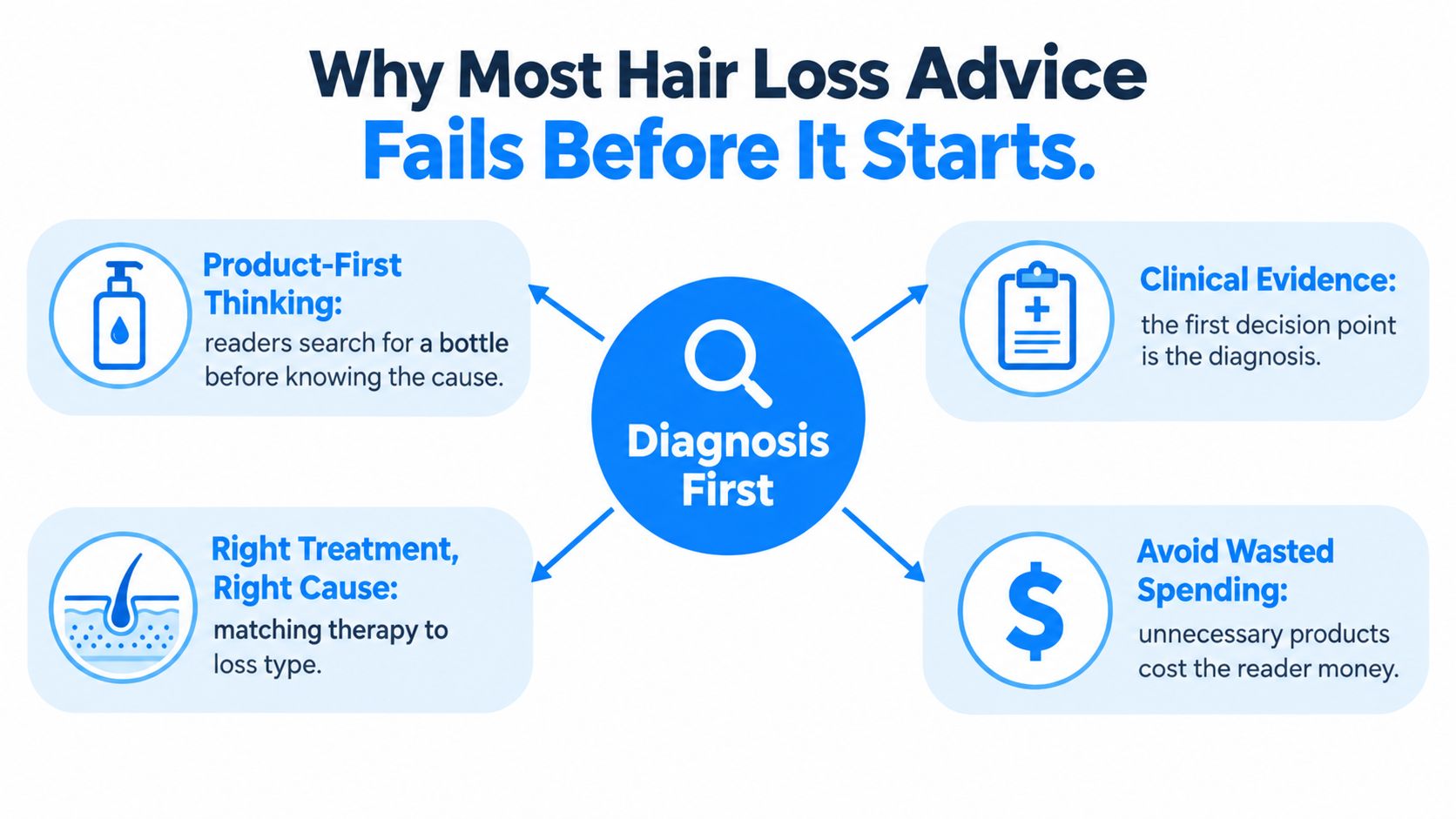
The first filter is cause, not confidence
For men with classic pattern loss, finasteride has one of the strongest long-term evidence bases among prescription treatments. For women with pattern loss, topical minoxidil has the clearest evidence among the mainstream options. That does not make either drug universal, and it certainly doesn't mean they belong in every case of shedding.
Practical rule: if the pattern is sudden, patchy, inflamed, or tied to a recent trigger, the bottle comes second.
The Vials + Vitals Medical Board approach is blunt on this point. If the diagnosis is wrong, the treatment plan is wrong, no matter how good the marketing sounds. The right path is to separate pattern loss from lookalikes before any ranking of products even begins.
What the rest of the plan should do
An evidence-based plan has three jobs. First, it identifies the hair-loss type. Second, it matches the therapy to that type. Third, it sets a timeline that patients can realistically follow, because hair regrowth is slow and maintenance matters.
That means no fantasy promises and no one-size-fits-all protocol. It also means stopping wasted spending on treatments that can't work for the condition in front of the clinician. The rest of this guide stays inside that frame.
Figuring Out What Kind of Hair Loss You Have
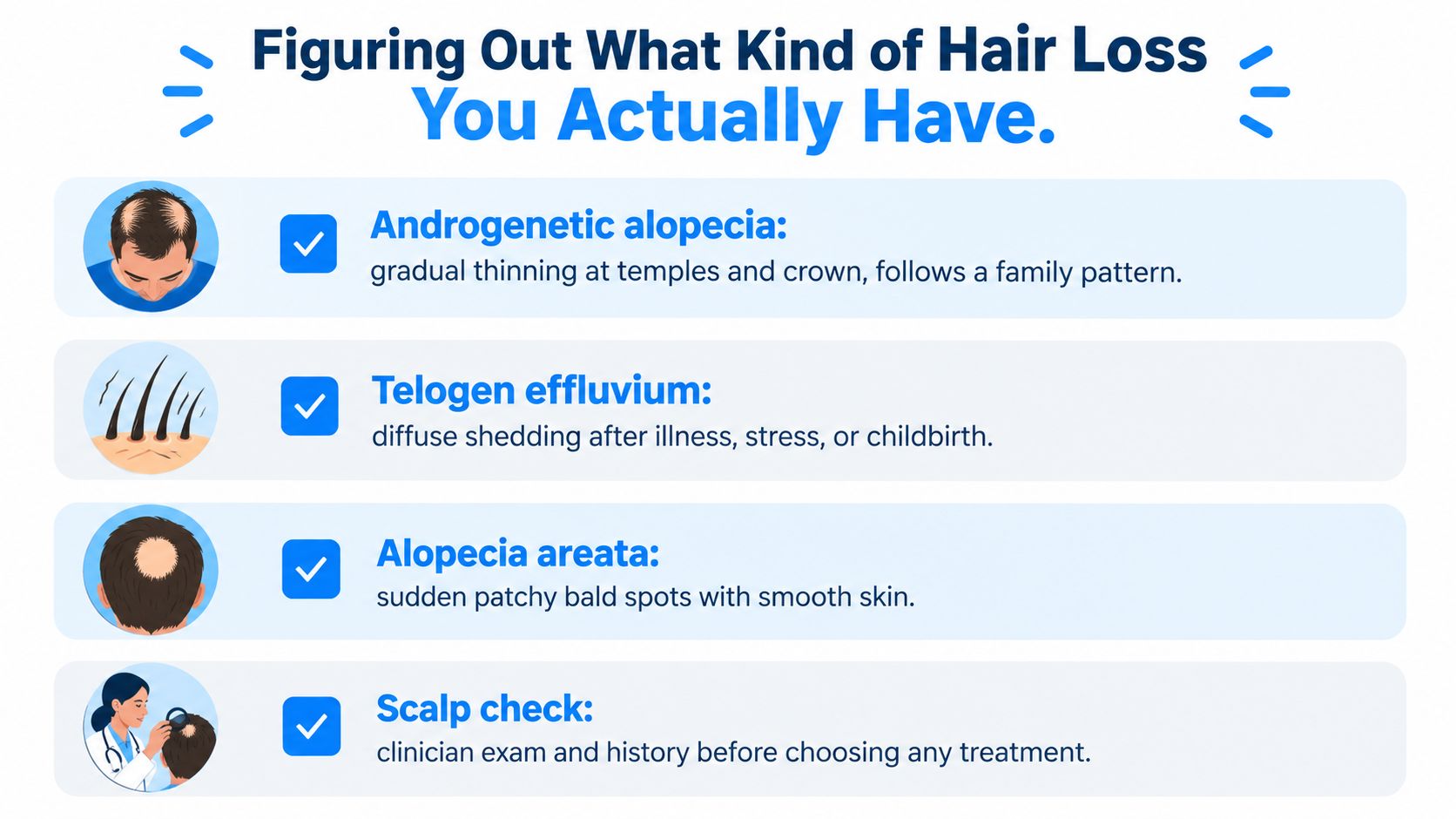
A useful diagnosis starts with pattern recognition before any treatment begins. Androgenetic alopecia usually causes gradual thinning at the temples or crown, often with a family pattern. Telogen effluvium is diffuse shedding that often follows a trigger, while alopecia areata usually appears as sudden patchy loss with smooth skin.
What belongs in the history
A clinician should ask about timing, distribution, illness, childbirth, weight loss, new medication, family history, scalp symptoms, and menstrual or hormone changes. That is not filler. It is how pattern loss gets separated from diffuse shedding and systemic causes.
AAFP guidance favors history, scalp examination, and selective labs instead of blanket testing, with dermoscopy or scalp biopsy when the picture is still unclear. When substantial loss comes with irregular menses, acne, hirsutism, or virilization, evaluation for androgen excess belongs on the table. When the scalp shows inflammation or signs of permanent follicle damage, waiting is the wrong move.
Red flags that should push the reader to a clinician
- Sudden patchy loss: think alopecia areata or another non-pattern process.
- Inflamed scalp changes: pimple-like perifollicular scale or visible irritation can point toward scarring disease.
- Diffuse shedding after a trigger: illness, childbirth, weight loss, or a new drug often fits telogen effluvium better than pattern loss.
- Irregular periods or excess androgens: women with those findings need a proper evaluation, not a guess.
A treatment that works starts with the right diagnosis, not a stronger product.
That matters even more for women, because a label like “hair thinning” can hide very different disorders. A patient who needs thyroid testing, iron review, or specialist assessment will not get there by using a scalp serum for six months.
Topical Minoxidil What the Evidence Actually Shows
Topical minoxidil is the most established over-the-counter option for pattern hair loss. It works by helping follicles stay in the anagen growth phase and by enlarging miniaturized follicles, which is not the same thing as correcting the androgen sensitivity underneath the problem. In other words, it helps the hair cycle, it doesn't rewrite the biology that caused the thinning.
What the data say
The strongest usable summary for women comes from a Cochrane review of 1,148 women. Among 593 women using minoxidil, 157 reported moderate-to-marked regrowth, compared with 77 of 555 using placebo, with a risk ratio of 1.93 and a 95% confidence interval of 1.51 to 2.47. That's a real effect, not a cosmetic rumor, and the review judged the evidence moderate quality for that outcome. The same review found no clear advantage of 5% over 2% minoxidil in the available comparison, and it did not support oral finasteride as a strong option for women.
How to use it without quitting too early
Minoxidil is a chronic therapy. It needs consistent application to the affected scalp, and response should be judged over at least 3 to 6 months, not two anxious weeks of looking in the mirror. Early shedding can happen when follicles shift into a new growth cycle, and people often mistake that for failure.
Clinical takeaway: standardized photos, identical lighting, and the same scalp part tell the truth better than daily shedding counts.
Irritation, itching, and unwanted facial hair can limit adherence, especially with stronger formulations. That's why the conversation should be about tolerability as much as potency. A treatment that can't be used consistently is a treatment that won't work.
Oral Finasteride for Men What Changes at Six and Twelve Months
For men with mild-to-moderate vertex androgenetic alopecia, finasteride 1 mg targets the upstream mechanism by inhibiting type II 5-alpha-reductase and lowering dihydrotestosterone. That matters because DHT is the androgen most tied to follicle miniaturization in genetically susceptible men. This is a preservation drug first, and a regrowth drug second.
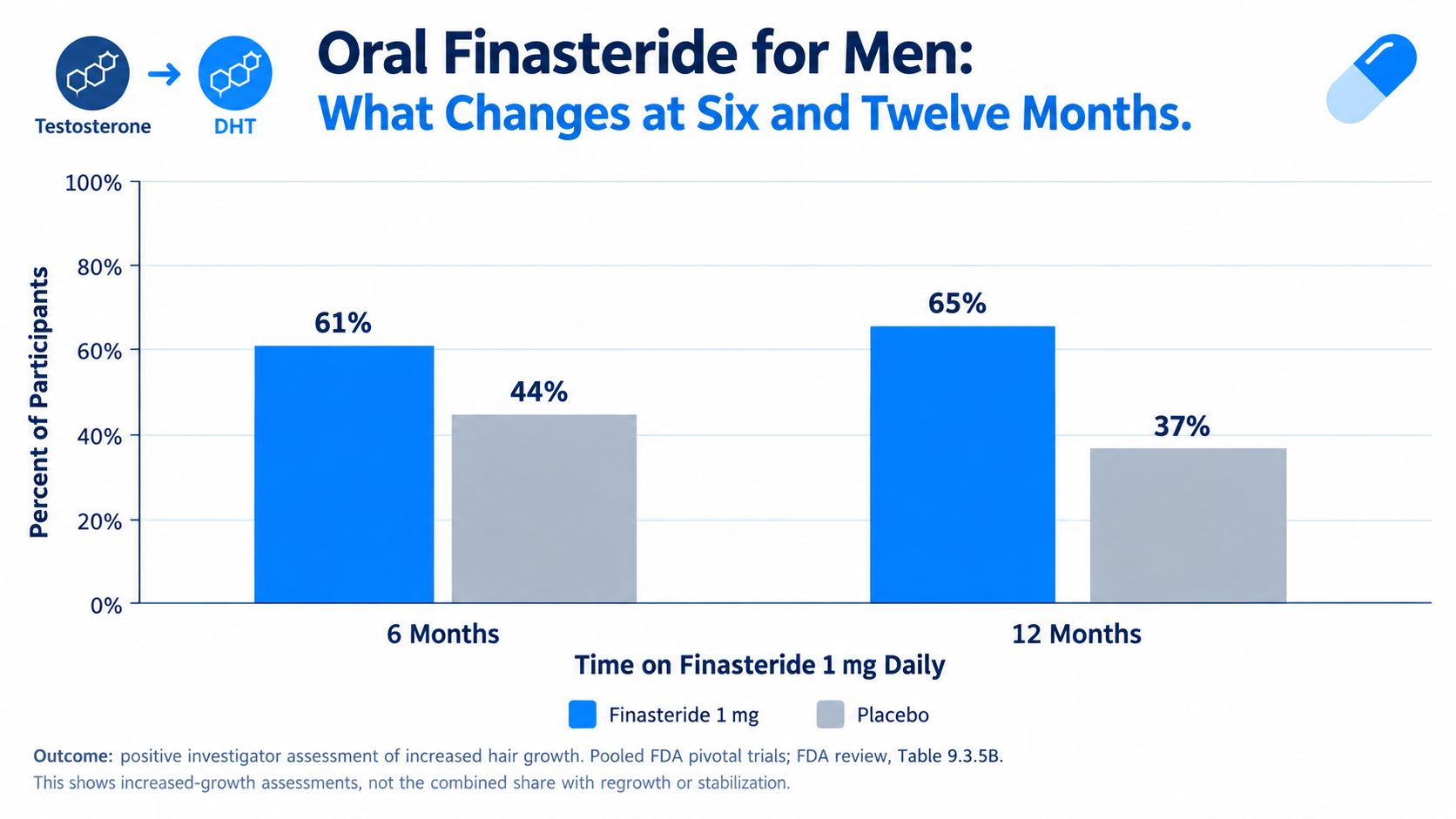
What the FDA-reviewed trials found
The FDA-reviewed evidence comes from three double-blind, randomized, placebo-controlled 12-month trials involving 1,879 men. In vertex-baldness studies, finasteride produced a 107-hair advantage over placebo within a 1-inch-diameter, 5.1-cm² target area at 12 months, with statistically significant differences already present at 6 months. The labeling also reports slowed further hair-loss progression for up to 5 years.
Those are strong numbers, but they don't mean everyone gets dramatic regrowth. The practical sequence is stabilization first, then visible density improvement later, usually with continued dosing required to keep the benefit.
What has to be said before prescribing
Sexual adverse effects and mood-related symptoms should be discussed before treatment starts and monitored during follow-up. Finasteride is indicated for men only in the cited FDA labeling, and people who are pregnant or may become pregnant should not take or handle crushed tablets because of fetal risk. The evidence also came from men with mild-to-moderate vertex loss, not complete baldness, so the data should not be stretched beyond the studied population.
A good candidate understands the tradeoff. Finasteride can be one of the most effective medical options for male pattern hair loss, but it is not a universal solution and it does not rescue every pattern of shedding.
Hair Loss Treatment Options for Women
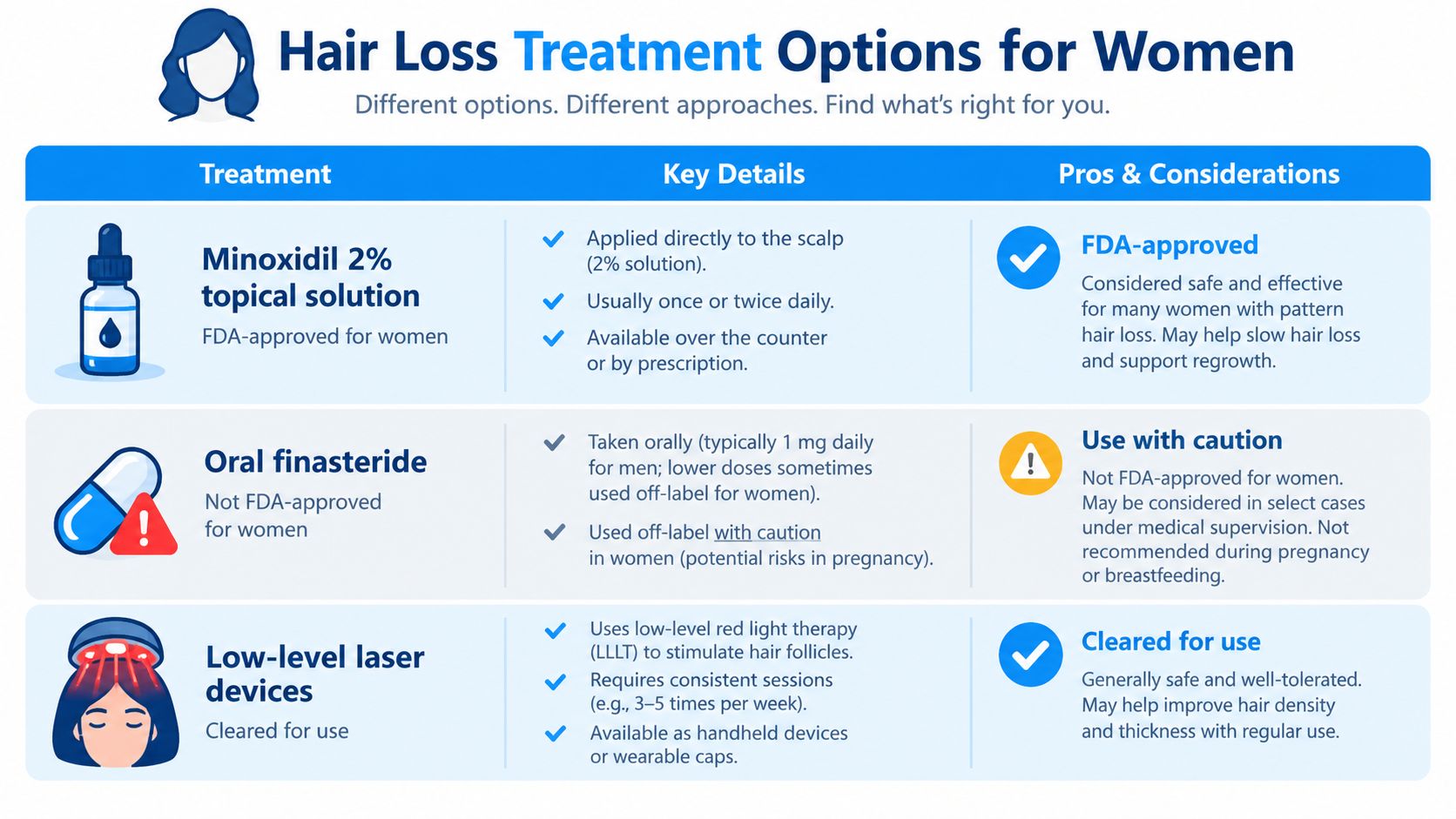
Women need a separate conversation, because many of the products marketed to them are borrowed from men and repackaged with softer branding. The strongest evidence for female pattern hair loss is still topical minoxidil, not casual low-dose finasteride. In the Cochrane review, minoxidil outperformed placebo, while oral finasteride did not.
What belongs at the front of the line
Topical minoxidil is the most defensible starting point for female pattern hair loss when the diagnosis is correct. Oral anti-androgens, such as spironolactone, can have a role when a clinician prescribes them off-label, especially when the hormonal pattern supports that choice. Low-level laser devices may be part of a broader plan, but they don't replace diagnosis or prescription therapy.
The finasteride data in women deserve a hard stop. In the Cochrane review, improvement occurred in 30 of 67 treated participants versus 33 of 70 on placebo, with a risk ratio of 0.95. That is not a persuasive signal for routine use.
The practical decision path
- Confirm the diagnosis. Female pattern loss should not be assumed when shedding is diffuse, sudden, or linked to a trigger.
- Start with topical minoxidil. That's the best-supported first move among standard options.
- Escalate under physician supervision if needed. Off-label hormonal treatment belongs in a real clinical plan, not a social-media guess.
Women with irregular periods, acne, or hirsutism should be evaluated for androgen excess before anyone reaches for a hair-growth shortcut.
The point is not to limit options. It's to stop treating every female scalp as if it were the same disease. The right treatment for the wrong diagnosis is still the wrong treatment.
GLP-1 Weight Loss and Hair Retention What Patients Need to Know
Weight-loss medication has entered the hair conversation for a simple reason, rapid body-weight change can trigger telogen shedding. That doesn't mean GLP-1 therapy is bad for hair. It means the rate of weight loss, the patient's nutrition, and the way dose escalation is handled all matter.
Why faster loss can backfire on hair
In adults with obesity but without type 2 diabetes, a 72-week phase 3b trial found mean body-weight reduction of 20.2% with tirzepatide versus 13.7% with semaglutide at maximum tolerated dose. A network meta-analysis of 7,179 participants also found maximum-tolerated-dose tirzepatide produced the largest average weight reduction, with a mean difference of -20.90% versus control, while semaglutide 2.4 mg produced -11.78%. Those results speak to efficacy, but hair retention is a different question.
Substantial or rapid weight reduction can create a physiologic stress signal, and that can show up as diffuse shedding weeks to months later. The fix is not to avoid metabolic treatment. The fix is to manage it properly.
What should be built into the plan
- Gradual titration: pushing dose too quickly can worsen nausea and intake problems.
- Adequate protein and micronutrients: the follicle cannot grow well in a deficit state.
- Clinical monitoring: hydration, appetite, and overall intake matter during escalation.
- Realistic expectations: the goal is durable weight loss without starving the hair cycle.
More rapid loss is not automatically better if it leaves the body underfueled.
That principle matters for any GLP-1-based plan, including tirzepatide and semaglutide. The same medication that helps metabolic health can stress follicular retention if the patient is eating too little or losing too quickly.
Procedures Telehealth and Compounded Options Ranked
Once the diagnosis is clear and the prescription path is chosen, procedures become a secondary layer, not the starting point. Hair transplantation is the only option here that relocates follicles. PRP and low-level laser therapy may help selected patients, but they do not replace medical therapy when the scalp is still actively thinning.
How to think about the options
PRP injections are best viewed as an adjunct in the right candidate, not a standalone cure. Low-level laser therapy can fit into a maintenance strategy for motivated patients who will use it consistently. Transplantation is for carefully selected cases where stable donor hair and a clear pattern make surgical restoration realistic.
Compounded therapies and telehealth can sit inside a physician-led workflow when they are done properly. That means a real intake, review by a U.S.-licensed clinician, formulation selection, dosing guardrails, and fulfillment through licensed pharmacy partners. In that setting, Vials + Vitals offers physician-directed hair-health protocols that may include prescription-strength compounded formulations, but only after clinical review and eligibility screening.
What a credible workflow should look like
- Intake first: duration, pattern, triggers, medication list, and goals.
- Prescriber review: the clinician decides whether treatment is clinically appropriate.
- Titration with guardrails: dose changes should be deliberate, not improvised.
- Ongoing monitoring: side effects, adherence, and response need follow-up.
Any approach that skips diagnosis, skips monitoring, or promises instant regrowth is not evidence-based care. It's retail.
When to See a Clinician and What to Do This Week
Self-treatment has a ceiling. The moment hair loss is sudden, patchy, inflamed, or tied to systemic symptoms, the patient needs a clinician instead of another product. The same is true when there's irregular menses, hirsutism, acne, or virilization, or when shedding follows a major trigger such as illness, childbirth, rapid weight loss, or a medication change.
A useful 7-day plan is straightforward. Bring a written timeline of the shedding, note whether it's diffuse, frontal, crown-based, or patchy, and list every new drug, supplement, illness, and weight-loss change from the last several months. Take baseline photos in the same lighting and at the same part line, then stop guessing about progress for a while.
Three commitments that actually help
- Get the diagnosis right: pattern loss, telogen effluvium, alopecia areata, and scarring disorders do not belong in the same bucket.
- Choose evidence over hype: minoxidil for women with pattern loss, finasteride for appropriate men, and clinician-guided escalation when needed.
- Respect the timeline: this is a months-long process, not a weekend fix.
Hair loss treatment works when the cause is identified, the therapy matches the cause, and the patient stays with the plan long enough to judge it fairly. That's the standard that should guide every next move.
Vials + Vitals provides physician-directed telehealth evaluation and protocol-driven treatment for hair health, including prescription-strength options selected after clinical review. For patients who want a medically supervised path instead of guesswork, visit Vials + Vitals to start an online assessment and see whether a clinician-directed plan is appropriate.