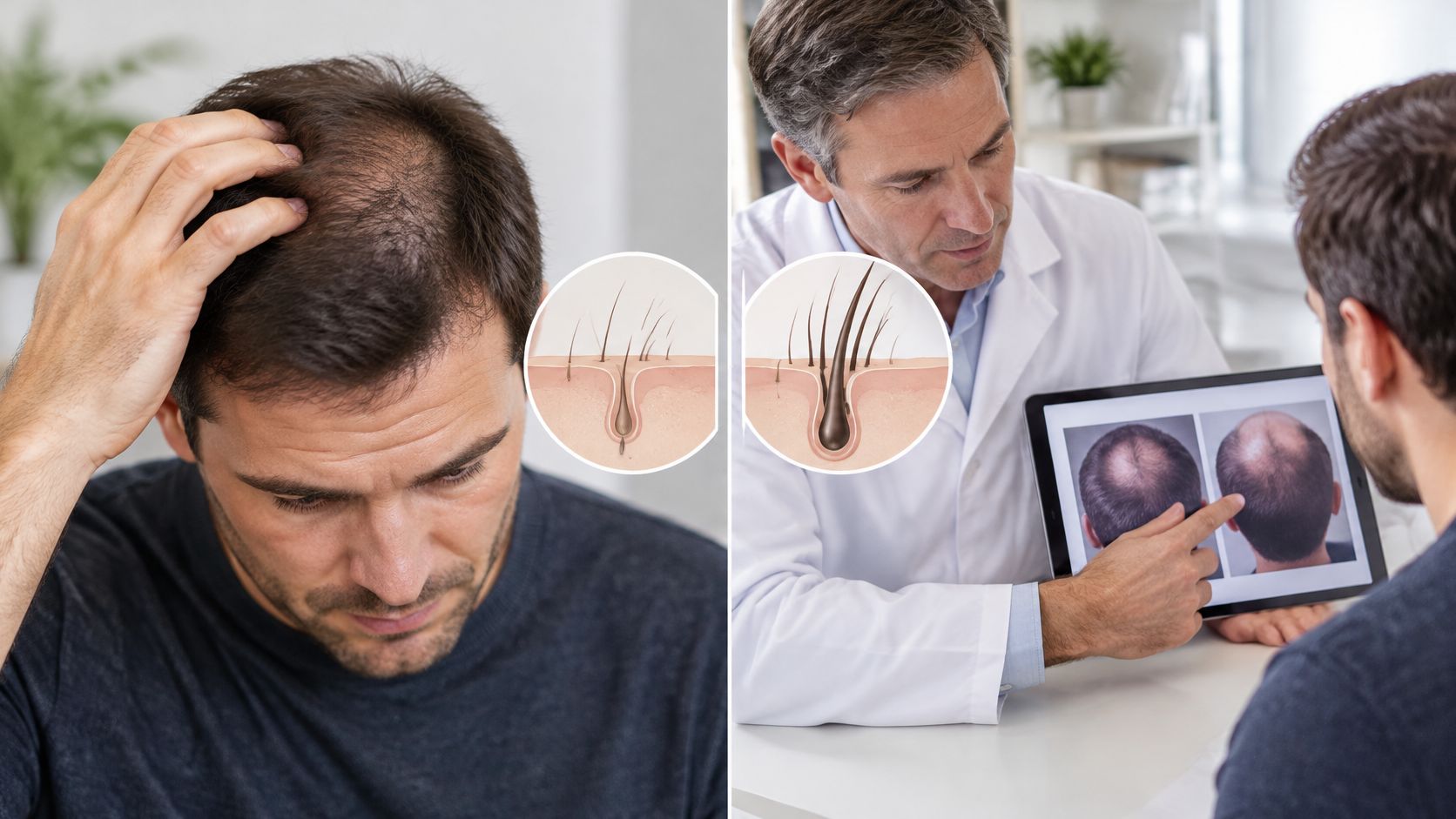
Best Hair Loss Treatment for Women Compared
Compare the best hair loss treatment for women, including minoxidil, antiandrogens, peptides, compounded prescriptions, procedures, risks, and telehealth.

The most popular advice about women's hair loss is also the least reliable: choose the strongest growth product and start immediately. That approach skips the decisions that matter most, including whether the problem is progressive thinning, temporary shedding, or a condition requiring specialized care. The best hair loss treatment for women is a diagnosis-matched plan, not a universal product ranking.
A clinically useful comparison weighs evidence, reproductive safety, adverse effects, and the likelihood that a patient can maintain treatment. It also separates hair retention during metabolic treatment from claims that semaglutide or tirzepatide directly injures follicles.
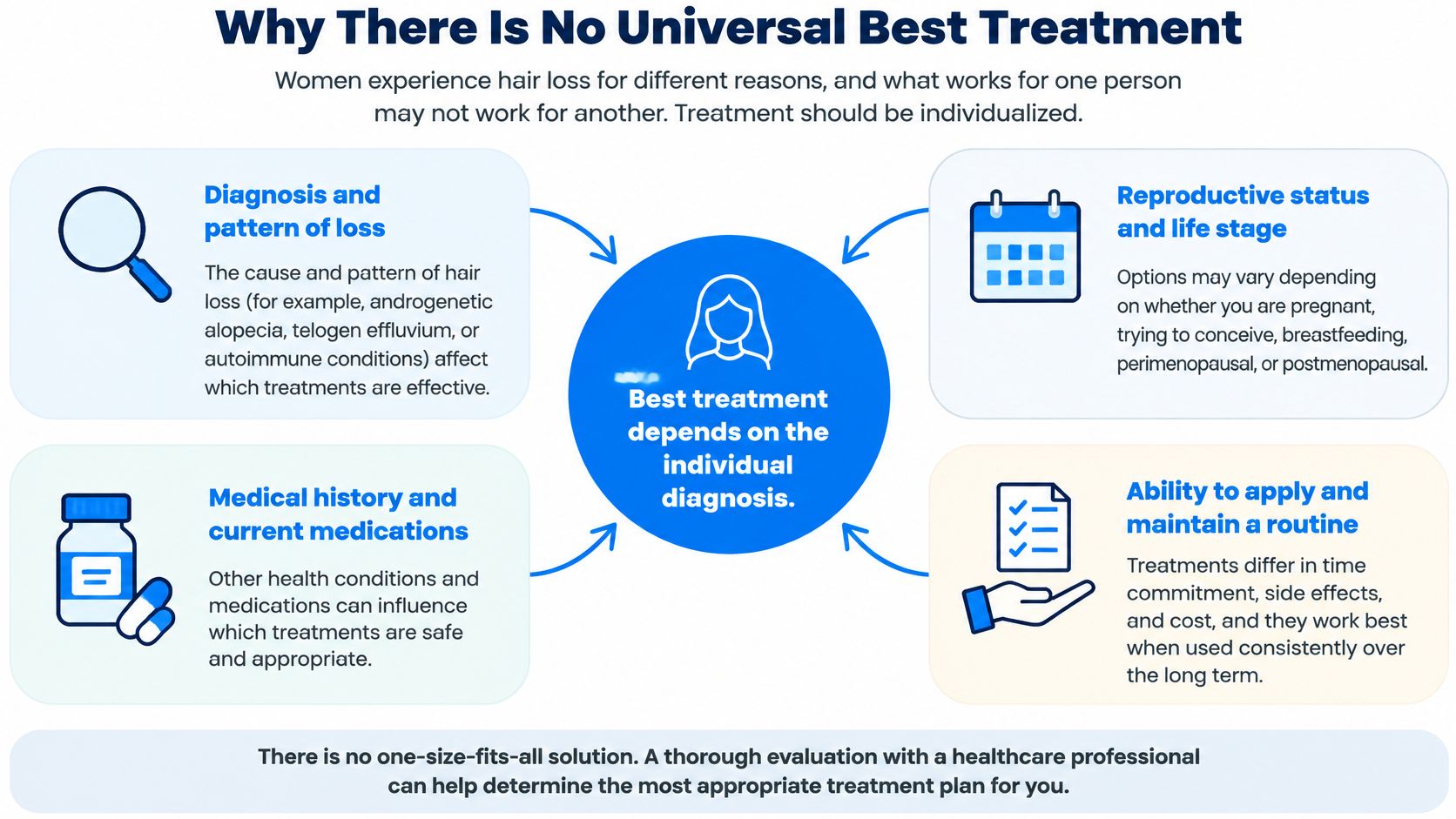
Why There Is No Universal Best Treatment
A widening part and sudden handfuls of shed hair shouldn't automatically lead to the same prescription. Female pattern hair loss, or FPHL, is a common progressive condition, but clinicians must distinguish it from other causes before selecting treatment.
FPHL often produces central-part widening and diffuse thinning while leaving the frontal hairline relatively preserved. Its prevalence varies substantially across populations and increases with age, which makes a single population estimate a poor substitute for an individual assessment, as discussed in this clinical review of female pattern hair loss.
Define success before choosing a product
For progressive thinning, a reasonable treatment goal is to preserve follicles and slow miniaturization, not promise an entirely new head of hair. Clinical follow-up should therefore consider more than visible regrowth.
Useful outcomes to document include:
- Stability: Whether thinning or part widening has stopped progressing.
- Hair caliber: Whether previously fine hairs appear thicker.
- Shedding pattern: Whether the patient reports a sustained change rather than an isolated good wash day.
- Comparable photographs: Whether images taken under consistent conditions support the patient's impression.
Match the plan to the person
The decision must account for reproductive status, medical history, current medications, and practical adherence. A patient who cannot reliably apply a scalp treatment faces a different choice from someone who wants to avoid systemic medication.
The same diagnostic discipline applies during weight management. Shedding that begins during GLP-1 treatment warrants evaluation rather than automatic attribution to the medication.
Clinical takeaway: Treatment success begins with choosing the correct problem to treat. A stronger formulation can't compensate for an incorrect diagnosis.
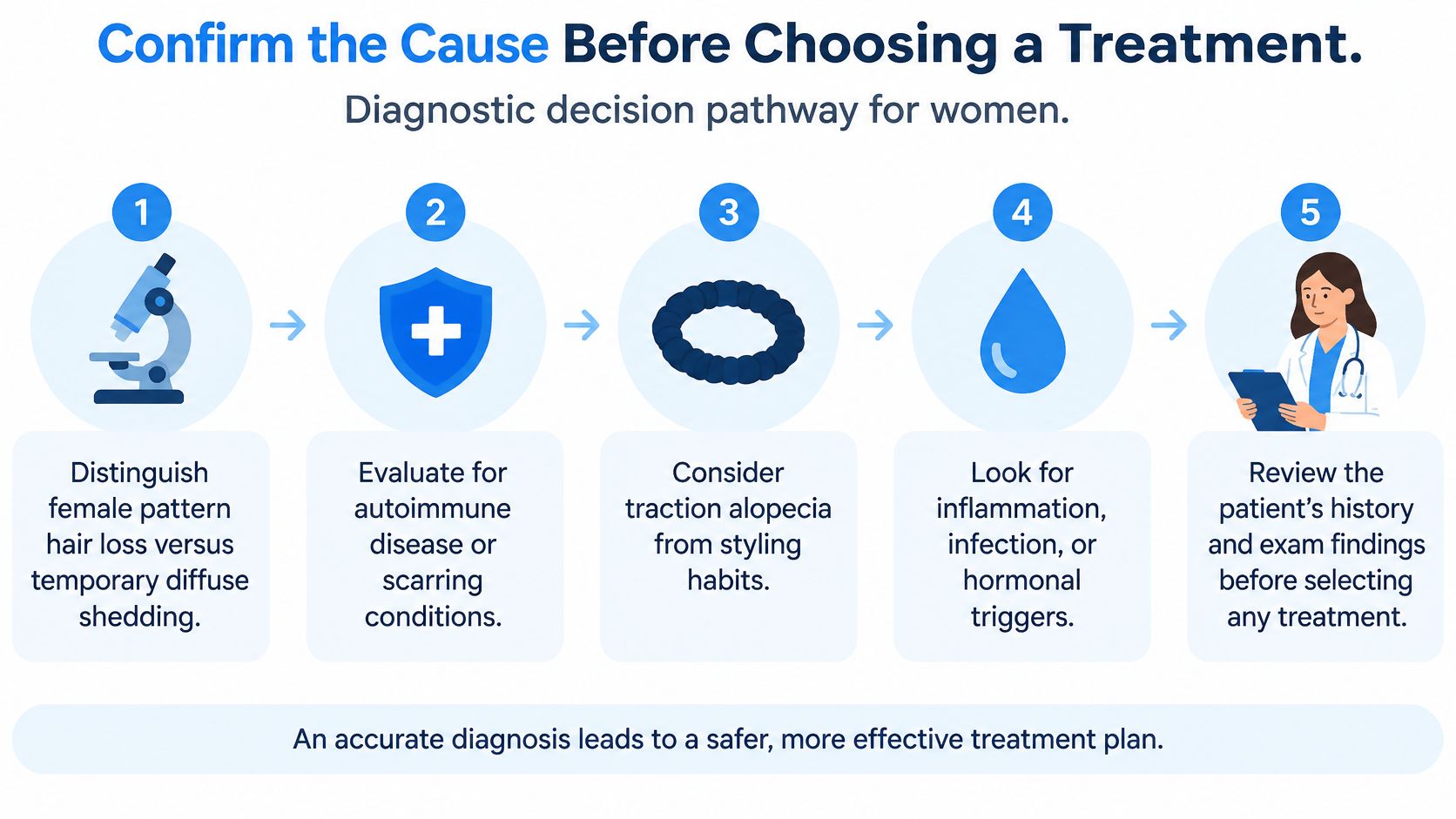
Confirm the Cause Before Choosing a Treatment
The initial assessment should establish what changed, when it changed, and what else was happening. A photograph can document appearance, but it can't provide the reproductive history, medication timeline, or scalp examination needed for a complete prescribing decision.
Clinicians should consider female pattern loss alongside telogen effluvium, alopecia areata, traction alopecia, inflammatory or scarring disorders, thyroid disease, iron deficiency, and medication-related shedding. Postpartum changes and recent weight reduction also belong in the history.
Build a useful timeline
Patients can make a consultation more productive by preparing a concise record rather than trying to estimate every shed hair. The following information helps the clinician decide which possibilities require closer evaluation:
- Onset and distribution: When shedding began, whether it was abrupt or gradual, and whether the central part is widening.
- Recent health changes: Illness, surgery, childbirth, substantial weight change, or changes in food intake.
- Reproductive context: Pregnancy, breastfeeding, contraception, menstrual changes, and plans for conception.
- Exposures: Prescription medications, supplements, metabolic therapies, and styling practices that place tension on the hair.
- Family and scalp history: Relatives with progressive thinning, plus itching, pain, scaling, or other scalp symptoms.
For patients organizing an abrupt-onset history, ProMD Health Bethesda's resource on what causes sudden hair loss can serve as a discussion aid, not a substitute for clinical assessment.
Use telehealth to identify examination needs
A responsible remote intake should ask about patchy loss, scalp pain, inflammation, visible skin changes, and rapid progression. These answers should help determine whether an in-person examination is needed before treatment proceeds.
The clinician should also establish whether laboratory evaluation is appropriate based on symptoms and history. Testing should answer a clinical question, such as whether iron deficiency or thyroid disease could explain the presentation, rather than serve as a universal shopping list.
Appearance alone shouldn't determine treatment intensity. A concern that hair looks thin when wet can be documented with comparison photographs, but prescribing decisions still require history and clinical interpretation.
The practical endpoint is a working diagnosis and an explanation of remaining uncertainty. Patients shouldn't start several prescription actives simultaneously, or change metabolic therapy because of shedding, before a clinician has reviewed that uncertainty.
Compare Established Treatment Options
Topical minoxidil has the clearest foundational role, while oral minoxidil and antiandrogens require more individualized prescribing decisions. Peptides, compounded mixtures, and procedures shouldn't receive the same evidentiary status just because they're available through a medical practice.
A systematic review of oral spironolactone treatment supports its potential role in FPHL but also documents heterogeneous responses. That distinction matters: an available treatment isn't necessarily an appropriate starting treatment, and improvement in a pooled study population isn't a personal guarantee.
Treatment comparison at a glance
| Option | Evidence and role | Key limitations | Best considered when |
|---|---|---|---|
| Topical minoxidil | Foundational, evidence-based treatment for confirmed FPHL | Requires consistent scalp application; tolerance and reproductive context still matter | A patient wants a topical starting option |
| Low-dose oral minoxidil | Physician-selected alternative when topical use is impractical | Systemic safety review, unwanted hair growth, and edema considerations | Application difficulty prevents a workable topical routine |
| Spironolactone | Antiandrogen option, including combination treatment | Pregnancy risk, menstrual effects, blood pressure, renal and potassium-related concerns | An androgen-sensitive component or inadequate response supports its use |
| Finasteride and other antiandrogens | Specialist-considered options with evidence and reproductive limitations | Fetal-risk considerations and less certain evidence for several agents | A clinician identifies a specific rationale after reviewing alternatives |
| Combination prescriptions | May address more than one treatment target | More ingredients complicate tolerability and attribution of benefit | A documented reason supports adding treatment |
| Peptides and compounded products | Require product-specific and diagnosis-specific scrutiny | Ingredient, dose, route, quality, and evidence cannot be assumed equivalent | A prescriber can explain a defensible indication |
| Procedures | Require a separate diagnosis-based assessment | Results and suitability cannot be generalized across techniques | A specialist can justify the proposed procedure |
Compare treatment fit, not isolated response percentages
A fair comparison uses the same criteria for every option: evidence, intended role, adherence, adverse effects, and reproductive or medical constraints. A treatment with encouraging results may still be unsuitable for a particular patient because of pregnancy plans, cardiovascular history, or inability to maintain the routine.
Combination treatment deserves particular care. Clinicians should distinguish an intentional addition for incomplete response from a multi-ingredient prescription started without a clear baseline.
For a broader consultation checklist, ProMD Health Ashburn Med Spa's women's hair thinning options guide can help patients organize questions about categories of care. The supporting evidence for each proposed prescription still needs separate examination.
A personalized combination can sometimes outperform monotherapy, but that doesn't justify combining everything available. The relevant question is whether each added component has a defined purpose, acceptable risk, and a plan for reassessment.
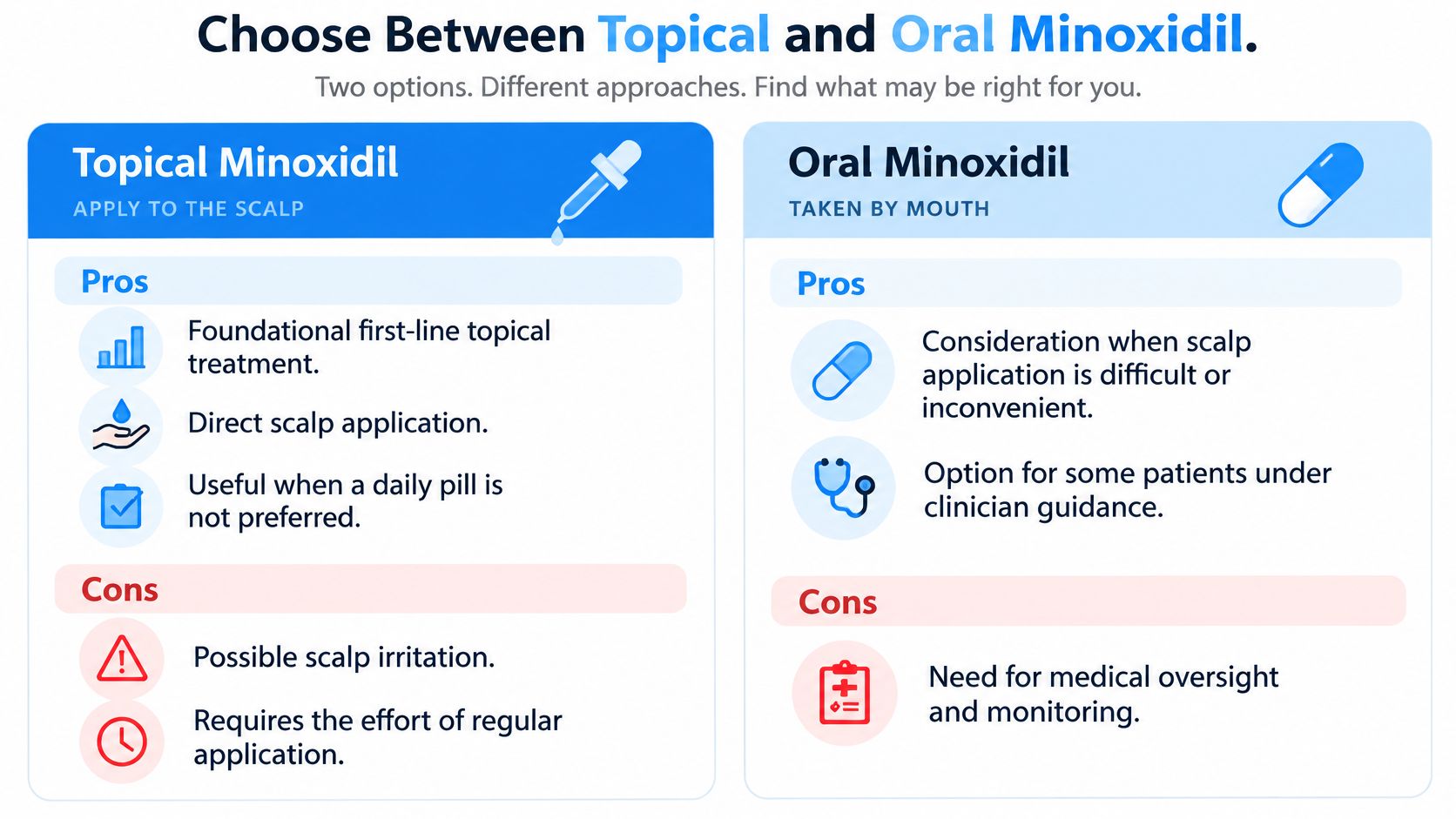
Choose Between Topical and Oral Minoxidil
The topical-versus-oral decision is primarily a question of practical fit and systemic risk, not proof that a pill produces better results. Topical treatment places the application burden on the patient; oral treatment shifts more attention toward medical screening.
In a 24-week randomized open-label study of 52 women, 1 mg oral minoxidil increased target-area total hair density by 12%, compared with 7.2% for 5% topical minoxidil applied daily. The difference wasn't statistically significant, with P = 0.10, according to this review of low-dose oral minoxidil evidence.
Interpret the comparison correctly
Those results don't establish oral treatment as superior. They support a more limited conclusion: both routes can be reasonable in selected patients, and convenience shouldn't be confused with greater efficacy.
In that same study, oral treatment produced hypertrichosis in 27% and pretibial edema in 4% of participants; these figures belong to the trial population described in the review above, not to every patient who receives oral minoxidil. Unwanted facial or body hair can be a meaningful trade-off even when scalp treatment is otherwise tolerated.
Choose a route that can be used safely
For oral treatment, the prescriber should review:
- Blood pressure and cardiovascular history: Whether systemic treatment creates concerns requiring additional assessment.
- Edema risk: Whether swelling is already present or develops during treatment.
- Unwanted hair growth: Whether the patient considers this an acceptable potential effect.
- Reproductive status: Whether pregnancy, breastfeeding, or conception plans require avoidance or specialist review.
Topical treatment remains a reasonable starting choice when systemic exposure is undesirable and the application routine is manageable. A patient who repeatedly misses scalp applications may instead benefit from discussing oral therapy rather than assuming the medication itself has failed.
A convenient route is useful only when its medical risks remain acceptable.
Both routes require patience. Response generally takes several months, and early shedding can occur, so a prescriber should explain what changes warrant observation and what symptoms require contact.
The follow-up decision should distinguish insufficient exposure, poor tolerability, and genuine lack of benefit. Changing routes before clarifying those possibilities can make an otherwise interpretable treatment trial difficult to assess.
Assess Antiandrogens and Combination Prescriptions
An antiandrogen-centered approach may be appropriate when a clinician identifies an androgen-sensitive component or when minoxidil alone hasn't provided an adequate result. It shouldn't be selected just because a product is described as more all-encompassing.
A meta-analysis of spironolactone for female pattern hair loss reported improvement in 56.6% overall, with 65.8% improvement in combination regimens compared with 43.2% with monotherapy. However, 37.8% had no improvement or only modest improvement, and heterogeneous study results limit direct comparisons between treatment designs.
Reproductive screening comes before prescribing
Pregnancy, breastfeeding, contraception, menstrual status, and time to intended conception must be discussed explicitly. Menopause changes the reproductive assessment, but it doesn't remove the need to review medical contraindications.
A clinical review of hair loss in women identifies topical minoxidil formulations as the FDA-approved options for FPHL and highlights fetal risks associated with antiandrogens and 5-alpha-reductase inhibitors. It also notes that evidence for spironolactone and several antiandrogens relies substantially on observational studies rather than multicenter randomized trials.
Spironolactone is unsuitable during pregnancy. Finasteride and related drugs require particularly careful reproductive-risk assessment; a compounded or topical presentation shouldn't be treated as automatic reassurance.
Separate the drugs from the regimen
Spironolactone has a practical role as an adjunct, but menstrual irregularities, breast tenderness, low blood pressure, electrolyte concerns, renal function, and interacting medications can affect suitability. Finasteride and other antiandrogens require their own drug-specific rationale rather than being treated as interchangeable substitutes.
Before initiating an antiandrogen or combination prescription, a safe plan should document:
- Baseline status: Relevant symptoms, medications, reproductive plans, and medical history.
- Monitoring needs: Whether blood pressure, renal function, or electrolytes require follow-up.
- Treatment purpose: What the added drug is expected to address.
- Change criteria: Which symptoms, pregnancy-related developments, or laboratory findings require review.
A discussion of hair loss treatment side effects can help patients prepare questions, but the prescribing clinician must provide individualized instructions.
The strongest argument for combination therapy isn't that it contains more ingredients. It's that the clinician has identified a remaining treatment target and can justify the additional exposure.
Evaluate Peptides Compounding and Procedures
A delivery method isn't an evidence category. A peptide, compounded capsule, injected preparation, and procedure each require separate evaluation of the exact intervention and the diagnosis being treated.
Patients should be cautious when marketing moves directly from a biological explanation to an expected clinical result. A plausible mechanism doesn't establish that a particular formulation improves female pattern hair loss.
Ask for product-specific evidence
Before a peptide or compounded prescription is considered, the prescriber should clarify:
- Indication and ingredients: The diagnosis, each active ingredient, and the reason for including it.
- Dose and route: Whether evidence supports the proposed formulation rather than merely the same ingredient used differently.
- Quality controls: The dispensing pharmacy, accreditation, and relevant potency or sterility testing.
- Clinical oversight: Who prescribes, who handles adverse effects, and how response will be assessed.
Compounded products shouldn't be presented as interchangeable with FDA-approved therapy. Pharmacy quality documentation and clinical efficacy answer different questions, and neither should be substituted for the other.

Keep procedure evidence within its boundaries
A randomized study of 54 women evaluated intradermal 0.5% minoxidil, finding improvements in terminal-to-vellus hair ratio and other measured outcomes, as reported in this trial of intradermal minoxidil for female androgenetic alopecia. The finding supports that studied intervention, not every injection protocol or minoxidil route.
Procedural consultations should likewise distinguish treatment for confirmed FPHL from interventions proposed for other diagnoses. ProMD Health Tysons Corner's information about medical aesthetics for hair loss can help frame procedural questions, but it doesn't replace diagnosis-specific evidence or an individual candidacy assessment.
Evaluate telehealth as a care pathway
Telehealth describes how care is delivered, not how well a treatment works. Patients should ask whether the clinician is licensed for their location, whether assessment is asynchronous or live, and when an in-person examination becomes necessary.
Before paying for a protocol, patients should establish who has prescription authority, how medical and reproductive histories are reviewed, and how follow-up is arranged. Discreet fulfillment may improve convenience, but it doesn't establish medication suitability.
A useful final question is concrete: Who will respond if the patient develops swelling, dizziness, menstrual changes, or a new pregnancy-related concern? A treatment pathway should have an answer before dispensing.
Make a Personalized Treatment Recommendation
The best hair loss treatment for women should emerge from a documented clinical decision, not a product label. The starting plan should be simple enough to evaluate and specific enough that patient and clinician can recognize benefit, intolerance, or diagnostic uncertainty.
Match the starting plan to the scenario
- Confirmed FPHL with a preference for topical care: Consider foundational topical treatment with a consistent routine and photographic baseline.
- Unworkable scalp application: Discuss whether physician-supervised oral treatment fits the patient's medical profile.
- An androgen-sensitive presentation: Assess whether an antiandrogen adds a justified benefit under the screening framework above.
- Pregnancy or breastfeeding: Obtain a reproductive-status-specific plan rather than applying a standard growth protocol.
- Uncertain diagnosis: Prioritize clarification before adding prescriptions or procedures.
The strongest regimen is the one that's correctly indicated, clinically supervised, tolerated, and followed consistently.
Investigate shedding during metabolic treatment
Rapid shedding after semaglutide or tirzepatide deserves a separate assessment. A systematic review of GLP-1-associated hair loss identified the strongest reporting signals with these drugs, while describing rapid weight loss as a plausible contributor rather than establishing direct follicular toxicity.
Telogen effluvium involves follicles shifting prematurely into the resting phase after a systemic stressor. During metabolic care, clinicians should examine weight trajectory, reduced intake, nutritional insufficiency, and competing causes instead of assuming that every episode represents medication damage.
A clinical review of GLP-1 therapies and hair loss reports that prospective controlled studies specifically evaluating hair loss as an outcome are lacking. Patients shouldn't stop, restart, or escalate metabolic treatment solely because of shedding without clinician review.
Establish a reassessment plan
Follow-up should revisit the original diagnosis, treatment exposure, tolerability, and objective change rather than demand an immediate verdict. New scalp symptoms, progressive patterned thinning, or systemic adverse effects should prompt reassessment rather than automatic intensification.
Lifestyle questions, including whether exercise helps hair growth, belong within a broader health discussion. They shouldn't displace a diagnosis-specific retention plan or evaluation of a suspected deficiency.
Vials + Vitals offers physician-directed telehealth assessment for hair-health and metabolic-care concerns, with licensed clinicians determining treatment eligibility and prescription plans. Adults experiencing thinning or shedding during weight management can visit the service to request an assessment and discuss reproductive history, current medications, and appropriate follow-up before selecting treatment.